

Key takeaways
- Start the out-time clock at the controlled-storage boundary, not when the robot begins moving.
- Bind every trip to the material identity, custody events, temperature evidence, and production order.
- Give return-to-freezer moves priority according to remaining qualified life and approved plant rules.
- Keep the MES as the authoritative record and treat AMR data as signed operational evidence.
The short answer: make each trip a material event
Autonomous mobile robots can transport temperature-sensitive prepreg, film adhesive, and other controlled composite materials while creating a precise record of each freezer departure and return. At the freezer threshold, the system identifies the roll or kit, starts or resumes its cumulative out-time clock, assigns custody to the AMR, records payload temperature, and dispatches the vehicle on a time-aware route. The return transaction stops or changes the clock only after the material crosses the approved storage boundary and the freezer accepts it.
The critical word is cumulative. Hexcel defines out-life as the maximum accumulated time at room temperature between freezer removal and cure. Its handling guide also instructs users to record time out of the freezer and return prepreg in a sealed bag. An AMR therefore does more than repetitive transport automation. It becomes one participant in a controlled chain of material events.
The robot does not decide that material is fit for use. The material specification, approved process, and quality system do. A sound design sends identification, timestamps, custody, temperature evidence, location, and exceptions to the manufacturing execution system, or MES, which calculates remaining qualified life and releases, holds, or rejects the material under plant rules.
Why does the freezer clock require material-specific rules?
There is no universal out-time allowance. Hexcel's current aerospace selector lists room-temperature out-life values ranging from 14 to 42 days among several aerospace resin systems, while its handling guide describes 12 months at minus 18 degrees Celsius as typical freezer shelf life. Toray's aerospace selector includes systems with 10, 28, 35, and 40 days of out-life at 72 degrees Fahrenheit, along with storage lives of 12 or 24 months at no more than 10 degrees Fahrenheit. The label and approved material specification always prevail.
Out-time is also distinct from shelf life and tack life. Shelf life concerns permitted storage duration under specified conditions. Tack life concerns handling behavior during layup. Treating these clocks as interchangeable can release a roll that is still tacky but no longer within its approved processing window.
Departure logic must therefore load the correct rule for the scanned material designation, batch, lot, roll, and condition. The timer should include previous withdrawals, warming, cutting, repackaging, and returns. A freshly dispatched AMR cannot erase exposure already accumulated upstream.
What exactly should the AMR identify?
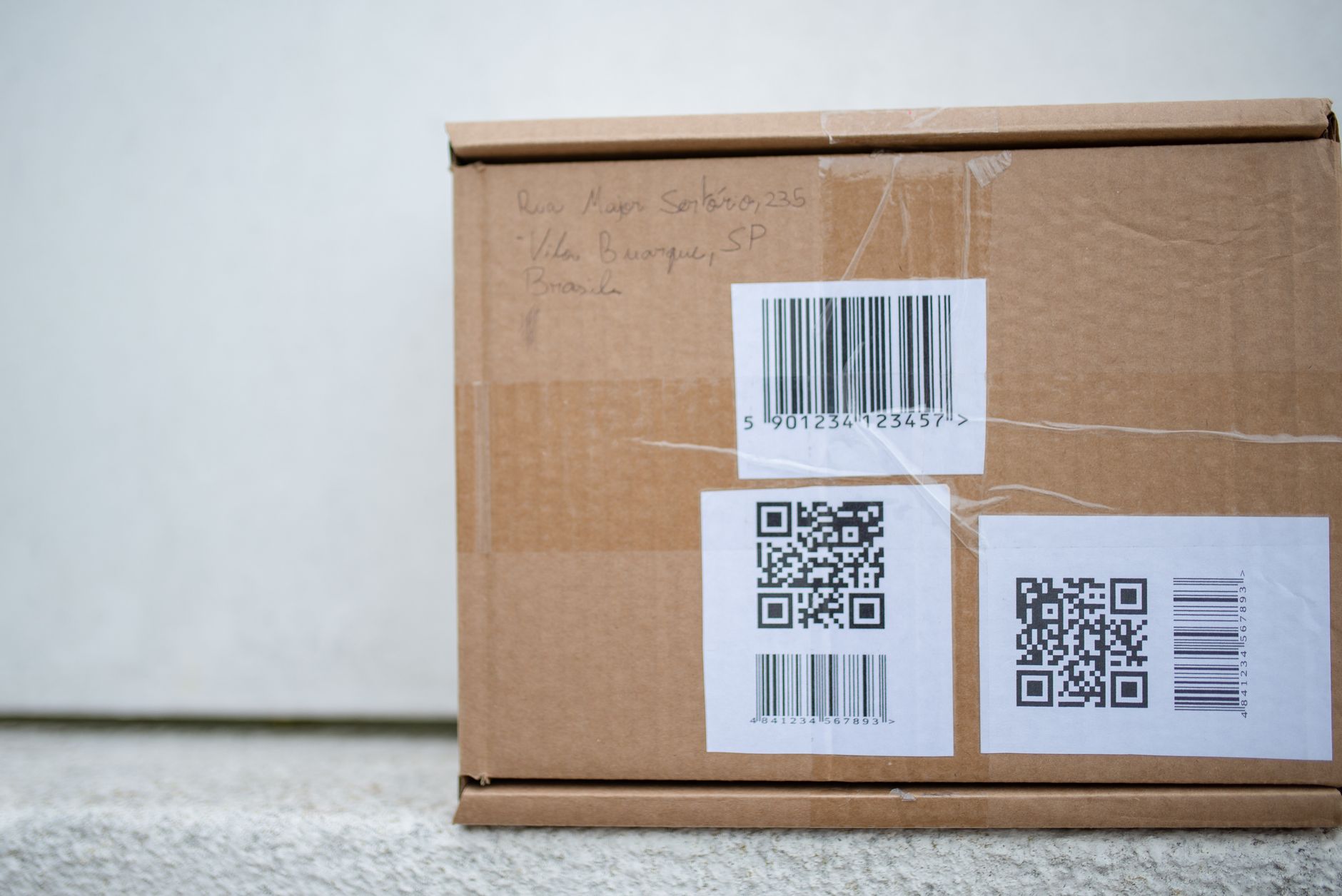
Identification should occur at the physical handoff, not from a work order selected several minutes earlier. A barcode or RFID read can bind the transported roll, sealed kit, or container to the mission. The AMR should refuse motion when the scanned identity conflicts with the MES reservation, the material is on hold, or required label data is missing.
FAA Advisory Circular 23-20 calls for composite packaging identification that includes information such as batch number, roll number, material designation, manufacturer, specification number, and manufacture date. It also calls for traceability from fiber, resin, and prepreg through cured laminates. Those requirements make the material identifier more important than the cart or tote identifier.
- Unique roll, kit, or container identifier, plus material designation and specification revision
- Batch, lot, roll, manufacture date, shelf-life expiration, and cumulative out-time already consumed
- Required storage band, approved out-time rule, quality status, and any engineering concession
- MES work order, operation, destination cell, requested quantity, and authorized recipient
- AMR mission ID, payload position, source location, and expected return or consumption state
How should custody be recorded?
A credible chain of custody has explicit transfer events. Freezer personnel release the identified material to a mission. The robot confirms load presence and departure. The receiving station confirms delivery and assumes responsibility. A return creates the reverse sequence, ending with freezer acceptance rather than the AMR merely arriving near the door.
GS1 EPCIS 2.0 provides useful event vocabulary for the what, when, where, why, and how of traceability. Its model includes event time and time zone, read point, business location, source and destination, business step, disposition, transactions, and sensor elements. It also supports transfers of responsibility or custody. An aerospace plant can map these concepts into its existing MES without adopting a specific scanner technology.
Every failed transfer needs a defined state. If nobody accepts the payload, a door will not open, or a scan is ambiguous, the AMR should retain custody, preserve the exposure clock, move only to an approved safe location, and alert operations. Manual overrides should capture the operator, reason, timestamp, and disposition.
Payload temperature is evidence, not a substitute for out-time
A robot-mounted ambient sensor may describe the aisle, but it does not necessarily describe the material. Temperature evidence should come from a calibrated sensor positioned in or against the validated payload enclosure, with its serial number, calibration status, sampling record, and mission association retained. For insulated containers, validation should establish how internal temperature behaves under expected loads, dwell periods, door openings, and routes.
FAA Advisory Circular 23-20 says recording devices should track temperature-exposure history when freezer temperatures are required during shipping and storage. FAA Advisory Circular 43-214A also directs organizations to keep material in moisture-tight packaging, allow it to thaw inside the package until exterior condensation dissipates, and record out-time before returning unused material to the freezer.
Those controls matter during AMR handling. A cold roll should remain sealed during transport and controlled warming. Returning it to cold storage does not automatically restore consumed out-life, and a low sensor reading should not pause the clock unless the approved material rule expressly allows that treatment. MES logic must distinguish measured temperature, qualified storage state, and cumulative exposure.

Which missions receive route priority?
The shortest path is not always the right path. A dispatch engine should rank missions using production need, remaining out-life, temperature risk, custody state, destination readiness, and approved recovery rules. A return carrying material with little remaining allowance may outrank an outbound delivery, while expired or suspect material should route to quarantine rather than the freezer or layup room.
Time-aware routing also requires control of waiting. Elevator queues, airlocks, badge-controlled doors, congested crossings, and occupied receiving stations can consume more exposure than travel itself. Before dispatch, the fleet manager should confirm that the destination can accept the load. During travel, it should recalculate risk when delay threatens the mission's permitted margin.
This is where robot fleet management and MES scheduling must cooperate. The MES knows work-order demand and material eligibility. The AMR controller knows traffic, route availability, battery state, and arrival estimates. Neither system alone has enough context to make every priority decision safely.
What should MES integration look like?
The MES should remain the authoritative source for material status, genealogy, accumulated out-time, and production release. NIST describes MES software as managing and synchronizing real-time manufacturing processes while supporting component and material traceability, genealogy, and process history. ISA-95 places MES and manufacturing operations management at Level 3 and defines information exchanges with business systems above it.
Each pickup, threshold crossing, delivery, return, alarm, and override should generate an event with a unique ID. Include the material ID, coordinated timestamp and time zone, source, destination, custody party, mission, sensor summary, raw-data reference, work order, and resulting material state. Unique event IDs let the MES reject duplicates when a network retry repeats a message.
Integration should also survive a communications interruption. The AMR can hold ordered, signed events locally, continue only within the plant's approved offline policy, and reconcile them when service returns. A missed message must not silently reset a clock. If the MES cannot prove material state, the conservative outcome is a hold pending quality review.
For multi-vendor environments, define the event contract independently of a particular robot manufacturer. That keeps material-control logic stable as vehicles change and supports multi vendor one dashboard operations without making the dashboard the quality system of record.
How should an aerospace plant pilot the workflow?

Begin with one freezer, one controlled material family, and one destination whose handling rules are already documented. Site assessment mapping should capture thresholds, traffic conflicts, access controls, communications gaps, safe waiting areas, and quarantine destinations. The commercial robot pilot program should then rehearse correct deliveries and adverse cases such as wrong-roll scans, missing temperature data, blocked routes, rejected handoffs, network loss, and emergency returns.
Acceptance testing should compare every physical movement with the MES event history. Quality personnel should verify that cumulative exposure survives repeated withdrawals, that freezer acceptance is distinct from arrival, and that over-limit material cannot be dispatched to production. Operations should also test packaging support, roll orientation, vibration, enclosure cleaning, and sensor calibration under representative payloads.
Service Robot Co. can act as the OEM-neutral, vendor neutral robot integrator for this work. The company selects equipment across manufacturers, arranges robot deployment and integration, connects fleet events to plant systems, trains users, and services each unit through a nationwide US engineer network. One vendor remains accountable across financing, deployment, go live support, and field service.
Commercial structures can include an AMR lease, autonomous mobile robot leasing, robot leasing for business, or a leasing program when the plant prefers an operating expense path. The technical gate remains the same for a purchase or manufacturing plant robot leasing: prove identification, custody, temperature evidence, routing behavior, MES reconciliation, and quality holds before production use.
Frequently asked questions
Sources
- FAA AC 23-20, Acceptance Guidance on Material Procurement and Process Specifications
- FAA AC 43-214A, Composite and Bonded Aircraft Structure
- Hexcel Prepreg Technology Guide
- Hexcel Aerospace Selector Guide
- Toray Aerospace Product Selector Guide
- GS1 EPCIS 2.0 Standard
- NIST Additive Manufacturing Data Integration and Recommended Practice
- ISA-95 Enterprise-Control System Integration