
Key takeaways
- For powder-coating rack loading, the best fit is usually a cobot cell outside the booth, upstream of the spray zone.
- Payload must cover the real hanging stack, not just part weight. Include the hanger, gripper, adapters, and awkward center-of-gravity shifts.
- Grounding and cleanliness are first-order buying criteria. Poor contact, oil, water, and silicone defects will ruin coating quality before the robot proves anything.
- If your part mix swings widely in size, hook style, or center of gravity, buy around part families and fixturing discipline, not around a marketing payload number.
What kind of cell is usually right for this job?
For hanging parts before powder coating, buy a cobot that can place the heaviest real part family onto the rack with stable wrist posture, consistent orientation, and clean metal-to-metal contact at the hanger. In most plants, that means an upstream cobot cell outside the spray booth, with the robot loading grounded hooks or fixtures before the rack enters the coating zone. The gripper should be mechanically simple, easy to clean, and tolerant of edge variation and minor part warp.
The buying sequence is straightforward. Size payload around the entire handled stack. Size reach around the farthest legal hook point on the rack, not the pretty point in the center. Choose a gripper that holds without marring cosmetic faces and that does not insulate the only useful ground path. Then treat contamination control, grounding, and part variation as cell requirements, not commissioning details.
That discipline matters because the labor you are replacing is repetitive and physically awkward. According to the U.S. Bureau of Labor Statistics, manufacturing recorded 332,600 injury and illness cases in 2024, a rate of 2.7 cases per 100 full-time workers. In the same January 22, 2026 BLS release, overexertion, repetitive motion, and bodily conditions accounted for 946,290 DART cases across private industry over 2023 and 2024. Rack loading sits squarely in that ergonomic trouble spot.
How should you size payload for hanging parts?
Ignore brochure payload first, and map the real suspended load. The robot may only pick the part, or it may pick the part plus a hook, nest, shuttle, or rack finger. Long stampings, tubes, wire forms, and cut-sheet parts can also create more wrist moment than their weight suggests because the mass sits far from the flange and likes to swing during acceleration.
A better rule is to build a payload stack sheet for every part family. If one family needs a larger gripper, longer fingers, or a stiffer compliance device, that family may become the true sizing case even if it is not the heaviest. Powder lines punish optimistic sizing because the robot does not just have to lift. It has to place accurately onto a hanger point, release cleanly, and avoid nudging the next part on the rack.
- Count the part, any hook or carrier the robot lifts, the gripper body, fingers, adapters, sensors, and dress pack loads that move with the wrist.
- Flag off-center parts separately. A flat panel with a cutout near one edge behaves very differently from a symmetric bracket at the same weight.
- Check the release moment. Parts that hang freely can rotate as the fingers open, which changes the effective load case right when placement must stay precise.
- If the rack indexes during loading, include the positional tolerance you need to survive line motion, hanger wear, and hook buildup.
How much reach is enough at the rack?
Reach failures are rarely about raw arm length. They come from tool geometry, rack depth, conveyor offset, and the need to approach a hook from the right angle without scraping adjacent parts. A cobot that can touch the back row in a lab test can still be the wrong machine if it reaches that point near singularity, with a weak wrist posture, or with no clearance for part approach and release.
Lay out the actual work envelope around three points: pick, travel, and hang. Measure the farthest hook point, the highest placement point, and the most crowded release condition after the rack starts filling. Then add the tool center point offset created by long fingers or a hanging fork. OSHA's spray-finishing rule also requires irregular goods that may swing to be rigidly supported and requires goods in fixed electrostatic processes to be carried on conveyors, which is a reminder that line geometry and part motion are inseparable in this application.
Which gripper styles hold parts without hurting the finish?
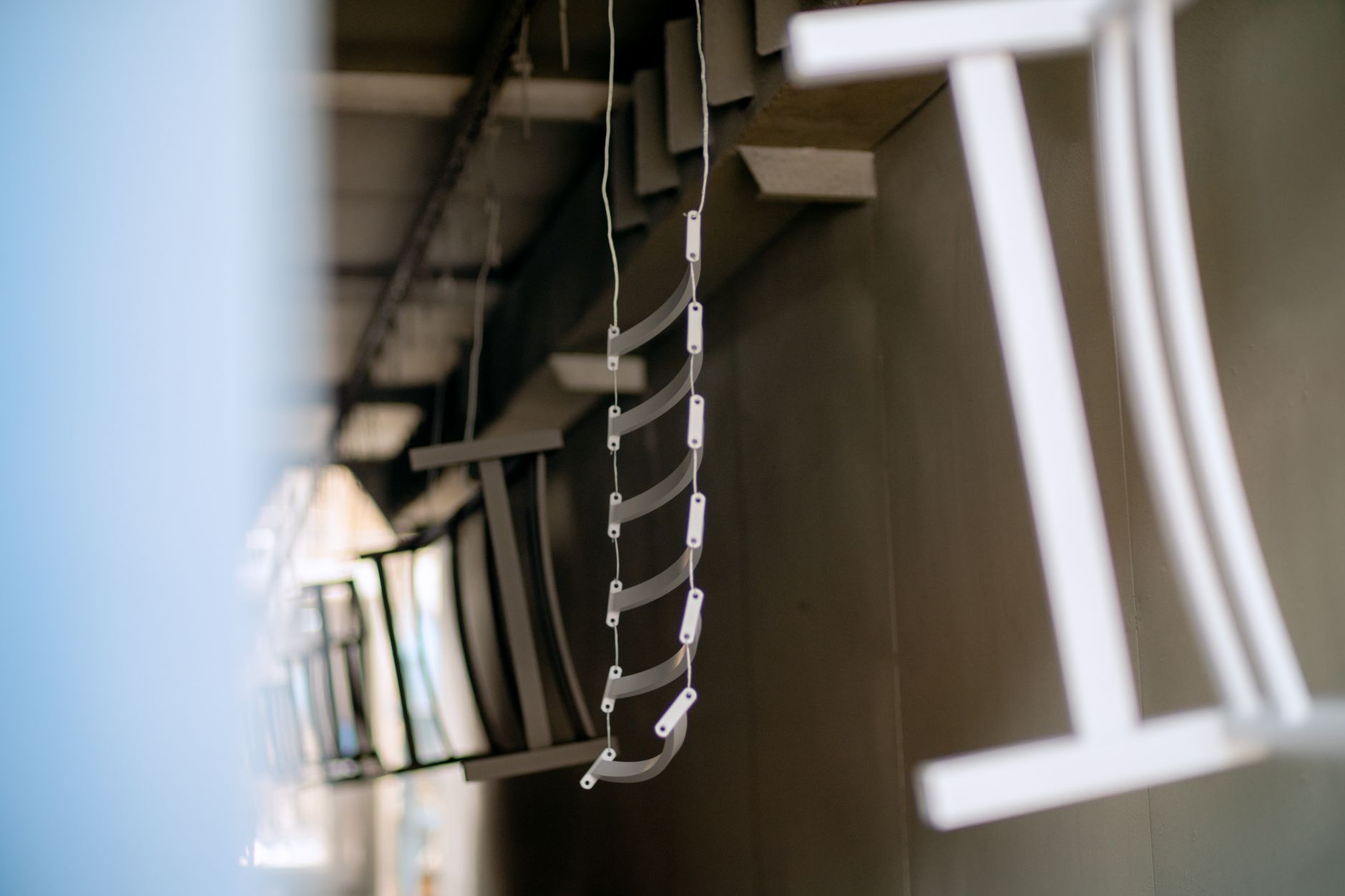
For pre-coat rack loading, the best gripper is usually a mechanical hand, not a delicate vacuum concept. Vacuum can work on flat blanks, but it becomes fragile around perforations, textured mill surfaces, oily carryover, and narrow edge picks. A mechanical hook hand, parallel clamp, or fork-style support with guided release is more forgiving when parts arrive with stamping variation or slight bow.
The gripper should contact non-cosmetic surfaces and preserve the hanging logic of the line. If the part needs a bare contact point for conductivity, the tool cannot cover or contaminate that point. If the part must hang from a specific edge to drain, vent, or present the show face correctly, the tool needs enough compliance to seat the part without springing it off the hook.
- Use fork or saddle support for long, floppy parts that would twist in a two-finger clamp.
- Use dual-contact clamping for rigid brackets and formed parts that need repeatable angular control at release.
- Use passive compliance when hook location varies slightly from rack to rack.
- Avoid soft, dust-grabbing contact materials on surfaces that later matter for grounding or appearance.
Grounding is part of the robot spec
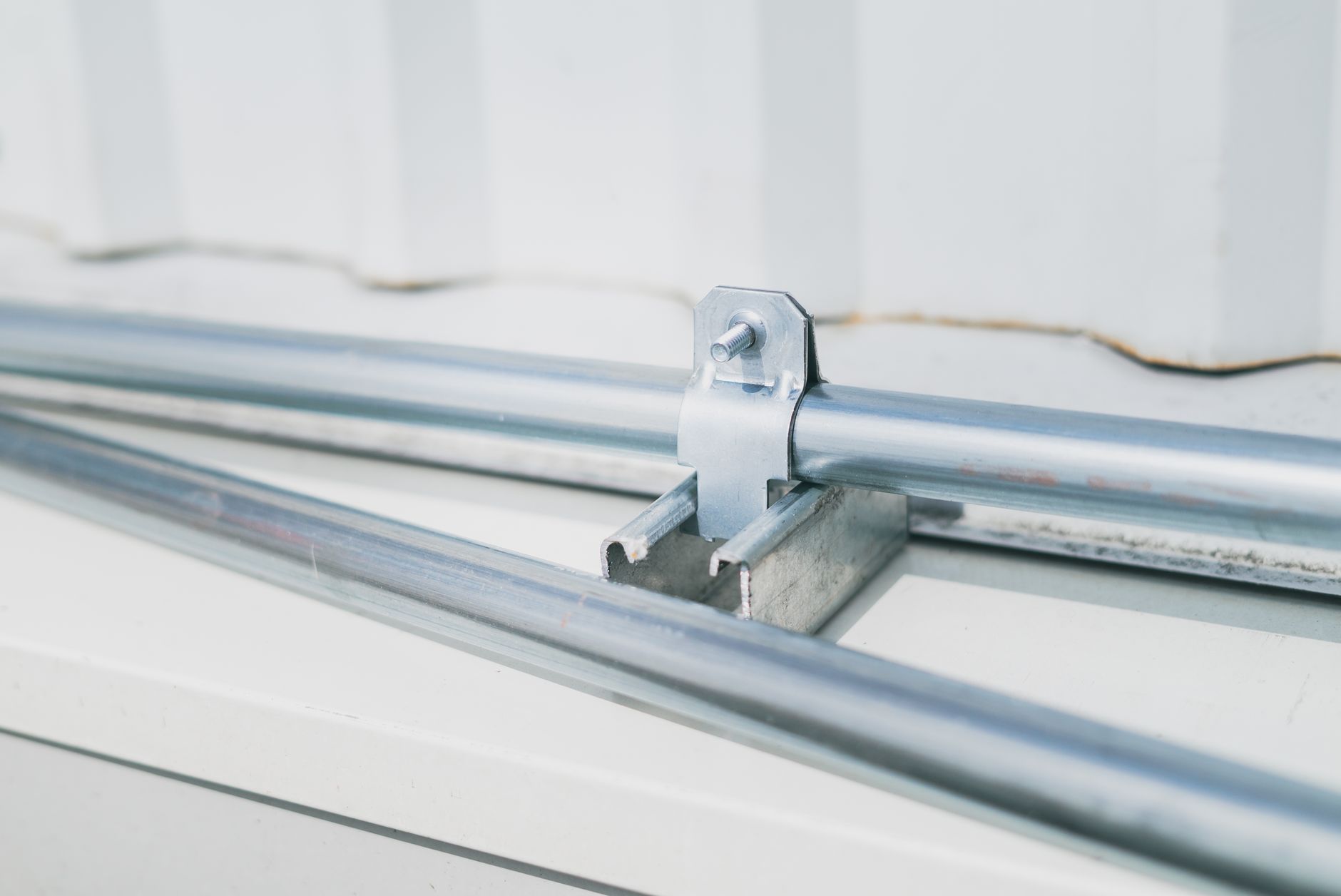
In powder coating, grounding is not just a finishing parameter. It changes transfer behavior, coating quality, and ignition risk. According to the Powder Coating Institute, uncoated metal parts, clean hangers, and clean conveyors should total no more than 1 megohm resistance to ground, and continuity is typically checked with a megger at 500 volts or higher. If your robotized loading method adds an insulated nest, dirty contact pad, or awkward hook presentation, you may buy a good robot and still create a bad line.
OSHA backs up the same discipline from the safety side. The agency requires all electrically conductive objects in the spraying area to be adequately grounded, and it requires objects being coated to stay in metallic contact with the conveyor or other grounded support. OSHA also says hooks should be regularly cleaned to ensure contact, and that contact areas should be sharp points or knife edges where possible.
For the buyer, that means grounding must appear on the cell acceptance checklist. Ask where the current path runs from part to hook, hook to rack, rack to conveyor, and conveyor to plant ground. Ask how buildup on hooks will be managed. Ask how the robot will present the part so the right contact patch lands every time. If no one can answer those three questions, the cell is underspecified.
Contamination control starts before the booth
Powder coating is less forgiving of dirty parts than many buyers expect. The Powder Coating Institute notes that powder lacks the solvents that can sometimes forgive residual organic soils in liquid paint systems, so the washer has to do a genuinely good cleaning job. PCI also points to the water break free test as the most widely used basic cleanliness check. If water sheets cleanly, the surface is likely ready. If it beads or pulls back, your robot may be loading scrap politely and repeatably.
Air quality is another quiet source of trouble. According to the Powder Coating Institute, clean compressed air sits right behind grounding in importance, and a practical starting point is a 35 degree Fahrenheit dew point with less than 0.1 parts per million contaminate or oil. That matters because air fluidizes powder, feeds guns, and pulses filters. Moisture or oil upstream of the booth can show up later as poor application behavior and unstable finish quality.
Then there is silicone. The Powder Coating Institute glossary notes that fisheye defects are often caused by contaminants such as oil or silicone, and specifically warns that silicone lubricants should not be used around a finishing system. Keep that in mind when you evaluate gripper pads, maintenance sprays, anti-spatter habits from nearby fabrication, and conveyor lubrication practices. The cleanest robot program is usually the one that bans entire contamination classes early.

How do you manage part variation without a fragile cell?
Part variation breaks these cells in four ways: shifting center of gravity, inconsistent pickup surfaces, hook-location spread, and release behavior after the part is already hanging. A robot that loads one bracket beautifully can struggle when the next family adds a flange, loses a datum hole, or changes the balance point by two inches. That is why powder-coating rack loading should be engineered around part families, not around the broad claim that one cobot will hang everything.
Start by clustering SKUs into families that share pickup logic, hang orientation, and cosmetic no-touch zones. If two families need different hook pitch, different gripper fingers, or different grounding contact strategy, treat them as separate recipes with their own tooling rules. Vision can help with pose correction, but vision should not be used to excuse bad upstream presentation. If incoming parts arrive randomly nested, oily, and bent, the robot cell will inherit that chaos.
A durable cell usually combines modest sensing with disciplined fixtures, hard stops, and release confirmation. The more your process depends on the robot finding perfect hang points in midair, the more commissioning time you will burn. In a finishing line, boring repeatability beats cleverness.
Inside the booth or outside it?
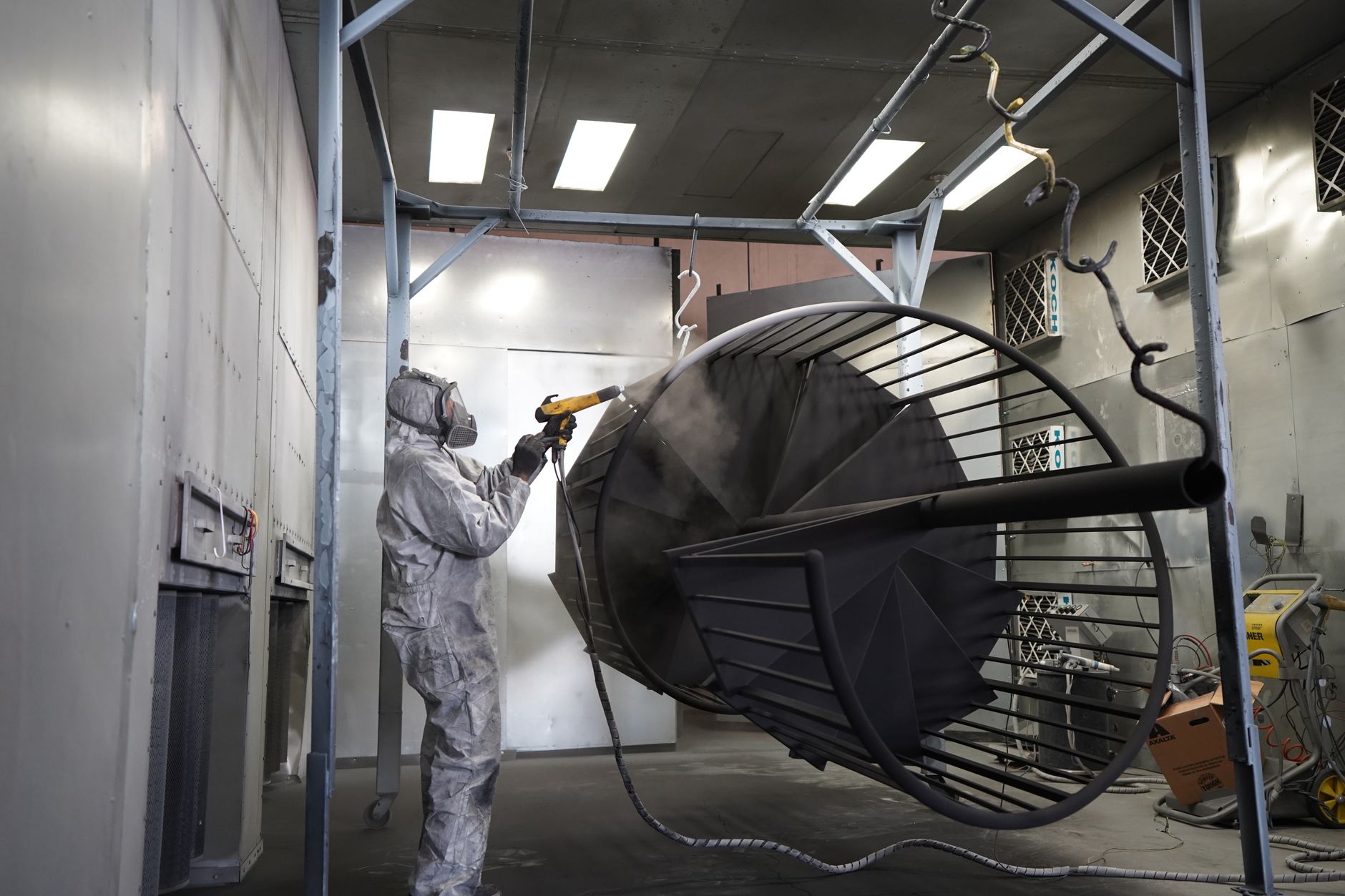
For most buyers, outside the booth is the right answer. If the job is hanging parts before powder application, put the cobot upstream of the spray area and pass the loaded rack into the booth. This is partly a quality choice and partly a safety choice. OSHA says transformers, power packs, control apparatus, and other electrical portions of electrostatic spray equipment should be located outside the spraying area unless they meet the applicable hazardous-location requirements. OSHA also bars open flame or spark-producing equipment in the spraying area or within 20 feet unless separated by a partition.
The booth environment is harsher than it looks on a plant tour. OSHA requires electrostatic operations to maintain at least 60 linear feet per minute air velocity over the open face of the booth, and it requires nondeposited suspended powder to be removed through exhaust to recovery equipment rather than released to the outside atmosphere. The same rule requires powder dust accumulation to be controlled and cleaned so dust is not scattered into clouds. Put a cobot inside that zone and you are asking joints, cables, sensors, and surfaces to live in residue, airflow, and housekeeping discipline they often do not need to face.
There are exceptions. If geometry, takt, or floor space truly forces the robot into or at the edge of the booth, treat that as a special case. Inference from OSHA's rule set is straightforward here: specify a cell that can tolerate powder ingress, route electrical components outside the hazardous area where possible, ground every conductive element that enters the charging influence, and interlock motion with ventilation and conveyor state. Buyers should assume outside-the-booth placement by default, and only pay the inside-the-booth complexity tax when the line layout leaves no cleaner option.
What should your site survey settle before you buy?
A serious buyer should force the site survey to answer the process questions before anyone debates brands. This is where a full-service integrator earns its keep. Service Robot Co. acts as a vendor neutral robot integrator for U.S. manufacturers, which matters on finishing lines because the best arm for payload and reach is not always the best fit for floor space, wash carryover, guarding, or service coverage. The right cell is the one that matches your hooks, racks, takt, contamination controls, and maintenance reality.
This is also where acquisition model becomes practical instead of abstract. Some plants want collaborative robot arm leasing or cobot leasing for manufacturing to prove the hang recipe on live production parts. Others prefer purchase or lease, robot leasing for business, or monthly payment programs that keep capital flexible. Service Robot Co. can handle robot deployment and integration, training, service, and turnkey robot deployment through one nationwide U.S. engineer network, so the buyer is not left coordinating separate vendors after the cell ships.
- Map every part family by weight, balance, no-touch surfaces, grounding contact points, and required hang orientation.
- Measure rack geometry, conveyor height, hook pitch, line speed, and the worst-case reach point after the rack is half full.
- Document contamination sources upstream, including wash carryover, oil mist, silicone use, compressed-air quality, and hook buildup.
- Decide the booth boundary early. If the robot stays outside, define the transfer method. If it must sit inside, define the environmental package and hazardous-area strategy before quoting.
- Plan service from day one. A free site assessment is useful only if it turns into a cell with clear acceptance tests for grounding, release repeatability, and finish quality.