

Key takeaways
- Remove grit before wet cleaning so the robot does not turn abrasive particles into haze or scratches.
- Map separate cleaning recipes for tile, grout, stone, resilient flooring, laminate, wood and carpet.
- Validate every route around display islands without compromising accessible aisles, exits or customer circulation.
- Use automation for repeatable open areas, while staff retain edge work, spot response and display detailing.
- Pilot with objective appearance checks, not cleaned-square-foot totals alone.
What should a showroom cleaning robot actually do?
A cleaning robot can keep a flooring and tile showroom presentation-ready by repeatedly collecting loose grit, removing footprints and scrubbing compatible hard surfaces. Success depends on assigning the correct cleaning recipe to each installed material, mapping safe paths around display islands and reserving delicate edges or fresh installation debris for trained staff.
The best program is not a single wet pass across the entire sales floor. It separates dry soil removal from wet cleaning, uses material-specific chemistry and moisture limits, and schedules high-visibility routes before opening or after close. Staff then handle grout haze, adhesive marks, damaged transitions and small spaces the machine cannot reach.
This division of labor protects the merchandise as well as the floor. A showroom cleaning robot handles repeatable acreage and overnight floor care, while employees concentrate on sample boards, corners, spill response and the details customers inspect at arm's length.
Why is a flooring showroom unusually demanding?
In most stores, the floor is infrastructure. Here, it is also the product demonstration. Dust on a dark plank, a shoe print across polished porcelain or cloudy residue over stone can change how a customer perceives color, sheen and texture. Cleaning quality therefore becomes part of merchandising.
The soil mix is unusually varied. Entrance grit arrives on shoes, cardboard fibers escape from cartons, grout particles migrate from displays and fine dust follows sample cutting or installation work. Large-format boards, wing racks and room-scene islands create pockets where soil accumulates beyond the main traffic lane.
Footprints deserve their own operating response. A heavy nightly scrub may leave the building clean at opening, yet a rainy morning can mark the primary sales path within minutes. Short dry or low-moisture patrols can restore that path without repeatedly wetting every installed sample.
Why should dry collection come before scrubbing?
Loose grit should be captured before brushes and cleaning liquid touch the floor. Otherwise, a scrubber can move abrasive particles across glossy tile, pack dust into grout lines or leave muddy trails at material transitions. Dry collection also reduces the amount of dirty liquid that must be recovered.
The Carpet and Rug Institute reports that 79 percent or more of carpet soil can be removed through dry vacuuming. That figure supports a wider showroom principle: frequent dry pickup is not cosmetic busywork. It removes much of the particulate load before deeper cleaning becomes necessary.
Fine tile dust requires additional care after cutting, grinding or renovation. OSHA sets a respirable crystalline silica action level of 25 micrograms per cubic meter and a permissible exposure limit of 50 micrograms per cubic meter, both measured as eight-hour time-weighted averages. OSHA also restricts dry sweeping when it could contribute to silica exposure and a lower-dust method is feasible. Such debris belongs under the site's silica-control procedure, not an ordinary autonomous route.
How should cleaning change across installed materials?
A sample-heavy showroom needs geofenced cleaning recipes rather than one universal setting. Brush pressure, liquid flow, detergent, speed and recovery should be approved for the exact product and finish. Visually similar planks may have very different moisture tolerances.
The robot map should identify each material boundary and apply the least aggressive verified method. Manufacturer care instructions and warranties remain controlling, especially for newly installed displays, sealed surfaces and specialty finishes.
- Ceramic and porcelain tile: remove loose soil first, then use water or an approved neutral cleaner. The Tile Council of North America warns that cleaner residue can leave a sticky film that attracts dirt, so recovery and rinsing matter.
- Cementitious grout: use compatible alkaline chemistry when deeper cleaning is needed. Extract dirty liquid, rinse with clean water and extract again. Acid can attack cement-based grout, while oil or wax cleaners can leave soil-catching residue.
- Natural stone: isolate it as a neutral-pH, non-acid route unless the exact stone has been verified. The Natural Stone Institute says sand and grit are abrasive, excess cleaner can streak, and acids may etch calcareous stone.
- Resilient flooring: begin with dry pickup, use product-approved chemistry and limit pad aggression. The World Floor Covering Association advises frequent removal of dust, sand and grit and warns against beater bars, scrub brushes and abrasive cleaners.
- Laminate: default to minimal moisture. Damp cleaning may be acceptable, but flooding can cause expansion, so the exact collection's care guide must govern the route.
- Real wood: prioritize sweeping or vacuuming and immediate spot response. The National Wood Flooring Association advises against wet and steam mops because excessive moisture can dull the finish or damage the wood.
- Carpet insets: use a vacuuming route, not a scrub program. Extraction or restorative carpet cleaning remains a separate scheduled task.

What should the daily operating rhythm look like?
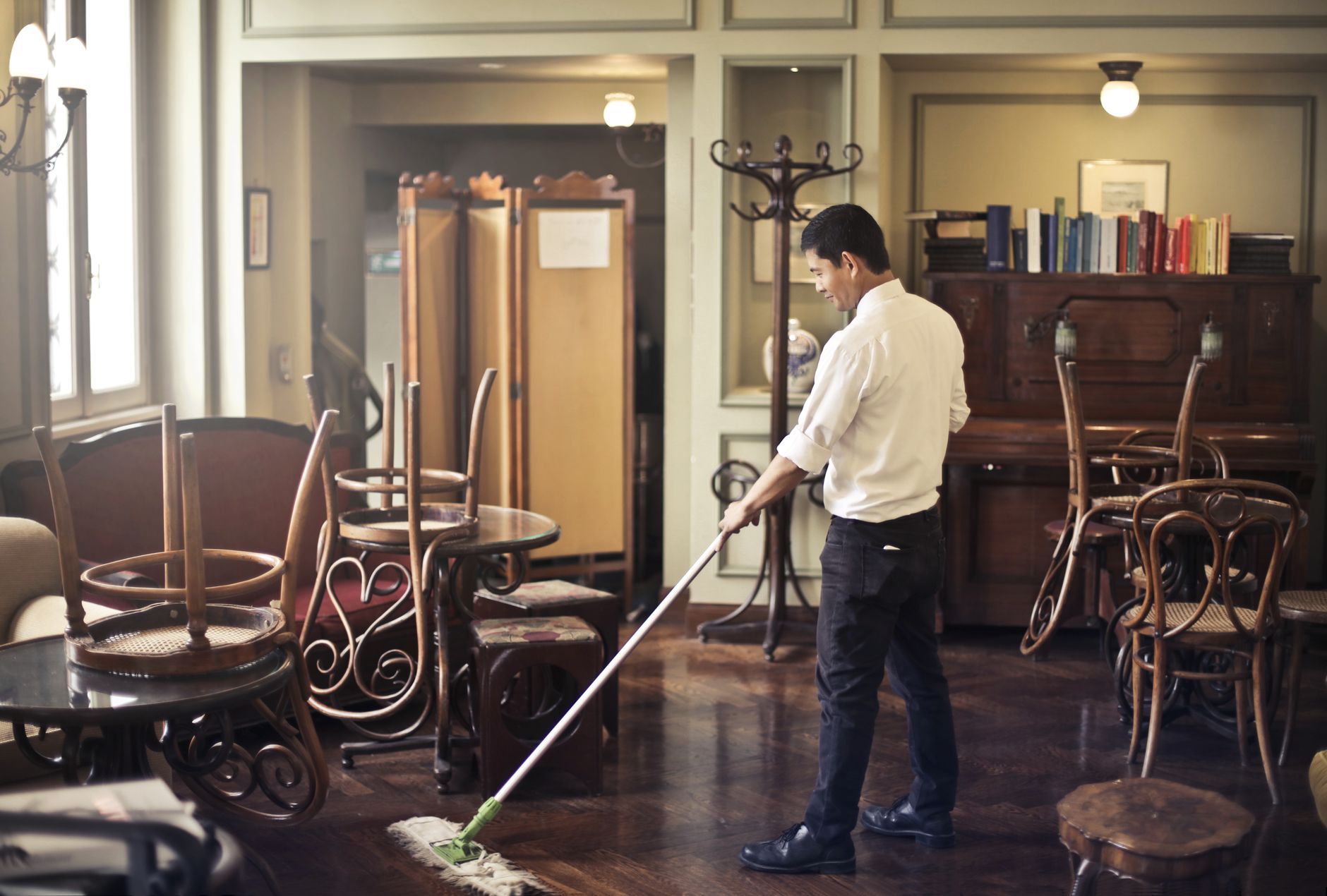
A practical schedule layers tasks by soil and customer impact. Before opening, run dry collection across entrances, main racetracks and the perimeter of high-gloss displays. Follow with wet cleaning only on approved hard-floor zones, allowing them to dry before customers arrive.
During business hours, favor short, low-disruption routes for visible grit and footprints. The machine should yield readily, pause near consultations and avoid laying down wet paths through active selling areas. OSHA requires floors to be kept clean and, to the extent feasible, dry, which reinforces zoned cleaning and prompt control of wet areas.
After close, perform the deeper scrub routes, recharge and complete operator checks. Staff should inspect squeegees, brushes, filters and tanks, then record exceptions such as missed corners, wheel marks, residue, damaged transitions or a display moved into the route.
- Opening presentation pass: entrances, glossy tile, dark resilient planks and the main customer path.
- Daytime recovery pass: localized dry pickup and footprint removal with public-area rules enabled.
- Nightly production pass: compatible scrubbing, vacuuming and repeat coverage after displays are secured.
- Manual detail pass: grout edges, under racks, baseboards, thresholds, stairs and fresh installation areas.
How should a showroom pilot be judged?
A commercial robot demo should use the real showroom at realistic soil levels. Run it with sample wings extended, consultation chairs displaced and common promotional fixtures in place. Test every planned transition, reflective surface, textured tile and narrow turn.
Judge the robot by appearance, not distance traveled. Inspect glossy floors under sales lighting for haze, streaks and wheel marks. Check textured tile for embedded soil, grout for redistributed slurry, resilient flooring for scuffs and wood or laminate for excess moisture. Record interventions and unreachable areas after every trial.
The pilot should also test operational discipline. Confirm who prepares the floor, clears loose cords, responds to an alert, approves map changes and performs manual edge work. A robot pilot program succeeds when the repeatable route and the human exception process work together.
Choosing one partner for a mixed-floor showroom
No single machine architecture is ideal for every showroom. A compact autonomous vacuum may suit carpet and delicate dry routes, while an autonomous scrubber may be better for larger expanses of compatible tile or resilient flooring. A mixed-floor site may require one machine with carefully separated programs or a small, complementary fleet.
Service Robot Co. acts as an OEM-neutral, vendor-neutral robot integrator for U.S. businesses. The company selects the robot that fits your floor, then handles financing, deployment, integration, training and service through a nationwide U.S. engineer network. That gives operators one vendor and one point of contact across the equipment lifecycle.
Procurement can include a commercial cleaning robot lease, robot floor cleaner leasing, autonomous floor scrubber leasing, financing or sale structure. The useful comparison is not simply robot leasing versus buying. It is the complete operating package, including site assessment mapping, go-live support, maintenance, remote triage and on-site dispatch.
Frequently asked questions
Sources
- OSHA respirable crystalline silica standard
- OSHA walking-working surfaces standard
- U.S. Access Board accessible routes guidance
- Tile Council of North America grout cleaning guidance
- Natural Stone Institute care guidance
- Carpet and Rug Institute commercial cleaning standard
- World Floor Covering Association care guide
- National Wood Flooring Association maintenance guidance