Key takeaways
- Vision lets a cobot locate seams, handles, lid features, and existing marks before placing each label.
- Recipe-driven tooling makes short paint runs practical only when label stock, fixtures, inspection, and line controls change together.
- A barcode reader confirms data, while formal barcode verification measures print quality against an applicable standard.
- Solvent vapor can make the installation an electrical-classification project, even if the robot itself is marketed for collaborative work.
- The best pilot measures first-pass label acceptance, changeover losses, rejects, stoppages, and recovery work on actual containers.
How does a vision cobot label changing paint SKUs?
A vision-equipped cobot can label short runs of paint cans and pails by identifying each container, finding its rotational reference, orienting it, and applying the correct pressure-sensitive label from a controlled recipe. The cell can accommodate changing diameters, artwork, languages, hazard panels, barcodes, and promotional labels without requiring a dedicated mechanical line for every format.
The most dependable architecture divides the work between specialized devices. A camera locates the seam, handle ears, lid tab, embossed feature, or printed registration mark. A servo nest or the cobot rotates the container. A peel plate presents the label, and a wipe, tamp, or roll-on tool presses it onto the curved wall with controlled force.
This approach is particularly useful when long runs no longer dominate the schedule. The gain comes from repeatable changeovers and fewer manual judgments, not merely from making the robot move quickly. A sound design protects label-to-container traceability from the production order through final inspection and reject handling.
What must the vision system see?
A round can has no useful front until the cell establishes one. Vision should therefore find a stable physical reference and calculate the angular correction before application. For a handled pail, the front panel may need to sit between the handle attachment points. On a metal can, the side seam may define an exclusion zone so the label does not bridge an uneven surface.
Container finish matters. Glossy metal, dark plastic, wet overspray, dents, and changing ambient light can confuse ordinary image tools. Controlled illumination, polarizing filters, a fixed camera exposure, and a background that contrasts with the package usually matter more than adding elaborate software later.
The inspection plan should distinguish features that control placement from defects that control acceptance. Useful checks include:
- Container family and size match the active production recipe.
- Rotational reference falls inside the taught confidence window.
- Label identity agrees with the scheduled SKU and batch record.
- Applied label stays within defined skew, height, overlap, and exclusion limits.
- Barcode, lot code, and required text are readable after the label follows the container curve.
How should short-run SKU changeovers work?

A good changeover begins with a recipe selected from the production order, not with an operator editing coordinates at the robot pendant. The recipe should call the container dimensions, orientation feature, robot path, label file, applicator settings, inspection regions, and reject rules as one controlled package.
Physical change parts should be obvious and difficult to install incorrectly. Color-coded nests, keyed guide rails, quick-release rollers, and sensors that confirm fixture identity reduce the chance of running a correct label on the wrong setup. If several label webs share similar artwork, roll identification should be scanned before the cell can enter automatic mode.
The acceptance event is the first verified saleable container, not the instant the cobot finishes loading a recipe. A retained golden sample or approved digital image gives operators a concrete comparison for placement, color, regulatory copy, and code location. Production should remain held until the vision result, line recipe, and label stock agree.
For high-mix plants, record changeover duration by cause. Mechanical adjustment, label threading, recipe selection, inspection setup, and quality approval are different losses. That separation tells the team where another fixture, a second unwind stand, or better master data would actually help.
What makes a paint label compliant and verifiable?
Label compliance begins upstream of the cobot. Under OSHA's Hazard Communication Standard, a shipped hazardous-chemical container label carries six categories of information: product identifier, signal word, hazard statements, pictograms, precautionary statements, and the responsible party's name, U.S. address, and U.S. telephone number. The cell should verify the approved artwork revision rather than attempt to decide the product's hazard classification.
The rule is also changing on a defined schedule. OSHA's current regulation gives manufacturers, importers, and distributors until November 19, 2027 to comply with modified provisions for mixtures. Paint producers should treat artwork revision control as part of the automation scope now, since an obsolete but perfectly applied label is still a failed container.
Architectural coatings can carry additional content. According to the U.S. Environmental Protection Agency's national rule, covered products must display a manufacture date or date code, thinning guidance, and VOC content in prescribed locations on the container, label, or lid. State requirements and transport markings can add further constraints, so approved copy should come from the plant's regulatory owner.
Verification also has levels. Presence sensing only proves that something was applied. Optical character recognition can read variable text, and a barcode reader can test decodability. Formal barcode verification is different: GS1's published process averages at least 10 scan grades across a linear symbol and reports quality on a 4.0 scale using the applicable aperture and light wavelength. Plants should use an online reader for every can and schedule verifier checks when customer or quality rules require a graded result.
Does the labeling cell belong in a hazardous area?
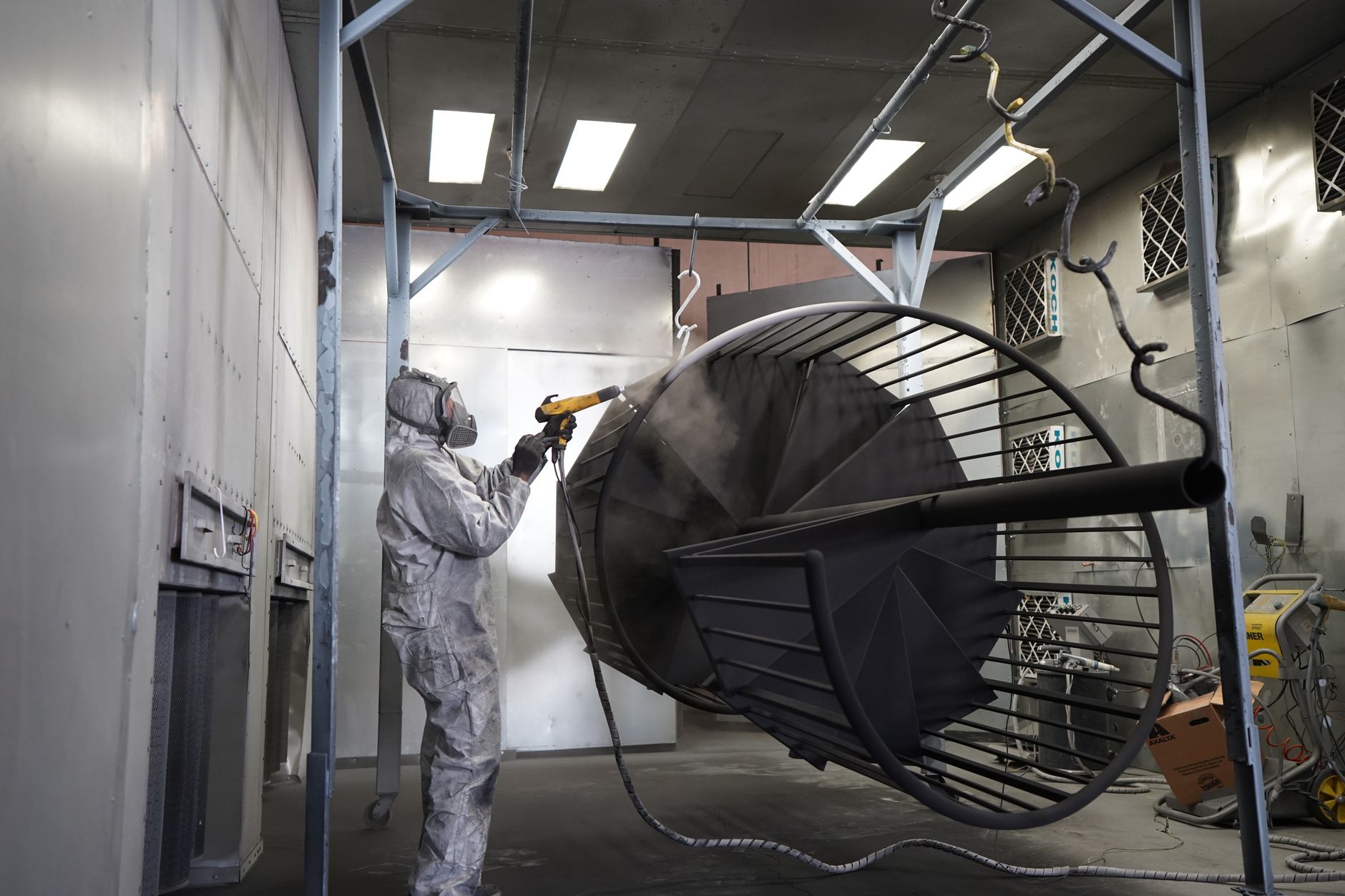
Do not infer the answer from the word paint. Waterborne products may be handled in an unclassified packaging room, while solventborne coatings, cleaners, or nearby spray operations may create a classified location. The facility's documented area classification, product safety data, ventilation design, process release scenarios, and authority having jurisdiction determine the boundary.
OSHA 1910.307 requires electrical equipment in hazardous classified locations to be intrinsically safe, approved for the specific location, or demonstrated safe for it. Approval must account for the class, group, and temperature conditions associated with the material present. Cameras, lights, motors, label dispensers, controls, connectors, and robot equipment all belong in that review.
Proximity to spray finishing deserves special attention. OSHA 1910.107 places requirements on electrical equipment outside but within 20 feet of a spraying area when no partition separates the spaces. OSHA also interprets dangerous quantities of flammable vapor or mist in spray finishing around the threshold of 25 percent of the lower flammable limit under the conditions described in its guidance.
A common engineering response is to place labeling beyond the classified boundary, then use conveyor accumulation or a partition to connect it with filling. That can be preferable to forcing standard equipment into an environment for which it was never approved. ISO 10218-1:2025 explicitly excludes potentially explosive environments from its scope, so ordinary robot conformity does not settle explosion protection.
How does the cell connect to a filling line?
The labeler needs a disciplined handshake with the filler, lidder, conveyor, and production system. At minimum, it must know that a container is present and stable, the active SKU is valid, the upstream container is complete, and the downstream lane can accept either a good unit or a reject. Line control should prevent a faulted labeler from creating an uncontrolled queue.
Traceability is strongest when the production order supplies the recipe and each container receives a serialized or batch-linked inspection record. The record can include label identity, captured code data, vision result, reject reason, timestamp, and recipe revision. Store useful evidence, but set retention and image-storage rules deliberately rather than saving every camera frame forever.
Mechanical integration deserves equal weight. A freshly filled can may slosh during abrupt indexing, carry product on its rim, or arrive with a lid that is not fully seated. Conveyor spacing, acceleration, clamping force, and the distance from filling to labeling should be tested with real product fill levels. A buffer can decouple brief label-roll changes from the filler, provided accumulation does not compromise product quality.
A practical interface exposes distinct states:
- Ready, running, starved, blocked, changeover, and fault conditions.
- Recipe accepted and physical setup verified.
- Container captured and safe to orient.
- Label applied, inspection passed, or reject requested.
- Upstream stop, downstream stop, and controlled restart permissions.
What does a safe, maintainable cell require?
A collaborative arm does not make the full application collaborative by itself. The risk assessment must include the container payload, sharp metal edges, pinch points at rollers and nests, stored energy in pneumatic devices, conveyor motion, label-web threading, and predictable human interventions. Fast motion or a hazardous tool can still require guarding, interlocks, scanners, or reduced-speed modes.
ISO 10218-2:2025 addresses the integration, commissioning, operation, maintenance, and decommissioning of industrial robot applications and cells. That lifecycle view fits labeling well because many exposures occur during roll changes, adhesive cleanup, jam recovery, and troubleshooting rather than normal automatic production.
Design recovery before go-live. Operators need clear instructions for a torn web, missing label, double feed, unreadable code, lost orientation, full reject bin, and container trapped during a stop. Maintenance access should not require reaching through the applicator or defeating a safeguard. Remote triage can shorten diagnosis, but lockout procedures and trained on-site work remain essential where hazardous energy is present.
How should a plant pilot and procure the cell?
Start with the hardest representative package family, not the easiest demonstration can. The robot pilot program should include glossy and dull containers, the smallest and largest diameters, handles, seams, changing artwork, low label-roll conditions, normal dents, and realistic line stops. Challenge the cell with approved worst cases and record every manual intervention.
Judge the commercial robot demo using first-pass label acceptance, false rejects, escaped defects, changeover loss, upstream and downstream stoppages, web waste, recovery time, and operator workload. Rate capability should be measured at the required acceptance standard on the actual filling line. A fast dry cycle has little value if filled cans oscillate, labels wrinkle, or inspection cannot keep pace.
Service Robot Co. can act as the vendor neutral robot integrator for this work. The company selects equipment across manufacturers, then handles robot deployment and integration, financing, training, and service through a nationwide U.S. engineer network. That gives a paint producer one partner one number across the cell's lifecycle instead of separate contacts for the arm, vision, applicator, controls, and field support.
Procurement can compare purchase, robot leasing for business, collaborative robot arm leasing, and monthly payment programs against the expected SKU mix and production horizon. A cobot lease for manufacturing should still define RoboCare™ service terms, spare-part ownership, on-site dispatch, remote triage, acceptance tests, and end-of-term options. Financing structure never substitutes for a validated process, but it can support phased deployment no shutdown when several lines need proof before wider adoption.
Frequently asked questions
Want a robot working for you?
Tell us the job and the site. We will recommend the robot, quote the lease, and keep it serviced.