

Key takeaways
- Treat every escalator mouth as a permanent no-go zone for autonomous cleaning.
- Map the robot around the landing field, not onto the comb plate, flat steps, or rider discharge cone.
- Keep signs and barriers from shrinking the pedestrian route below accessible clearances.
- Use off-peak or overnight windows, and define a dry manual handoff zone for the last few feet.
What is the safe way to automate these landings?
You can automate the flat floor around an escalator, but the safe method is to treat the escalator mouth as a permanent exclusion zone. The robot should clean the broad landing field, the waiting area, and the approach lanes, then stop short of the comb plate, flat steps, and passenger discharge cone. The last strip nearest the machine is a hand-finish task, not an autonomy task.
That distinction matters because escalators combine two hazards in one small footprint. In a 2008 safety release, the U.S. Consumer Product Safety Commission said about 11,000 escalator-related injuries were treated in 2007, and 10 percent involved hands, feet, or shoes getting trapped. The workplace housekeeping backdrop is serious too. The U.S. Bureau of Labor Statistics reported 844 fatal falls, slips, and trips in 2024, including 150 same-level incidents.
The operating recipe is straightforward. Build a virtual boundary before the comb plate, preserve a clear pedestrian route across the landing, place caution signs where they guide traffic instead of choking it, run the autonomous floor scrubber in low-traffic windows, and define a dry handoff zone where a worker can finish the edge safely. A commercial floor cleaner robot belongs on the open floor. People handle the pinch points.
Why is the escalator mouth different from the rest of the floor?
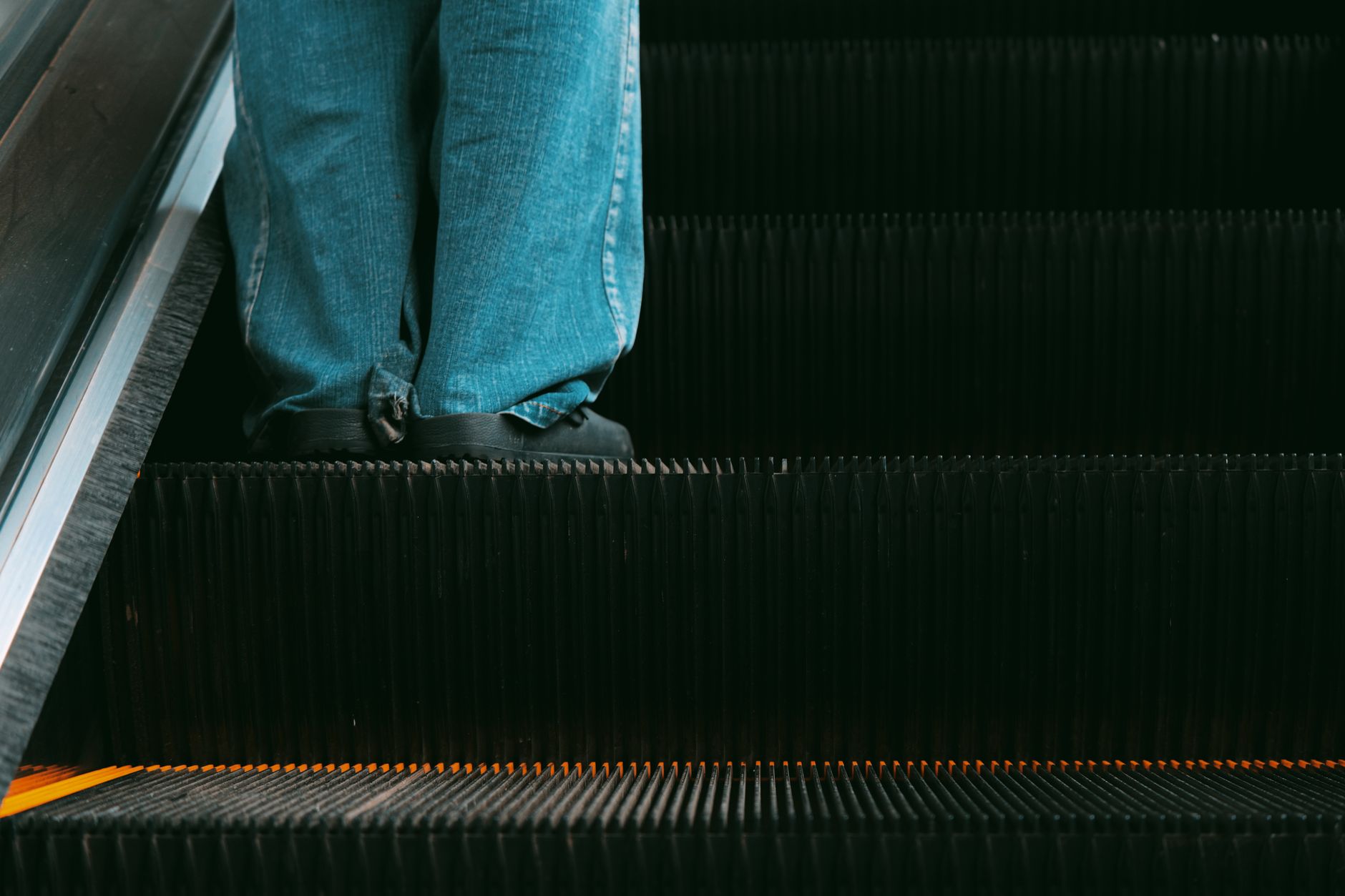
An escalator landing is not just another wall edge. It is a merge point where riders step off, regain balance, glance for direction, turn toward storefronts or concourses, and sometimes stop abruptly. The Elevator Escalator Safety Foundation teaches basic rider habits such as stepping on and off carefully, standing forward, holding the handrail, and not touching the sides below the handrail. Those cues tell you exactly where a robot should not invite interaction.
According to the U.S. Access Board, escalators in rail and fixed-guideway stations have at least 2 and no more than 4 flat steps at entrances and exits, and the steps are demarcated by yellow lines up to 2 inches wide. For a cleaning operator, that is a practical visual boundary. Do not map edge-following passes onto the flat steps. Do not aim a scrub path across the yellow demarcation. Treat the moving equipment and the rider stabilization zone as off-limits, even if the surrounding floor is fair game.
How should the route be drawn on the flat floor?
Start route design with people, not with square footage. Watch where riders exit, where they pause, which side bags and strollers tend to swing, and where security or janitorial staff already stand during spill response. Then draw the robot route outside that movement cloud. The best paths are broad parallel passes along the fixed landing and adjoining floor, not nose-in approaches toward the comb plate.
Accessibility numbers help here. The U.S. Access Board says accessible walking surfaces need 36 inches of clear width minimum, can narrow to 32 inches only for a 24-inch stretch, and need 42 inches approaching a 180-degree turn and 48 inches at the turn unless you have a 60-inch turning pocket. Use those dimensions as the floor-plan floor, not the stretch goal. If a sign, docked robot, manual cart, or queue stanchion shrinks the landing below that clearance, the route is too aggressive. Redraw it or exclude the area.
Where do virtual boundaries and handoff zones go?
Virtual boundaries should sit on the stationary landing, never on the moving step field. In practice, the cleanest maps draw a hard no-go strip before the comb plate and a second no-go bubble around the rider discharge arc where people first step off and settle. If you cannot place both while still keeping a comfortable pedestrian lane, exclude the whole landing and let the robot clean only the adjacent apron. Not every landing is a robot landing.
The manual handoff zone is the opposite of the exclusion strip. It is a dry staging pocket on stable floor, outside the passenger cone, where the robot stops and a worker takes over with a mop, microfiber pad, or walk-behind tool. Mark it in the SOP, not just in the map, so every shift knows where the robot ends and the person begins.
- Spills or debris that extend to the comb plate or yellow step-demarcation zone
- Traffic surges after events, breaks, bell times, or transit arrivals
- Strollers, luggage, carts, or mobility devices clustering at the landing
- Any escalator alarm, inspection, or maintenance activity
- Temporary displays, pallets, or promo fixtures that change the discharge pattern
What signage and traffic control actually help?
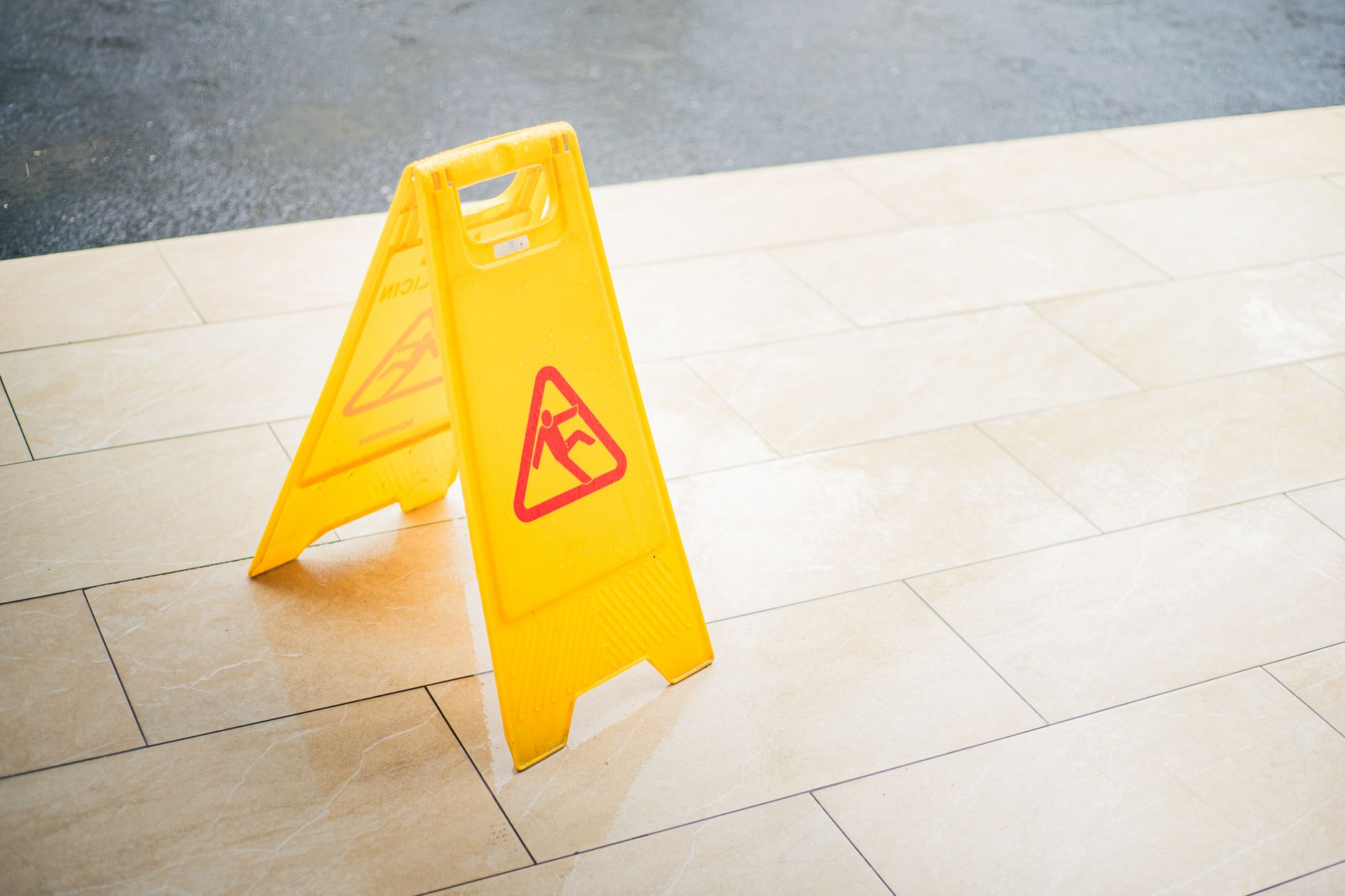
Signage should steer people around cleaning activity without turning the landing into an obstacle course. OSHA recommends cleaning one side of a passageway at a time and providing good lighting in halls and stairwells. That principle fits escalators well. Use the minimum number of signs needed to cue attention, keep them upstream of the wet path, and avoid blocking the rider exit line unless a person is actively hand-finishing the edge.
Placement matters as much as the message. The U.S. Access Board says accessible routes need 36 inches of clear width, protruding objects cannot reduce that width, and signs or obstructions mounted between posts must keep their lowest edge at 27 inches maximum or 80 inches minimum. For floor care, that means no low crossbars, no sloppy caution tape, and no power cords dragged across the landing. If your traffic control creates a new trip hazard, it failed.
- Place the first caution sign where riders can choose a path before they reach the wet area
- Keep chargers, docks, and spare pads off the landing and out of exit sightlines
- Use bright, even lighting during overnight cleaning and pre-open resets
- Give security or the closing manager a simple radio phrase that pauses the robot and triggers manual handoff
When should the robot run, and when should a person take over?

The best run window is usually after close or in a predictable off-peak block, because the landing behaves more like a corridor and less like a bursty merge point. A night shift autonomous scrubber can cover the outer flat field with good repeatability, then a human can finish the last few feet near the escalator. In a 24-hour property, use micro-windows tied to traffic patterns, not just the clock. If arrivals spike at 6:00 a.m., the robot should be gone by 5:50.
Open-hours cleaning can work on some sites, but only on the perimeter of the landing and only if the route never crosses the discharge cone. Keep the dock far enough away that the robot is not waiting beside the escalator, and keep recovery procedures dry and fast. OSHA's walking-working surface rule says floors should be clean and, as far as feasible, dry, and hazards that cannot be corrected immediately should be guarded. That is the right standard for robot floor care too.
How do you keep this consistent across a portfolio?
Consistency across sites comes from a repeatable hazard-zone template. Class every landing by traffic intensity, landing depth, adjacent fixtures, and sightlines. Keep one map standard for compact retail landings, another for wide mall or airport landings, and a separate manual-only rule for tight sites that never preserve safe clearance. Then audit the result in person. A route that looks clean in software can still feel wrong when people pour off the escalator with bags and momentum.
This is where Service Robot Co. earns its keep. We are an OEM-neutral, vendor neutral robot integrator for U.S. businesses, so we match the robot to the floor and the operating pattern instead of forcing one machine everywhere. We handle site assessment mapping, robot deployment and integration, training, service, and go-live support through a nationwide U.S. engineer network. If you want commercial cleaning robot leasing, autonomous floor scrubber leasing, robot leasing for business, or a leasing program with RoboCare™ service, the landing rules do not change. One partner, one number, and one lifecycle owner is what keeps a mixed property portfolio from drifting into bad habits.
Frequently asked questions
Sources
- U.S. Consumer Product Safety Commission Escalator Safety
- U.S. Bureau of Labor Statistics Fatal Injury Table
- OSHA Walking-Working Surfaces Rule 1910.22
- OSHA Slips, Trips, and Falls Guidance
- U.S. Access Board Stairways and Escalators Guide
- U.S. Access Board Accessible Routes Standard
- U.S. Access Board ABA Standards
- Elevator Escalator Safety Foundation A Safe Ride