
Key takeaways
- A good recovery drill protects people first, restores traffic flow second, and worries about uptime third.
- Only designated employees should move robots, chargers, or surrounding equipment beyond basic safeing steps.
- Repeated E-stops, battery heat, localization loss, collisions, and dock failures need fast escalation to remote support.
- Every drill should end with a short written record, photos, and a clear handoff for the next shift.
What should a night crew recovery drill accomplish?
A good recovery drill gives the night crew a short, repeatable path through an after-hours failure. The goal is not heroic troubleshooting. It is to make the area safe, decide who may touch the robot, restore traffic flow, switch to a safe fallback task, and hand clean facts to remote support or the morning team. If those five things happen in order, operations stay controlled even when the machine does not.
That discipline matters more at night. In its July 14, 2026 Fatigue and Work guidance, CDC's NIOSH says fatigue can slow reaction times, reduce attention, limit short-term memory, and impair judgment. NIOSH training materials also note that accident and error risk rises 28 percent on night shifts and 15 percent on evening shifts compared with regular day shifts. A drill removes guesswork when the crew is most vulnerable to it.
The safety case is not abstract. The U.S. Bureau of Labor Statistics reported 2.6 million nonfatal workplace injuries and illnesses in private industry in 2023, and 946,500 of those cases involved days away from work. Robot recovery drills should be written with that reality in mind. People first, building access second, robot uptime third.
Which failures belong in every after-hours scenario set?
Keep the drill library tight. Teams do not need twenty exotic cases. They need the five failures that regularly interrupt overnight cleaning no operator programs, transport routes, and light after-hours patrol or delivery work. The same core set applies to a night shift autonomous scrubber, an office delivery route, or a hospital transport robot, because the operational question is always the same: can the crew recover safely with approved steps, or does the event need escalation?
Each scenario needs an operational finish line. The robot either returns to service, moves to a defined safe parking spot, or stays out of service while people continue the work manually. Anything fuzzier invites improvised decisions, and improvised decisions are exactly what the drill is supposed to prevent.
- Blocked path or trapped robot. Practice how the crew secures the aisle, checks for spills or unstable loads, removes ordinary obstructions only if site rules allow it, and decides when the robot stays parked.
- Localization loss. Practice how the crew pauses the unit, verifies obvious environmental changes such as moved fixtures or closed fire doors, and avoids wandering manual pushes that can make mapping problems worse.
- Low battery away from the dock. Practice how the crew clears the docking lane, confirms the charger area is usable, and parks the unit in a safe staging spot if it cannot return home cleanly.
- E-stop event. Practice how the crew treats an E-stop as a real hazard signal, checks for a person, cart, spill, or pinch point, and escalates repeated or unexplained stops instead of normalizing them.
- Inaccessible dock. Practice what happens when the dock is blocked, the room is locked, power is unavailable, or the approach lane has been repurposed by pallets, carts, or housekeeping gear.
Who may move the robot, charger, or surrounding equipment?
Write the drill around role boundaries, not personalities. OSHA's lockout and tagout guidance says workers must be trained for the safe application and removal of energy controls, and employees in the area must be instructed not to restart or reenergize equipment under control. Your night drill should borrow that logic even when the event falls short of full maintenance. The point is simple: not everyone who notices a robot failure gets to handle the machine.
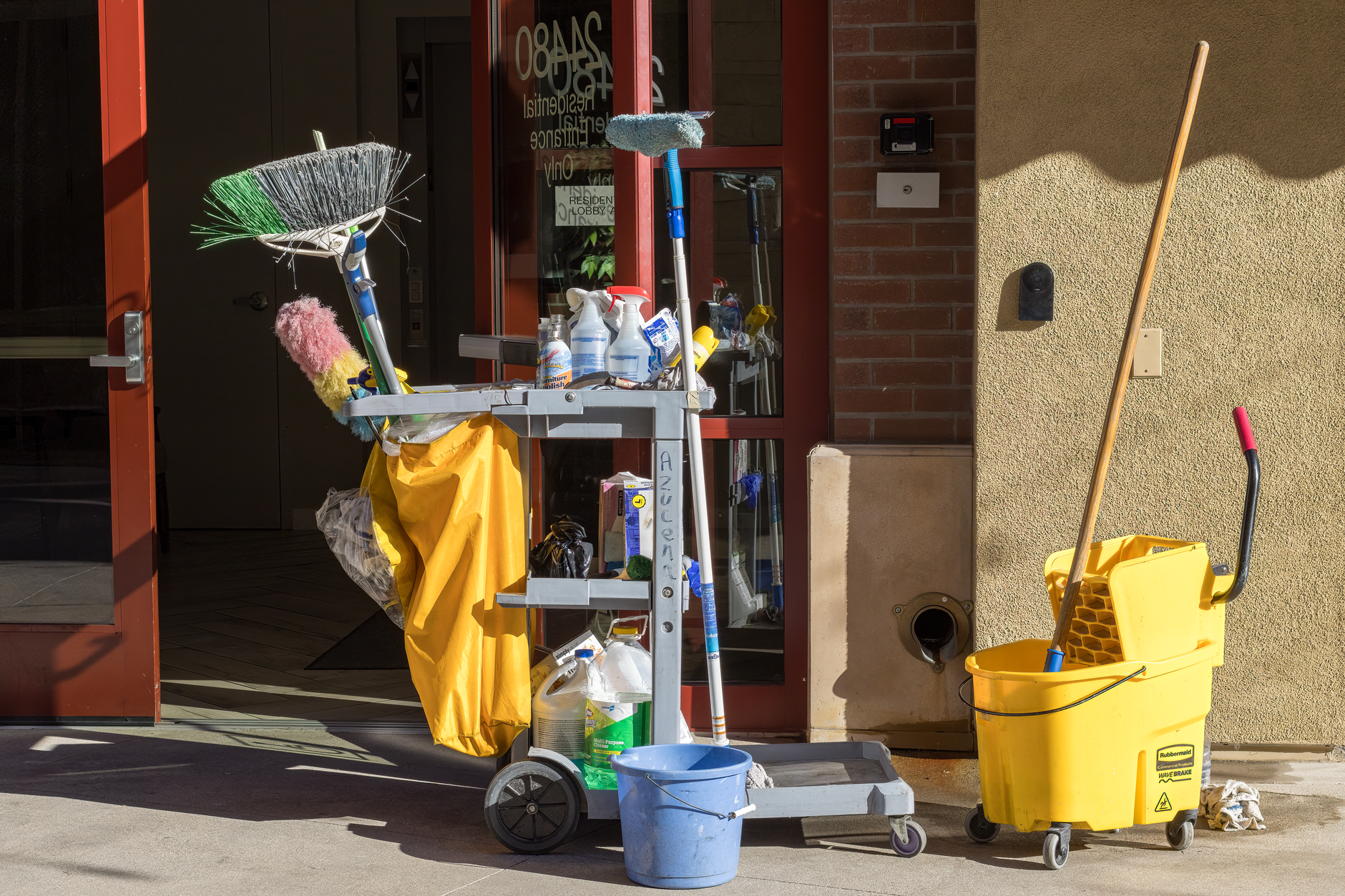
This is also the right place to define who may move surrounding equipment. A night janitor may be authorized to roll away a dry trash can. The same person should not be guessing about a loaded cart, a pallet, a wet floor feeding a charger, or a locked electrical room. Spell that out. The drill is far cleaner when the answer to who may touch what is written before the incident starts.
- Affected crew members. They may stop traffic, set cones or signs, use normal on-screen pause or stop functions, and report what they see. They do not open panels, bypass interlocks, force the robot, or reconnect damaged charging hardware.
- Designated site responders. These are trained employees who may move a unit by hand, clear low-risk obstacles, escort it to a safe parking zone, or perform other manufacturer-approved recovery steps documented in the site playbook.
- Qualified maintenance or remote support. These people own anything involving covers, brake releases outside the approved quick-recovery steps, wiring, charging contacts, battery handling beyond normal approved procedures, or repeated faults that suggest a deeper failure.
When should the crew call remote support?
Remote support should not be the last resort after a string of improvised fixes. It should be the next step when the event crosses from ordinary recovery into uncertain hazard. In its 2025 lithium-ion battery fact sheet, OSHA says thermal runaway indicators can include rising battery temperature, venting gas, vapor, smoke, or fire. It also says emergency action plans should include battery incident procedures based on manufacturer instructions. Those are immediate call conditions, followed by site emergency response if life safety is at risk.
Build the call tree so the crew knows exactly whom to contact first, what photos to send, and what stays offline until support responds. That aligns with OSHA's emergency action plan rule, which requires procedures for reporting emergencies and clear contact roles. It also protects the night crew from the most common after-hours trap, the belief that one more reset will surely fix it.
- Any battery that is hot, smoking, leaking, swelling, or giving off odor.
- Any E-stop that cannot be tied to a clear, corrected hazard.
- Any repeated localization loss after the approved basic recovery steps.
- Any collision, person contact, near miss with a vehicle, or strike to shelving, doors, or glazing.
- Any dock failure tied to power, charging contacts, locked access, water intrusion, or building systems.
- Any recovery that would require opening the unit, overriding a safety device, or moving the robot through an occupied or obstructed area without a clear safe path.
How do you keep operations moving safely while the robot is down?
Every recovery drill needs a degraded-mode operating plan. If the robot cannot finish the route, the crew should already know which work continues manually, which areas can wait until morning, and which zones must never be deferred. In a warehouse that may mean dock aprons, main cross aisles, and spill-prone intersections. In healthcare it may mean public corridors, medication paths, and soiled utility approaches. In offices it may mean lobbies, restrooms, and elevator landings.
Keep the fallback safe for people first. OSHA says exit routes must stay free and unobstructed, and no equipment may be placed temporarily or permanently within the exit route. That means a failed robot, a charging cart, cones, or a pile of removed obstacles cannot migrate into egress paths just because the building is quiet. Safe continuation is not just getting the task done. It is getting the task done without creating a new hazard.
- Switch the affected route to manual coverage with a named person and a clear handoff.
- Park the unit only in a marked safe bay that does not block fire equipment, exits, doors, or docking traffic.
- If part of the building remains safe for autonomous work, isolate only the failed task instead of shutting down unrelated routes.
- Leave a visible status tag so the morning shift can see at a glance that the unit is down, why it is down, and who owns the open support case.
What must the team document every single time?

The documentation standard should be boring and exact. After-hours failures are often reconstructed by people who were not present, and vague notes waste the best evidence. A clean record lets support separate site conditions from true robot faults. It also shows leadership whether the issue is random, route-specific, shift-specific, or tied to a repeat obstruction that facility teams need to fix.
Keep the form short enough that people will actually complete it on third shift. One page is usually enough. If you run mixed equipment, standardize the log across the fleet. A vendor neutral robot integrator can help here, because the reporting language should be consistent even when the machines are not.
- Date and exact time the event began and ended.
- Robot identifier, task name, map or route name, and precise location.
- What the crew first observed, including on-screen message or alarm state.
- Battery state, dock status, and whether an E-stop was engaged.
- Photos of the approach path, the robot position, the dock if relevant, and the surrounding lighting or obstacles.
- Every recovery step attempted, by whom, and in what order.
- What work continued manually, what work was deferred, and any temporary controls such as cones or barricades.
- The remote support ticket or service case number, plus the condition required before return to service.
How often should you rehearse it, and what counts as a pass?
Run the drill in real night conditions. Lights should be at night settings. Deliveries, carts, locked doors, floor crews, and reduced staffing should look the way they actually look after hours. CDC's NIOSH says 15 million Americans work full-time evening, night, rotating, or other irregular schedules, and 30 percent of American workers get less than six hours of sleep per night on average. Training that only happens at 10 a.m. misses the environment where the failure will actually occur.
Put the drill on a recurring safety calendar and rerun it whenever routes, docks, building access rules, software behavior, or night crew responsibilities change. OSHA requires emergency action plan reviews when employee duties or the plan itself changes, and that is a useful standard here too. A pass is not perfect uptime. A pass means the team followed role boundaries, protected egress, escalated correctly, preserved evidence, and kept the operation safe while the robot was unavailable.
Why a single lifecycle partner changes the recovery drill
Mixed fleets often fail for operational reasons more than technical ones. Different chargers, support numbers, user interfaces, and service boundaries create hesitation, and hesitation is exactly what night work punishes. Service Robot Co. helps simplify that. As an OEM-neutral commercial robot integrator for U.S. businesses, the company selects the right machines across manufacturers, then finances, deploys, integrates, trains, and services every unit through a nationwide engineer network.
For the operator, that means one partner and one number when the route breaks at 2 a.m. It also means the drill can tie together robot fleet management, remote triage, commercial robot repair service, on-site dispatch, and emergency response nationwide inside one playbook. That is the operational resilience angle in plain language. The recovery drill stops being a patchwork of vendor exceptions and becomes part of the full lifecycle service plan.