
Key takeaways
- Robots can document plenum conditions with fewer ceiling openings, but they still need planned access and recovery points.
- Indoor localization should reference ceiling grids and building coordinates because GPS performs poorly inside buildings.
- Dust control, tile handling, and occupant scheduling belong in the inspection plan, not in post-job cleanup alone.
- Contractors need location-tagged findings and clear closeout status, not hours of unindexed video.
- Robot imagery can flag questionable fire-stopping, but required code inspections remain the work of qualified parties.
What can a robot actually inspect above a suspended ceiling?
Small indoor drones and compact crawlers can document piping, valves, cable pathways, ductwork, insulation, staining, corrosion, displaced materials, and visible gaps around penetrations. Their main advantage is reach. One carefully selected tile opening can reveal conditions across a larger ceiling zone without repeatedly moving ladders, furniture, and occupants.
The right inspection is a controlled evidence-gathering mission, not an aimless camera flight. Each visible condition should be tied to a ceiling-grid coordinate, room or corridor, nearby asset, image timestamp, and follow-up owner. Thermal, moisture, acoustic, or gas sensors may add useful screening data when the suspected defect calls for them.
A robot does not remove every access problem. An operator still needs a safe launch or insertion point, a recovery method, and permission to approach sensitive fire protection, electrical, security, and communications infrastructure. The best programs reduce openings and time aloft while producing records that a contractor can act on immediately.
Which machine fits the plenum?
Platform choice begins with the physical route. A flyer suits an open void with enough clearance around hangers, piping, cable bundles, and flex duct. A crawler needs a verified load-bearing path, such as an approved structural surface or purpose-built track. Acoustic tile, exposed ceiling grid, loose cable, and unsupported ductwork are not travel surfaces.
Propeller wash can lift dust and disturb light insulation, while a tether can catch on threaded rod or cable. Crawlers avoid sustained downwash but may struggle at elevation changes and crowded crossings. A close-range pole camera may be the safer first tool near an access opening, with the robot reserved for areas that cannot otherwise be seen.
- Measure the smallest opening, vertical clearance, turning space, and narrowest passage before selecting hardware.
- Confirm camera focus distance, lighting, stabilization, and the ability to read labels in reflective or nearly black spaces.
- Specify protected rotors, low-speed contact behavior, obstacle sensing, lost-link response, and a physical recovery method.
- Test sensor performance against shiny pipe, foil-faced insulation, standing water, dust, darkness, and repeating ceiling geometry.
How should tile access be planned?
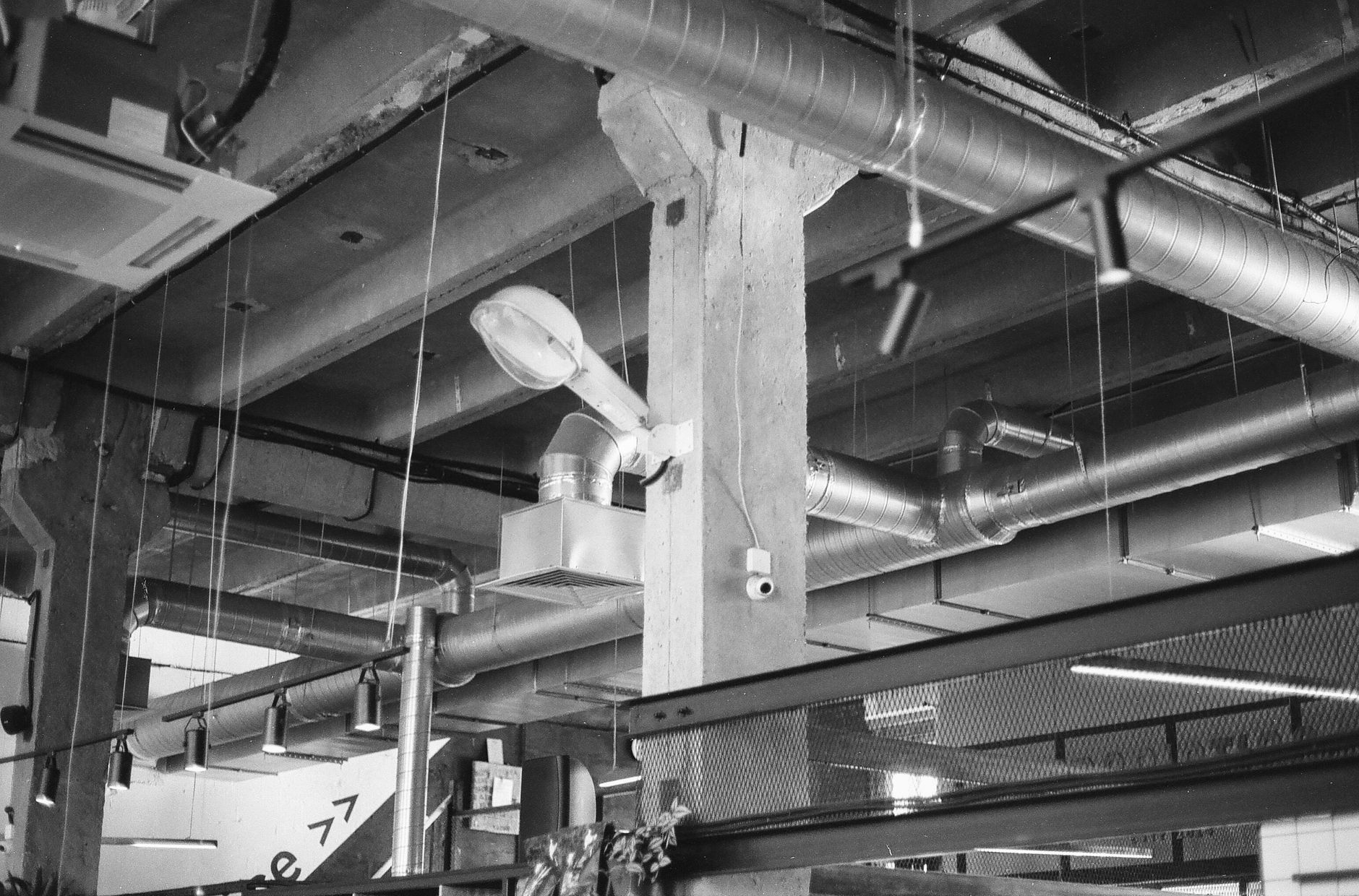
Start with reflected ceiling plans, available record drawings, maintenance history, and a walkdown from below. Mark permitted access tiles, hold-down clips, light fixtures, diffusers, alarms, partition heads, and furniture that limits ladder or lift placement. Assign every opening a unique identifier before the first tile moves.
Technicians should use clean handling methods and protect finished surfaces. Tiles with staining, cracking, sagging, concealed fasteners, or suspect debris need special review before removal. OSHA instructs ladder users to maintain three points of contact, work from stable level surfaces, and account for the combined load of personnel, tools, and equipment. Robotic reach can reduce repeated climbing, but it does not relax those access rules.
How do you control dust and occupant disruption?

Schedule work around clinics, classrooms, trading areas, conference rooms, food service, and other sensitive operations. Establish a small exclusion zone below each opening, protect furnishings, coordinate alarms and HVAC status, and test the robot at low speed before entering a dusty void. Warn occupants about noise, lighting, and the exact duration of access.
Where potentially hazardous materials could be disturbed, the inspection needs an environmental review and job-specific controls. In its guidance for PCB-related renovation, the Environmental Protection Agency recommends containment, HEPA equipment, and protection against dust entering ventilation systems. That guidance cites 4-mil or 6-mil plastic sheeting for interior floor protection. The appropriate controls still depend on the building, material history, and planned disturbance.
A robot should observe, not excavate. Do not push through unidentified debris, scrape sprayed material, move insulation, or force a blocked route merely to complete coverage. Stop, preserve the location, and refer the condition to the facility's environmental or safety lead.
Why is localization difficult above ceilings?
Plenums combine darkness, repeating grid patterns, reflective foil, slender obstacles, and few dependable landmarks. The National Institute of Standards and Technology says GPS is largely ineffective indoors and particularly poor at determining altitude. Its 2026 indoor-positioning test facility uses 50 motion-capture cameras across a 450-cubic-meter, four-story environment, which illustrates how demanding trustworthy three-dimensional location can be.
A practical plenum map should combine robot odometry and visual or inertial localization with building references. Anchor the mission to the access opening, room number, ceiling-grid row and column, structural bay, and known assets. Temporary fiducial markers can reduce ambiguity if facility rules allow them. Operators should pause at junctions and record orientation so a later reviewer can reconstruct the route.
What evidence can contractors use without interpretation?
Raw video is an archive, not a work order. The handoff should separate observations into individually numbered findings, each with a plan location, direction of view, asset description, still image, relevant video interval, condition category, and requested next action. Distinguish observed facts from interpretations. A dark stain is visible evidence; an active roof leak is a diagnosis requiring confirmation.
The U.S. Army Corps of Engineers provides a useful documentation principle in its construction quality guidance: inspection activities should be supported by logs, reports, and photographs, with the date, project name, location, observations, test results, and corrective actions recorded. A commercial plenum survey benefits from the same traceability.
- Finding ID and inspection date
- Building, floor, room, ceiling-grid coordinate, and access-point ID
- System or asset affected and the responsible trade
- Overview image, close-up image, and video timestamp
- Instrument reading, units, calibration status, and stated limitations when sensors were used
- Priority, assigned party, completion evidence, and reinspection status
How should fire-stopping findings be handled?
The camera can expose missing material, visible gaps, damaged seals, abandoned penetrants, unlabeled work, and apparent mismatch between the opening and installed firestop. It cannot confirm a listed system from appearance alone. Record the penetrant type, opening geometry, surrounding assembly, label information, and views from every reachable side, then refer the finding to the authority responsible for code compliance.
The 2024 International Building Code requires approved-agency inspection of covered penetration firestop systems in certain high-rise, Risk Category III or IV, and qualifying residential fire areas, including those with an occupant load greater than 250. The code points to ASTM E2174 for penetration-firestop inspection. Robot records can help an inspector locate and revisit conditions, but they do not replace mandated inspection or destructive verification.
Ceiling membranes also matter. The 2024 International Mechanical Code identifies approved protection methods for duct and air-transfer openings through rated ceiling assemblies, including listed ceiling radiation dampers in specified cases. A plenum survey should therefore capture the surrounding assembly, not just the pipe, cable, or duct at its center.
What should a pilot and service program include?
Begin with a robot pilot program in a representative zone containing tight clearances, multiple trades, dust, reflective surfaces, and at least one difficult recovery route. Acceptance criteria should cover usable asset detail, location accuracy, coverage gaps, tile openings required, recovery performance, occupant controls, and the percentage of findings a contractor can locate without another exploratory visit.
Service Robot Co. approaches this as an OEM-neutral, full-service commercial robot integrator for U.S. businesses. A free site assessment can determine if an inspection robot lease, purchase, or another access method fits the building. This is especially important when a crawlspace inspection robot is being considered for a plenum, because the two environments impose different support, clearance, and recovery constraints.
After selection, Service Robot Co. handles robot deployment and integration, operator training, financing paths, and lifecycle support through a nationwide U.S. engineer network. Programs can include maintenance, remote triage, and on-site dispatch. The facility gets one partner and one service number instead of coordinating separate equipment, integration, training, and repair vendors.
Frequently asked questions
Sources
- NIST indoor localization test facility
- EPA renovation and dust-control guidance
- OSHA portable ladder safety guidance
- FAA guidance for indoor drone operations
- 2024 International Building Code special inspections
- 2024 International Mechanical Code duct systems
- USACE construction quality documentation manual