
Key takeaways
- Patrol robots extend surveillance and document conditions, but trained personnel retain authority for access control and response.
- Cargo facilities, vehicle docks, and accepted-cargo staging areas may fall inside a Security Identification Display Area.
- The strongest deployment pairs fixed fence sensors with mobile visual or thermal verification.
- Routes must protect aircraft operations, emergency access, cargo traffic, and workers before maximizing patrol coverage.
- Alarm value depends on dependable communications, clear escalation rules, and evidence that operators can retrieve quickly.
Where do patrol robots fit around an air cargo operation?
Security robots can be a practical second layer for landside cargo yards and restricted perimeter roads. An autonomous patrol robot can repeat fence-line rounds, inspect gates, flag stopped vehicles, and send live imagery to a security operations center. It should augment guards and fixed systems, not act as the final authority on access, interception, or law enforcement response.
The best operating zone is usually a controlled road or yard with predictable traffic, adequate pavement, and a defined boundary. The robot watches the quiet stretches between staffed posts, revisits known trouble spots, and gives an operator another camera angle when a fence sensor alarms.
Airport deployment is not ordinary commercial property work. Route ownership, cargo custody, access credentials, aircraft movement, emergency lanes, and the TSA-approved Airport Security Program all determine where the machine may travel and what happens after it detects something.
Which aviation security rules shape the deployment?
The regulatory boundary matters more than the label landside. Under 49 CFR Part 1542, airport operators must prevent and detect unauthorized entry, presence, and movement of people and ground vehicles in secured areas and air operations areas. Their approved security programs describe boundaries, access controls, movement controls, identification systems, training, and response measures.
Cargo property can carry a higher designation. Section 1542.205 states that areas regularly used to load or unload cargo from covered aircraft must be Security Identification Display Areas. It also includes cargo facilities, vehicle docks, and places where accepted cargo is sorted, stored, staged, consolidated, processed, screened, or transferred.
Screening and perimeter patrol are different controls, but they protect the same custody chain. According to TSA, 100 percent screening of U.S.-origin international cargo carried on all-cargo aircraft became mandatory on June 30, 2021. Former Impractical to Screen amendments expired on October 31, 2023, reinforcing the need to preserve cargo integrity after screening or acceptance.
A robot does not replace the airport operator's regulatory duty or grant itself access. Personnel who deploy, recover, maintain, or remotely support it may need the training and authorization appropriate to the route. If deployment changes security measures, staffing, area descriptions, or relevant physical layouts, the airport should determine with its Airport Security Coordinator and TSA if an Airport Security Program amendment or notification is required. Part 1542 can require notification within 6 hours after discovery of certain changed conditions, followed by written information within 72 hours for changes expected to last less than 60 days.
How should robots work with fence analytics?
A fixed fence system is good at announcing that something moved. A mobile robot is useful for determining what moved, where it went, and what the surrounding scene looks like. The operating concept should link every fence zone to one or more robot observation points, not merely send the machine toward vague coordinates.
Useful payloads can combine visible-light cameras, thermal imaging, directional audio, lighting, and location data. Analytics should distinguish a person climbing, cutting, loitering, or abandoning an object from ordinary cargo traffic, windblown material, vegetation, birds, and maintenance activity. Detection thresholds need separate day, night, rain, fog, and seasonal validation.
Fence visibility is an environmental control too. TSA's July 2025 General Aviation Security Guidelines, which are advisory and do not replace an airport's approved program, suggest clear areas of 10 to 30 feet around fencing where practical. Pallets, containers, parked trailers, utility poles, and overgrown vegetation can conceal intruders and degrade both fixed and mobile analytics.
Every confirmed patrol observation should carry a timestamp, position, camera view, alarm source, and disposition. That record lets security managers compare sensor zones, identify recurring nuisance alarms, and show that an alert was assessed rather than merely acknowledged.
How can a robot coexist with tugs, trucks, and emergency vehicles?
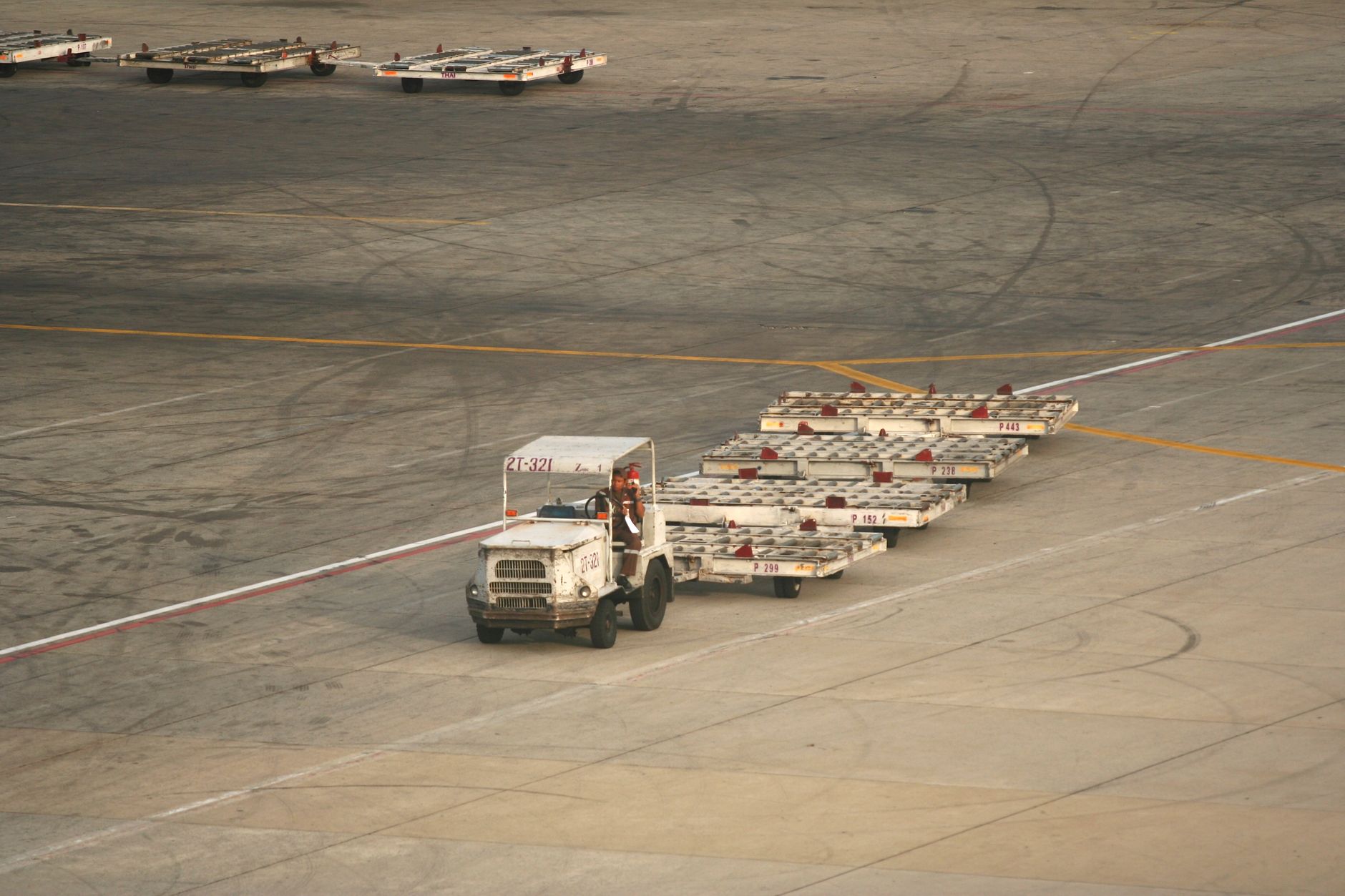
Cargo yards are full of backing tractors, dollies, forklifts, vans, and workers stepping from behind containers. A safe route begins with traffic study and site assessment mapping during representative peaks, shift changes, aircraft turns, and poor weather. A quiet demonstration at midday proves little about a midnight export bank.
The route should favor protected perimeter roads, one-way segments, marked crossings, and pull-off points. Operating rules need explicit speed limits, vehicle right of way, minimum stand-off distances, horn or light behavior, remote stop authority, and procedures for construction, snow removal, fuel spills, and temporary closures.
Emergency access always wins. TSA guidance cautions that stronger perimeter controls must not prevent fire and emergency vehicles from reaching the airfield. The robot must yield, clear designated lanes, and move to a safe state if localization, braking, or communications becomes unreliable.
Keep an initial pilot outside movement areas unless the airport has completed the additional safety work and approvals. The FAA identifies perimeter security vehicles as an airport use for autonomous ground vehicle systems, but its current guidance also says the agency is still researching standards for integrating these systems safely. FAA Advisory Circular 150/5210-20A remains the active reference for airport ground-vehicle training and pedestrian control on movement and safety areas.
What communications architecture belongs at the perimeter?
Perimeter coverage is rarely uniform. Warehouses create radio shadows, metal containers reflect signals, and remote fence roads may sit beyond dependable Wi-Fi. A pilot should map latency, packet loss, handoff behavior, and video quality along the entire route, then repeat the test under operating traffic and bad weather.
The machine should retain local obstacle avoidance and a defined loss-of-link behavior. Depending on the risk assessment, that may mean stopping in a refuge, completing a short move to a safe point, storing evidence locally, and alerting the control room through a secondary connection. A dropped video stream must not produce uncontrolled travel.
Cyber design should separate robot traffic from access control, airport operations, and other critical networks. Use device identity, least-privilege permissions, encrypted communications, controlled remote access, logged administrative actions, and a documented patch process. CISA recommends TLS 1.3 for TLS-capable protocols and emphasizes network segmentation and monitoring at key boundaries.
Do not assume cellular service alone equals resilience. Document the primary and backup paths, who owns each network, how certificates and credentials are renewed, and how operators communicate with patrol staff if both data paths fail.
What should happen after the robot raises an alarm?

Detection without a practiced response is just recorded uncertainty. Each alert class needs an owner, a verification window, an approved action, and a fallback if the operator cannot reach the robot. The playbook should distinguish safety events, security events, maintenance faults, and benign anomalies.
A practical escalation ladder assigns increasing authority rather than treating every detection as an emergency.
For suspected unlawful interference, the Airport Security Program and Airport Emergency Plan govern. Part 1542 requires immediate evaluation and appropriate action after covered threats, plus immediate TSA notification of acts or suspected acts of unlawful interference. Incident procedures must be reviewed with responsible parties at least once every 12 calendar months.
Law enforcement dispatch remains a human decision under airport procedures. Part 1542 requires adequate law enforcement support and records of each covered law enforcement action to be retained for at least 180 days. Robot evidence should enter that established record system with controlled access and retention rules.
- Advisory: log a damaged sign, blocked view, open service cabinet, or minor fence condition for facilities follow-up.
- Verification: present live and recorded imagery to a trained operator when analytics detect loitering, climbing, cutting, or an unknown vehicle.
- Security dispatch: send authorized personnel when the operator confirms an intrusion, access-control breach, or suspicious activity.
- Emergency escalation: notify airport police, emergency services, the Airport Security Coordinator, and TSA as required by the approved plans.
How should an airport pilot and procure the system?
Start with one defensible mission, such as a restricted cargo-yard loop between two staffed gates. Establish baseline guard rounds, fence alarms, response times, communications gaps, maintenance calls, and missed patrols before introducing the robot. Then run day, night, rain, glare, congestion, and network-loss scenarios.
Acceptance testing should cover route completion, stopping behavior, pedestrian and vehicle encounters, gate approaches, alarm delivery, evidence retrieval, manual control, safe shutdown, and recovery after obstruction. Security personnel, airport operations, cargo tenants, information technology, police, fire responders, and labor representatives should all participate where their duties intersect.
Service Robot Co. approaches this as a full-lifecycle integration project. As an OEM-neutral, vendor neutral robot integrator for U.S. businesses, we compare suitable platforms across manufacturers, then handle financing, robot deployment and integration, training, and service through a nationwide U.S. engineer network.
That one partner, one number model matters at an airport, where a failed charger, damaged sensor, expired network credential, or route-map change can cross several departmental lines. Programs can be structured as a security patrol robot purchase or lease, with RoboCare™ service where appropriate. The commercial model should follow the approved operational case, not drive it.
Which metrics show that the patrol is working?
Robot mileage and hours are activity measures, not security outcomes. Judge the deployment by completed patrols, missed checkpoints, alarm verification time, confirmed events, nuisance-alert rate by zone, communications availability, safe stops, interventions, and evidence-retrieval time.
Track operational friction too. Record blocked roads, cargo delays, worker complaints, emergency-lane conflicts, recovery calls, and maintenance downtime. A system that detects well but repeatedly obstructs tractors or summons staff for trivial faults is not ready to scale.
Review results by shift, weather, location, and event type. That reveals if one fence segment needs vegetation control, a fixed camera, better lighting, a different patrol angle, or no robotic coverage at all. The goal is a layered security posture in which each control performs the job it handles best.
Expand only after the airport has stable routes, trained operators, tested communications, documented escalation, and a service plan. A disciplined pilot can show where autonomous security robots add useful vigilance without confusing machine observation with regulatory accountability.
Frequently asked questions
Sources
- 49 CFR Part 1542, Airport Security
- 49 CFR Part 1540, Civil Aviation Security
- FAA Autonomous Ground Vehicle Systems on Airports
- FAA Ground Vehicle Operations Advisory Circular
- FAA 2026 Sample Airport Certification Manual
- TSA General Aviation Security Guidelines
- TSA Air Cargo Security Fact Sheet
- CISA Communications Hardening Guidance