Key takeaways
- For most regional casino hotels, cleaning is the best first robot because it covers the most square footage, runs overnight, and attacks the hardest-to-staff hours.
- Security moves to the top when the property has large parking areas, long exterior walks, or persistent overnight blind spots that fixed cameras do not close.
- Delivery rises when guest towers, room service, and amenity runs create constant low-value walking for already thin front desk and housekeeping teams.
- Cash-handling support is usually a second or third automation step because cage, count, and compliance workflows demand tighter process design and internal sign-off than cleaning or delivery.
What should a regional casino hotel buy first?
For most regional casino hotels, the first robot should be a cleaning robot, specifically for overnight hard-floor care. It usually touches the widest part of the property, it works during the least popular shifts, and its value is easy to see in labor coverage, floor consistency, and guest-ready presentation by morning. If your casino floor, prefunction space, corridors, and lobby create long repetitive scrub routes, cleaning normally comes first.
There are two common exceptions. Security should come first if the real pain sits outside the building: sprawling parking, distant entrances, repeated after-hours incidents, or a patrol schedule your team cannot reliably keep. Delivery should come first if labor is getting burned on room runs, amenity drops, and food handoffs across guest towers. Cash-handling support can matter, but for a smaller property it is rarely the best first purchase because the process and controls are tighter, and the operational win is concentrated in fewer routes.
This is not a mega-resort question anymore. In its State of the States 2026 report, published May 12, 2026, the American Gaming Association said U.S. commercial gaming revenue reached $78.62 billion in 2025, and its commercial gaming database describes more than 300 casino properties and related markets across 37 states plus Washington, D.C. The addressable market is broad. Regional properties face the same 24 hour labor reality as larger resorts, just with thinner teams and less room for a bad first bet.
Why does the first-buy decision usually start with labor math, not novelty?
Regional casino hotels do not need a flashy use case. They need relief where staffing friction repeats every day. The labor data still points in that direction. The U.S. Bureau of Labor Statistics reported a 5.6 percent annual average job openings rate for leisure and hospitality in 2025, and a 3.9 percent annual average quits rate. That is better than the peak churn years, but it is still a rough operating backdrop for any property that never really closes.
Hotels feel that strain directly. In a February 20, 2025 survey release, the American Hotel and Lodging Association said 65 percent of surveyed hotels still reported staffing shortages. Seventy one percent had open jobs they could not fill despite active recruiting, and the average property was trying to fill six to seven positions. Housekeeping was the most cited shortage at 38 percent, followed by front desk at 26 percent.
That is why a first robot should be judged by one question: where do we have recurring hours that are hard to staff, easy to standardize, and painful to leave undone? A regional casino hotel usually finds that answer in one of four places: floor care, patrol, delivery, or controlled transport. The winning category is the one with the highest repetition and the lowest tolerance for inconsistency.
- Choose the first robot by repeatable labor hours displaced or stabilized per week.
- Prefer workflows that can run on a fixed route and fixed schedule.
- Favor tasks guests notice when they are missed, but do not need human judgment every minute.
- Push complex compliance-heavy workflows to phase two unless they are clearly your largest operational drag.
When is cleaning the clear first move?
Cleaning is the default first purchase because casinos generate exactly the kind of floor burden robots handle well: broad hard-floor zones, predictable overnight windows, and a constant need for presentable surfaces. BLS says janitors and building cleaners had a median hourly wage of $17.27 in May 2024, and about 351,300 openings are projected each year on average from 2024 through 2034. The issue is not just wage rate. It is the sheer difficulty of covering repetitive night work consistently.
A regional casino hotel should put cleaning first when the property has a large gaming floor, long public corridors, event space that needs reset by dawn, and a housekeeping or EVS team that is regularly pulled into reactive tasks. In that environment, an autonomous floor scrubber rental or floor scrubber monthly lease can cover routine passes while human staff handle spills, edges, bathrooms, and exceptions. The robot does the miles. Your people do the judgment.
Cleaning also wins because it has the broadest visibility. Guests see the lobby sheen, the corridor condition, and the gaming floor finish. Operators see the staffing pressure that disappeared from the graveyard shift. This is where a casino service robot rental or robot as a service model often makes sense for a first step, especially if you want maintenance included, remote triage, and a no upfront capital path while the property proves utilization.
- Put cleaning first if most of your square footage is indoor hard floor with repeatable overnight routes.
- Put cleaning first if missed floor care shows up in guest comments or morning manager walk-throughs.
- Put cleaning first if EVS is covering callouts with overtime or borrowed day staff.
- Put cleaning first if you want the simplest first deployment and the fastest staff adoption curve.
When should security move ahead of cleaning?

Security becomes the better first robot when the property’s weak point is perimeter coverage, not floor finish. That usually means a casino hotel with distant parking, multiple entrances, outdoor queue areas, or long patrol loops that absorb officer time without adding much judgment. In that setting, an autonomous patrol robot can extend presence, document rounds, and create a steadier overnight rhythm.
The labor base here is not trivial. BLS says about 162,300 openings for security guards and gambling surveillance officers are projected each year on average over the 2024 to 2034 decade. Its occupational data also notes that casino hotels employed 22 percent of gambling surveillance officers in 2024. Security in gaming is a distinct operating discipline, and that matters. Patrol automation has to support the security program, not distract from it.
A regional property should still be careful. A security patrol robot rental is strongest where the route is observable and repetitive: parking lots, exterior promenades, service roads, and structured indoor public areas. It is weaker as a first buy if management is secretly hoping it will replace incident response, de escalation, or cage-level judgment. It will not. It is a coverage tool, an audit tool, and a deterrence tool.
- Choose security first if the biggest labor waste is routine patrol mileage.
- Choose security first if the property has outdoor or semi-outdoor territory that fixed cameras do not truly cover.
- Choose security first if incident logs show repeated nuisance events in the same places and same hours.
- Do not choose security first if your main problem is indoor floor appearance or guest-delivery delays.
Where does delivery outrank both?
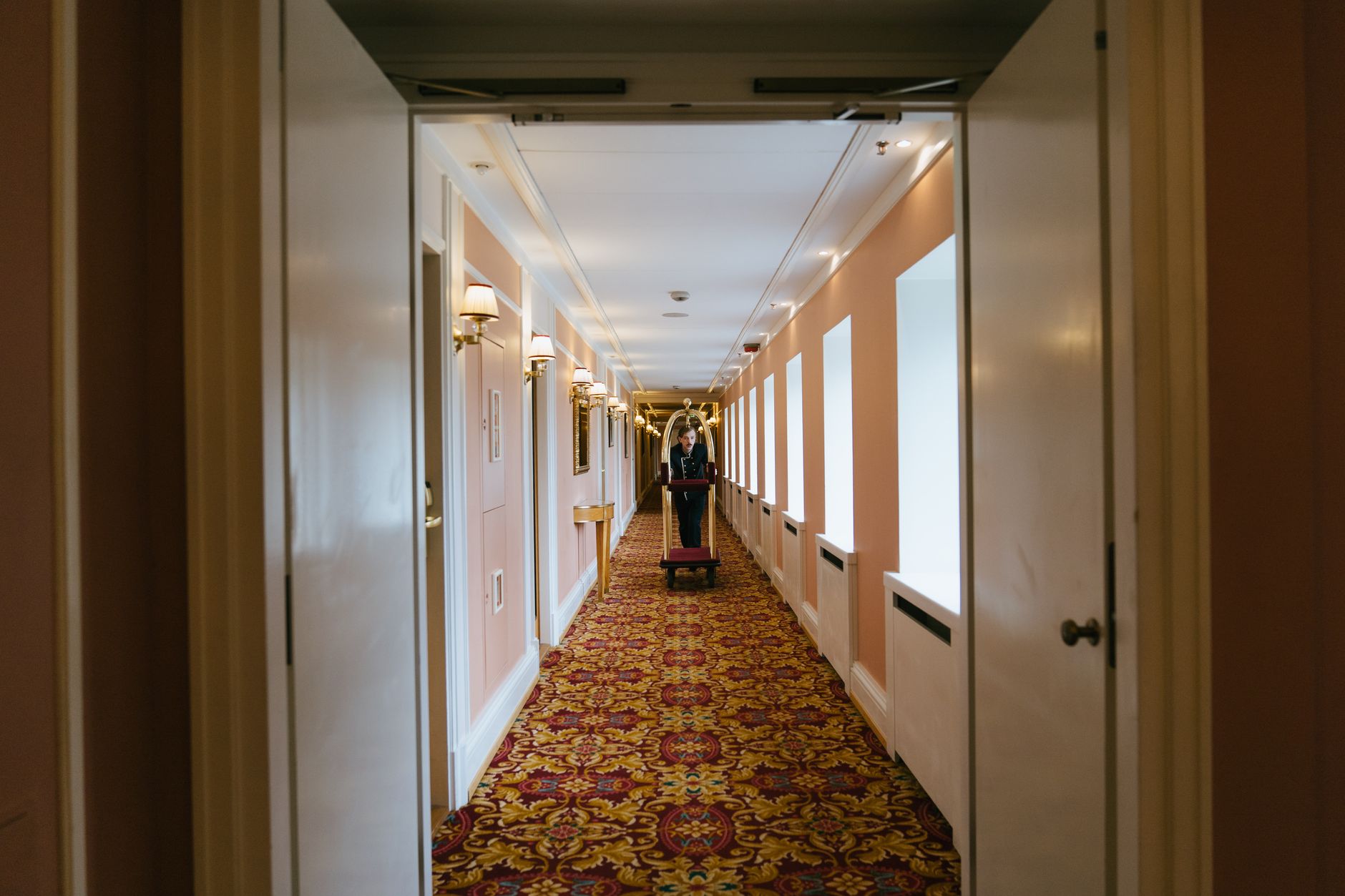
Delivery jumps to first place when the property loses too many paid hours to walking. Think guest towers with long corridors, frequent amenity requests, room service handoffs, and housekeeping teams that keep bouncing between linen, supplies, and service recovery tasks. A delivery robot does not need to be glamorous to pay off. It just needs a dense lane of short repeat trips.
The staffing backdrop supports that logic. AHLA’s 2025 survey found front desk shortages at 26 percent of surveyed hotels, while BLS reported 264,200 hotel, motel, and resort desk clerk jobs in 2024 and projected 9,900 average annual openings for that occupation over the following decade. On the food side, BLS reported about 1,159,600 annual openings for food and beverage serving and related workers. If your front desk, F and B, and housekeeping teams are all spending time on low-complexity runs, delivery can be the cleanest release valve.
For a regional casino hotel, the best delivery case is usually not restaurant theater. It is operational cleanup: room service robot support during late hours, amenity delivery robot runs, ice and sundry requests, and back-of-house transfers between pantry, desk, and tower. If elevators, doors, and call workflows can be integrated cleanly, hotel delivery robot rental can be a sharper first move than cleaning on tower-heavy properties with limited overnight staffing.
- Choose delivery first if guest towers create constant short-haul work between the desk, pantry, and rooms.
- Choose delivery first if room service, sundry, and amenity requests bunch up during understaffed hours.
- Choose delivery first if the pain is not cleanliness or patrol coverage, but staff walking time.
- Avoid delivery as the first robot if the building layout makes elevator and access integration unusually difficult.
Why is cash-handling support usually not first?
Cash-handling support can be valuable in gaming, but for a smaller property it is usually a phase-two decision. The workflow is narrower, the controls are tighter, and the buy case depends on process discipline as much as labor relief. That makes it a weaker first automation category unless your property already has a clearly mapped transport path, strong internal controls, and leadership alignment across security, finance, and operations.
A first robot should teach the organization how to deploy, schedule, service, and supervise automation. Cleaning and delivery do that with less operational friction. Cash routes, by contrast, bring a denser stack of questions: chain of custody, stop logic, exception handling, camera coverage, access rules, and who owns the handoff at every point. If those decisions are fuzzy, the robot project stalls before go-live.
There is still a real use case. If a regional casino has a stable internal transport path between gaming, count, cage, and back office areas, then controlled support can reduce repetitive escorted movement and tighten audit trails. But if you are buying your first robot, you normally want the category with the widest operational footprint and the shortest path to staff confidence. Cash handling rarely wins on those terms.
- Move cash support to first only if internal transport routes are already disciplined and documented.
- Move cash support to first only if security and finance both agree on ownership, controls, and exception handling.
- Keep cash support for phase two if the organization has never deployed service robots before.
How should a regional property buy, lease, or rent the first unit?
The best commercial robot program for a regional casino hotel is often the one that limits commitment while the property learns. That is why many smaller operators prefer lease rental or sale flexibility instead of an all-or-nothing capital purchase. A commercial robot rental, robot rental monthly structure, or monthly payment program can make sense when the main goal is proof, not fleet scale.
This is where the integrator model matters more than the hardware label. Service Robot Co. works as an OEM-neutral robot integrator for U.S. businesses, which is especially useful for casino hotels whose floor mix is messy by definition. One property may need an overnight cleaning no operator workflow first. Another may need a hotel delivery robot rental tied to elevators. Another may need security patrol support. The right answer is the robot that fits your floor and labor pattern, not the one a single manufacturer happens to sell.
For a first deployment, regional operators usually benefit from one partner handling the site assessment, mapping, integration, training, financing, and service plan. That keeps the learning curve shorter and the accountability clearer. If you are testing robot leasing for business, no long term contract options, or a robot pilot program, you want one number to call when uptime, staffing, and workflow all meet reality at 2 a.m.
- Use a pilot-friendly structure if the property wants measured adoption and a lighter budget decision.
- Ask for maintenance included, on-site dispatch expectations, and emergency replacement terms before signing.
- Prefer a vendor neutral robot integrator when your first-buy category is still being debated internally.
- Match the commercial model to the deployment risk, not just the monthly payment.
What does a smart first-buy process look like in practice?
Start with one month of route evidence. Pull the overnight floor schedule, patrol logs, guest request timestamps, room service volume, and any internal transport runs that happen daily. You are not searching for every possible robot use. You are looking for the single workflow that burns the most repeatable labor hours with the least need for human discretion.
Next, score each candidate workflow on five factors: weekly repetition, staffing pain, guest visibility, site readiness, and ease of supervision. Cleaning usually scores highest on repetition and readiness. Security often wins on risk visibility. Delivery can beat both when tower travel is intense. Cash support only climbs if the route is already operationally mature.
Then pilot one robot in one zone with a hard success standard. For cleaning, that might be nightly coverage of the same floor set for 60 to 90 days. For security, it might be documented patrol consistency across a defined perimeter. For delivery, it might be a fixed set of guest and back-of-house runs during thinly staffed hours. The first buy should teach your organization how to live with automation. If it does that well, the second and third decisions get much easier.
For most regional casino hotels, the cleanest path is still this: start with cleaning, move to delivery if towers dominate labor loss, and put security first only when the perimeter is the actual headache. Cash-handling support belongs in the conversation, but usually after the property has already learned how to operate one service robot well.
Frequently asked questions
Sources
- American Gaming Association State of the States 2026
- American Gaming Association Commercial Gaming Database
- American Hotel and Lodging Association staffing survey
- BLS Janitors and Building Cleaners outlook
- BLS Security Guards and Gambling Surveillance Officers outlook
- BLS Food and Beverage Serving workers outlook
- BLS Information Clerks outlook
- BLS JOLTS annual openings and quits tables