Key takeaways
- Pool complexes are outdoor, wet, furniture-dense environments, so a hotel corridor robot spec usually fails here.
- Night work at pools is mostly a traction, drainage, lighting, and obstruction problem, not just a cleaning problem.
- Security automation around pools needs dependable patrol routes, low-light sensing, and clear escalation rules after guest hours.
- The best pool-deck program is usually a mixed fleet plan with maintenance included, not a one-unit bet.
- A vendor neutral robot integrator matters because resorts often need lease rental or sale options, financing, deployment, and nationwide service under one number.
What does a resort pool complex robot actually need to handle after hours?
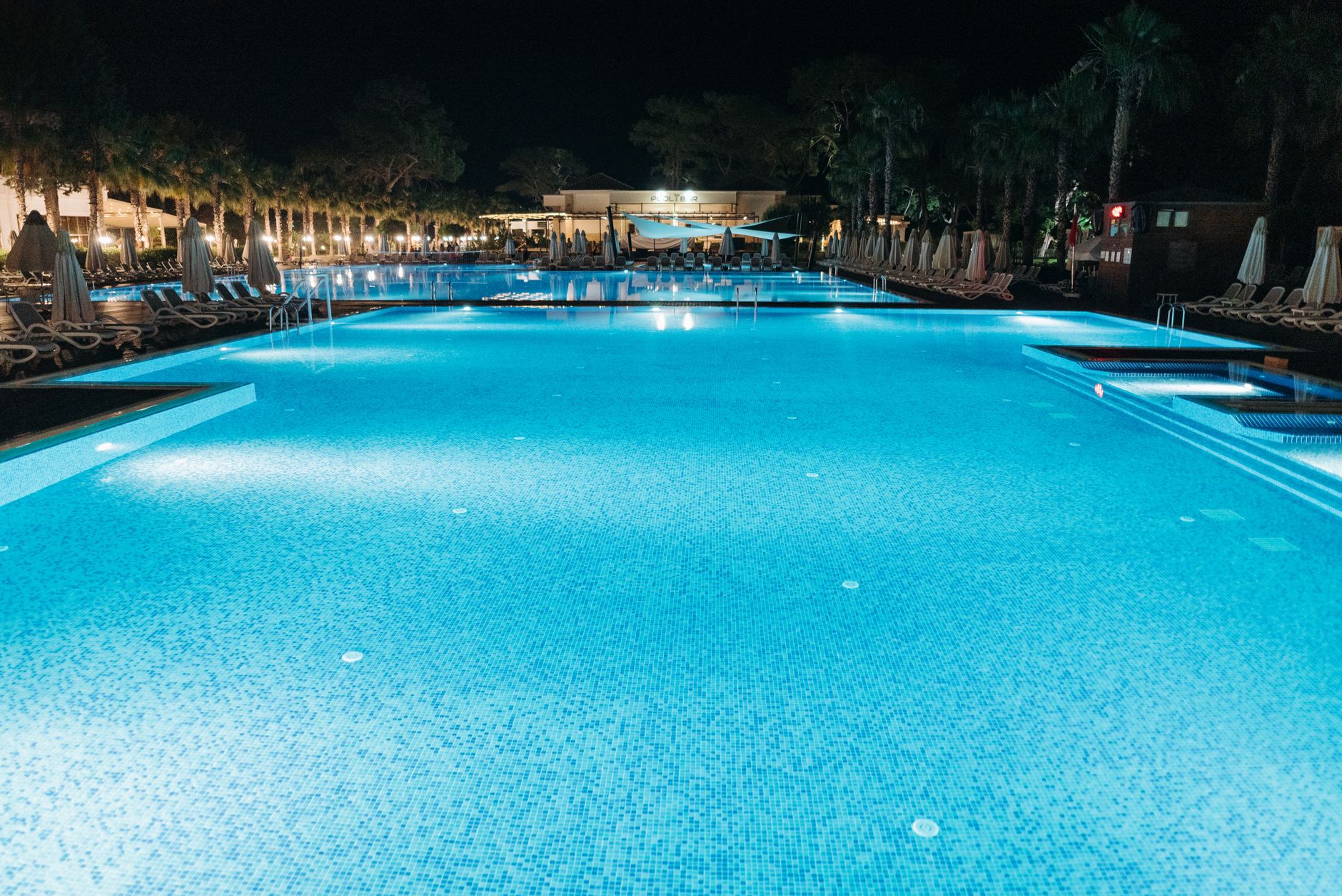
At night, a resort pool complex robot has to do far more than drive a loop and scrub tile. It must keep traction on wet deck coatings, navigate furniture that rarely returns to the exact same position, work around towel bins and cabana curtains, tolerate outdoor humidity and windblown debris, and patrol paths where lighting is uneven and reflections off water can confuse sensors. That is a very different specification problem from an indoor hotel corridor.
The practical spec starts with surfaces and geometry. According to the U.S. Access Board, accessible walking surfaces need a 36 inch minimum clear width, a running slope no steeper than 1:20, and a cross slope no steeper than 1:48. Around pools, ADA rules also call for clear deck space by lifts. If a robot needs extra width, a wide turning arc, or a dry polished floor to localize cleanly, it is already mismatched to the job.
The second part is operations. The robot must complete useful work in the narrow window after guest use ends and before early-morning setup begins. That means dependable mapping, predictable docking, quick recovery from moved chaise lounges, and an escalation path when the deck is blocked, a gate is latched, or standing water makes a route unsafe.
- Wet textured tile, broom-finish concrete, pavers, and transition strips
- Pool perimeters, spas, cabanas, towel stations, bars, and outdoor restrooms
- Low-light patrol on winding paths, steps, and access gates
- Nightly debris such as leaves, cups, towels, and furniture drift
Why is a pool deck harder than an indoor hallway?
A hallway is a controlled box. A pool complex is an exposed microclimate. Water blows across the deck, humidity spikes after dusk, and even clean surfaces change friction as they cool. OSHA notes that employers should keep floors clean and dry and that slip-resistant surfaces are advisable where areas are generally slippery. It also points to a static coefficient of friction of 0.5 as a guide, while noting higher friction may be needed for tasks like pushing or pulling loads.
That matters because a night shift autonomous scrubber is not just traversing wet ground. It is accelerating, braking, turning, and sometimes nudging through residues from sunscreen, drink splash, and tracked-in food. A robot floor cleaner rental that performs well on dry vinyl indoors can become a liability on damp, sloped exterior deck surfaces.
Pool decks also create a sensor problem. Water reflections, glass cabana doors, dark landscaping edges, and half-open umbrellas can all distort what the robot thinks is navigable. Security patrol robot rental plans need the same realism. A patrol robot cannot treat shimmering water, moving palm fronds, and late towel pickups as equivalent signals.
Which site details change the cleaning spec first?

Start with drainage and deck fall. The Centers for Disease Control and Prevention says the Model Aquatic Health Code is guidance for public aquatic venues, including hotels and motels, and the current edition posted in December 2024 reflects 122 approved change requests out of 202 submitted. That is a reminder that pool environments are governed by an evolving body of operating and safety guidance, not generic janitorial assumptions.
In practice, the first field questions are simple. Where does water collect after close. Which zones stay wet longest. Which pathways narrow when loungers are reset. Where do staff stage folded towels, refill carts, and trash liners. Those answers decide wheel type, allowable speed, scrub pressure, docking placement, and how much of the route can truly run overnight cleaning no operator.
Deck furniture matters more than many buyers expect. Cabanas create fabric edges, tie-backs, and shadow pockets. Towel stations create overflow carts and bags at irregular hours. Outdoor bars leave sticky zones with glass-adjacent debris. If the route depends on perfect nightly staging, the program will fail as soon as the resort is busy.
- Drainage pattern and standing-water zones
- Surface texture changes between deck, path, and threshold
- Night furniture reset practices by pool staff
- Access pinch points near gates, lifts, and service corridors
How should the cleaning workflow be divided across the pool complex?
Not every area wants the same machine behavior. Open deck zones usually favor repeatable floor care. Towel stations, cabana thresholds, and bar approaches favor tighter navigation, slower speeds, and more exception handling. Peripheral outdoor paths may need sweeping or inspection before scrubbing. A single commercial robotic floor cleaner can cover some of this, but a spec that forces one robot to do every task usually compromises all of them.
A better design is a task map. Give the main deck a repeatable overnight floor care route. Give secondary paths a lighter pass focused on leaves and grit. Treat towel and cabana zones as assisted segments with stricter obstacle rules. That is how large facility coverage becomes credible instead of theoretical.
For many resorts, the right program looks more like commercial cleaning robot rental plus a separate autonomous patrol robot than one do-everything unit. This is where robot rental monthly and service robot rental structures can help. A pilot lets operations learn what the environment actually does between 10 p.m. and 5 a.m. before locking into a larger fleet decision.
What must the security side do besides drive around?
After hours at a pool, security is not just perimeter motion detection. The robot or connected patrol system has to distinguish normal overnight activity from exceptions that deserve action. That includes a pool gate left open, a person in a closed pool area, a blocked egress path, glass break indicators near the bar, or a maintenance cart parked where accessibility clearance is lost.
Lighting matters here. OSHA repeatedly ties slip prevention to adequate lighting, especially during night hours, and the same principle applies to patrol quality. Low-light sensing is only useful if the route keeps sightlines on gates, deck entries, towel huts, and outdoor paths where staff actually walk. A patrol route that hugs the pool edge for dramatic effect but misses the service corridor is poor design.
The security spec also needs escalation logic. Who gets the alert. What image or event data is retained. When does the robot stop and wait for remote triage. When does it continue patrol. A security patrol robot rental program is operationally mature only when those rules are written before go live, not discovered during the first false alarm weekend.
How do ADA and safety constraints affect robot size and routing?
Pool complexes punish oversized machines. The U.S. Access Board requires accessible routes to maintain 36 inches of clear width in general, with passing spaces at intervals when routes are narrower than 60 inches. ADA pool guidance also requires clear deck space near lifts, including a 36 inch by 48 inch area parallel to the seat, with deck slope not steeper than 1:48. Those dimensions are small enough to matter every night.
For a resort operator, this means the robot that fits your floor is not just the one with enough battery and tank size. It is the one that can work without compromising accessible travel or forcing staff to re-stage the deck into a robot-friendly shape. If the machine only works when chairs are stacked differently than guests or pool attendants normally leave them, the site is being bent around the robot instead of the robot being fitted to the site.
That is one reason Service Robot Co. stays OEM-neutral. A vendor neutral robot integrator can choose a tighter chassis for deck routes, a different platform for outdoor paths, and a separate security unit if needed, then handle site assessment mapping, robot deployment and integration, go live support, and on-site dispatch through one partner one number.
What does good overnight uptime look like in a resort setting?
Night work fails in small ways before it fails in dramatic ones. A charger in the wrong alcove collects splash and leaves. A path segment goes offline because cabana furniture drifts three feet. A towel cart is parked in the same pinch point every Friday night. The right answer is not to demand perfect housekeeping. The right answer is to build for recovery.
That means maintenance included, remote triage, and emergency response nationwide if the property has multiple resorts or seasonal peaks. It can also mean a backup robot program or loaner units during critical occupancy windows. Resorts do not want a dead machine occupying deck space on a holiday weekend.
This is where commercial robot repair service and a real service plan matter more than the sales brochure. Service Robot Co. acts as a full-service commercial robot integrator for U.S. businesses, so operators can evaluate robot leasing for business, a month to month robot lease, or lease purchase program structures while still getting training, service coverage, and a single lifecycle partner instead of piecing support together themselves.
How should a resort evaluate the business case?
Start with the operating window, not the headline pitch. How many usable after-hours hours exist on a typical night. How much of the pool complex is truly repeatable. How often do staff rework the same deck because late cleanup ran short. Those answers matter more than abstract talk about autonomy.
Verified public data underscores the safety side of the equation. The CDC says Americans swim more than 300 million times in pools and other bodies of water each year. The Bureau of Labor Statistics recorded 150 fatal same-level slip, trip, stumble, or fall cases across all U.S. work settings in 2024. A resort pool deck is not typical office flooring, so any robot plan that reduces wet-surface exposure for staff while keeping routes clear deserves serious evaluation.
The procurement structure should match operational uncertainty. Commercial robot rental, robot as a service, and monthly payment programs can make sense when a resort wants to try before you buy, expand by phase, or avoid no upfront capital shocks. The real question is not lease rental or sale in the abstract. It is which model lets the property prove nightly coverage, service response, and staff adoption without betting the program on assumptions.