
a South Dakota manufacturer of loader attachments
Robotic Welding Cuts a Loader Attachment Run 30%
See how a South Dakota loader attachment maker cut a 100-part welding run to 13 hours, with a source-reported 30% operating-time reduction in a documented case.
- 30%
- source-reported operating-time reduction
- 13 hrs
- robotic 100-part run
- 100 parts
- representative production batch
- 20% to 50%
- reported efficiency improvement
Based on a documented real-world deployment. Figures are from public reporting; the organization is not named.
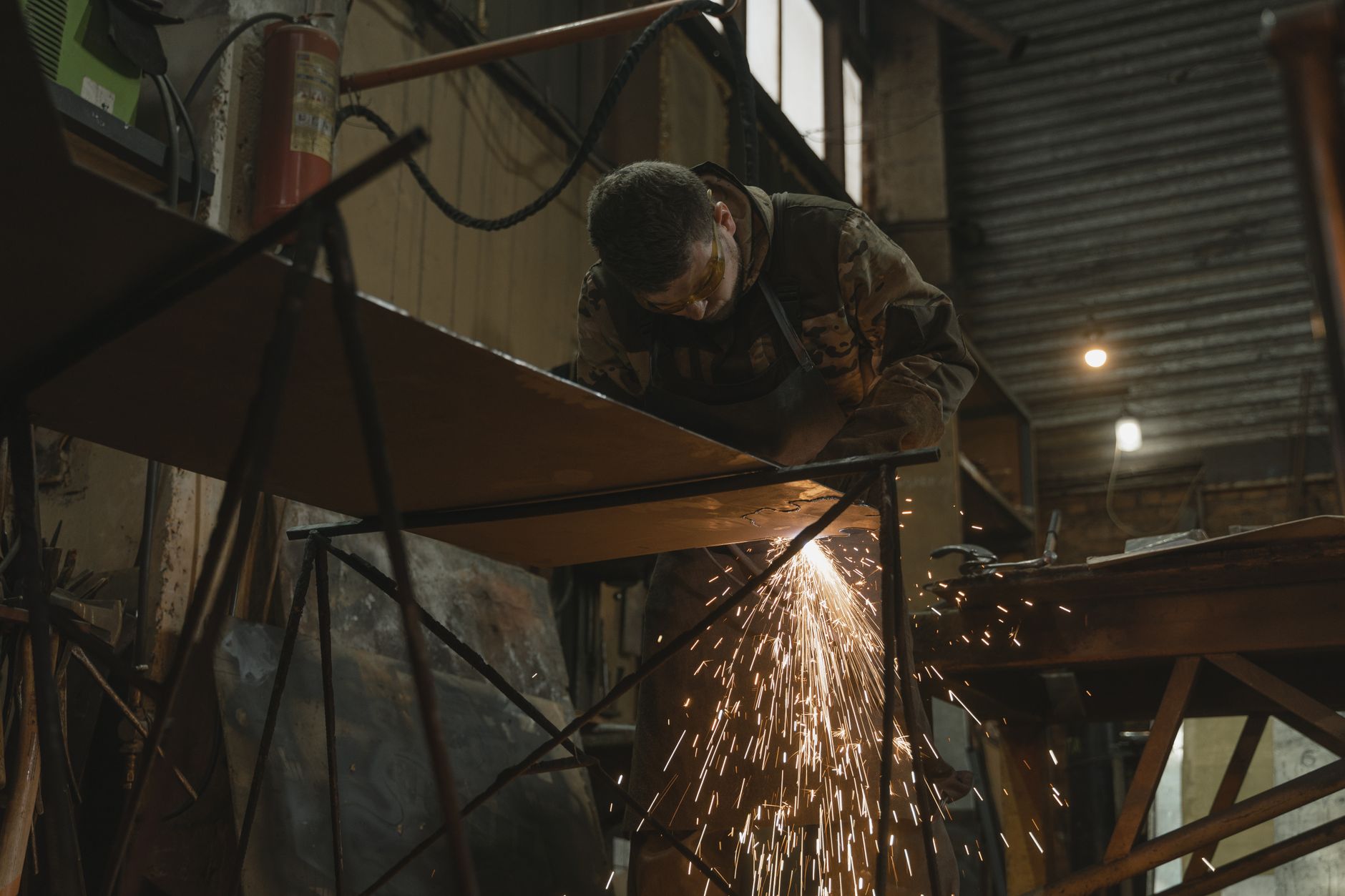
Manual Welding Had Become a Planning Constraint
A South Dakota manufacturer of loader attachments produced numerous related components for buckets, grapples, hay tools and pallet forks. Repeatable weldments often kept an employee on the same task throughout the day, limiting the skilled labor available for more demanding fabrication work.
Rising demand exposed a second constraint. Manual cycle times made production studies less dependable, which complicated lead-time forecasting and the scheduling of customer orders. The operation needed greater pace and consistency without sacrificing weld quality.
Rework added friction to an already constrained process. Because the company had not previously adopted automation, the cell also had to be approachable for operators and practical to install in an active manufacturing environment.
- Increase the welding speed of repeatable parts
- Reduce rework and improve weld consistency
- Build credible time studies for lead-time forecasting
- Move skilled employees from repetitive welding to higher-skill projects
A Focused Entry Into Robotic Welding
The operation was evaluated to identify repeatable welding work with a clear production burden. A standard, pre-engineered robotic arc-welding cell was selected, giving the manufacturer a defined starting point instead of a plantwide automation program.
The compact cell consolidated multiple operations into a single robotic operation. Straightforward installation and operator training helped employees become productive with unfamiliar equipment while keeping the deployment anchored to actual parts and established workflows.
The published account describes a focused initial deployment rather than a broad conversion. Its reported performance gave management evidence for considering further automation, with engineering support remaining part of those future plans.
- Evaluate the existing welding process and isolate repeatable work
- Select a pre-engineered cell suited to a first automation project
- Install the cell within the current production environment
- Train operators around the equipment and production task
- Use measured performance to judge later expansion
A 100-Part Run Fell to 13 Hours
The clearest production comparison involved a batch of 100 parts. Before automation, welding the batch took about 16 hours. The robotic cell completed the same quantity in 13 hours.
The primary source characterizes that change as a 30% reduction in operating time for the representative part. Because the published times and stated percentage do not arithmetically align, this case study preserves the 30% figure as a source-reported claim rather than presenting it as an independently calculated result.
The manufacturer also reported efficiency improvement ranging from 20% to 50% across its experience with the cell. No part-level breakdown for that broader range was published, so it should not be applied to every weldment.
Beyond cycle time, the cell produced more consistent work and reduced rework. Repeatable robotic timing also supported more accurate production studies and lead-time forecasts, while employees shifted attention toward projects requiring greater skill.
A Practical Model for Heavy Equipment Fabricators
This documented example was not a Service Robot Co. deployment. It nevertheless shows the value of beginning with a bounded, repeatable weldment, measuring the result and expanding only after the production evidence is clear.
Service Robot Co. is a full-service, OEM-neutral commercial robot integrator for U.S. businesses. We select equipment across manufacturers, then finance, deploy, integrate, train and service each unit through a nationwide U.S. engineer network, giving customers a single accountable vendor across the equipment lifecycle.
For a fabricator assessing robotic welding, that can include a free site assessment, commercial robot demo, robot pilot program and robot deployment and integration plan. Service Robot Co. can also compare robot leasing vs buying, robot financing for small business and monthly payment programs, then pair the chosen path with operator training and a robot maintenance service plan.
That continuity matters after commissioning. Remote triage, on-site dispatch and ongoing service keep technical ownership clear as a manufacturer moves from an initial cell toward a larger automation program.