

The short answer
An autonomous mobile robot makes sense at a commercial laundry plant when the same cart route repeats on every shift between washing, drying and folding, and the floor can be mapped and followed safely. It does not make sense where routes change daily, carts are few, or the hauler's real work is loading and sorting that a machine cannot do. For most plants, the autonomous mobile robot vs linen cart hauler answer is a robot on the repeat route with fewer staff, not a full swap.
Key takeaways
- A robot fits a cart route that repeats on every shift, not a route that changes by the day.
- The robot moves carts; people still load, sort, fold and clear faults.
- Your own overtime, night call-out and hauling logs decide the staffing case, not a generic estimate.
- Published injury and turnover figures are broad and do not isolate industrial laundries.
- Start with one mapped route and a free site assessment before scaling.
Autonomous mobile robot vs linen cart hauler: which makes sense at a laundry plant?
The autonomous mobile robot vs linen cart hauler decision turns on route repetition. A plant where loaded carts run the same loop between washing, drying and folding stations on every shift gives a robot steady work it can do for long stretches without a break. A plant with a handful of carts, a route that shifts from day to day, or heavy manual loading around every move gets much less from the same machine.
The robot makes sense when cart moves are a large share of hauling time, the floor is clear and consistent enough to follow a set path, and the plant runs more than one shift so the robot covers hours a hand mover would be off. It does not make sense in a small plant with one or two carts, in a building where fixed equipment or frequent traffic blocks the path, or where the hauler's time goes mostly to handling and sorting.
We are a US commercial robot integrator. We pick the robot for the site, arrange a fixed robot lease payment through financing, deploy and integrate it, train staff and service it nationwide. Our lease quote follows a free site assessment, so the decision starts with the floor plan and the hauling log, not with a sales pitch.
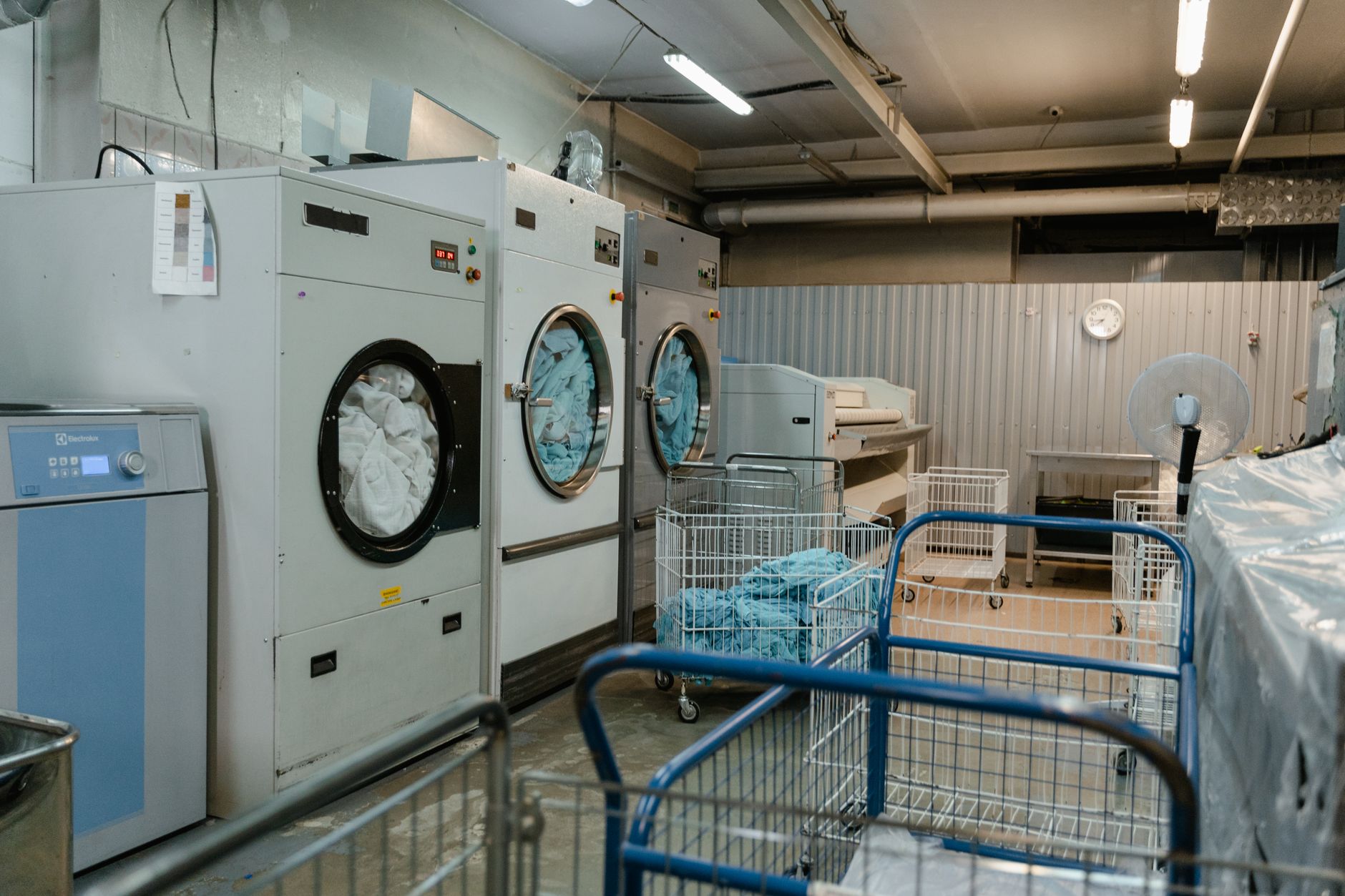
What does a linen cart hauler do during a shift?
A linen cart hauler moves carts of soiled and clean linen between departments. In a plant that runs washing, drying, folding and pressing as separate stations, the hauler takes loaded carts forward, returns empty carts, and keeps staging areas clear. The same trip repeats through the shift, which is why hauling is usually the first laundry task that automation planners look at, and why it is worth measuring before any decision.
Loads can be heavy. A university research project page on a hospital linen system in Hong Kong describes a transporter that grips a linen trolley and navigates to wards, with linens moved several times per day and loads that can weigh up to 200 kg. The same design handled automatic doors and a short outdoor path. A hospital route is not a plant floor, but the handling problem is similar, and it shows that both the load and the path need to be measured on site.
Much of the hauler's shift is spent in gaps: waiting for a cart to fill, clearing a jam at a folder, or covering a station when someone is out. Those stops are the hardest part to plan around, because they do not show up on a route map. Your own dispatch log, kept for a typical week, is the most reliable way to see how much of the shift is pure hauling.
Median hourly wage, Laborers and Freight, Stock, and Material Movers, Hand
$4,380
Monthly cost of one full-time worker, at the median wage plus payroll costs (an estimate, not a quote).
Which parts of the cart route can an autonomous mobile robot take?
The robot can take the repeated, route-based moves: a loaded cart from the washer exit to dryer staging, an empty cart back to the washers, and finished carts from folding to shelving or dispatch. It follows a mapped path, stops for obstacles, and runs the same path with the same timing each shift. A Singapore nursing home case reported by American Laundry News projected savings of 176 man-minutes per day from automating laundry delivery, which shows how the time adds up on a route that repeats.
The robot cannot load or unload soiled linen, sort items, handle a cart jammed in a gate, or decide to skip a stop when a station is in trouble. Those tasks stay with people, and they are often the parts of the hauler's shift that take the most judgment. Trade press also reports that industrial laundries often rely on rails and conveyors for larger facilities, so a cart robot may cover stretches those systems do not serve rather than replace them.
Some cart systems are offered with autonomous bases that follow floor lines and battery propulsion, but that claim is vendor-reported and should be tested on your floor. Ask for a demonstration on your actual route, with your carts, your doors and your thresholds, before you accept any speed or accuracy claim.
- Repeat cart route all shift
Autonomous Mobile Robot
Runs the same mapped path with the same timing on every loop
Linen Cart Hauler
Strong on the route, but tires and needs breaks and relief
- Night and weekend coverage
Autonomous Mobile Robot
Runs on a schedule the plant sets, with no call-out needed
Linen Cart Hauler
Depends on staffing each off-hour shift, subject to sick days and overtime
- Loading and sorting soiled linen
Autonomous Mobile Robot
Cannot do it
Linen Cart Hauler
Does it well and adapts to mixed loads
- Route changes and one-off moves
Autonomous Mobile Robot
Needs the route reprogrammed and checked by staff
Linen Cart Hauler
Adapts on the spot
- Clearing a jam or spill
Autonomous Mobile Robot
Stops and alerts, and a person must clear it
Linen Cart Hauler
Fixes it on the spot
What do hours and labor look like in a laundry plant?
Published figures for this exact job are thin. The BLS page for personal and laundry services (NAICS 812) reports a 2024 total recordable rate of 1.8 per 100 full-time workers, and a rate of 0.9 for cases with days away, job restriction or transfer. TRSA notes that BLS does not separate dry cleaning and coin laundry from linen supply and industrial laundry, so these are broad industry references, not a linen plant benchmark.
Turnover is the labor problem most plant managers feel, but no BLS or TRSA national turnover rate was found for this run. TRSA reports that the industry has had no historical data on employee retention, based on contacts with CEOs and HR directors at over 200 plants. A TRSA recruiting survey drew 47 responses from 360 executives emailed, a small sample that signals difficulty rather than a measured rate.
Overtime, night shift coverage and sick days decide the staffing case, and they should come from your own timekeeping, not from an industry average. Build the picture from these records, then bring it to the site assessment:
- Hauling hours per shift, from a logged typical week
- Overtime paid to cover hauling and station gaps
- Night and weekend call-outs and unfilled shifts
- Sick days and absences on shifts that run the hauler route
- Hours a station sits waiting for a cart
| Task | Today | With a robot |
|---|---|---|
| Move loaded carts from washer exit to dryer staging | Repeated trips across every shift, timed in your log | Route set once, then run on the plant schedule |
| Return empty carts to the washers | A hauler trip each time, with waiting between | Robot returns on its loop, and staff confirm at the station |
| Cover night and weekend cart moves | Depends on whether the shift is staffed | Robot runs on the set schedule |
| Load and sort soiled linen | Stays with staff | Stays with staff |
| Clear faults, jams and spills | Hauler stops to fix them | Robot alerts, and a person clears the fault |
No published hour figures for this job were found in this run. Build the hours from your own dispatch and timekeeping logs for a typical week. The table shows where the time moves, not how much time each task takes.
How does a team work with a robot in a laundry plant?
Plan for a robot plus fewer staff, never zero staff. The robot removes the repeated haul, which lets the person who was pushing carts move to loading, sorting, quality checks or cover for a short station. Cutting every hauler and expecting the robot to run the plant creates gaps the first time a route faults, and a stopped route with no one on the floor can hold up the line behind it.
Staffing changes usually come in phases. A plant often keeps a hauler on the day shift, runs the robot on a repeat route, and reduces hauling headcount through normal attrition over months rather than in a single move. Train at least one person per shift to clear faults and to call remote triage, so a stopped robot does not wait for a technician to arrive.
We train staff on the route, the stop procedures and the daily check before go-live. The plant owns the floor and its people, and we handle the robot's service nationwide, so the crew has one team to call when a robot needs attention.
What can an autonomous mobile robot not do in a laundry plant?
A robot cannot load or unload soiled linen, sort items, fold, press, or check for stains and damage. It cannot clear a cart stuck in a gate or a spill on the path without a person. It cannot judge when a station is backed up and change its route on its own. Those limits are why the robot works as a partner to the crew rather than a replacement for it.
Floor conditions decide safety and fit. Wet floors, uneven thresholds, a path that crosses forklift traffic, or a dock with rails and conveyors can each change whether a route is safe. A survey on site tells you whether the route is clear, which a drawing or brochure cannot. Trade press reports that larger industrial laundries rely on rails and conveyors rather than carts, so the robot may fit only the stretches those systems do not serve.
Safety data for the sector is loose. A third-party page built on BLS 2024 data lists 1.3 injuries and illnesses per 100 full-time workers for drycleaning and laundry services (NAICS 81232), with a relative standard error of 23.7 percent, which is high enough to treat the figure as an estimate. Plan a safety review of the robot's route before go-live, and log near misses from the first months.
Is an autonomous mobile robot lease worth it for a laundry plant?
Worth it depends on hours. Multiply the hauling hours you log each shift by the shifts each week, then compare that with the gaps you cover today through overtime, call-outs and unfilled night shifts. The government wage data on this page gives the local wage for this job, which lets you put a value on those hours in your plant budget.
Payback is set by repeat count and the hours it frees, not by the robot alone. A route that runs only a few times a shift saves little, while a route that runs all night and removes an unfilled shift can change the staffing plan. Ask for a quote that matches your shift pattern, and set the fixed robot lease payment against the overtime and gap hours in your log.
Adoption figures show the market is growing, though they do not measure laundry payback. According to A3, North American companies ordered 17,635 robots in the first half of 2025, up 4.3 percent year over year. A3's full year 2025 figures show North American robot orders up 6.6 percent, with 7,212 cobot units ordered, and cobots are a different robot type from cart robots. Use these figures to judge market depth, not to predict your savings.
How do you get started with a robot at a laundry plant?
Start with one route. Map the cart path, count loaded moves per shift from your log, and mark the stops where people wait. That single route shows whether the robot pays back before you scale. We begin with a free site assessment that maps the floor and checks doors, thresholds, rails, traffic and the charging spot.
Then deploy and integrate. Integration covers the route, the stop points at each station, the charging location, alerts to the floor lead and the link to your linen tracking. Staff training happens on the floor before go-live, and a go-live period watches the first weeks of runs so problems are caught while the route is still small.
We lease the robot through financing, with the quote issued after the site assessment, and we service it nationwide. Keep one partner and one number for the robot, service and training, so the plant does not manage several vendors for one route. Then add routes one at a time as the first one proves out.
Robot or cart hauler: how should a laundry plant decide?
Choose the robot when the cart route repeats on every shift, the floor is clear and consistent enough to map safely, and hauling hours show up as overtime or unfilled shifts. Keep a person on the hauler job when routes change often, the work is mostly loading and sorting, or the floor cannot be mapped without a risk you cannot manage.
Most laundry plants will land between the two: a robot on the repeat route, with staff on the loading, sorting and fault work. That mix is the realistic target for an autonomous mobile robot vs linen cart hauler decision, and the checklist above is built to test whether your plant fits it.
Bring three records to the site assessment: a logged week of hauling, the overtime and call-out record for the same weeks, and an up-to-date floor plan. A decision built on those inputs holds up better than one built on an industry estimate, because it reflects your own floor and your own shifts.
Frequently asked questions
Want a warehouse robot at your commercial laundry plant?
Tell us about your site. We will recommend the robot, quote the lease, and keep it serviced.
Sources
- US Bureau of Labor Statistics, Occupational Employment and Wage Statistics (OEWS May 2024)
- BLS, personal and laundry services (NAICS 812)
- SafetyRecord, citing BLS 2024 data
- TRSA, tracking turnover trends
- TRSA, recruiting survey
- A3, first half 2025 robot orders
- Robotics 24/7, A3 full year 2025 orders
- University research project page, Hong Kong hospital linen AMR
- American Laundry News, distribution and delivery tools