
The short answer
Cobot ROI for meat processing plants comes mostly from the packing and case-loading hours a cobot takes over, which lets a line hold its pace while hiring for those positions is slow. The savings range depends on how much of each shift the cobot can realistically handle, how many hours of that work the site really logs, and the lease cost quoted after a site assessment. Treat any range as an estimate that an assessment of your own line will narrow, not as a promise.
Key takeaways
- The return comes from packing and case-loading hours a cobot takes over, not from eliminating a whole job.
- A cobot usually takes a share of each shift, so the math starts with a time study of the actual station.
- Turnover in meat processing is high enough to slow lines, but your own rate has to be measured.
- Line speed, changeovers and lease terms move payback more than the robot's rated speed does.
- A free site assessment turns the savings range into a lease quote you can test against your hours.
Run the numbers for your site
Pick your city or state for a real regional number - we use the real BLS wage there. (On the live site this auto-detects from your location.)
What do you want to automate?
The cobot stacks the repetitive end-of-line pallets; your team handles changeover and QA.
What is cobot ROI for meat processing plants?
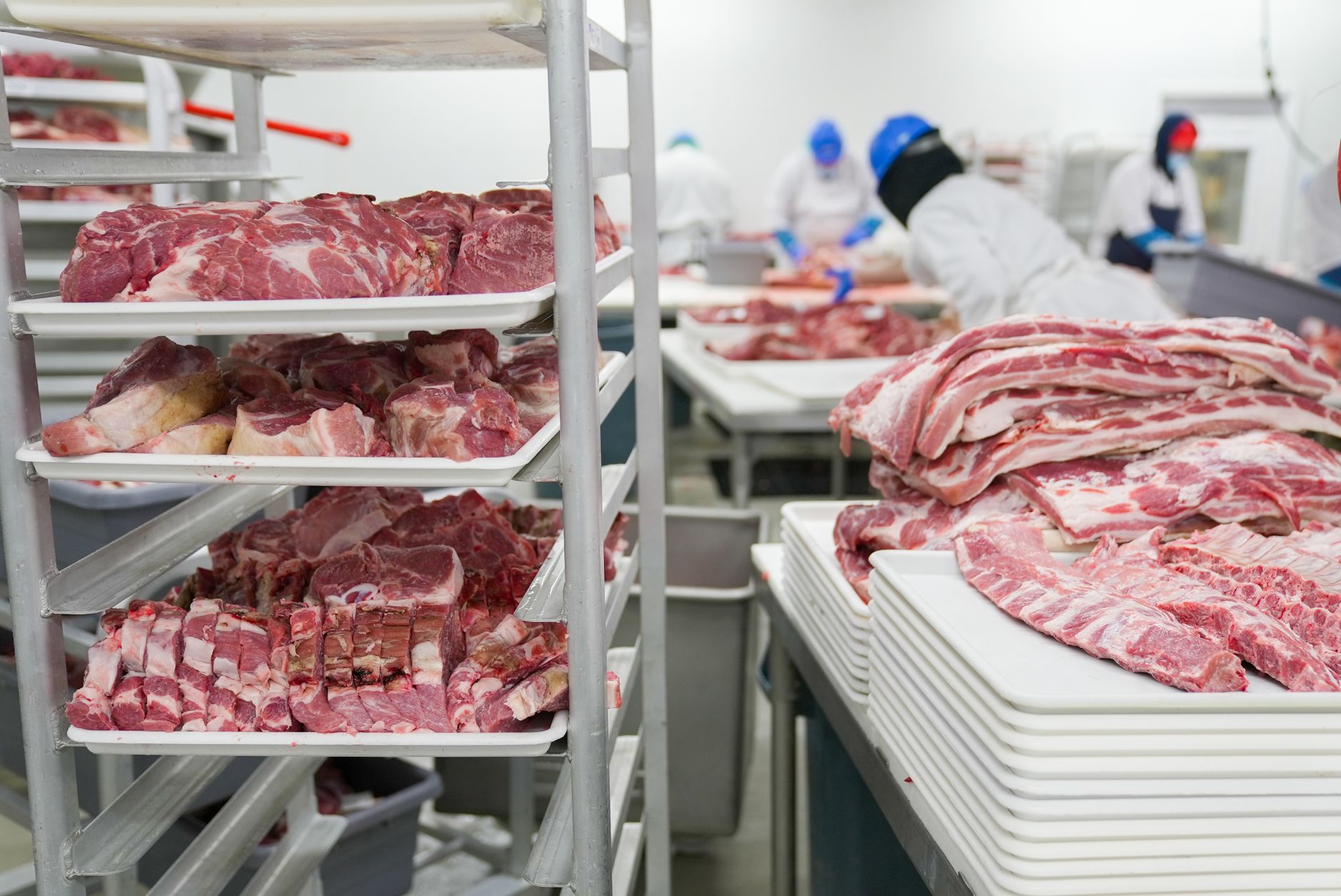
Cobot ROI for meat processing plants is the return a plant earns when a collaborative robot takes over part of the repetitive work on a packing or case-loading line. Cobots share a workspace with people, so they suit steps such as placing product into trays, filling cases, and moving finished cases toward a pallet. The return is measured in labor hours that no longer need to be staffed by hand, set against the cost of leasing the robot.
The setting is large. According to the USDA Food Safety and Inspection Service, more than 6,500 federally inspected establishments operate in the United States and territories. That directory count covers meat, poultry and egg product plants combined, so it is not a meat-only figure, and the directory files were last dated January 21, 2025. The economics on this page apply to the packing steps that a cobot can share with a person, wherever those steps appear in a plant.
Why are packing and case-loading positions hard to fill?
Turnover is the pressure point. According to the American Association of Meat Processors' 2024 industry report, about two-thirds of the processors it surveyed reported annual turnover of up to 25 percent of their workforce. The sample was small, with 145 companies, so treat it as a directional read rather than a national rate.
When people leave, replacements take time to train, and the line runs short first at the stations that are hardest to staff. Repetitive packing and case loading is physical work repeated across a full shift, which is why it is among the positions plants struggle to fill. A typical packing or case-loading station is staffed by a small crew, but no published headcount for this setting was found in this research, so the headcount on this page is an estimate.
The government wage data on this page for Laborers and Freight, Stock, and Material Movers, Hand is the wage used to price the labor side of the math. That matters because the robot takes that kind of work off the line. It does not replace the specialized cutting and trimming work that stays with skilled staff.
Median hourly wage, Laborers and Freight, Stock, and Material Movers, Hand
$4,380
Monthly cost of one full-time worker, at the median wage plus payroll costs (an estimate, not a quote).
How does the savings math work?
The core calculation has three parts. First is the number of hours of packing and case-loading work the cobot takes over in a week. Second is the local wage for that work from the government wage data on this page, which prices each hour. Third is the lease cost quoted for the robot, which is set against the labor value the hours represent.
A simple way to check the math is to write the hours per shift, multiply by shifts per week and weeks per year, price those hours at the local wage for the job, and subtract the lease cost quoted for the same period. Run the calculation at the low and high end of each input so the range shows its spread, rather than a single point that hides the uncertainty.
Savings are shown as a range because each input has spread. The hours depend on line speed and on how much of the shift is spent on steps that suit a cobot. The wage depends on the area. The lease cost depends on term, equipment scope and service coverage, so two plants with the same robot can see different results.
Payback is the point where cumulative labor value covers the lease and setup costs. A plant that runs more shifts earns the same hourly offset on every shift, so shift count changes the total faster than almost any other input. Do the math on your own schedule, not on a single shift's output.
How much of a packing shift can a cobot realistically take?
A cobot takes a share of the work, not all of it. Steps that repeat on a fixed pattern, such as placing product into trays or loading cases into a set position, suit a cobot well. Steps that need judgment, such as trimming, product inspection or handling irregular pieces, usually stay with people. The share the robot can take is what the site assessment measures.
Adoption is growing in food settings. According to the International Federation of Robotics, US industrial robot installations rose 11 percent to about 38,000 units in 2025, with food and other non-manufacturing sectors driving the gain. In the same IFR reporting, as summarized by The Robot Report, food and beverage installations rose 30 percent to 2,900 units in 2025.
Cobots are a growing share of the whole market. According to an earlier IFR press release, more than 64,500 cobots were sold in 2024, nearly 12 percent of new installations. That figure is global and not food specific, so use it as context, not as a benchmark for a meat plant.
What do injury rates tell you about this work?
Injury and illness rates are the other side of the case. According to the National Chicken Council, citing BLS 2024 data, poultry processing had a total recordable injury and illness rate of 2.4 cases per 100 full-time workers, the lowest for that sector since 1994. In the same reporting, as covered by Food Safety News, food manufacturing stood at 3.3 per 100 and all manufacturing at 2.7 per 100.
These are poultry and industry-group figures, not meat-only rates. The 1994 poultry rate of 22.7 per 100 workers, according to The Poultry Site, shows how far the sector has moved. Check the official BLS table for poultry processing and for meat rows before citing any rate in an internal proposal.
For the return, the useful point is that a cobot can reduce repetitive strain at the stations where cases are lifted and stacked. Any injury benefit has to be measured on your floor, not assumed from industry averages.
What changes the number up or down?
Line speed is the first lever. A faster line gives the robot more cases to handle in the same shift, so the hours it takes over rise. A line that stops often gets less value from the same robot, because the robot waits with the rest of the station.
Product variation is the second lever. A line with frequent size or case changes needs longer changeovers, and each changeover takes time away from the robot. Shift count and wage area set the value of each hour. Lease term and included service set the cost side, so compare quotes on the same scope before judging payback.
Crew size at the station is a third factor. If a station already runs short because positions go unfilled, the hours the robot covers are often hours that would otherwise be missed, which makes the offset easier to measure against open shifts than against a fully staffed baseline.
What are the risks to the return, and how do you avoid them?
The biggest risk is downtime. A cobot that stops during a shift leaves its station uncovered, and the line either slows or a person steps back in. Ask for spare coverage or a backup unit in the lease, and set a stated response time for on-site dispatch before signing.
The second risk is underuse. If the robot is placed on a station that changes product every hour, its hours fall. Start with the steps that repeat, and leave the variable steps with staff until the first results are in.
The third risk is integration and training. A robot that is not tied into the station's pace, or that operators do not trust, will be bypassed. Budget for staff training and go-live support, and agree a target for the share of shift hours the robot should handle before the lease starts. Cobot ROI for meat processing plants holds up best when those three risks are planned for at the start.
How long does it take from assessment to payback?
Timelines depend on site readiness, but the sequence is predictable. Assessment and mapping come first, followed by the lease quote, equipment delivery, deployment and integration at the station, staff training and go-live support. Payback starts after the robot is running steadily, not on the day it is installed.
The steps run in this order.
- Site assessment and time study on the target station.
- Lease quote with term, equipment scope and service coverage.
- Integration and station setup, with a safety review of the layout.
- Staff training and go-live support.
- Steady running, then payback tracking against measured hours.
How do I get an exact figure for my plant?
The precise figure comes from a free site assessment. We map the station, time the packing and case-loading work over several shifts, confirm which steps suit a cobot, and price the labor side with the government wage data on this page for Laborers and Freight, Stock, and Material Movers, Hand.
We pick the right robot for the site, lease it through financing, deploy and integrate it, train the staff and service it nationwide. The lease is quoted after the assessment, so the figure reflects your line, your term and your service scope.
Bring line speed, the shift schedule, changeover frequency and sanitation rules to the assessment. With those in hand, the savings range narrows to a figure your team can test against actual hours within the first months of running.
Frequently asked questions
Want a cobot at your meat processing plant?
Tell us about your site. We will recommend the robot, quote the lease, and keep it serviced.
Sources
- US Bureau of Labor Statistics, Occupational Employment and Wage Statistics (OEWS May 2024)
- USDA FSIS Meat, Poultry and Egg Product Inspection Directory
- American Association of Meat Processors 2024 industry report, via Supermarket Perimeter
- National Chicken Council, citing BLS 2024 data
- Food Safety News
- The Poultry Site
- International Federation of Robotics US release via BusinessWire, June 2026
- The Robot Report, IFR food and beverage figures
- International Federation of Robotics press release on US robot industry