Key takeaways
- Use a cage cart when the reset is irregular, bulky, and full of exceptions.
- Use an AMR when the night includes the same backroom-to-floor moves over and over.
- Current BLS and OSHA data make labor pressure and ergonomic risk part of the buy case, not side notes.
- A small pilot with leasing or monthly financing is usually the cleanest way to test retail AMR fit outside the DC.
Which tool wins on reset night?
If your overnight reset crew runs the same backroom-to-sales-floor loop across store after store, an AMR can beat a manual cage cart by removing the least valuable part of the shift: repeated hauling. If the move changes constantly, includes odd-shaped fixtures, or depends on crew improvisation, the cage cart is still the better tool.
The practical dividing line is repeatability. AMRs earn their keep on fixed staging points, stable routes, and predictable loads such as sign kits, shelf strips, peg hooks, replenishment cartons, and light fixture components. Cage carts win when teams are sorting mixed goods, repositioning bulky displays, or deciding the next move on the fly.
For most regional retailers, the first sensible step is not chainwide automation. It is a narrow pilot on one recurring reset loop, often a single department or a single night pattern, then expansion only if the move behaves like a route and not like a scramble.
What kind of move is this really?
Reset nights bundle several jobs into one shift: staging, hauling, lifting, assembly, signage, and final merchandising. AMRs only help with the transport portion, so the first question is not Can a robot do the reset. It is How much of the reset is just internal linehaul.
That distinction matters because many stores overestimate the share that deserves automation. If one person spends most of the night opening cartons, reading planograms, and making judgment calls, a cage cart remains the right companion. If two or three people burn long stretches just walking the same loads from receiving to the same department pad, repetitive transport automation starts to look much more attractive.
Why does the cage cart still survive every comparison?
Because it is forgiving. A cage cart accepts awkward geometry, mixed SKUs, overhang, partial loads, and late changes without mapping, docking, or route discipline. A veteran reset lead can redirect it instantly when a display arrives late or a department swap changes the whole night.
That flexibility matters more than autonomy when resets are infrequent, stores are highly variable, or fixture pieces are heavy enough to require two-person handling anyway. OSHA guidance says lifting loads heavier than about 50 pounds raises injury risk, and loads needing more than about 50 pounds of force to move call for mechanical assist. When the work is already borderline heavy, the smarter comparison may be cage cart versus powered assist, not cage cart versus fully autonomous travel alone.
Where do AMRs start to pull ahead?
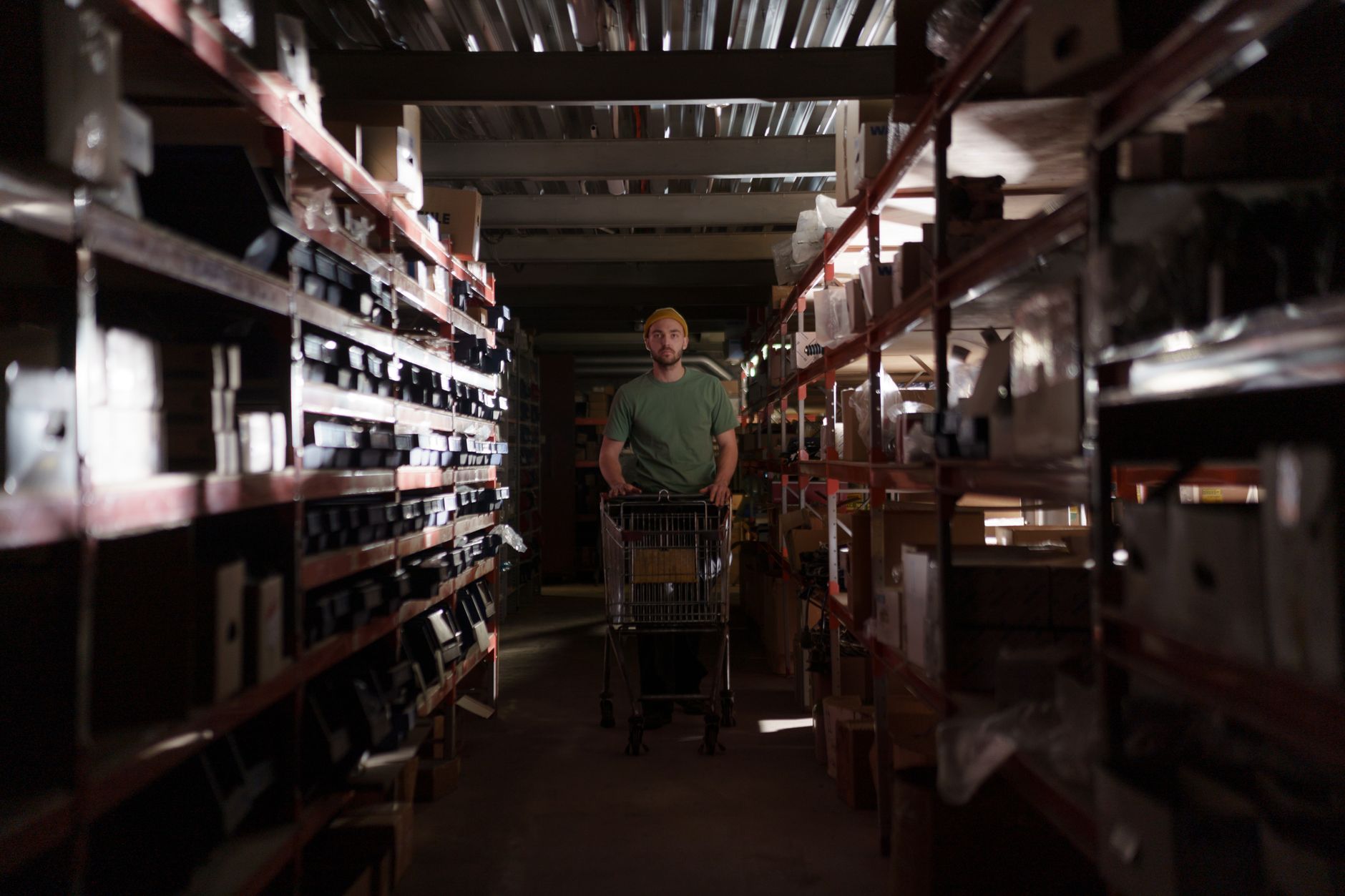
AMRs shine when the path is stable and the handoff is simple. Think repeated shuttles of sign packages, shelf hardware, small fixture parts, replenishment cartons, and cardboard returns from a backroom lane to the same selling zone, then back again. In that pattern the robot is not replacing merchandising judgment. It is taking the walking and pushing out of the shift.
Labor data explains why that matters. The U.S. Bureau of Labor Statistics counted 2,833,810 stockers and order fillers in May 2025, with a mean hourly wage of $19.01 and a median hourly wage of $17.95. BLS also reported 774,000 retail trade job openings in June 2026, seasonally adjusted. When staffing is that tight, freeing experienced reset staff from shuttle work can matter more than the raw count of labor hours saved.
Another BLS profile shows hand laborers and material movers held about 6.9 million jobs in 2025, and 35 percent of those jobs sat in retail trade. Their schedules often include nights and weekends. Overnight reset work lives inside that labor pool, which is why an autonomous mobile robot lease or AMR leasing pilot can make sense even outside a distribution center.
- Signage packets, shelf strips, and planogram kits with a fixed destination
- Peg hooks, dividers, brackets, and other light fixture parts that can be staged consistently
- Case packs or cartons that always move from the same backroom lane to the same department pad
- Empty cardboard and dunnage that follow a predictable return route
What do the labor and injury numbers say about manual hauling?
The safety case is not abstract. BLS reported a 2024 total recordable case rate of 3.0 per 100 full-time equivalent workers for retail trade. It was 3.3 for building material and garden equipment and supplies dealers, 4.0 for grocery stores, and 4.1 for supermarkets and other grocery stores. Manual cart work is not the only driver in those figures, but it sits squarely in the same lifting, pushing, and repetitive-motion exposure.
BLS also reported 946,290 private-industry cases tied to overexertion, repetitive motion, and bodily conditions across 2023 and 2024, with a median 24 days in the broader DART measure. OSHA adds the field guidance: push rather than pull when possible, keep cart loads below eye level, and treat more than about 50 pounds of pushing force as a sign that mechanical assist belongs in the process. The more often a reset night repeats those motions, the stronger the case for automation or powered help.
OSHA also advises using automation whenever possible to reduce the repetition and duration of lifting performed in awkward postures. That does not automatically make every AMR project a good one. It does mean the burden of proof should not rest only on labor minutes. Ergonomic exposure deserves equal weight.
How should a regional retailer score the job before buying anything?
Do not start with a robot brochure. Start with one reset route and measure it for two or three nights. Count trips, distance, handoffs, queue time at receiving, floor transitions, door thresholds, and the share of moves that follow the same start point and destination. That scorecard tells you whether you are looking at a route problem or a general labor problem.
This next rule is operating judgment, not a federal benchmark: AMRs deserve a serious look when the move is repeatable, low-complexity, and frequent enough that crews complain about the walking before they complain about the merchandising. If the pain is mostly route repetition, automation helps. If the pain is mostly judgment, lifting, and exceptions, the cage cart stays.
- Route stability from staging lane to sales-floor zone
- Load presentation that can be standardized in totes, shelves, or a towable cart
- Clear aisle width and reliable overnight floor conditions
- Handoffs that do not require a specialist to babysit the move
- An exception rate low enough that the crew is not constantly re-routing the job
- A reset calendar dense enough to reuse the same workflow across multiple stores
How do retailers de-risk automation outside the DC?
This is where the commercial model matters as much as the machine. Many retailers do better with a robot pilot program, commercial robot leasing, or robot leasing for business than with an outright purchase. An autonomous mobile robot lease, a material handling robot lease, or a leasing structure with monthly payment programs and no long term contract can let operators test one department reset, validate service assumptions, and expand only after the process proves itself.
Service Robot Co. fits that buying pattern because it is an OEM-neutral, full-service commercial robot integrator for US businesses. The company can evaluate purchase or lease, handle site assessment mapping, robot deployment and integration, go live support, training, and service, then back each unit with remote triage, on-site dispatch, and a nationwide US engineer network. For a regional chain, that vendor neutral robot integrator model and one partner, one number support path can matter more than owning every technical layer in house.
For operators watching cash and rollout risk, no upfront capital structures, RoboCare™ service coverage, and a lease purchase program can be more practical than staffing a robotics department before the first pilot proves out. The point is not to force robot leasing vs buying into a generic finance debate. It is to match the commercial model to a store process that still has to work at 2 a.m.
The practical buying rule
Use a cage cart when the reset is messy, irregular, or dominated by bulky fixture handling and human judgment. Use an AMR when the night includes the same low-complexity internal moves again and again, across enough stores that route discipline can be standardized. Many chains will land in the middle, with manual carts for the odd work and AMRs for the long, dull, repeatable shuttles.
That is why overnight retail is becoming a legitimate AMR use case outside the DC. Not because robots can do the whole reset. Because small, repeatable moves pile up across a region, and those moves are exactly the kind of operational drag that automation can remove without touching the higher-skill work your crew still has to own.