Key takeaways
- Indexing tables win on raw cycle time when the part and sequence stay fixed for years.
- Cobots win when SKUs, fasteners, or inspection steps change often and reprogramming beats new tooling.
- Safety layout differs: fenced indexing lines versus collaborative speed limits and risk assessment.
- Budget both changeover labor and integrator support when you model five-year cost.
Which fits your line: cobot or indexing table?
For repetitive small-part assembly, the real choice is fixed automation versus flexible automation. An indexing table moves pallets or nests through a tight sequence of stations with hard tooling at each stop. A collaborative robot arm tends one or more stations and can be reprogrammed when the part family shifts.
Pick the indexing table when you have high volume, few variants, and a process you are willing to lock into steel fixtures. Pick a cobot when mix changes, engineering updates land weekly, or you need one cell to cover multiple short runs on the same shift.
Neither option removes the need for good part presentation. Chips, loose tolerances, and bad incoming kits hurt both architectures. Start with a stack-up of cycle time, changeover minutes, and floor space before you fall in love with either machine type.
What indexing tables do well
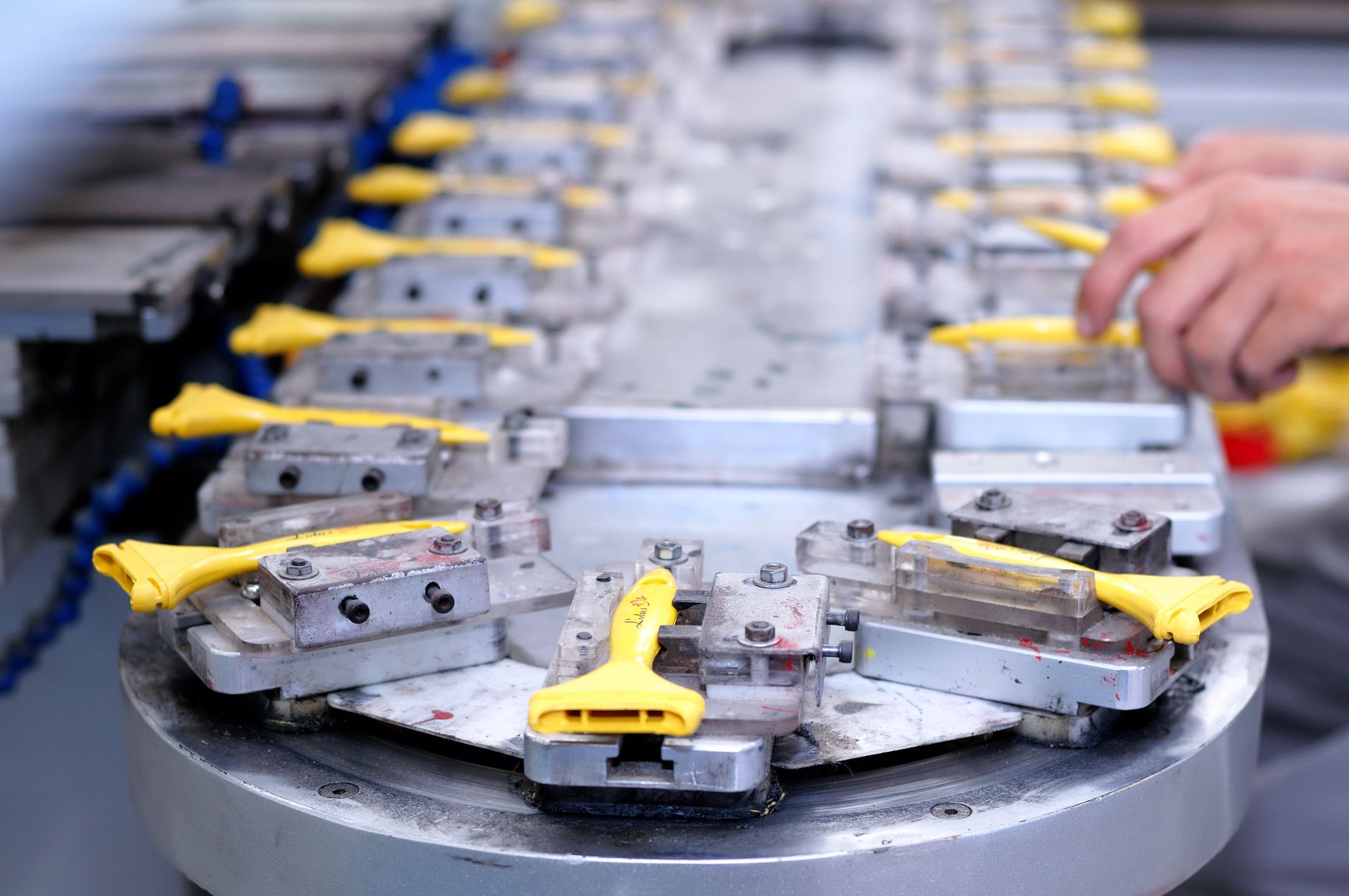
Indexing systems shine when the operation is a clockwork loop: pick, press, stake, vision check, unload. Once dial plates and nests are proven, beat times stay predictable shift after shift.
Operators often load at one index position while other stations work in parallel. That overlap is how you buy speed without buying four separate machines.
The trade is rigidity. A new variant can mean new nests, new stops, and downtime while tooling shops catch up. For a stable SKU that funds the line for years, that trade is acceptable.
What cobot cells do well
A cobot cell trades some raw speed for adaptability. Swap a gripper, adjust a pick point, and teach a new infeed tray, and the same arm can run tomorrow's bracket instead of today's.
That matters in job shops, medical device subassembly, and electronics builds where lot sizes are modest but documentation and traceability are not optional.
According to the International Federation of Robotics World Robotics 2024 report, global industrial robot installations reached 541,302 units in 2023, the second-highest annual total on record. Plants are still adding automation even when macro growth wobbles, which is why flexible cells get a serious look beside traditional hard automation.
How do cycle time and product mix decide the winner?
Model takt honestly. Indexing lines often win when you need sub-ten-second station times and the part always presents the same way.
Cobots catch up when changeover would idle a dial for half a shift. If you run eight variants a week, count programming time, fixture storage, and who approves the safety restart.
Mixed lines sometimes split the work: indexing for the stable core operation and a cobot beside it for kitting, fastening, or inspection that changes often.
- Stable SKU for 24+ months: lean toward indexing
- Frequent engineering changes: lean toward cobot
- Parallel stations with shared load: indexing advantage
- Low volume with high traceability: cobot advantage
Fixtures, floor space, and safety
Indexing tables consume a defined footprint and usually demand guarding around moving platens. Cobots can sit closer to people when a risk assessment supports collaborative speeds, but you still need clear zones, light curtains, or separation when the tool is sharp or fast.
Fixture cost shifts between types. Indexing pays upfront in dial machining; cobots pay in end-of-arm tooling libraries and repeatable presentation trays.
Leave aisle space for maintenance. A stuck nest on a dial or a mis-picked part on a cobot both need a human in there without dismantling half the line.
Changeover labor and maintenance skills
Indexing changeovers are physical: bolts, pins, and locating surfaces. Cobot changeovers are digital plus physical: frames, programs, and force settings.
Staff skills differ. Dial maintenance leans mechanical; cobot upkeep blends mechanical with basic programming and network literacy for connected cells.
Plan training before you buy. A cell that only one integrator can touch becomes expensive every time product management adds a hole pattern.

Expansion plans and financing paths
If you expect to add stations later, ask how the architecture grows. Indexing lines scale by lengthening the dial or duplicating modules. Cobot lines scale by adding arms or shifting the arm to a second machine tend duty.
Service Robot Co. stays vendor neutral on cobot cells and can scope indexing partners when hard automation is the right answer. We help manufacturers compare monthly lease versus purchase paths, run pilots on the actual parts, and service deployed arms through a nationwide engineer network so the cell you buy is the cell you can keep running.