Key takeaways
- US airports are increasingly using robots to handle tasks from passenger assistance to tarmac operations.
- Recent 2026 deployments at San José (SJC) and Gerald R. Ford (GRR) airports highlight this trend.
- Key drivers for robot adoption include persistent labor shortages and the need for greater operational efficiency.
- Robots are active both in passenger-facing terminal roles and in secure airside ground support operations.
- A full-service integrator can manage the entire lifecycle of a diverse airport robot fleet.
Why Are Robots Suddenly Everywhere in US Airports?
Travelers moving through American airports are increasingly likely to encounter a new type of employee: the autonomous robot. These machines are no longer theoretical concepts but active, working assets in terminals and on the tarmac, deployed to tackle persistent operational challenges. Airports are becoming major adopters of automation, using robots for everything from greeting passengers to moving baggage and scrubbing floors.
The trend is a direct response to a fundamental shift in the labor market. The facility services sector, which includes airport janitorial staff, faces an annual turnover rate of 61%, making it difficult to keep terminals clean. This pressure is compounded by a surge in travel, with airports now managing immense daily passenger volumes. Faced with these challenges, airport operators are turning to automation to ensure consistent service, safety, and efficiency.
Recent, real-world deployments show how quickly this technology is advancing. In 2026, airports like San José Mineta International (SJC) and Gerald R. Ford International (GRR) are piloting autonomous robots for a wide range of tasks. At SJC, an AI-powered humanoid robot is assisting passengers in multiple languages, while GRR is testing a multi-purpose autonomous robot for ground support tasks like runway debris detection and perimeter security.
What Roles Do Robots Play Inside the Terminal?
Inside the airport terminal, robots are taking on highly visible, passenger-facing roles as well as critical background tasks. The goal is to improve the passenger experience while freeing human staff to handle more complex issues.
One of the most prominent applications is passenger assistance. In early 2026, San José Mineta International Airport debuted a humanoid robot in its terminal to greet travelers, provide directions, and answer questions in over 50 languages. This type of interaction provides a valuable service, especially for international visitors or those with tight connections.
Terminal cleaning is another area seeing significant automation. Large autonomous floor scrubbers are now a common sight, cleaning vast concourses and gate areas even during peak hours. These machines provide a consistent level of cleanliness essential for passenger satisfaction and public health. Beyond floor care, some airports have deployed UV disinfection robots to sanitize surfaces, a trend that gained traction in recent years.

How is Automation Changing Tarmac and Airside Operations?
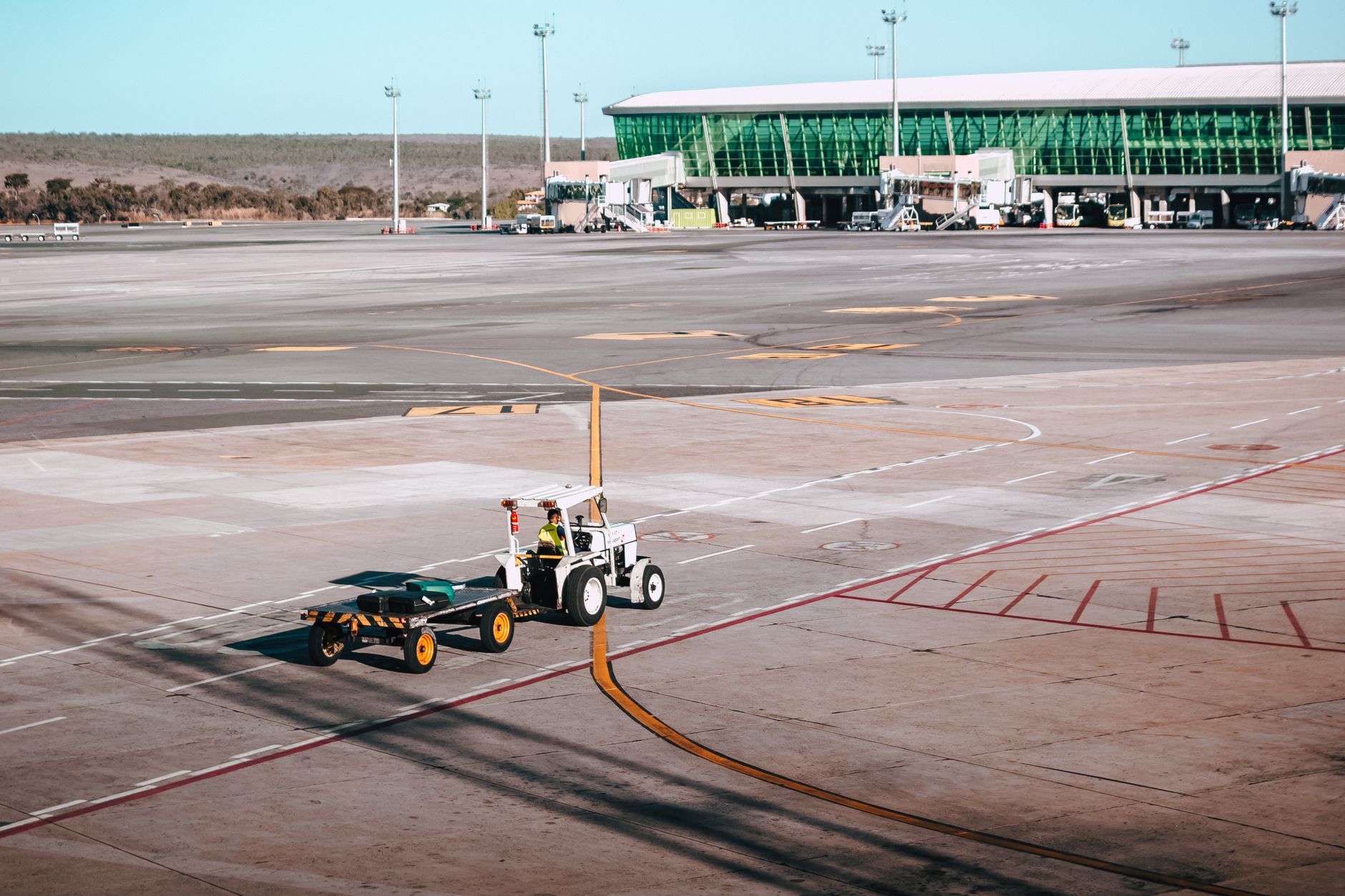
The most significant and complex automation is happening outside the terminal, in the secure, high-stakes environment of the tarmac. Here, autonomous mobile robots (AMRs) and other robotic systems are being tested and deployed to make ground support operations safer and more efficient.
At Gerald R. Ford International Airport in 2026, a pilot program is testing an autonomous robot designed for multiple airside tasks. This includes sweeping the tarmac for foreign object debris (FOD), a critical safety function, and patrolling perimeter fences to enhance security. Automating these repetitive but vital jobs allows ground crews to focus on higher-priority work.
Baggage handling is also being transformed. Dallas Fort Worth International (DFW) Airport has tested a system of autonomous vehicles that transport individual bags from the recheck area to the correct baggage belt, handling nearly 450 bags per hour. At Purdue University Airport, a 5G-powered system of autonomous tugs now serves commercial flights, representing a major step toward fully automated baggage handling from the terminal to the aircraft.
What is Driving This Push Toward Automation?
The adoption of robotics in airports is not driven by technology for its own sake. It is a strategic response to pressing economic and operational realities. The most cited factor is the ongoing labor shortage that affects nearly every industry, including aviation.
Airport partners consistently report that staffing remains a significant issue. Automation allows airports to fill gaps left by unfilled shifts and redeploy existing staff away from repetitive or physically demanding tasks toward roles that require a human touch. This can lead to both improved efficiency and a better work environment for human employees.
Efficiency is the other primary driver. Autonomous systems can operate 24/7 with a consistency that is difficult to achieve with human labor alone. Robots performing tasks like floor cleaning or FOD detection generate detailed data logs, providing airport managers with verifiable proof of work and insights into operational patterns. This data-driven approach allows for more precise planning and resource allocation.
How Do Airports Manage a Fleet of Different Robots?
As airports deploy robots for cleaning, security, and delivery, they face a new challenge: managing a diverse fleet from multiple manufacturers. Each system may come with its own proprietary software and service requirements, creating operational silos. A security robot, a floor scrubber, and a baggage tug may not naturally communicate or operate from a single platform.
This is where a vendor-neutral robot integrator becomes essential. Instead of airport staff having to learn multiple systems and contact different vendors for support, an integrator provides a single point of management. At Service Robot Co., we specialize in bringing together the right robots for the job, regardless of the manufacturer. Our role is to create a cohesive, functional fleet from disparate parts.
We handle every aspect of the robot lifecycle through one vendor relationship. This includes initial site assessments to map deployment areas, financing through programs like robot rental or leasing, and on-site integration to ensure all systems work within the complex airport environment. A single partner for deployment, training, and nationwide on-site service simplifies operations and ensures there is always one number to call, whether a floor scrubber needs maintenance or a delivery robot's tablet is broken.
What is the Future of Robotics in Airports?
The current wave of airport automation is just the beginning. The global airport robots market is projected to grow from USD 597.8 million in 2026 to over USD 1 billion by 2034, according to Fortune Business Insights. This growth points to a future where robotic systems are standard, integrated infrastructure.
Future developments will likely focus on greater autonomy and collaboration between different robotic systems. Imagine autonomous jet bridges that dock automatically with aircraft, AI-powered systems that optimize baggage routes in real-time based on flight changes, and fleets of ground support robots that coordinate refueling, loading, and pushback tasks.
For airports, the key to navigating this future is finding a partner who can manage the complexity. Service Robot Co. provides that expertise, offering everything from pilot programs to test new technologies to phased fleet deployments that avoid operational shutdowns. By providing turnkey deployment and ongoing support, we help airports build a structural advantage through automation, making them safer, more efficient, and better equipped for the future of travel.
Frequently asked questions
Sources
Service Robot Co. is not affiliated with, sponsored by, or endorsed by the companies mentioned in this article.