Key takeaways
- A robot pass on a podium or roof lawn starts with the building team's structural sign off, not the mower.
- Saturated soil weight is the design case, so get the load in writing before any mapping visit.
- Drain inspection schedules in public guidance run from monthly in year one to two or three times a year.
- Map every drop off, planter lip and parapet, and record the clearance from grass to fall.
- Edges, drains and any zone with a gap in the record stay with the crew.
Can a robot mower work on a podium or rooftop lawn?
Sometimes, and only after the checks come back clean. A podium or rooftop lawn can take a robot pass on open, flat panels once the building team has confirmed the structure, the drains and the drop off edges. Where any one of those is uncertain, the crew keeps the work and the robot stays off that zone.
Our research pass did not find a published source on robot mowers used on rooftop or podium decks, so nothing here says a mower model is approved for a roof. What follows draws on green roof and drainage guidance from public agencies, plus the edge limits that mower makers publish for ground level lawns. Confirm each check for the actual building before any quote.
The order matters. Structure comes first, then drainage, then edges, then the choice of panels. A lawn that fails an early check never reaches the mapping stage.
Why does structural load come before the mower?
A roof is not automatically built for a lawn. According to DC's stormwater guidance, a conventional roof should typically be designed for an extra 15 to 30 psf for an extensive green roof, and the guidance calls for a structural engineer on every green roof design. The mower is not the design case. The wet soil is.
A Penn State student thesis estimated one extensive system at 19 pounds per square foot dry and 26 saturated. Those are thesis estimates, not code values, so they show the scale of the question rather than the answer for your building. Saturated weight is the case to design for, because a soaked lawn is the heaviest it will be, and public access adds live load on top.
ZinCo's info sheet gives reference values for dry and saturated layer weights by build up thickness, with a deviation of about ±1.0 kg/m² per cm. Treat those as a starting point, and ask for the manufacturer's product data for the layers actually specified. Put the robot's weight and the crew's traffic on the same list as the soil.
Which drain checks come before the first pass?
Inspection schedules differ by city, so the stricter local rule should win. Camden's drainage guidance calls for drain inspection twice a year, before and after the rainy season, and after severe storms under its green roof rules. Lincoln, Nebraska says at least three times a year, with the inlet cover removed so crews can check the pipes for roots or debris. Philadelphia's blue green roof guidance recommends monthly checks in the first year after installation, so the ongoing frequency can be set from what those checks find.
Lincoln also says green roof drains must stay permanently accessible. That matters for a robot pass, because a drain hidden under a panel edge or a mower route cannot be checked on schedule. Before any pass, open every inlet on the route, confirm water moves, clear leaves and debris, and log any drain that does not clear.
How do you map drop off edges before a robot runs?
Mower makers publish edge limits for ground level lawns, not decks. Ankersolix says, as of November 2026, that its mower keeps about 10 cm from walls and fences to avoid falling or damaging blades, so cuts near those edges can be missed. A retailer's spec sheet for one drop and mow model says the unit is unsuitable for areas with a drop off edge, and that a raised edge of at least 6 cm is needed to keep it on grass.
Those figures are not a rule for a podium. They show that makers treat edges as a hard limit, and they give the crew a question for every parapet, planter lip and step: how far is the grass from the fall, and what stops the machine if a sensor misses it? Walk the whole perimeter with a tape, and record each edge in the same format.
- Edge type: parapet, planter lip, step or open drop
- Drop height measured from the grass line
- Clearance from the grass edge to the fall, in centimeters
- The maker's stated edge offset for the model under review
- Any drain or inlet within reach of the edge
Which open panels suit a robot pass?

Open means open. A panel suits a robot pass when it is flat, has no drain or inlet in the path, keeps a clear margin from every parapet and planter lip, and leaves room to turn without touching an edge. Panels crossed by stairs, furniture, irrigation heads or heavy foot traffic usually stay with the crew. The research did not establish slope limits for rooftop turf, so slope belongs to the maker's spec and the engineer's report.
Rank panels rather than picking a whole deck. A podium often splits into several zones. One zone may pass every check while the next has a drop along two sides. Run the robot where the record is clean, leave the rest to hand work, and remap after any change.
When should the crew keep the work on the roof?
Keep the work with the crew when the structural sign off is missing or the design load is unknown. Keep it when a drain did not clear, when a drop off has no measured clearance, or when the lawn is saturated after rain. A soaked lawn is the heaviest case in the structural figures above, so a plan written for dry turf no longer describes the deck.
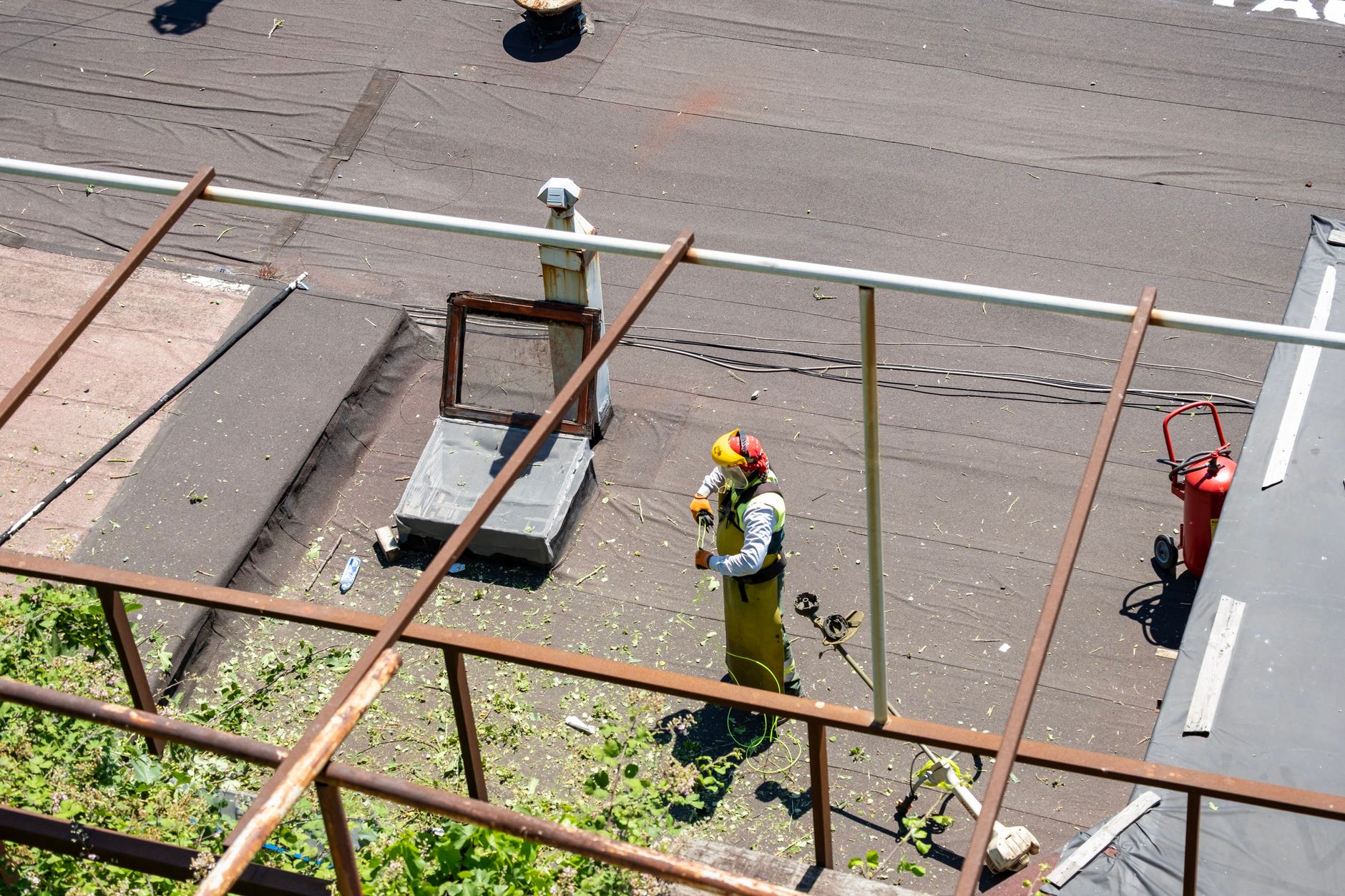
Crew hands should also take the corners, the drain surrounds, the edges along parapets, and any panel where the mapping record has a gap. A robot can carry the open middle of a zone that passes. The crew carries everything that depends on judgment at an edge.
Where does a site assessment fit before a lease quote?
Service Robot Co. runs a site assessment before any lease quote. We map the zones, mark the edges and drains on the record, and bring the building team's engineering sign off into the file rather than assuming it. Only then is one fixed payment quoted on a three year lease, with our RoboCare service plan and regional service engineers behind the unit.
An assessment does not replace the building engineer, the drain contractor or the maker's spec sheet. We are OEM neutral, so the mower recommended depends on the zone rather than a single catalog. If a podium fails the checks, the honest result is a smaller robot zone and a crew plan for everything else.
Frequently asked questions
Want a robot working for you?
Tell us the job and the site. We will recommend the robot, quote the lease, and keep it serviced.
Sources
- DC stormwater guidance, Section 3.2 Green Roofs
- Penn State student thesis, Analysis III Structural Considerations for Green Roofs
- ZinCo Info Sheet, Green Roof Ballast
- Camden drainage guidance
- Lincoln, Nebraska post construction maintenance requirements
- Philadelphia blue green roof maintenance guidance
- Ankersolix help page on mower lawn edges
- Screwfix product page for a drop and mow robotic mower