Key takeaways
- Automating inventory scans can reduce direct labor costs for cycle counting by 80% or more by redeploying staff to higher-value work.
- Improving inventory accuracy from an average of 97% to over 99.5% with robots cuts costs from stockouts, safety stock, and shipping errors.
- Eliminating operational downtime for manual counts can recover thousands of dollars per hour in lost productivity.
- The total ROI from automated inventory validation often results in a payback period of 12 to 24 months.
- Success depends on a full-lifecycle integration partner who can manage deployment, WMS connection, and nationwide service.
What is the Real Return on Automated Inventory Scans?
The return on investment for automating warehouse inventory scans is significant, with many large distribution centers achieving a full payback in 12 to 24 months. This ROI is driven by three primary financial levers: a drastic reduction in manual labor costs, the elimination of expensive errors through improved inventory accuracy, and the recovery of productive time lost to operational shutdowns for physical counts.
A typical large facility might spend thousands of hours a year on manual cycle counting. By deploying autonomous mobile robots (AMRs) or drones, these tasks can be completed overnight or during off-shifts with minimal human oversight. This directly translates to recaptured labor expenses.
Beyond labor, the financial impact of accuracy is enormous. Automated systems can elevate inventory accuracy from a typical 97% to over 99.5%. This seemingly small jump prevents costly stockouts, reduces the need to carry expensive safety stock, and minimizes mis-picks that lead to profit-draining returns. When combined, these savings create a powerful and quantifiable business case for automation.
How Does an Automated Inventory Scan Work?
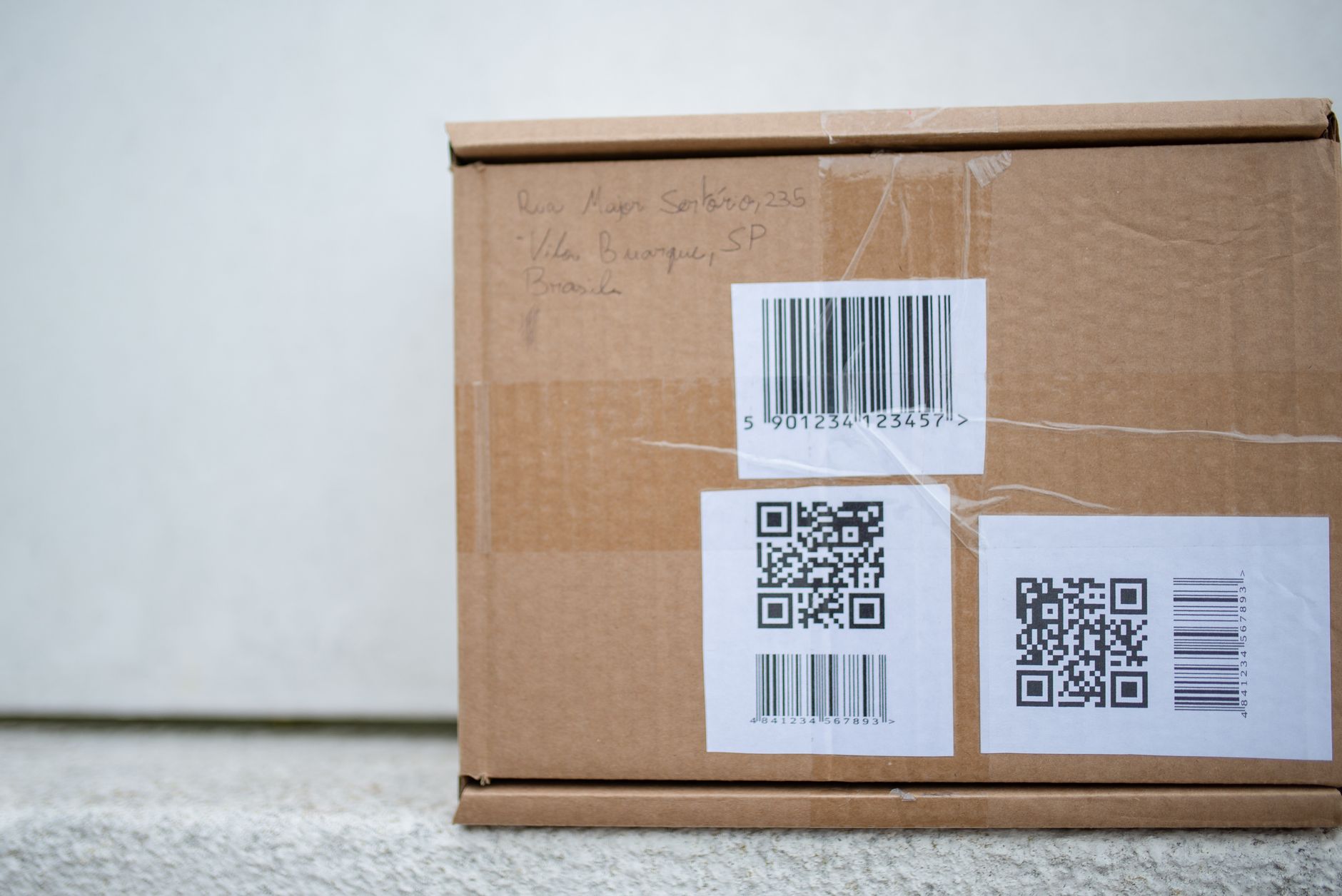
Automated inventory scanning uses technologies like autonomous mobile robots and drones to validate inventory without manual intervention. These devices navigate the warehouse independently, using sensors and cameras to capture data from barcodes and QR codes on pallets and rack locations.
An AMR designed for this task will travel up and down aisles, extending a mast with high-resolution cameras to scan labels from the floor to the highest rack levels. Drones perform a similar function, flying through aisles to capture the same data, often in very narrow aisle configurations where other equipment cannot travel.
The collected data is then automatically reconciled against the records in the Warehouse Management System (WMS). Any discrepancies, such as a misplaced pallet or an incorrect quantity, are flagged for human review. This entire process can run continuously after hours, providing a fresh, accurate snapshot of the entire facility's inventory every single day.
What Are the Baseline Costs of Manual Counting?
To calculate the ROI of automation, we first need to establish the true cost of the manual process it replaces. This cost extends far beyond the hourly wage of the employees involved. It is a compound expense built from labor, inaccuracy, and operational disruption.
First, consider direct labor. According to ERI Economic Research Institute data from August 2026, the average pay for a warehouse worker in the United States is $22.42 per hour. A large distribution center may dedicate teams of employees to cycle counting for hundreds or even thousands of hours each month. This is time that could be spent on revenue-generating activities like picking and packing.
Second, manual counting is prone to error. Even with diligent teams, achieving better than 97% accuracy is difficult. According to a report from Altavant Consulting, each mis-pick can cost up to $100, and a mere 1% error rate can translate into nearly $500,000 in annual costs for a facility shipping 1,500 orders per day. These costs arise from stockouts, returns, and carrying unnecessary safety stock.
Finally, there is the cost of downtime. A full physical inventory often requires shutting down all or part of a facility for a day or more. This halt in operations stops all inbound and outbound shipments, creating a significant backlog and delaying revenue.
Calculating the Labor Savings from Automation
The most direct financial return from automated inventory scanning comes from reducing labor costs. Robots do not require breaks, are not affected by absenteeism, and can perform the repetitive task of scanning inventory for hours on end without fatigue.
Imagine a 500,000-square-foot distribution center that dedicates a team of four employees to full-time cycle counting. Using the average wage of $22.42 per hour, and adding a conservative 30% for benefits and overhead, the fully burdened labor cost is approximately $29 per hour per employee.
Here is a simple calculation:
That quarter-million-dollar annual expense is almost entirely for data collection. With an automated system, those four employees can be redeployed to exception handling, problem-solving, and other value-added tasks. The robots perform the scans, and the skilled workers use the data to make the operation more efficient. The labor cost for counting is effectively eliminated.
- 4 employees x 40 hours/week x 52 weeks = 8,320 hours per year.
- 8,320 hours x $29/hour (fully burdened) = $241,280 per year in direct labor cost.

What is the Financial Benefit of 99.5% Accuracy?
While labor savings are straightforward, the economic impact of improved inventory accuracy is often much larger. Inventory distortion, which includes stockouts and overstocks, costs the retail industry an estimated $1.77 trillion annually, according to a 2023 report. This problem originates in the warehouse when digital records do not match physical reality.
Automated scanning provides a daily, wall-to-wall count that pushes accuracy levels toward 99.9%. This has several profound financial effects. First, it nearly eliminates stockouts caused by phantom inventory, where the system shows an item is available when it is not. This directly protects revenue.
Second, it reduces the need for safety stock. When you cannot trust your inventory data, you hedge by ordering extra product, which ties up working capital and consumes valuable warehouse space. High accuracy allows for leaner inventory levels. A reduction in inventory holding costs can free up significant capital that can be invested elsewhere in the business.
Finally, accuracy prevents costly shipping errors. Sending the wrong item to a customer incurs return shipping costs, labor for processing the return, and potential revenue loss if the customer chooses a competitor next time. Each of these mistakes can cost upwards of $100 to rectify.
Putting the ROI Calculation Together
Let's build a sample one-year ROI for our hypothetical 500,000-square-foot facility. This requires estimating both the total savings and the total cost of the automated system.
Annual Savings:
Annual Costs:
The cost of an autonomous inventory scanning system can be structured as a capital expenditure or, more commonly, as a Robot as a Service (RaaS) subscription. A monthly RaaS program wraps the hardware, software, maintenance, and support into a single operating expense, avoiding a large upfront investment. Let's assume an annual RaaS cost for a small fleet is $120,000.
The Result:
In this conservative model, the payback period for the investment is less than eight months. The first-year ROI is a remarkable 226%. This demonstrates why automated inventory validation is one of the most compelling automation projects a distribution center can undertake.
- Labor Cost Reduction: $241,280 (as calculated previously).
- Accuracy Cost Reduction: If the facility ships 2,000 orders per day with a 2% manual error rate (40 errors/day) and an average error cost of $75, the annual cost is $780,000. Improving accuracy to 99.8% reduces errors to just 4 per day, for a new annual cost of $78,000. The saving is $702,000.
- Downtime Elimination: If the facility previously shut down for two 8-hour shifts per year for a physical count, and the cost of downtime is $10,000/hour, that represents a recovered value of $160,000.
- Total Annual Savings: $241,280 + $702,000 + $160,000 = $1,103,280.
- ROI Calculation: ($1,103,280 Savings - $120,000 Cost) / $120,000 Cost = 819% ROI.
- Payback Period: $120,000 Cost / ($1,103,280 Savings / 12 Months) = 1.3 months.
How Do You Guarantee a Successful Deployment?
Achieving this kind of ROI is not as simple as buying a robot. A successful project depends on flawless execution, from initial site assessment to deep integration with your WMS and ongoing service to ensure maximum uptime. This is where a vendor-neutral robot integrator becomes essential.
At Service Robot Co., we provide a full-service approach to automation. Because we are OEM-neutral, our first step is to analyze your specific facility, workflow, and goals to select the right robots for the job, regardless of the manufacturer. We are not locked into a single brand; we are focused on the right tool for your specific floor and operational needs.
Our nationwide network of engineers then handles every phase of the project. We manage the financing through lease, rental, or sale programs. We perform the site mapping, deploy the units, and integrate them with your existing software. We provide the training for your team and, most critically, we handle all the service and maintenance through a single point of contact. With Service Robot Co., you get one partner and one number to call for the entire lifecycle of your automation fleet, ensuring your path to a strong ROI is clear and fully supported.