Key takeaways
- ORMC tied robots to specimen, supply, and medication movement, which is where many community hospitals feel daily friction first.
- The hospital framed the robots as support for nurses and clinical staff, not as replacements or a broad AI moonshot.
- That narrow scope matters because transport loops are measurable, repetitive, and easier to pilot than patient-facing automation.
- Community hospitals make up 5,121 of the 6,100 U.S. hospitals, according to the American Hospital Association, so practical deployment models travel far.
- A vendor-neutral integrator matters because hospitals need financing, mapping, integration, training, and service around the robot, not just the machine itself.
Why does ORMC's June 2026 demo matter?
Odessa Regional Medical Center got the framing right. In its June 9, 2026 announcement, the 211-bed hospital said collaborative service robots would begin supporting lab specimen transport, patient supply delivery, supply-room retrieval, and medication movement between nursing stations, the lab, the pharmacy, and hospital supply areas. That is a serious operational use case, not a stage prop.
Just as important, ORMC explicitly positioned the robots as support for clinical teams rather than replacements. The hospital said the robots would handle routine, non-patient-facing tasks so nurses and clinicians could spend more time on care. For community hospitals, that is the useful lesson. Start with the long hallway, the repeat trip, the low-complexity internal run, and the measurable step burden. Do not start with a grand automation promise you cannot operationalize.
What exactly did ORMC announce?
According to ORMC's June 9 release, the robots were preparing to begin operating in designated clinical support areas within weeks of the demo. The hospital said they can navigate the facility, including elevators, and that they do not enter patient rooms. That boundary matters. It keeps the first deployment inside a controlled internal logistics lane instead of pushing the program immediately into sensitive bedside workflows.
Local coverage from First Alert 7 added useful specifics. It reported that ORMC had three service robots, using locked drawers and QR-code-based navigation, to move medications, lab specimens, and supplies throughout the hospital. In other words, the hospital did not pitch novelty. It pitched dependable internal circulation.
That distinction is easy to miss. Hospitals do not buy value from a charming hallway interaction. They buy value from fewer interruptions, fewer unnecessary steps, more consistent handoffs, and less time spent hunting down routine items.

Why is step reduction a better first target than flashy patient-facing tasks?
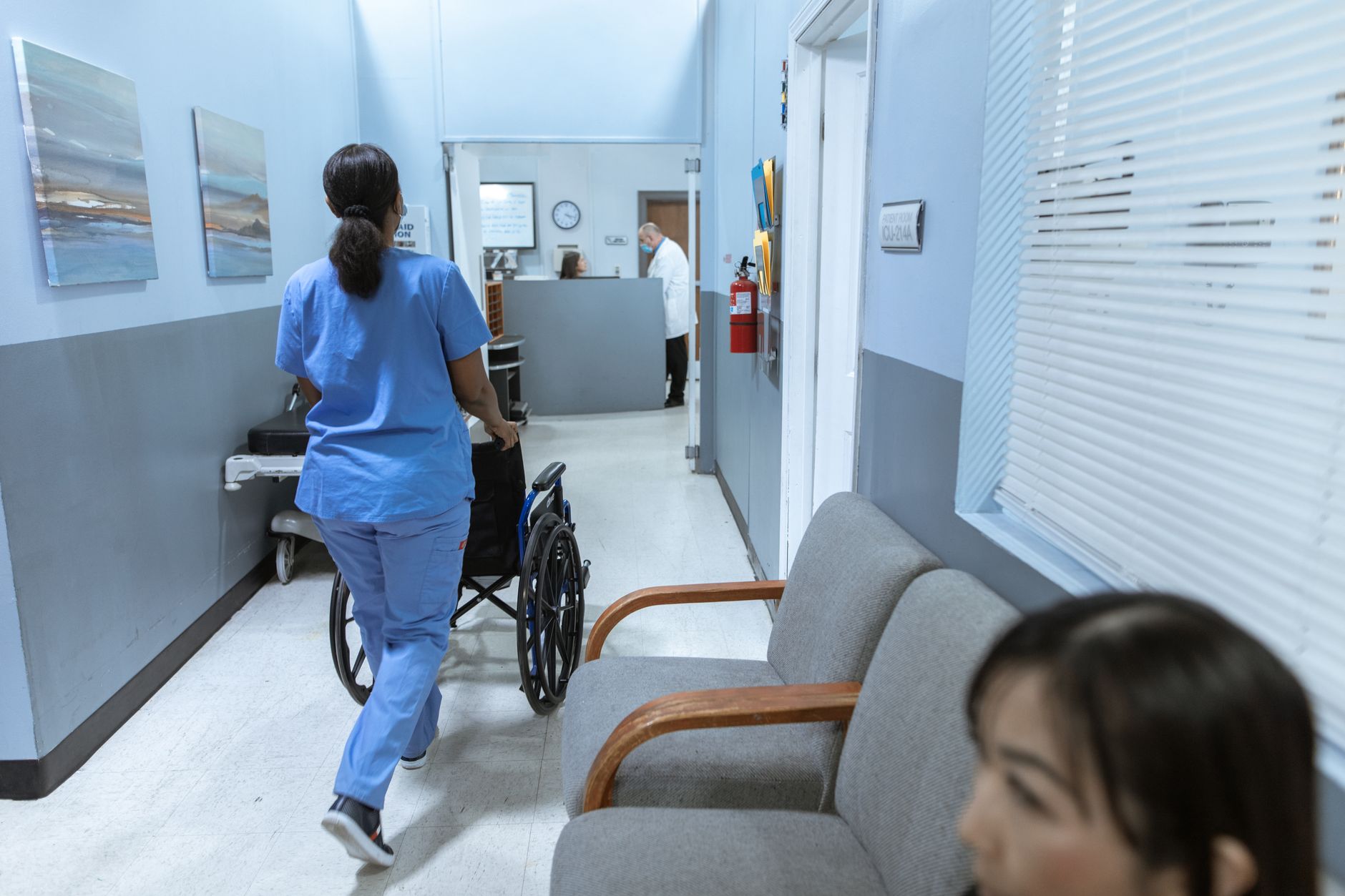
Because step reduction is real labor relief, and it shows up every shift. ORMC's chief executive said many nurses walk several miles during a typical shift. The broader research backs that up. A 2024 study in the Journal of Nursing Management found nurses averaged 8,172 steps during a 12-hour shift, while another hospital study found nurses averaged 9,360 steps and 5.79 kilometers during an average 9.4-hour shift. In an ICU study, nurses covered a mean 10.7 kilometers over a 12-hour shift.
Those numbers matter because transport errands are not rare exceptions. They are built into hospital rhythm. A specimen still has to reach the lab. A medication still has to move between controlled points. Supplies still have to get from storage to the place of care. When robots take only a slice of that repetitive movement, the recovered staff time is not imaginary. It is reclaimed from walking, waiting, and context switching.
Patient-facing robots can be useful in the right environment, but they often trigger harder questions first: bedside etiquette, patient acceptance, exception handling, infection-control choreography, and wider change-management overhead. Internal runs are simply cleaner operational ground for a first hospital delivery robot rental or hospital service robot pilot.
Why does this fit community hospitals especially well?
Community hospitals need practicality more than spectacle. According to the American Hospital Association's 2026 Fast Facts, the United States has 6,100 hospitals, and 5,121 of them are community hospitals. ORMC itself is a community-scale facility at 211 beds with about 700 employees and roughly 250 physicians on staff. That makes the June 2026 demo relevant far beyond West Texas.
A community hospital usually does not have the appetite, staffing depth, or political room for a sprawling automation moonshot. It needs a narrow first deployment that can be mapped, trained, governed, and serviced without building a new department around it. Specimen, supply, and medication movement fit that requirement because the routes are repeated, the endpoints are known, and the operational wins are legible to nursing, pharmacy, lab, and facilities leaders alike.
There is also a financial logic to this sequencing. Community hospitals are managing volume growth, staffing pressure, and tight operating discipline at the same time. A pilot aimed at repetitive transport automation is easier to judge on missed trips, response times, staff acceptance, route reliability, and coverage hours than a fuzzy promise about hospital AI.
What makes internal transport the right deployment lane?
The best early robot work usually shares four traits. It is frequent. It is repetitive. It travels a defined path. And it does not require clinical judgment in motion. ORMC's announced use cases check every box. A robot that carries specimens, supplies, or medications between designated points is taking work off people without trying to impersonate people.
That is the kind of task design community hospitals should respect. A hospital delivery robot rental program works best when the first assignment is mundane but relentless. Repetitive transport automation is where autonomous mobile robot rental and robot pilot program thinking become practical instead of theoretical.
A sensible first scope often includes:
These lanes do not remove humans from care. They remove avoidable walking from care. That is a cleaner thesis and a safer place to prove value.
- Lab specimen runs from nursing units or the emergency department to the laboratory
- Medication transport between pharmacy and designated nursing stations
- Restocking trips from supply rooms to high-use clinical areas
- After-hours internal runs when staffing is thinner and interruptions are more expensive
What did ORMC avoid getting wrong?
It avoided the biggest messaging mistake in hospital robotics: overselling replacement. ORMC's release said the robots support clinical teams. Local coverage quoted staff saying the robots are a tool to help them do their jobs better and spend more time with patients. That matters because workforce adoption rises or falls on whether staff read the machine as relief or as theater.
It also avoided the temptation to make the robot the main character. The main character in ORMC's message was the clinical team. The robot was cast as infrastructure. That is exactly where a first hospital delivery robot belongs.
Finally, ORMC kept the deployment boundary tight. The robots were described as operating in clinical support areas, not patient rooms. For community hospitals, that kind of constraint is a strength. It reduces policy sprawl, narrows training, and makes it easier to define success in the first 60 to 90 days.
How should a community hospital copy the good part of this playbook?
Start with a route study, not a robot brochure. Map the handoffs between the emergency department, lab, pharmacy, central supply, and nursing stations. Count trip frequency by shift. Note where access control, elevator behavior, or cart handoff rules complicate movement. Then pick one or two loops with the highest repetition and lowest exception rate.
Next, define success in operational terms. Good pilot metrics include completed runs per shift, average turnaround time, missed-run rate, manual intervention rate, and nurse minutes returned to patient care. If the deployment cannot be measured at that level, it is probably scoped too loosely.
This is where Service Robot Co. fits naturally. Community hospitals rarely need just a robot. They need one partner that can stay OEM-neutral, choose the right machine for specimen, supply, or medication transport, handle finance, deployment, site assessment mapping, integration, training, and ongoing service, and back it with a nationwide U.S. engineer network. One partner for the full lifecycle is often the difference between a working pilot and an orphaned asset.
That approach also leaves room for lease rental or sale, robot leasing for business, and robot as a service structures when a hospital wants to start with a hospital delivery robot rental instead of a permanent fleet commitment. The practical question is not which brand is fashionable. It is which robot fits the route, the building, the payload, the staffing model, and the support expectation.
What does this signal for the rest of 2026?
ORMC's demo points toward a more disciplined phase of hospital robot adoption. The headline is not humanoids, and it is not hospitality-style novelty. The headline is internal movement. Hospitals are increasingly interested in robot deployments that behave like dependable infrastructure: predictable, auditable, and tied to a narrow operating burden.
That is good news for community hospitals because it lowers the bar to entry in the right way. You do not need to automate everything. You need to automate one stubborn source of wasted motion first. ORMC's June 2026 demo is useful because it shows how to do that without pretending a support robot is a substitute for a nurse.
For hospitals evaluating a first robot pilot program, that may be the clearest lesson of all. Begin where the miles are. Begin where the routine is. Begin where staff already know the job should not require so much walking.
Frequently asked questions
Sources
- ORMC June 9, 2026 robot announcement
- First Alert 7 coverage of ORMC robot rollout
- ORMC about page
- AHA Fast Facts on U.S. Hospitals, 2026
- Journal of Nursing Management study on nurse steps
- Study on nurses' steps and distance traveled
- ICU nurse distance study
- AHRQ summary on medication administration workflow
Service Robot Co. is not affiliated with, sponsored by, or endorsed by the companies mentioned in this article.