

The short answer
A cleaning robot makes sense in Orlando when a building has large, mostly open hard floors that repeat the same route, such as office corridors, retail floors and warehouse aisles, and when those floor hours fall on nights that are hard to staff. It does not make sense for sites made of small rooms, restrooms, heavy soil or constant clutter, and it never replaces the whole crew. For most sites the real cleaning robot vs janitor in Orlando decision is which floor hours move to a machine while people keep the work that needs hands and judgment.
See what a cleaning robot costsRun the numbers in the ROI calculator
Key takeaways
- A floor robot fits large, open, hard-floor areas that repeat on one mapped route.
- It does not fit small rooms, restrooms, heavy soil or sites with constant clutter.
- Staff stay on site, because a robot covers part of the floor hours, not the whole crew.
- Turnover estimates range from about 68% to around 300%, so check your own payroll records.
- Repetitive floor passes are a real part of the injury picture for this job, so they deserve a close look.
Cleaning robot vs janitor in Orlando: which makes sense?
A cleaning robot makes sense in Orlando when a building has large, mostly open hard floors that get the same route cleaned again and again. Office corridors, retail floors, warehouse aisles and some campus buildings fit that pattern. It makes less sense when the site is built from small rooms, restrooms, carpet, heavy soil or many obstacles that change daily. In most buildings the answer is not robot or janitor. It is which floor hours can move to a machine, so that the people who stay do the work that needs hands and judgment.
This page works through that split for an Orlando site. It covers what a janitor really does in a shift, which tasks a robot can take, what the labor data says about turnover and injuries, how a team runs with a robot, and what a robot cannot do. The local wage for this job is in the government wage data panel beside this text, so the wage itself is not repeated here.
When does a cleaning robot make sense in Orlando, and when does it not?
It fits when the floor is large and simple. Long corridors, open retail floors, back-of-house aisles and warehouse lanes are good candidates, because a robot can follow a mapped route on a schedule and run after closing when nobody is walking through. The more predictable the route and the layout, the less setup time eats into the benefit.
It does not fit when the work is mostly small rooms with doors, furniture that moves, or restrooms that need hand cleaning, touchpoint wiping and supply restocking. A robot also struggles with unknown spills, thick debris and carpet that a floor scrubber cannot handle. If the layout changes every week, the mapped route needs constant attention, and much of the saving disappears.
The adoption picture is still early. The AACEM/ISSA Autonomous Cleaning Survey from 2019, which drew nearly 23,000 building service contractors, in-house providers and facility managers, found that 27% were active users of autonomous cleaning equipment. About one-third of non-adopters said they were somewhat likely to adopt within a year. That survey is dated and does not cover Orlando, but it shows that most respondents were not yet using these machines.
A good first check is simple. Walk the floors at the hour the robot would run, count the hard-floor square footage that repeats on one route, and note how many times a person must step in each shift. Sites with large repeat routes and few stops are where a leased machine tends to earn its place.
Median hourly wage, Janitors and Building Cleaners
$3,550
Monthly cost of one full-time worker in Orlando, FL, at the median wage plus payroll costs (an estimate, not a quote).
- Night coverage
Cleaning Robot
Runs a mapped route after close with no operator on the floor
Janitor
Can handle spills, requests and odd jobs during the shift, but night staff are hard to find and keep
- Repeat passes on open floors
Cleaning Robot
Runs the same route and pass pattern on every run
Janitor
Pass quality drops with fatigue and workload, but adapts when the floor changes
- Clutter and obstacles
Cleaning Robot
Stops when pallets, cords or moved furniture block the route
Janitor
Moves items, steps around hazards and makes the call
- Restrooms and touchpoints
Cleaning Robot
Does not clean fixtures, sinks or high-touch surfaces
Janitor
Cleans restrooms, wipes touchpoints and restocks supplies
- Layout changes
Cleaning Robot
Needs re-mapping and route updates when the layout changes
Janitor
Can be re-routed on the spot by a supervisor
- Readiness to start
Cleaning Robot
Needs a site assessment, mapping and staff training first
Janitor
Needs hiring, onboarding and a schedule that someone can fill
What does a janitor actually do in a shift there?
A janitor's shift is a mix of floor work and everything around it. Sweeping, mopping and scrubbing matter, but a large share of the time often goes to restrooms, trash and recycling, restocking paper and soap, wiping touchpoints, and answering spills or requests from tenants and managers. Those tasks are scattered across the shift, so the floor work rarely shows up as one clean block of hours.
The floor passes are also where much of the physical load sits. According to the Bureau of Labor Statistics injury and illness snapshot, janitors and cleaners had 21,100 nonfatal injury and illness cases with days away from work in 2020, at an incidence rate of 191.6 per 10,000 full-time equivalent workers. That is a reason to check which repetitive passes can move to a machine, though the same rate also reflects lifting and chemical exposure that a floor robot does not remove.
Before deciding anything, log the shift as it actually runs for two or three weeks. Note which tasks are fixed by time, which are triggered by events, and which are done by one person who cannot be spared. The floor routes a robot could take are usually only part of that list, and the events are what determine how many people must stay.
Which cleaning tasks can a robot take, and which can it not?
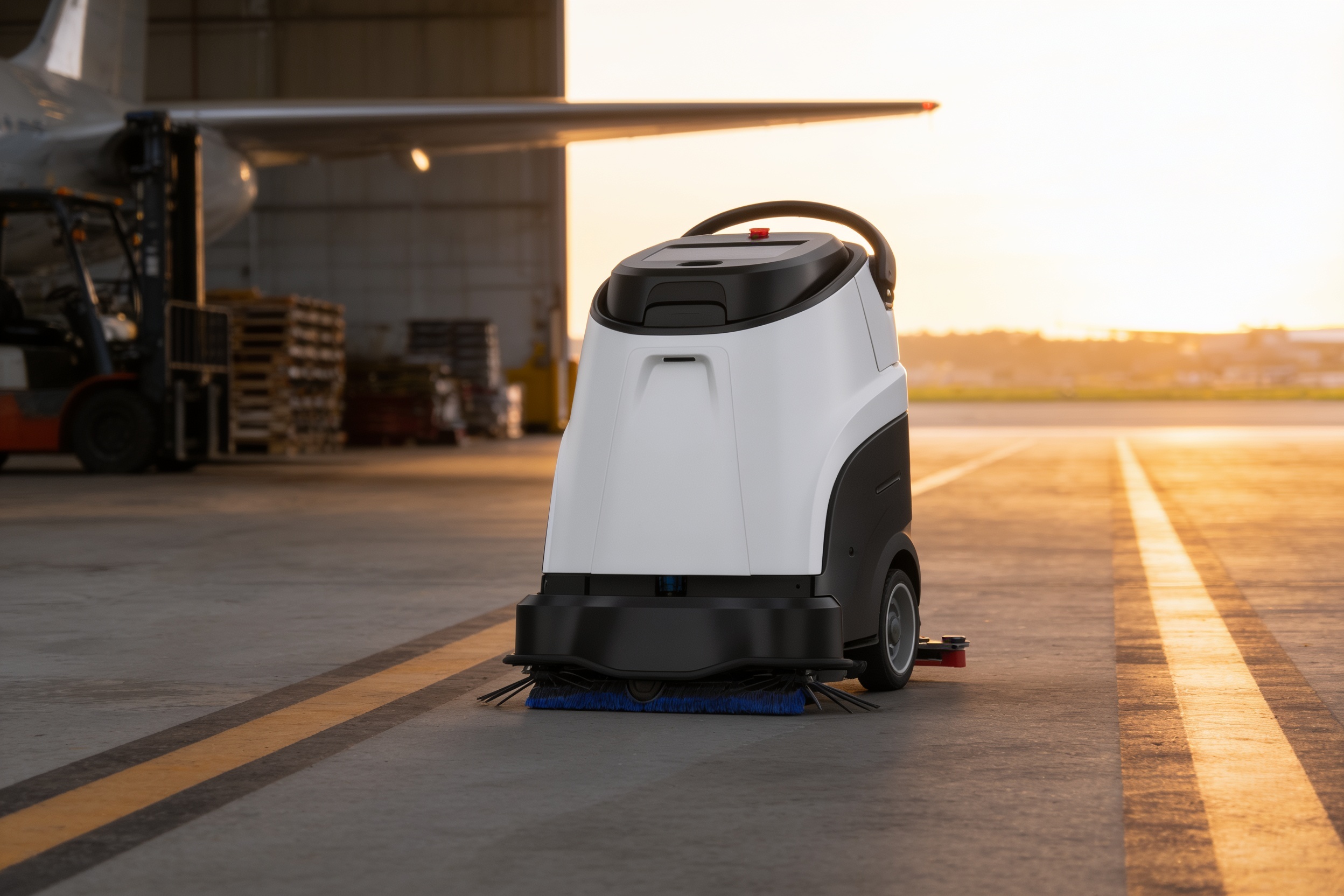
Autonomous floor scrubbers are the clearest case for a robot. They handle scrubbing and sweeping on mapped hard floors, run a fixed route, and cover large areas without a person pushing the machine. Smaller vacuum-type robots suit light debris on smooth floors. Output depends on the route, the battery and the floor area, so the number that matters comes from a test in your own building.
Tasks a robot cannot take include restroom cleaning, sink and fixture work, touchpoint disinfection, trash removal, restocking, heavily soiled carpet, stairs, and any task that needs a person to judge whether a mess is a hazard. Window work, outdoor areas and high ceilings are outside a floor robot's scope. Staff keep those tasks and also handle the robot's exceptions: blocked routes, spills it cannot map, and a dead battery in the middle of the night.
The useful question is not whether a robot can clean a floor. It is whether the floor work is a large single block of time, repeats on a predictable route, and happens when the machine can run unattended. If that is true for part of the building, the robot takes that part and the staff take the rest. The timeline below is an example of how a night might be laid out, not a measured result.
What does the labor picture look like: turnover, injuries and staffing?
Staffing for this work is large and churns. According to the Bureau of Labor Statistics Occupational Outlook Handbook, there were about 2.4 million janitor and building cleaner jobs nationally in 2024, with projected growth of 2% from 2024 to 2034, which the handbook calls slower than average. In Florida, 126,070 people were employed as janitors and cleaners in May 2023, according to BLS OEWS data. The Orlando metro figure is older: the May 2017 OEWS count for building and grounds cleaning there was 58,310 employed, with a location quotient of 1.55, meaning the area had more of this work than the national average. Treat that nine-year-old count as context only.
Turnover is where the sources disagree most. A CleanLink reader survey found 73% average industry turnover and notes that around 300% is the figure trade press most often quotes. A Swept vendor study cites about 200% average annual turnover for janitorial staff. A vendor blog attributes a 68.4% annual separation rate for services to buildings and dwellings to BLS JOLTS data for 2024, which we could not verify against BLS. None of these is an official rate for Orlando janitors, and no BLS janitor turnover figure was available. Treat the spread as a warning that a site relying on a small group of trained night staff will feel every resignation.
I did not find verified Orlando data on night-shift premiums, overtime or sick leave for this job, so those inputs must come from your own payroll. Pull the last twelve months of overtime hours, callouts and open cleaning shifts. Those are the hours a robot can move, and they are where your own case should start.
How does the local wage for this job change the decision?
The government wage data panel beside this text shows the local wage for janitors and building cleaners in the Orlando metro, based on the May 2024 OEWS survey. Read it as the cost of one staffed position before benefits, payroll taxes, supervision, supplies and the cost of an empty shift. A hard-to-fill position costs more than its wage suggests, because overtime, agency cover and manager time all stack on top.
The honest comparison is between hours. If a robot covers the repeat floor passes, the question is how many hours those passes take each week, whether they fall on nights where cover is hardest to find, and whether the remaining staff can absorb the rest. The wage panel tells you what an hour of this labor costs. Your own time test tells you how many hours the robot can take. Neither alone decides the case.
We quote a lease after a free site assessment. The quote is a fixed robot lease payment that covers the financing, deployment, staff training and service, so compare that quote with the labor hours it removes, not with a headline figure on a web page.
How does a team work with a robot, and why never zero staff?
The team that works best is a robot plus fewer people, not a robot in place of everyone. The robot takes the repeat floor passes and the hours they use. Staff keep restrooms, touchpoints, trash, restocking, spills, the robot's exceptions and the building's daily standards. A site that goes to zero staff loses the person who clears a blocked route, judges a hazard, or answers someone who needs help during the night.
In practice a supervisor sets the route and time windows, one person checks the robot at the start and end of each run, and the crew reports stops and blocked areas. Training matters more than people expect. Whoever is on shift must know how to pause the machine, clear a path, recharge it, read the run report, and know when to stop it and call for service.
Staffing changes come after the first months of data, not on day one. A realistic plan reduces the number of people on repeat floor work once the robot has run reliably, and keeps enough cover for the tasks it cannot take.

What can a cleaning robot not do?
A robot does not clean restrooms, handle trash, restock supplies, or disinfect high-touch points in a way that replaces a trained person. It does not decide whether a spill is safe, call for help, or respond to someone who needs assistance. It cannot clean stairs, heavily soiled carpet, outdoor walkways or ceilings. Its route depends on a mapped layout, so a building that is always changing needs ongoing attention.
The robot also depends on the building. Doors left open, power interruptions, wet surfaces and unexpected obstacles can stop it. A vendor's rated output is not the same as real floors, so a timed test in your own building is the only number worth trusting. Expect the first weeks to show more stops and adjustments than the later ones.
These limits are why the staff stay. A robot changes the mix of work and the hours people must cover, but the building still needs a trained person who can judge what the machine cannot.
How do you get started with a cleaning robot lease in Orlando?
Start with one site and one route. Ask for a free site assessment, which maps the floor, measures the repeat routes, and identifies stops and obstacles. From that we produce a lease quote through financing, covering deployment, integration, staff training and service. The quote comes after the assessment, and it is the number to compare with your labor hours.
Run a pilot before committing to more. Measure the hours the robot takes over, the stops it generates, and whether the hard-to-fill nights are covered. Plan for downtime from the start, and confirm who answers when the robot stops at night, including a named contact for dispatch and remote triage. A pilot on your own floors tells you more than any table, including the ones on this page.
Once the pilot is clear, scale across the building or the portfolio. Keep the staffing plan honest: fewer people on repeat floor work, more time on the tasks only people can do, and never a shift with no one on it.
Frequently asked questions
Put a robot to work in Orlando.
We walk your site, learn the job, and recommend the unit that fits. Then we quote the lease, deploy it, and keep it serviced.
Sources
- US Bureau of Labor Statistics, Occupational Employment and Wage Statistics (OEWS May 2024)
- Bureau of Labor Statistics, Occupational Outlook Handbook: Janitors and Building Cleaners
- Bureau of Labor Statistics, OEWS May 2023: Janitors and Cleaners
- Bureau of Labor Statistics, OEWS May 2017: Orlando-Kissimmee-Sanford
- Bureau of Labor Statistics, Injury and Illness Snapshot: Janitors and Cleaners 2020
- ISSA and AACEM, Autonomous Cleaning Survey Report
- CleanLink, The Turnover Trap (reader survey)
- Swept, Janitorial Industry Turnover Rate (vendor study)
- Netchex, Why Turnover Is High in Janitorial and Cleaning Services (vendor blog)