

The short answer
A cleaning robot makes sense in Oklahoma City when a building has large, mostly open floors that need the same pass on a fixed schedule, while a janitor still covers restrooms, trash and detail work. It does not make sense for small, cluttered or constantly changing spaces, where the robot spends more time waiting for a clear path than cleaning. For most sites, the answer in any cleaning robot vs janitor in Oklahoma City decision is a robot plus fewer staff, not zero staff.
See what a cleaning robot costsRun the numbers in the ROI calculator
Key takeaways
- A floor robot fits large, mostly open floors that get the same pass every night.
- Restrooms, trash, spills and detail work stay with people at nearly every realistic site.
- Measure your own repeat floor hours first, because national turnover data for this job is thin.
- The 2020 BLS injury rate for this job makes repetitive floor work worth a close look.
- Plan for a robot plus fewer staff, with a service plan that covers the robot when it stops.
Cleaning robot vs janitor in Oklahoma City: when does a robot make sense?
A cleaning robot makes sense in Oklahoma City when most of the work is repeat floor cleaning across large, open areas. Warehouse aisles, big-box retail floors, office corridors, school hallways and lobbies that get the same pass every night are the usual candidates. The robot runs the scrub or sweep on a fixed route, and a person handles everything that needs judgment.
It does not make sense when the building is small, when floors are crowded with furniture or equipment that moves every day, or when most of the janitor's time goes to restrooms, trash and spills. In those buildings the robot spends its time waiting for a clear path. For most sites, the right model is a robot plus fewer staff, not a robot instead of the whole crew.
What does a janitor actually do in a shift?
A janitor's shift is rarely just floors. It usually includes emptying trash and recycling, restocking paper and soap, cleaning restrooms, wiping high touch surfaces, answering spills, and then the sweeping, mopping or scrubbing. Floor work is often the largest single block of time, but it is spread across the building in short pieces, which makes it hard to see from the outside.
Your own shift log is the most useful source. Break a typical week into task blocks and mark which blocks follow a fixed route and which depend on what happened that day. Those two columns settle most of the robot question, and they tell you more than any national average.
Median hourly wage, Janitors and Building Cleaners
$3,484
Monthly cost of one full-time worker in Oklahoma City, OK, at the median wage plus payroll costs (an estimate, not a quote).
Which parts of the cleaning can a robot take, and which can't it?
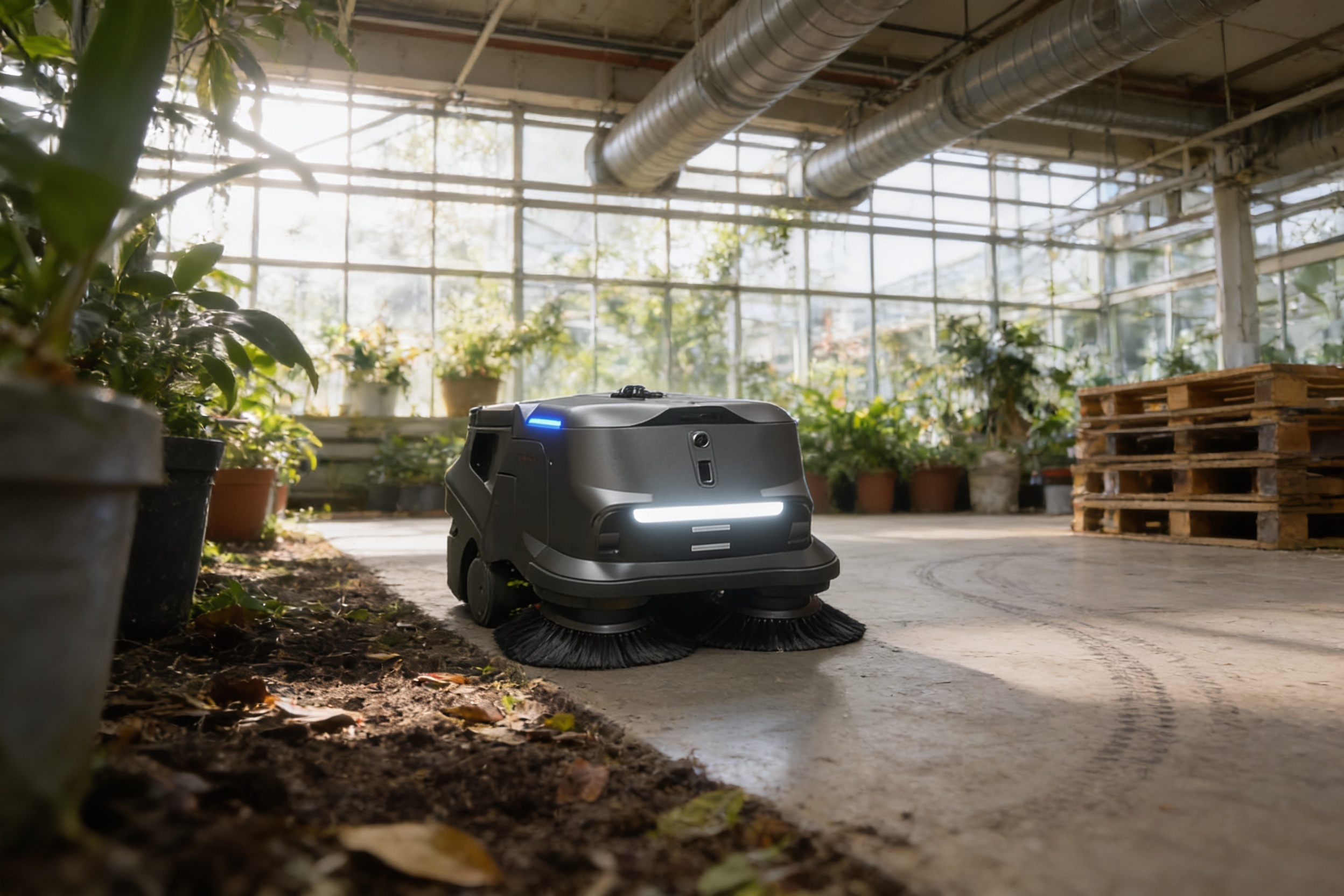
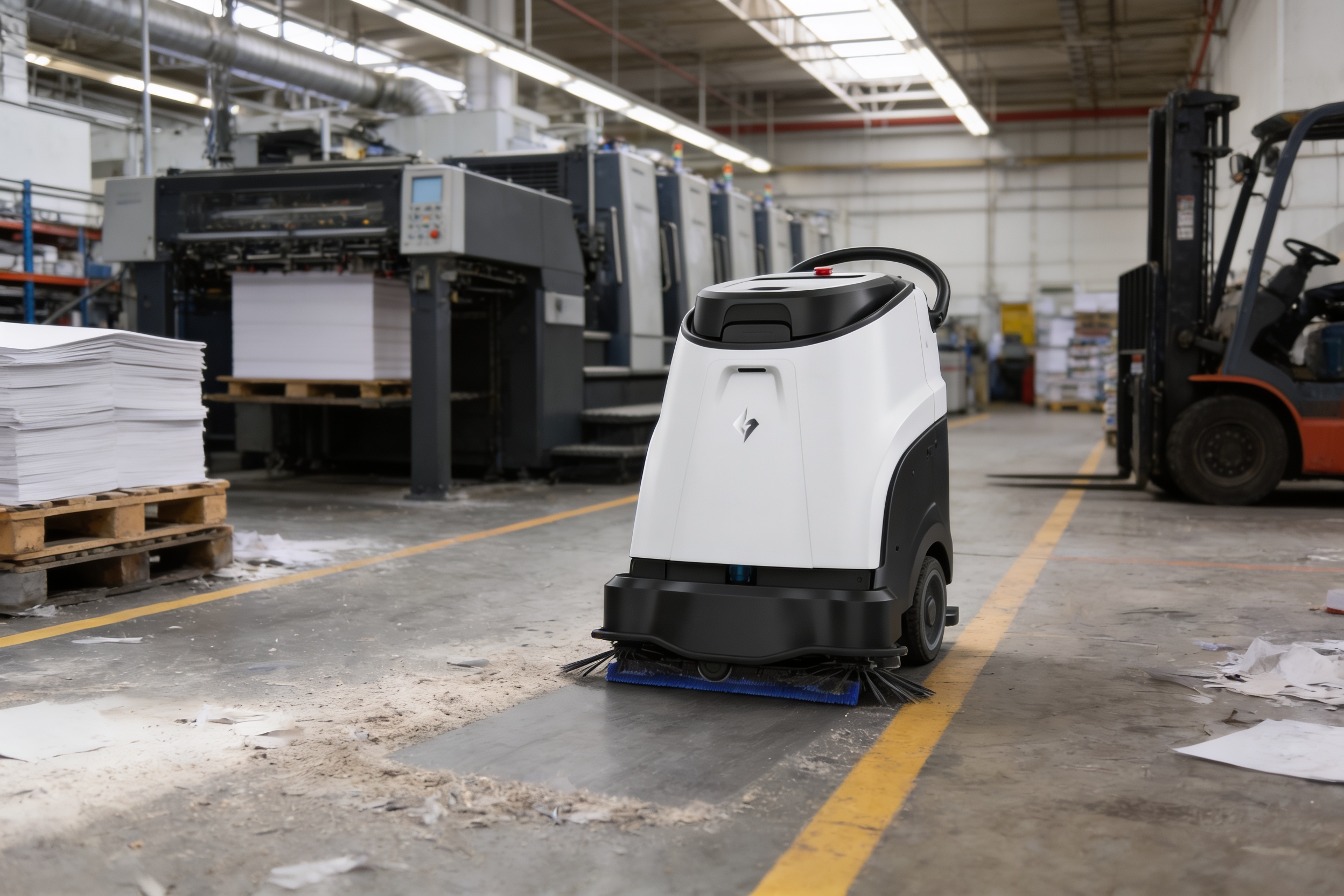
A floor robot can take the scrubbing and sweeping of open floor, the fixed passes that repeat every night. Autonomous floor scrubbers are the usual choice for this work. In the 2019 AACEM/ISSA survey, 89% of adopters used their equipment in large open areas, 80% in hallways and 39% in entryways, so those zones are the first ones to map.
Restrooms, trash, restocking, dusting, spill response, stairs and detail work stay with a person. A robot cannot sanitize a sink, empty a bin, or decide that a spill by a doorway needs attention before the route gets there. The split is simple: repeat floor area goes to the robot, while judgment and touch work stay with staff.
- Repeat floor passes
Cleaning Robot
Runs a fixed route on open floor the same way every time
Janitor
Can clean the same route, but gets pulled to other tasks during the shift
- Night coverage
Cleaning Robot
Runs on schedule after close with no one on site
Janitor
Needs a shift, breaks, and a supervisor to check the work
- Restrooms and trash
Cleaning Robot
Cannot do this work
Janitor
Does it, including restocking and touch surfaces
- Spills and surprises
Cleaning Robot
Routes around or stops, then needs staff to clear it
Janitor
Responds, judges the spill, and fixes it on the spot
- Layout changes
Cleaning Robot
Needs remapping when the layout changes
Janitor
Adapts without setup
- Physical strain
Cleaning Robot
Takes the repetitive pushing of heavy equipment off staff
Janitor
Carries the strain and slip risk that the BLS injury data reflects
How common is autonomous floor cleaning in US facilities?
Adoption is real but still a minority practice. In an AACEM/ISSA survey fielded in early 2019, with 250 complete responses from about 23,000 contacts and a margin of error of 6% at 95% confidence, 27% of respondents were using autonomous cleaning equipment, 7% had stopped, and 66% had never used it. That survey is several years old, so treat it as a baseline, not a forecast.
According to the same survey, adopters gave cleaning efficacy (38%), labor savings (25%) and productivity (23%) as their top reasons, and 5% of non-users said they were highly likely to adopt within a year. ISSA Today reports in its November to December 2025 issue that labor shortages, rising wages and client expectations have accelerated adoption, though that is trade press rather than measured data.
What do the staffing, turnover and injury numbers show?

The occupation is large. According to the BLS Occupational Outlook Handbook, about 2.4 million janitors and building cleaners were employed in 2024, with employment projected to grow 2% over the decade and about 351,300 openings a year on average. The handbook does not split those openings between growth and replacement, so it cannot say how many come from people leaving the job.
Turnover is the hard number to find. We did not find an official BLS turnover rate for this occupation. A 2025 industry benchmark cited in ISSA Today says half of front-line janitorial workers have under one year of experience, which points to a young, fast-moving workforce, though that figure is trade press and not independently verified. We also did not find verified national figures for overtime, night shift premiums or sick days in this job, so pull those from your own payroll.
Injury data is firmer. The BLS snapshot for janitors and cleaners, the latest occupation-specific figures we found, recorded 21,100 nonfatal cases with days away from work in 2020, an incidence of 191.6 per 10,000 full-time equivalent workers, and 42 fatalities. The incidence rate was 178.6 in 2016, and fatalities that year numbered 46, according to the BLS multi-year snapshot. For all private industry, BLS reported 2.3 cases per 100 full-time equivalent workers in 2024, down from 2.4 in 2023, as reported by Business Insurance.
How does the local wage for this job change the decision?
The government wage data on this page gives the local wage for this job in Oklahoma City. Use it as the cost of the hours a janitor spends on floor work, not as the whole case. The saving comes from hours, specifically the repeat floor hours a robot can take and any overtime or unfilled shifts those hours create today.
Statewide context helps. WageDex, citing BLS May 2024 data, puts the Oklahoma median for janitors and cleaners about 15% below the national median, and lists about 23,000 people employed in the occupation statewide on a 2024 basis. WageDex is a secondary aggregator, so confirm those figures against the BLS tables before you use them in a budget.
Wage is one input, not the answer. A wage below the national median makes each hour of floor work easier to justify keeping in-house, while a tight night labor market with hard to fill shifts can shift the math quickly. Set the local wage beside your own unfilled hours and turnover, not against an assumed national average.
How does a team work with a robot?
The working model is always a robot plus fewer staff. The robot takes the scheduled floor route, usually after close, while a person checks the route before it starts, clears obstacles, handles spills, and runs the restroom and trash work. Staff who once spent most of the night pushing a scrubber now spend that time on tasks that need a person.
Roll it out in phases. Start with one or two zones on one shift, run the robot next to the existing crew for a few weeks, then move hours only after the route is stable. Training on the robot itself is short. Staff need more time on what to do when it stops and who calls for service, because that is where the first problems show up.
What can a cleaning robot not do?
A floor robot is limited by the floor. It struggles with crowded or changing layouts, stairs, thresholds, loose cords, and people or carts that step into its path. It does not handle restrooms, trash, dusting, windows or spill response on its own, and it cannot judge whether a floor looks clean beyond what its sensors and route report.
There is also a service question. A stopped robot leaves its route uncleaned unless someone is ready to respond. Ask how a fault is triaged, how fast on-site dispatch happens, and whether a spare or loaner unit is available. Without a clear answer, the robot swaps staff hours for dependence on someone else's response time, a trade worth checking before you sign.
How do you decide and get started in Oklahoma City?
Start by measuring. Map the floor area that gets the same route every night, the hours spent on it, and the zones with the most obstacles. Compare those hours with the local labor picture and your own unfilled shifts. If most floor work is repeat area in large open zones, a robot deserves a closer look. If it is not, better scheduling and a janitor may be the better answer.
We start with a free site assessment. We map the floor, choose the robot that fits the site, and describe lease options through financing. The lease payment is quoted after that assessment, once the route and hours are clear. We deploy and integrate the robot, train the staff and service it nationwide, so one partner handles the arrangement from first walk to daily operation.
Frequently asked questions
Put a robot to work in Oklahoma City.
We walk your site, learn the job, and recommend the unit that fits. Then we quote the lease, deploy it, and keep it serviced.
Sources
- US Bureau of Labor Statistics, Occupational Employment and Wage Statistics (OEWS May 2024)
- BLS Occupational Outlook Handbook: Janitors and Building Cleaners
- ISSA Today, November to December 2025
- WageDex: Janitors and Cleaners in Oklahoma
- BLS Injuries, Illnesses and Fatalities snapshot: Janitors and Cleaners, 2020
- BLS Injuries, Illnesses and Fatalities snapshot: Janitors and Cleaners, 2016 to 2020
- AACEM/ISSA Autonomous Cleaning Survey report
- FMLink: AACEM/ISSA Autonomous Cleaning Survey
- Business Insurance: Work injuries down in 2024, citing BLS