
The short answer
A cobot vs labeling operator choice at a winery favors the cobot only for one steady labeling station, where the same label goes on the same bottle again and again and a person stays on the line for everything else. It does not make sense for small hand-finished runs, frequent label format changes, or a winery that wants to remove the crew entirely. The practical answer is one cobot station with people still feeding, checking and handling exceptions across the line.
Key takeaways
- A cobot fits one steady labeling station; it does not replace a bottling crew.
- Placement is the repetitive part; format changes and hand-finished labels stay with people.
- Public data gives winery counts and labor projections, but no winery hours per shift.
- Harvest labor pressure is the reason to test a station, measured on your own line.
- Start with one leased station, time it through a season, then decide on more.
Cobot or labeling operator at a winery: which makes sense?
A cobot vs labeling operator decision at a winery turns on one question: is there a single bottling station that runs the same label on the same bottle for long stretches? If yes, a cobot placing and aligning labels at that station can take the repetitive hand placement, while a person stays on the line. If the runs are short, the labels are hand-finished, or the format changes several times a week, a labeling operator is still the better fit.
The answer is almost never a cobot in place of the crew. It is one station with a cobot and fewer people, with the same team covering feeding, checking and exceptions. That matters during harvest peaks, when the people who label are also pulled into crush, sorting and cellar work. A station can free a few hands for that work, but it does not cover a labor shortage by itself.
What does a labeling operator actually do in a bottling shift?
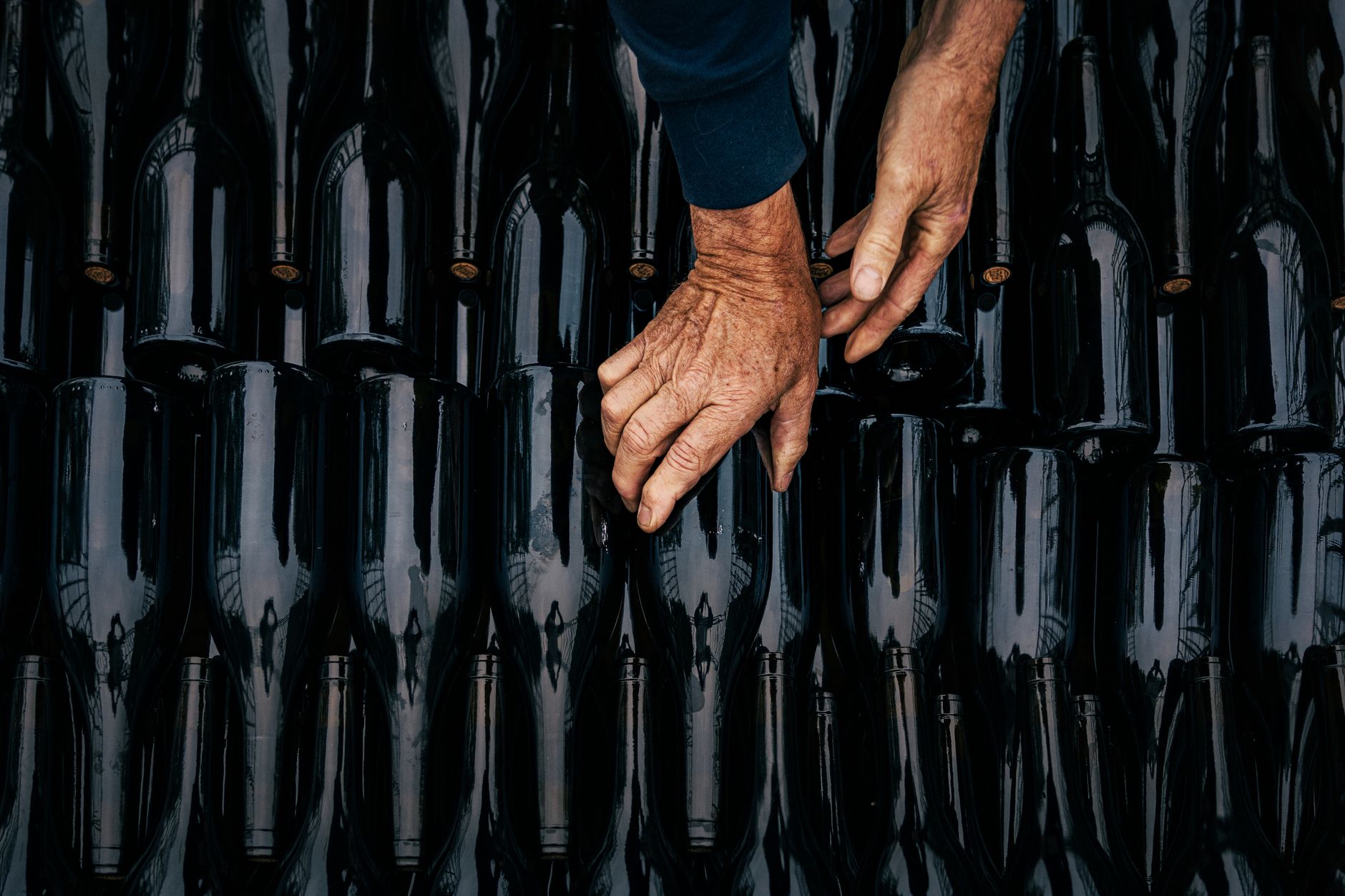
On a bottling run, the labeling operator stands at or beside the labeler and takes bottles off the infeed, presents each bottle to the label head or applies the label by hand, and checks the placement. They watch for wrinkled labels, crooked front or back labels, missing labels and double labels. They also swap label reels when stock runs low and clear jams when a bottle tips at the station. The pace is set by the line, so the work is repetitive for hours at a time.
Around those tasks, the operator checks the first bottles after every start, confirms the format settings, reports rework and marks the batch as run. On special releases or small lots, the same person may hand-apply labels one bottle at a time, and that is where judgment matters most. A cobot station replaces the placement motion on standard runs, not the checks and decisions that come with a new batch.
Which parts can a cobot take, and which parts can it not?
A cobot can take the placement cycle at a station: picking a label from the feed, positioning it on the bottle, pressing it on, and repeating that motion at the pace of the line. Those steps are the same on every bottle of a standard run, which is why placement is the part to automate first. The person keeps the steps that need eyes and hands on the bottle, such as loading bottles that arrive at the wrong angle, clearing a tipped bottle and deciding whether a misapplied label goes back or gets scrapped.
We did not find a published cobot labeling station for wine bottles in the sources reviewed. A German wine bottler is reported to use a collaborative arm to palletize wine cartons at the end of the line, which is another job entirely. Vendor-reported cobot labeling work targets beverage bottles and label reel loading, not wine, so treat any winery station as a trial on your own bottle shape, label stock and closure.
- Placement repeatability
Cobot
Same placement motion on every bottle of a standard run
Labeling Operator
Good, but placement drifts as fatigue builds over a long shift
- Format changes
Cobot
Needs new settings and a test run for each format
Labeling Operator
Adjusts quickly by hand for a new label or bottle
- Special releases and hand-finished labels
Cobot
Not a fit for foil, wrap or hand-finished work
Labeling Operator
Handles these well, one bottle at a time
- Damaged bottles and bad labels
Cobot
Places on the bottle it is given and does not judge fit
Labeling Operator
Spots tipped, cracked or wrinkled labels and decides on rework
- Harvest peaks
Cobot
Holds the station steady while staff cover other tasks
Labeling Operator
Gets pulled into crush, sorting and cellar work
- Staffing and training
Cobot
Needs trained staff to run the station and a site assessment first
Labeling Operator
Needs hiring and training each season, with turnover risk
How many wineries are there in the US, and how much labor do they use?
The count of US wineries depends on the source. Vinetur, reporting a WineBusiness Analytics count for 2025, put the total at an estimated 11,107, down about 3% from 11,450, a loss of 343 wineries, with California at 4,646 in that dataset. VinePair, citing TTB bonded winery data, reports over 16,000 bonded wineries, but bonded locations under common management may be counted separately, so the two figures measure different things. For a plant decision, your own bottling lines and label formats matter more than the national total.
For the occupation itself, the BLS projects packaging and filling machine operators and tenders to add about 1,700 jobs from 2024 to 2034, according to a Packworld summary of those projections. The same summary says manufacturing employers will need to fill nearly one million production openings a year through 2034, but that covers all production work, not this occupation. An O*NET-based page gives 381,200 employees in this occupation for 2024 and 398,200 for 2034, which does not match the BLS projection, so check the BLS Occupational Employment and Wage Statistics table before quoting a total.
What do hours and labor look like on a bottling crew?
We did not find published figures for the hours per shift that hand labeling takes at a winery, staffing levels per bottling line, overtime for bottling crews, or night shift use in winery bottling. Floor area for winery bottling halls was not found either, and no injury or incident rate for repetitive placement in wine work was verified. Any hour value you see from a generic table should be replaced by timing taken on your own line.
Turnover is the other gap. The ProWein industry staff shortage survey, covering reports from 2022 and 2023, found seasonal workers were the largest staff gap at 63%, with the shortage most severe among producers in Portugal at 94%, Spain at 77% and California at 73%. That survey is dated and spans several countries, but it shows where the pressure sits. The Texas Workforce Commission vineyard employer survey exists, yet the version we checked was the questionnaire with no findings, so it does not yet give turnover or hours.
| Task | Today | With a robot |
|---|---|---|
| Place and align front and back labels | One operator per station, paced by line speed | Cobot places labels at the station, operator checks samples |
| Swap label reels | Operator stops the labeler to change stock | Operator stages the next reel during a planned pause |
| Clear jams and tipped bottles | Operator clears them at the station | Operator still clears them, with a short stop routine |
| Check first bottles after a start | Operator checks by eye and by sample | Operator checks the test batch before the full run |
| Case packing and palletizing | Separate crew members | Not changed by a labeling station |
The sources reviewed publish no winery hours per shift, so this table describes the work rather than timing it. Each hour value should come from a timed run on your own line, measured during the site assessment.
How does a team work with a cobot at the bottling line?
The team is always a cobot plus fewer people, never a cobot with zero staff. At the labeling station, the cobot takes the placement cycle while one person loads bottles, watches the labels, handles exceptions and signs off the batch. Staff who used to place every label move to the tasks that stack up during harvest, such as case handling, cellar work and cleaning, so the same crew covers more of the winery.
Changeovers are where people underestimate the work. A format change means new settings, a reel change and a short test run before the batch goes on. We train the staff who run the station and set a routine for first-bottle checks and reel swaps, so the same operator handles those steps on every shift. The routine matters as much as the machine.
What can a cobot not do at a winery?
A cobot cannot judge a label that looks straight on the screen but sits crooked on a curved bottle. It cannot handle hand-finished labels, foil or wrap work, or a bottle that arrives cracked or shifted. It cannot run unattended, because a person still clears faults, loads bottles and signs off batches. It also does not help a line that is short of bottles, or a winery whose label runs are too small to justify a station.
It does not solve harvest labor on its own. A station takes over one repetitive task, which can free people for other work, but a seasonal shortage across the winery still needs hiring, scheduling or a different mix of staff. Be wary of any claim that a cobot covers a shift by itself. The sources we reviewed show the labor pressure, not a cobot that removes it, and no published winery data showed a cobot cutting hours.
What should you check before deciding on a cobot?
Measure your own line before deciding. The checklist below covers the numbers that change the answer. The strongest case is one bottle shape and one label per station, a steady run for long stretches, and harvest pressure on the same crew. If your runs change format often or labels are hand-applied, keep the operator and revisit when the run settles.
How do you start a leased cobot for labeling?
We are a US commercial robot integrator. We pick the robot for the site, lease it through financing, deploy and integrate it, train the staff and service it nationwide. For a winery, the first step is a site assessment that covers the bottling station, the bottle and label formats, power, space and how the crew covers harvest. The fixed lease payment is quoted after that assessment, so the number reflects your line rather than a generic estimate.
A practical start is one station on one bottling line, run for a season alongside the existing crew, with timing taken at each step. That gives you the hours and staffing picture from your own floor. If the station holds up, the next decision is whether to add a second station, and by then the timing data will answer most of the question. Start with one leased unit before deciding on more.
Frequently asked questions
Want a cobot at your winery?
Tell us about your site. We will recommend the robot, quote the lease, and keep it serviced.
Sources
- WineBusiness Analytics 2025 winery count, reported by Vinetur
- TTB bonded winery count, reported by VinePair
- BLS projections as summarized by Packworld
- ProWein industry staff shortage survey, 2022 and 2023 reports
- O*NET Online local trends for 51-9111.00
- BLS Occupational Employment and Wage Statistics, 51-9111
- Texas Workforce Commission vineyard employer survey