
The short answer
Cobot vs palletizing worker in Fresno comes down to whether the stacking is repeatable. A cobot makes sense when similar cases stack in the same pattern on a fixed layout and the plant struggles to staff every shift. A palletizing worker still makes more sense when SKUs change often, cases arrive damaged or irregular, or most of the job is checking, wrapping and fixing rather than stacking, and for most sites the right answer is a cobot working beside a smaller crew, not a cobot replacing everyone.
Key takeaways
- Cobot vs palletizing worker in Fresno turns on whether the stacking is repeatable.
- A cobot covers the repeat stacking, while people keep mixed cases, wrapping, load checks and jams.
- BLS reports transportation and material moving at 9.4 percent of Fresno metro employment.
- GAO found overexertion was the most common hazard category in general warehousing.
- Plan for a cobot working beside a smaller crew, never zero staff, and quote the lease only after a site assessment.
Cobot vs palletizing worker in Fresno: which makes sense?
A cobot palletizer makes sense for a Fresno plant when the line sends the same kind of case in a predictable order, the pallet pattern stays the same through the shift, and the hard part of the job is the lifting and the repetition. An arm handles repetition steadily. It is a poor fit when the line runs many products in short batches, when incoming cases are often mixed or damaged, or when the pallet needs a person to judge stability, labels and load quality before it leaves the cell.
The local wage for this job appears in the government wage data on this page. Treat it as the base rate, not the verdict. The fuller comparison includes overtime hours, open shifts, sick days and the injury exposure of manual stacking across a full shift. A plant can measure all of those on its own timeclock and pallet logs, and that is the first step before anyone quotes a cell.
Service Robot Co. is a US commercial robot integrator. We pick the arm and layout for the site, lease it through financing, deploy and integrate it, train the staff who run it and service it nationwide. The lease payment comes in a quote after a free site assessment, so the decision starts with your line, not with a catalog.
What does a palletizing worker actually do in a Fresno shift?
Palletizing is usually one station in a longer chain. The worker takes cases from the end of a conveyor or a staging area, sets them into a layer pattern, adds slip sheets or layer sheets, builds the pallet to height and moves the full load to a staging lane. Many plants have the same person wrap the load, apply labels and clear jams or mispicks when the line stops.
The government wage data on this page uses the occupation Laborers and Freight, Stock, and Material Movers, Hand. The BLS Occupational Outlook Handbook describes this group and notes that moving heavy objects in warehouses or onto trucks may cause sprains, strains and overexertion. That is the exposure a palletizing cell is meant to reduce, although a cell does not remove it entirely.
Over a shift the worker moves between lifting, walking to the pallet and waiting on the line. Pace depends on the infeed. When cases arrive in a steady flow, the job is mostly repetition. When they arrive in bursts or out of order, the worker spends time on sorting and recovery, which is the part of the job that is hardest to automate.
Median hourly wage, Laborers and Freight, Stock, and Material Movers, Hand
$4,179
Monthly cost of one full-time worker in Fresno, CA, at the median wage plus payroll costs (an estimate, not a quote).
Which parts of palletizing can a cobot take, and which can't it?
A cobot arm can take the repetitive core: picking cases from a known infeed, placing them in a programmed pattern and stacking layer after layer when case size and orientation are consistent. The gripper is matched to the case, and the program follows the pattern. Most of the integration work sits in the infeed and the pattern, which is why the site assessment matters more than the arm itself.
What stays with people is the work that depends on judgment or on a changing floor. That includes sorting mixed or damaged cases, reading labels that do not match the order, placing sheets or load bars that vary by customer, wrapping and tagging, and moving the finished pallet across the floor. Some of these can be added with extra equipment, but that changes the cell and should be scoped as a separate project.
- Sorting mixed, damaged or unlabeled cases
- Customer-specific slip sheets and load bars
- Stretch wrap, labels and load checks
- Moving finished pallets to staging
- Clearing jams and correcting dropped cases
- Repeat stacking of similar cases
Cobot
Holds the same pattern for the full run without fatigue
Palletizing Worker
Adjusts quickly when a case is slightly off and judges the layer by eye
- Mixed or damaged cases
Cobot
Struggles without a known case and a steady infeed
Palletizing Worker
Sorts, sets aside damaged product and reads unmatched labels
- Changeover to a new pattern
Cobot
Needs a program change, a gripper check and a supervised first layer
Palletizing Worker
Re-stacks by eye with a short check and little setup
- Night and weekend coverage
Cobot
Runs with a smaller crew, with a trained person still watching the cell
Palletizing Worker
Needs a shift, a wage and a break schedule
- Injury exposure from repetitive lifting
Cobot
Removes the repeat lift of each case
Palletizing Worker
Still handles loads, pallet moves and checks, so exposure is reduced, not removed
- Floor and layout needs
Cobot
Needs fixed floor space, a clear infeed and pallet staging
Palletizing Worker
Works in cramped or changing layouts
- Faults and recovery
Cobot
Pauses and waits for an operator on a jam or dropped case
Palletizing Worker
Fixes a dropped case on the spot and keeps the line moving
What do the hours and labor numbers look like in Fresno?
The BLS May 2024 Fresno release covers Fresno and Madera counties and is based on 3,382 establishments with a 64 percent response rate. In that release, transportation and material moving was the second-largest occupational group by share of local employment, at 9.4 percent, behind office and administrative support at 11.0 percent. That tells you the metro has a sizable pool of workers in this type of job, but it does not tell you how hard it is to staff one line.
Occupation-level turnover for this job was not published in the sources reviewed, so the closest published figures are broader. The BLS annual JOLTS release reports a 2025 average quits rate of 2.0 percent and a layoffs rate of 1.1 percent, and annual quits fell by 1.3 million in 2025. FRED's quits rate for trade, transportation and utilities, a wider group that includes warehousing, was 2.6 in December 2025 and 2.3 in February 2026, seasonally adjusted.
For warehousing and storage, BLS industry data shows seasonally adjusted employment of about 1,834,700 in February 2026, a preliminary figure. Private-industry establishments in the sector rose from 22,929 in Q4 2024 to 23,539 in Q3 2025. These are national series, not Fresno counts. Overtime, night-shift premiums and sick-day use at Fresno palletizing lines were not verified, so do not fill those gaps with estimates. Pull them from your timeclock for the last full year.
How does a cobot work with a palletizing crew?
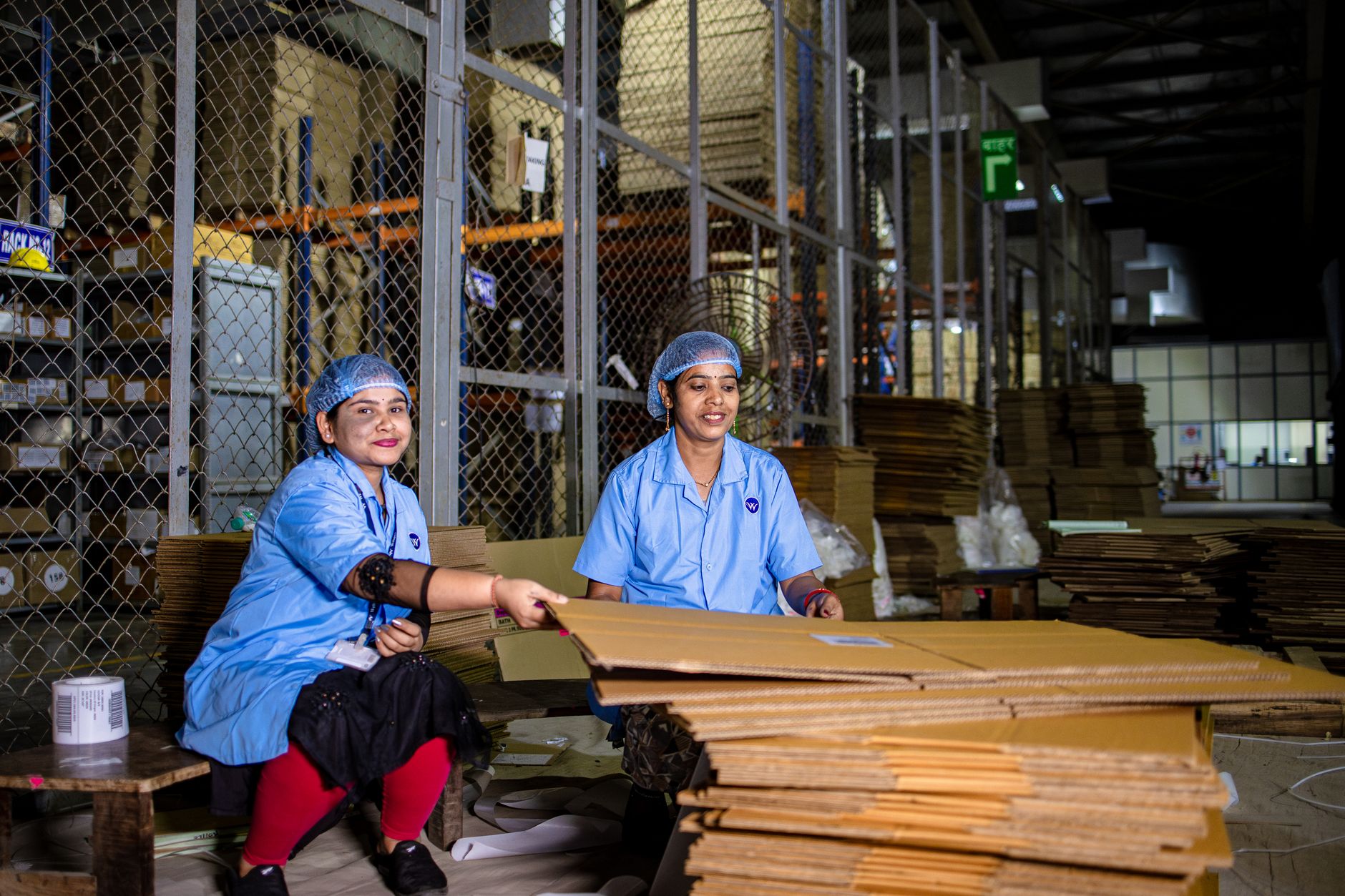
The model that works is a cobot plus fewer staff, never zero staff. A typical cell keeps a person on the infeed and pallet exchange, another on load checks and wrapping, and a trained operator on the cell itself. The arm takes the repeat stacking, and the people move from stacking to the work the arm cannot do.
Staffing needs fall because the arm covers repetition, not because the line runs unattended. Plant leads still have to plan for absences. A cell with a single trained operator is a single point of failure, so cross-train at least one other person on infeed and restart before go-live.
What can't a palletizing cobot do well?
Changeovers are where a cell earns or loses its keep. Each new case size or pallet pattern needs a program change, a gripper check and a supervised first layer. If the line changes pattern several times a day, that setup time and staff attention can cancel out the repetitive work the arm saves. A cell built for one product family is the wrong tool for a job-shop line.
Low volume is the other limit. A cell that builds only a few pallets a shift may not justify integration, while a worker covers that work with no setup at all. Layout matters too. The cell needs floor space, clear access for forklifts and pallet jacks, and a reliable infeed. A cramped dock often needs changes before any cell can run.
Are injury rates and adoption reasons to move to cobots?
GAO-24-106413 reports that transportation and warehousing had the highest serious injury and illness rate of 19 sectors in 2022, an estimated 3.8 cases per 100 workers. The same report found overexertion was the most common hazard category in general warehousing and last-mile delivery, using BLS data for 2018 to 2022. Palletizing sits squarely in that hazard group, but a sector rate does not describe your plant, so measure your own injury log.
Adoption is growing across industrial settings. According to The Robot Report summarizing International Federation of Robotics data, collaborative robots made up 10.5 percent of industrial robot installations worldwide in 2023. IFR's own release reports a record operational stock of 5 million industrial robots, up 9 percent in 2025. No palletizing-specific installation share was published in the sources reviewed, so treat these figures as context, not as a benchmark for your line.
What should you check before deciding on a palletizing cobot?
Before you decide cobot vs palletizing worker in Fresno, gather a short list of facts about your line. Collect them before any integrator sets a layout, including us. A site assessment checks the same things, and a plant that brings its own numbers gets a faster and more useful quote.
Each item below either changes the fit of the cell or changes the labor math, so answer them first.
How do you get started with a cobot palletizer in Fresno?
Start with a free site assessment. We map the infeed, pallet staging, floor and shift pattern, then recommend a cell that fits the line. The lease payment is quoted after that assessment, so financing terms can be compared against the work the cell will actually do.
A pilot on a single line is the lowest-risk path. Begin with a single leased unit, train the staff who will run it, go live with support and expand only after the first product families run cleanly. Ask about spare-unit coverage before go-live, so a single fault does not halt the line.
Service Robot Co. handles deployment, integration, training and service nationwide, so the plant has a single point of contact from assessment through repairs. Keep the palletizing crew in place during the pilot, and write down their new duties before the cell goes live.
Frequently asked questions
Put a robot to work in Fresno.
We walk your site, learn the job, and recommend the unit that fits. Then we quote the lease, deploy it, and keep it serviced.
Sources
- US Bureau of Labor Statistics, Occupational Employment and Wage Statistics (OEWS May 2024)
- BLS, Occupational Employment and Wages, Fresno metro, May 2024
- BLS Occupational Outlook Handbook, Hand Laborers and Material Movers
- GAO-24-106413
- BLS annual JOLTS release, 2025 averages
- IFR, five million robots now operate in factories globally
- The Robot Report, summary of IFR data
- FRED, quits rate for trade, transportation and utilities
- BLS Industries at a Glance, warehousing and storage