
The short answer
A cobot vs pick-and-place operator decision at a contract electronics plant usually favors the cobot when one placement or pick step repeats with fixed fixtures, consistent parts, and steady volume. Skilled hand assembly still wins when kits change often, parts are fragile or irregular, or the work depends on judgment and rework. In most plants the answer is a cobot working beside a smaller team, not a cobot in place of people.
Key takeaways
- A cobot fits one repeated placement step with fixed fixtures and steady volume.
- Hand assembly still wins on frequent changeovers, irregular or fragile parts, and rework.
- Plan for a cobot working beside fewer staff, never zero staff.
- The BLS counted 56,220 employees in semiconductor and electronic component manufacturing in May 2023.
- Time your own cycles and changeovers before comparing any lease quote.
Cobot vs pick-and-place operator: when does a robot make sense?
A cobot vs pick-and-place operator comparison starts with one question: is the placement step repetitive and stable enough to teach once and repeat for hours? At many contract electronics stations the answer is yes. The same component goes to the same pad or hole, the fixture holds the board in the same place, and the cycle repeats thousands of times a shift. A collaborative robot arm is built to share a work cell with people and to slow or stop on contact, so it can take over that motion while a person stays at the station.
It does not fit everywhere. A plant that runs many small lots with frequent changeovers pays for new programs, grippers, and fixtures each time, and the saving shrinks with every switch. Irregular or fragile parts, and steps that need a person to judge whether a joint looks right, still favor skilled hands. Low volume and high mix work usually points to hand assembly, and so does any station where most of the job is rework.
In most plants we would assess, the realistic outcome is a robot at the repeated step, a smaller staff than before, and at least one person still on the line for loading, checks, and faults. Replacing the whole team is rarely the right goal.
What does a pick-and-place operator actually do in a shift?
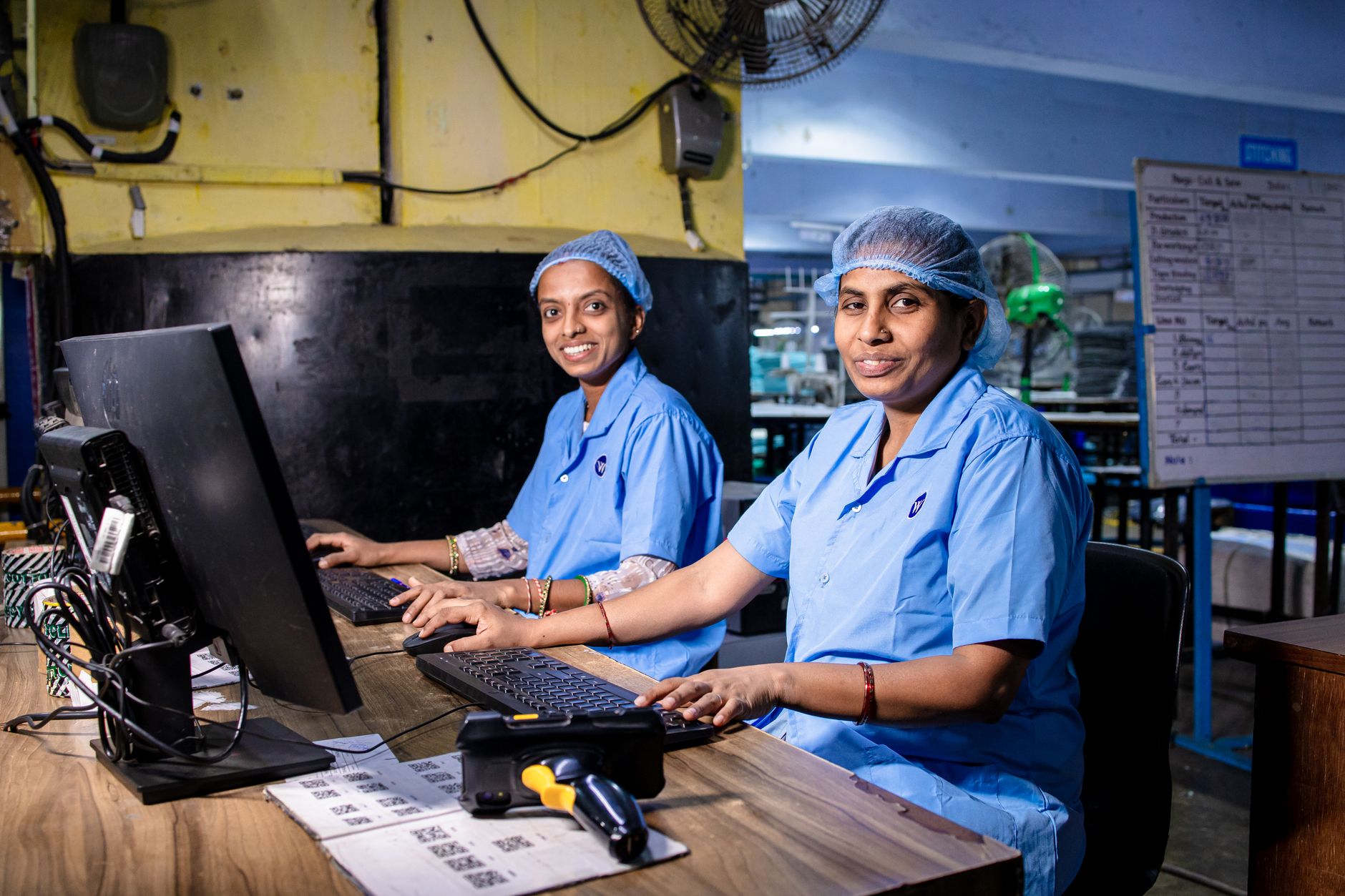
In many plants, high-speed placement machines handle most surface-mount parts, and people handle the steps the machine cannot: hand-placed through-hole parts, connectors, press-fit items, and some board-level work. The operator loads feeder reels or trays, picks parts by hand or with a vacuum tool, seats them on the board, checks orientation, counts and logs, swaps reels, clears jams, and pulls samples for inspection.
A typical shift mixes picking, placing, checking, and refilling. The repeated motion is the part a cobot can take. Reel changes, tray refills, and rework are where a person still has to be present, and those interruptions are where a station loses much of its real throughput. Any cobot plan has to account for them, or the cell will look faster on paper than it runs on the floor.
The labor pool behind these stations is sizable. According to the BLS Occupational Employment and Wage Statistics for May 2023, semiconductor and electronic component manufacturing had 56,220 employees, or 14.34% of that industry's employment, up from 46,040 in the May 2019 table. The tables reached in this research do not give a headcount for placement operators on their own, so use the total as a measure of industry scale, not as your station count.
- Pace on the same placement
Cobot
Holds a steady cycle when the fixture and part are consistent
Pick-and-Place Operator
Slows with fatigue but adjusts on the fly when a part is off
- Night and weekend coverage
Cobot
Runs unattended cycles when staffed for oversight
Pick-and-Place Operator
Needs breaks, days off, and sick cover
- Changeover to a new part
Cobot
Needs a new program, fixture, and gripper
Pick-and-Place Operator
Learns a new part by sight with some training
- Irregular or fragile parts
Cobot
Struggles unless the fixture and vision are designed for the part
Pick-and-Place Operator
Feels a seated part and adjusts by hand
- Spotting defects nobody programmed for
Cobot
Flags only what its sensor or camera is set to check
Pick-and-Place Operator
Notices odd defects no one anticipated
Which parts can a cobot place, and which can it not?

Weight is rarely the limit. According to a 2026 overview of cobots from mfgrobots, typical cobot payloads run about 3 to 30 kg, with reaches of roughly 600 to 1,800 mm. Electronic components sit far below those payloads, so the real limits are grip, placement precision, and how the part is presented to the cell.
Good candidates share three traits: they arrive in a tray, on a reel, or in a magazine with a known orientation; they have a consistent shape; and they seat into a fixture or onto a pad that does not move. Board-level modules, connectors with a repeatable form, and small housings loaded into a fixture are common examples. The cycle is short and the orientation is predictable, which is what a cobot handles well.
Poor candidates include flexible cables, thin film parts, bulk parts with random orientation, parts that tangle, and work that needs a person to feel whether a seat is right. Very fine placement tolerances also need checking, because the arm's repeatability, the fixture, and the vision system all have to hold that tolerance together. Test a sample of your own parts before deciding.
How much labor is involved, and what do turnover and injury data show?
Turnover is the labor number that matters most at a placement station. According to FRED, which publishes the BLS series, seasonally adjusted manufacturing quits ran between 159 thousand and 184 thousand a month from July 2025 through February 2026. That is a national flow, not a plant rate, but it shows that people leave manufacturing jobs steadily, and each departure means a new person at the station.
One plant gives a closer view. An iConnect007 article on recruiting and maintaining a manufacturing workforce describes a Grand Rapids electronics plant with monthly turnover above 6 percent, concentrated among people with less than a year of tenure. That is one facility, not an industry rate, but it shows where the cost sits: new hires take the longest to become steady at a station.
Injury data sets the safety baseline. The BLS rates for NAICS 334, computer and electronic product manufacturing, were 0.9 total recordable cases per 100 full-time workers, 0.5 for cases with days away, job restriction, or transfer, and 0.3 for cases with days away only. The BLS page does not label its reference year, so treat these as a sense of scale, not as today's rate.
Hours are the gap in the public data. The research for this page did not find published hours per shift for placement stations, overtime rates, night shift counts, or sick day rates for this job. Those numbers have to come from a time study on your own line, and the table after this section shows what to measure.
| Task | Today | With a robot |
|---|---|---|
| Feeding trays and reels to the cell | Time it on your line; no published figure found | Set by the refill interval you record |
| Repeated placement cycle | Operator hand time, from your time study | Cell runs the cycle; staff monitor |
| Changeover to a new board | Average several changeovers on your line | Program and fixture swap; time it on the cell |
| First-article and sample checks | Operator inspection time | Operator still checks; camera may assist |
| Rework of rejected boards | Operator rework time | Stays with the operator |
No published hours for placement stations, changeovers, or rework were found in this research. Fill the today column from a time study on your own line before comparing, and use the BLS figures in this section only as scale.
How does a team work with a cobot on the line?
The working model is a cobot plus fewer people, never zero. The cell runs the repeated placement while an operator loads feeders, watches the first articles, and handles rework. One person can often oversee more than one cell, but that depends on changeover frequency, which is the variable to measure before you plan staffing.
Roles change. Some operators become cell leads who run changeovers, set fixtures, and check quality. Others move to inspection, rework, or material flow. The training is specific: stops, faults, changeovers, and restarts. Each of those has to be practiced, not just explained, and the team needs to know how to stop the cell, clear a fault, and restart it safely.
Every shift needs a named person responsible for the cell, a plan for faults, and spare grippers and fixtures on hand. Without those, a stopped cell sits idle while parts wait, and the saving disappears.
What can a cobot not do?
A cobot does not judge. It does not notice a bent lead, a lifted pin, or a misaligned part unless a sensor or camera is set to check for that condition, and even then it flags the problem rather than fixing it. The person at the station still decides what to do with a flagged board.
Safety also limits speed. Automate's guidance on ISO/TS 15066 warns that a low-power cobot is not automatically risk-free, and that a sharp tool, high speed, or heavy payload may still require fencing. The collaborative design lowers the risk, but the risk assessment decides how close people can stand and how fast the arm can move.
Cobots also handle mixed work poorly. A station that switches among many part numbers each shift needs a program, fixture, and sometimes a gripper for each, and each switch costs setup time. That is the main reason hand assembly still wins at high mix, low volume plants.
Is a cobot worth it for a contract electronics plant?
Whether a cobot is worth it depends on three things: the hours the repeated step takes, how often the job changes over, and what a stopped cell costs your line. Put those into a simple comparison before looking at any lease quote, and include the ramp-up and rework hours your team spends, not only the placement cycle.
Adoption is growing across the robot market, though cobots are a smaller share than they were. According to the International Federation of Robotics, cobot installations reached about 66,000 units in 2025, roughly 11 percent of all industrial robot installations, and total industrial robot installations were 603,000 units, up 11 percent. The IFR president's report says the cobot share is down from earlier years, so do not assume market adoption alone makes the case for your plant.
We are a US commercial robot integrator. We pick the robot for the site, lease it through financing, deploy and integrate it, train the staff, and service it nationwide. Robots are only leased, and the fixed robot lease payment comes in a quote after a free site assessment, so the number is known before the cell goes live.
How do I start a cobot pilot at a contract electronics plant?
Start with one station and one repeated step. Choose the station with the steadiest cycle, the least part variation, and the lowest cost when it stops. Time it for at least a full working week so the baseline includes normal variation, not just a good day.
A free site assessment covers the layout, the safety zone, fixtures, and feeder setup. Ask for cycle time and changeover time measured on your floor, not the robot's best-case rate. A pilot is a single cell, and if it holds, expansion runs in phases so the line does not have to stop.
Set the success measures before the cell goes live: placements per hour, first-pass yield, rework rate, and staff hours spent on the step. Those four show whether the next cell is worth leasing, and they give you a number to check after go-live support ends.
What safety standards apply to a cobot beside people?
Collaborative robots fall under safety standards that are themselves being updated. According to Automate, sources disagree on whether ISO/TS 15066 is a voluntary technical specification or has been folded into the 2025 revision of ISO 10218-2. Ask your integrator which edition the risk assessment follows, and get the answer in writing before you sign anything.
The collaborative design lowers risk, and Automate's guidance warns that a low-power cobot is still not automatically risk-free. A sharp tool, high speed, or heavy payload may still require fencing. Plan the cell around the tool, the speed, and the zone people can reach, not around the arm alone.
A safe deployment starts with a risk assessment before the cell goes live. It maps the zone, tests stop behavior, and trains staff on faults and restarts before the first production run. Skipping those steps to hit a start date is how a cobot cell ends up fenced in later.
Frequently asked questions
Want a cobot at your contract electronics manufacturing plant?
Tell us about your site. We will recommend the robot, quote the lease, and keep it serviced.
Sources
- BLS Occupational Employment and Wage Statistics, May 2023
- BLS Occupational Employment and Wage Statistics, May 2019
- FRED, manufacturing quits (JTS3000QUL)
- iConnect007 article on recruiting and maintaining a manufacturing workforce
- BLS injury and illness rates, computer and electronic product manufacturing (NAICS 334)
- International Federation of Robotics, president's report 2026
- Cobot payload and reach overview
- Automate, ISO/TS 15066 explained