
The short answer
The delivery robot cost for food halls depends on how far finished orders travel, how many stalls and seating zones the route must cover, how heavy the lunch peak runs, and how much mapping and ordering integration the site needs. Floor size matters, but route layout and peak traffic often move the quote more. We issue a lease quote through financing only after a free site assessment that measures your actual runs.
Key takeaways
- Route layout and peak traffic often move the delivery robot cost for food halls more than floor size does.
- According to a 2026 food hall industry report, 458 food halls were operating in the US, with at least 114 more in the pipeline.
- Projected employment for waiters and waitresses is down 1 percent from 2024 to 2034, while quits in accommodation and food services were above 500 thousand in each month from October to December 2025.
- Mapping, integration, training and service belong in the quote, not in a surprise after go live.
- The lease quote follows a free site assessment that measures your routes, peak window and flooring.
What does a delivery robot cost for food halls depend on?
The delivery robot cost for food halls is set by the work the robot must do on your floor, not by a single fixed number. The main inputs are how far a finished order travels from the stall to the guest, how many stalls and seating zones sit on that route, how many robots must run during the lunch peak, and how much integration is needed so the robot knows when an order is ready. Each one changes the unit count, the mapping effort and the service plan, and those three set the lease.
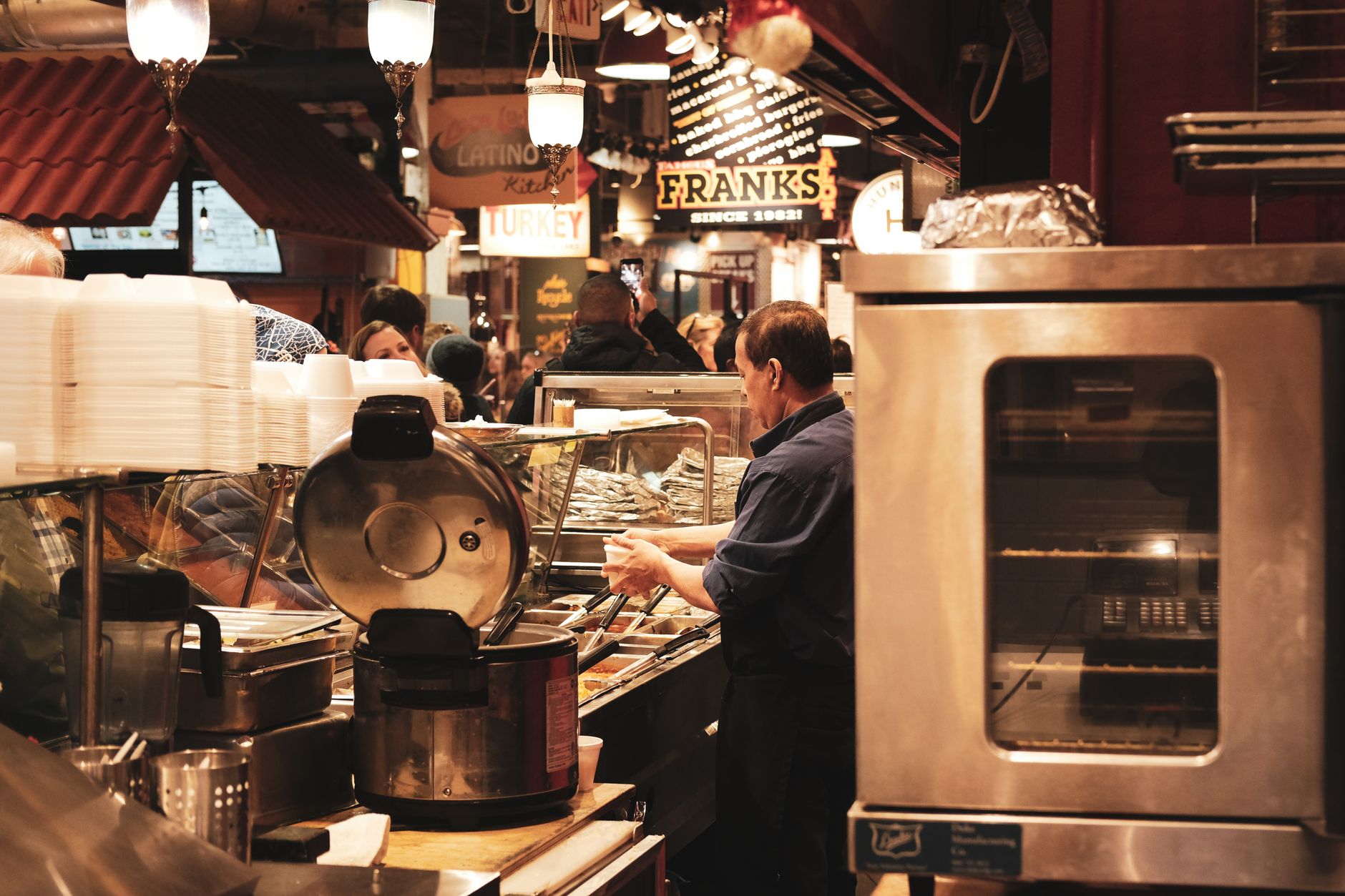
Food halls are a large and growing format. According to the 2026 food hall industry report, 458 food halls were operating in the US, with at least 114 more projects in the pipeline. Many halls hold several independent vendors under one roof, so one site can have many pickup points and many drop points on a shared floor.
Two halls of the same size can need very different robots. The first question is not how big the room is. It is how many separate runs happen in one peak window and whether those runs repeat along the same lanes. That pattern decides whether a fixed route is practical.
Which factors raise or lower the cost at a food hall?
Route length and layout is the largest factor. A robot carrying plates from a counter at one end of the hall to a table at the far end does more work per trip than one serving nearby tables, and it needs more mapped path, more battery planning and clear lanes. Long, straight, clear routes are usually simpler to set up than many short routes that cross, merge and double back.
Floor surfaces and thresholds matter. Smooth concrete, tile and sealed stone are usually easier to map and drive over than carpet, raised thresholds, drain covers and ramps. Each transition can add a setup step or force a detour, and seating areas with rugs may need a dedicated lane or a route of their own.
Traffic and peak timing decide how many units you need. A hall with a sharp lunch peak and quiet afternoons is planned around the peak, not the daily average. When guests crowd the aisles in the same minute, the robot's speed and stop behavior become part of the plan, and one unit may not cover the rush.
Mapping and site assessment is a fixed effort that does not shrink with the size of the robot. It includes walking the route, marking zones, testing each pickup and drop point and setting safe stopping distances. A hall with many vendors has more points to test, so the work grows even when the floor stays the same size.
Integration with ordering and kitchen tickets adds effort. A robot told by hand which tray goes where is a demonstration. A robot that receives a ready signal from the point of sale or the pass, and reports delivery back to the system, needs a connection with each vendor system. Counting those systems early is one of the most useful steps you can take.
Number of units and service coverage complete the picture. One unit on a simple loop is less work to plan than a small fleet that shares a charging area and a dispatch process. Service response time also matters. A hall that cannot afford a stopped robot during peak may need a spare unit, and that changes the scope of the lease.
Why do food halls suit a delivery robot, and what does the staffing data show?
A food hall run is short, repeated and fixed. A finished order leaves a stall, travels a known path and arrives at a seat. Robots suit that pattern because the path can be mapped once and reused. The real question is whether those repeated runs take enough staff time to justify the effort of setting up a robot.
Staffing is the pressure point. According to the Bureau of Labor Statistics Occupational Outlook Handbook, waiters and waitresses held about 2,329,700 jobs in 2024. Projected employment change over 2024 to 2034 is down 1 percent, about 16,300 fewer jobs, and about 456,700 openings are projected per year on average over the decade. Those openings include replacements for workers who leave, so hiring never stops.
Turnover is high across the sector. Food halls are restaurants and sit inside accommodation and food services, which the Bureau of Labor Statistics tracks. The Federal Reserve Bank of St. Louis reports quits in that sector at 514 thousand in October 2025, 583 thousand in November 2025 and 605 thousand in December 2025. In its September 2025 jobs openings release, the Bureau said accommodation and food services accounted for a 158,000 increase in quits, the largest sector increase since July 2021.
For a hall manager, the implication is practical. Every open runner shift is a run someone else must cover. A delivery robot does not replace the host, the bartender or the cashier. It takes over the repeated carry on a fixed route, so people can focus on the counter, the seats and the guest.
How does leasing through financing work, and what does the quote include?
Robots are leased through financing, and the cost is spread across the lease term as a fixed robot lease payment written into your quote. The lease terms, including term length and any end-of-term options, appear in the lease documents for review. Terms come from the written quote and lease documents, not from a verbal estimate.
The quote is written only after a free site assessment. We walk the route, count stalls and seating zones, check flooring and thresholds, observe the peak window and confirm how many units the route needs. Without those measurements, any number would be a guess, and a guess is a poor basis for a lease.
A complete quote should let you compare the parts. It should list the lease itself, the number of units, whether a spare unit is included, mapping, deployment and integration, staff training, go live support, and the service plan with remote triage and on-site dispatch. If a line is missing, ask about it before you sign.
You can start small. A hall can lease one unit for its busiest route, run a phased deployment that keeps existing staff serving until the robot is working, and add units once the route and peak data are proven. That keeps disruption low and gives you real operating data before you commit to a larger fleet.
- Lease terms through financing, including term length and what the fixed payment covers
- Number of units and whether a spare unit is included
- Site assessment mapping and route setup
- Deployment and integration with ordering and kitchen signals
- Staff training and go live support
- Service plan with remote triage and on-site dispatch
How many labor hours does a delivery robot take over each shift?
The honest answer depends on the hall, and this page does not publish a figure for runner or busser hours. The research behind it did not find a reliable source for those hours, so it is better to show the work by task than to invent a number. The table below lists what changes, so you can match each line to your own records.
Your own data is the best measure. Count runs per peak window from the point of sale, record the time from ready to delivered, and note how many runners are on the floor during each run. The site assessment captures the same measures on your floor before any quote is written.
Once you have those numbers, the question becomes which runs a robot can take on its route and which stay with staff. Runs that cross the hall, return trays or need a person at the table stay with people. A robot takes over the repeated carry, which is the most predictable part of the job, but it does not remove the whole job.
What can a delivery robot not do in a food hall?
A delivery robot moves trays along a mapped route. It does not take orders, answer questions about allergens, check that a dish is right or resolve a guest complaint. Those jobs stay with the people who run the stalls and the floor, and they should be planned that way from the start.
It also has limits on routes. Stairs, unmapped levels, steep ramps and blocked exits should not be planned into a robot route without a separate design and safety review. Crowded seating can slow it, and a robot that stops for a guest's bag needs a clear lane to resume.
Most faults need a person. A jam, a sensor fault or a battery issue usually means staff clear the lane, reset or pull the unit and call for help. That is why the service plan and spare unit planning matter as much as the robot itself.
Guest acceptance is a real question. A consumer survey reported in the trade press found about 47 percent of customers would order from a restaurant using drones or autonomous vehicles for delivery, up from 44 percent in 2021. A separate trade press report found about one third of diners do not want robots preparing their food. Carrying food is not the same as preparing it, so explain the robot's role plainly to guests.
Safety in crowded food service needs context. Bureau of Labor Statistics data for full-service restaurants, from 2018, estimated 7,850 injuries from falls, slips and trips, of which 5,170 were falls on the same level. That data is older and describes people, not robots, but it shows why aisles, wet floors and crowd flow need planning around any moving device.
How do you get a quote after a free site assessment?
Getting a quote is a short process. It starts with a free site assessment, and the quote follows from what that visit finds. We do not give a figure from a floor plan alone, because the route, the flooring and the peak traffic change the number, and a drawing rarely shows all three.
Before the visit, gather the stall count, the number of seating zones, the ordering systems in use, a rough peak window and any events that block lanes. A list of pickup and drop points helps too. This speeds the assessment and makes the quote more accurate.
After the lease is chosen, deployment, integration and training follow, and the robot goes live with support on site. Service continues after go live, and we service robots nationwide, so the same team can support a hall in another city. One partner and one number keep the work in one place.
Is a delivery robot worth it for a food hall?
Whether it is worth it depends on the hours you can move, the peak you need to cover and the cost of a stopped lane. A hall with a steady lunch peak and hard-to-fill runner shifts has a very different case from one with light traffic all day. The honest test is whether the repeated carry is a large share of your staffing problem.
Savings are real only when the robot takes work staff would otherwise do, and when the service plan keeps it running at peak. Ask how the robot performs during the rush, not during a quiet demonstration. A pilot on one route with clear measures of success is the cleanest way to test the case.
Before deciding, check the route, the flooring, the number of vendor systems, the peak window, the service terms and the guest experience. Those six items decide most of the answer, and the site assessment covers each one.
Frequently asked questions
Want a delivery robot at your food hall?
Tell us about your site. We will recommend the robot, quote the lease, and keep it serviced.
Sources
- Bureau of Labor Statistics, Occupational Outlook Handbook, waiters and waitresses
- Bureau of Labor Statistics, Job Openings and Labor Turnover release, September 2025
- Federal Reserve Bank of St. Louis, quits in accommodation and food services
- Bureau of Labor Statistics, full-service restaurants injury fact sheet, 2018 data
- 2026 food hall industry report, as covered by hospitality news
- Trade press report on consumer acceptance of autonomous delivery
- Trade press report on diners who do not want robots preparing food