
The short answer
The robotic lawn mower cost for office parks depends less on the machine than on the site: how much open turf there is, how islands, slopes and beds break it up, when it can run without disturbing people, and how much mapping, integration and service the property needs. A lease quote is built from those inputs after a free site assessment, not from a template. For most properties, the figure to test is the mowing and edging hours a grounds crew spends on the same turf each week.
Key takeaways
- Turf area, how it is split into zones, and slopes set most of the scope.
- Quiet mowing windows reduce conflict with people, but lighting and gate access must be checked.
- Mapping, integration and training are one-time work that belongs in the quote.
- Crew hours on open turf are the number to test any lease quote against.
- A free site assessment comes before any lease quote.
How much does a robotic lawn mower cost for office parks?
There is no single figure that fits every office park, and a number quoted before anyone has seen the grounds should be treated with suspicion. The robotic lawn mower cost for an office park is set by the scope of the site and the terms of the lease, and both are settled only after someone walks the property. The sections below explain what moves that number, so you can test a quote when it arrives.
The property base is large. According to the BOMA 2022 Office Market Study, privately owned office buildings of 25,000 square feet or more held 8.6 billion square feet across 85 markets served by BOMA local associations. That study measures floor area and excludes government-owned buildings. It does not measure lawns, so the size of any one park has to come from a survey of your own grounds.
We build the quote from that survey and the site visit. A lease quote follows a free site assessment, and it states the robot, the lease term, the fixed robot lease payment and what the lease covers. The quote is not a template.
What drives the cost up or down at an office park?
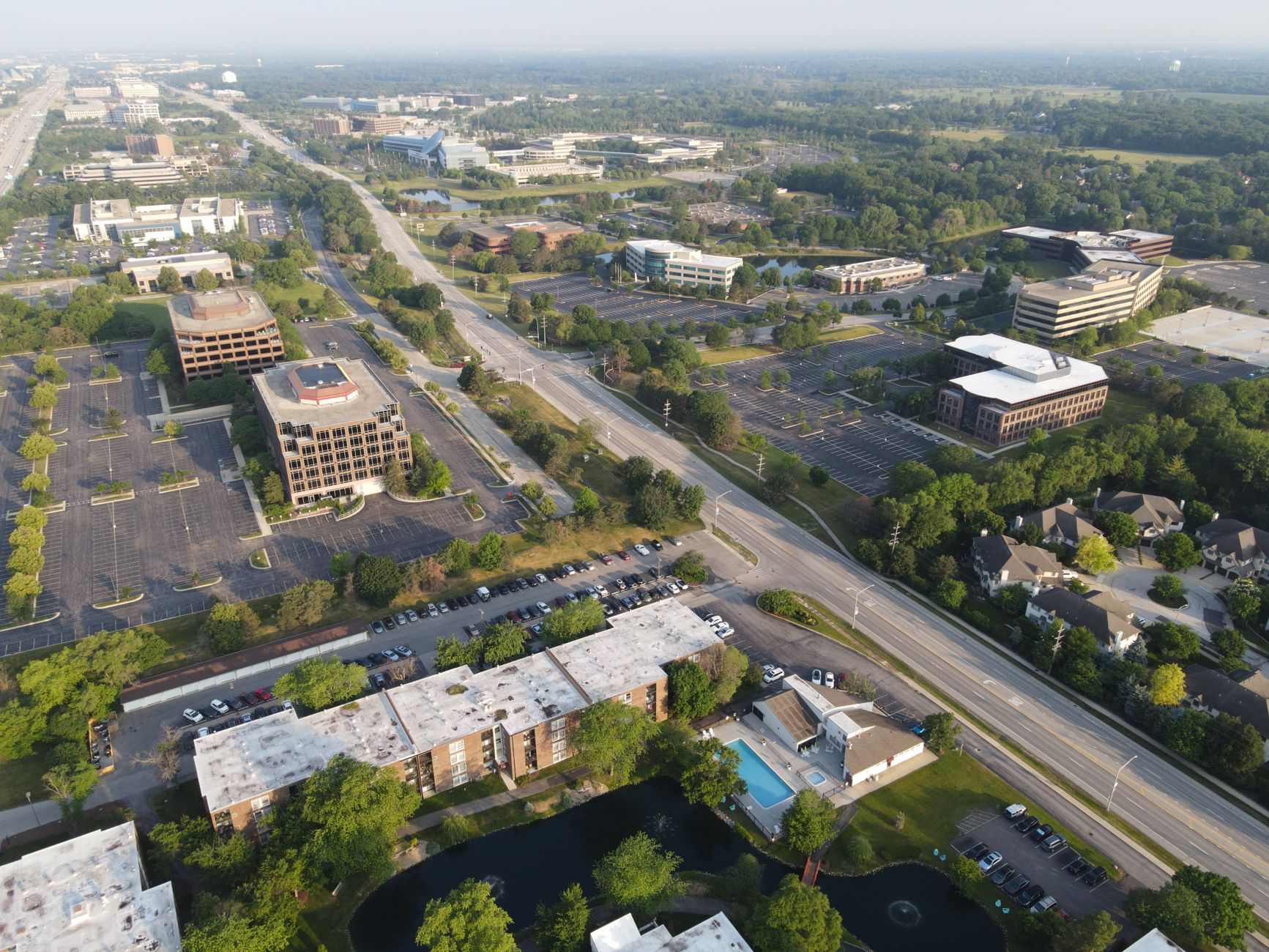
The biggest driver is how much mowable turf there is and how it is divided. A park with one large open field costs less to set up than the same acreage broken into many small islands, each with its own curb edge, tree ring and sign post. Every separate zone adds boundary mapping and another route to check, so the zone count matters as much as the total area.
Slope and surface come next. Flat, unobstructed lawn is the easiest case. Berms, steep banks, drainage swales and gravel strips can require a different unit or extra boundary work, and they slow the machine down. Benches, light poles, signs and landscape beds add mapping and fencing time that rises with their count.
The mowing window is a driver people underestimate. A run during quiet hours keeps people out of the path, but a night or early morning run needs lighting, gate access and sometimes added sensing. A window that overlaps with deliveries or staff arrivals may need a shorter schedule or a different sequence of zones.
Unit count and service distance set the rest. One robot covers one zone, and a second unit adds a charging point and a backup path for the day one is serviced. A site near a service base can be attended quickly, while a remote site needs a longer response plan, and that goes into the quote.
Why do office parks suit scheduled autonomous mowing?
Open turf between buildings is where a robot does the most useful work. The route follows lawn and avoids parking, entrances and walkways, and the run happens on a fixed schedule. When the mowing runs during low-traffic hours, people do not have to dodge it, and the grounds crew moves on to edging, bed work and irrigation checks.
The labor pool is large but not growing fast. According to the Bureau of Labor Statistics, Occupational Employment and Wages for May 2023, 929,930 people worked as landscaping and groundskeeping workers. The Bureau's Occupational Outlook Handbook projects 4 percent growth for grounds maintenance workers from 2024 to 2034, which it describes as about as fast as average.
Average growth does not guarantee available staff in any given town, so the case for scheduled autonomy rests on predictable hours on the open turf. It is not a claim that a robot replaces a crew.
How many mowing hours does a robot take over?
Mowing time depends on area, slope and obstacles, and the best published benchmarks are rougher than most owners expect. A vendor pricing guide on commercial lawn care gives 1 to 1.5 hours per acre for a commercial mower on flat, unobstructed ground, and 1.5 to 3 hours per acre for standard mowing and edging on complex or sloped sites. The guide does not come from a time study, and its ranges disagree at the edges, so use them to frame a site walk, not to sign off on hours.
Crews also lose productive time to travel, fueling, trimmer work and set-up. The same guide family notes that downtime and travel reduce productive hours on the job. Count those losses when you compare a crew's day with a robot's run, or the comparison will overstate the crew's hours on turf.
A useful comparison works from the same turf on both sides. Record how many hours the crew spends on open lawn in a typical week, then subtract the edging, trimming and checks that stay with people. What remains is the labor a robot could take over, and that is the number the lease quote should be tested against.
Labor pressure is why many managers look at hours at all. According to the National Association of Landscape Professionals, as reported in a landscape trade magazine, over 80 percent of landscape companies report difficulty finding qualified workers. Turnover adds to it. The association's 2024 Compensation and Benefits report, using 2023 data, found quit rates fell from 37 percent in 2022 to 30 percent in 2023, and operations-role turnover at larger firms was 35 percent, against 23 percent for all respondents.

How does leasing through financing work, and what does the quote include?
The robot is leased through financing. You pay a fixed robot lease payment over the term instead of one large payment at the start, which spreads the cost across the years the robot works. The term, the payment and the start date are set in the quote after we assess your site, so the numbers reflect your turf and not a generic model.
The lease term matters as much as the payment. A longer term spreads cost further but ties the site to one set of terms, while a shorter term limits that exposure. Ask how the quote changes if the layout changes, because a new building or a removed island can alter the zones the robot covers.
A quote from us covers the robot lease, deployment and integration on your grounds, staff training, and nationwide service. It also states the lease term, the mowing window the layout supports and the response time you should expect. Ask for each item in writing, and ask what is excluded, because an exclusion is where most surprises appear.
- Robot lease through financing, with the term and fixed payment stated
- Site assessment, mapping and integration with your grounds
- Staff training on pausing, clearing and reading alerts
- Nationwide service and the response time for your location
What can a robotic mower not do at an office park?
A robot handles regular mowing on defined turf well, and it does not replace judgment on the rest. Tall, wet or matted grass after a storm usually needs a manual pass first. Heavy leaf loads, construction debris and tree litter can block sensors or wheels. Steep banks beyond the unit's rated slope, tight beds and zones with unpredictable foot traffic need a different tool or a manual crew.
Weather and season change the job. Wet turf and saturated soil can stop a run or leave tracks, and spring flush or fall leaf drop can outpace a fixed schedule. Plan the window so the robot covers open turf on normal days, and a crew handles the peak weeks.
Adoption on commercial grounds is still early, and owners are still testing how the machines perform across different sites. A single-zone pilot is a sensible way to test that before committing a whole campus.
Safety belongs in the picture too. A news report citing federal data puts the fatal injury rate for grounds maintenance workers at 20.9 per 100,000 in 2024, with 239 fatalities. A safety records site citing Bureau of Labor Statistics data reports 3.0 injuries and illnesses per 100 full-time workers in 2024 for landscaping services employers. That second figure is an industry-level secondary summary, so use it as context. A robot cuts exposure on the open lawn, but people still work near moving equipment and need training.
How do I get a lease quote for my office park?
Start with a free site assessment. We walk the property with you, measure the turf, map the zones, note slopes and obstacles, and agree a mowing window that fits your staff and visitors. From that visit we pick the robot that fits the grounds, and we send a lease quote built from the site.
The steps are short on paper, and the work in each one is specific. The assessment turns your grounds into scope, the quote turns scope into a lease, and deployment turns the lease into a working route. Each stage has a clear output you can check before you move on.
Expect a review of the early runs with your grounds lead before the schedule is treated as settled. The first weeks show where the robot pauses or hesitates, and that is when the map and window get adjusted.
What should I gather before the site assessment?
Bring what your team already knows. The better the inputs, the tighter the quote and the fewer changes after go-live. Most of it is available from the grounds lead, the facilities office and the crew's records.
Note any area that floods, drains slowly or stays wet after rain. Those spots change the run more than their size suggests, and the assessment should see them in person.
- Site map or aerial image with turf, beds and paths outlined
- Count of separate turf zones, islands and slopes
- Hours when staff, deliveries and visitors use the grounds
- Existing mowing hours and crew size for the same turf
- Gates, lighting and irrigation schedules the route must respect
- Service contacts and any past equipment incidents on site
Frequently asked questions
Want a robotic mower at your office park?
Tell us about your site. We will recommend the robot, quote the lease, and keep it serviced.
Sources
- Bureau of Labor Statistics, Occupational Employment and Wages, May 2023
- Bureau of Labor Statistics, Occupational Outlook Handbook, grounds maintenance workers
- BOMA 2022 Office Market Study
- National Association of Landscape Professionals, 2024 Compensation and Benefits report summary
- Landscape trade magazine reprint on robotic mowers
- Safety records site citing Bureau of Labor Statistics injury data
- News report citing federal fatal injury data
- Vendor pricing guide on commercial lawn care job pricing