Summary
A delivery robot may travel a corridor perfectly and still add work for the team. The decisive moment is often where a person loads it, receives it, and confirms that the right item reached the right place.
Count completed handoffs and the human steps around them. Distance traveled is useful only if those steps become easier.
01 / Analysis
Map the trip from request to receipt
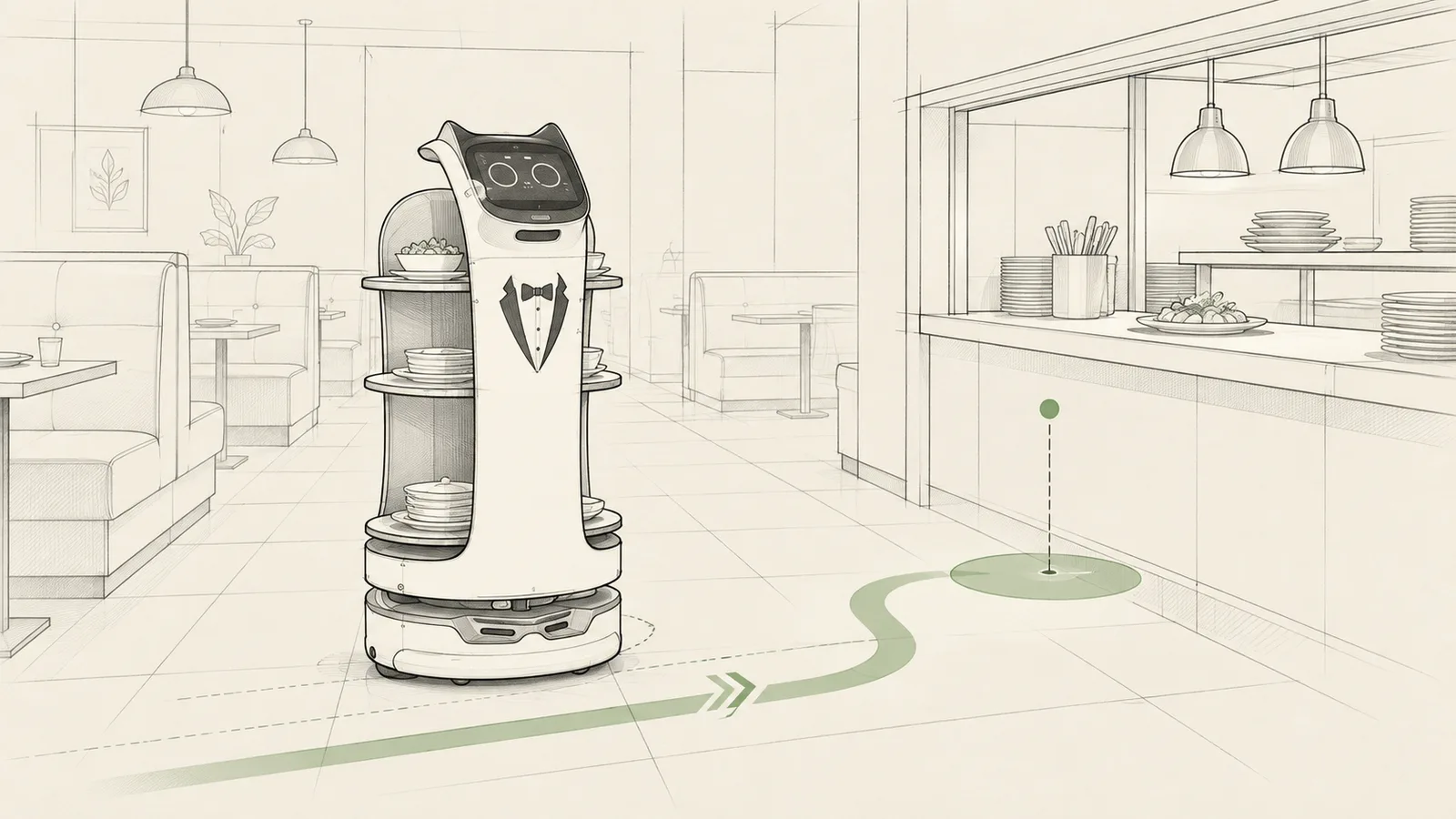
Start with a real task, such as carrying prepared dishes from a kitchen pass to a dining zone. Note who requests the trip, who loads the trays, who sends the robot, who unloads it, and who returns empty dishes. If one person must wait at either end, the robot may shift labor instead of reducing it.
Different items behave differently. Covered supplies can tolerate a pause; hot food often cannot. A route suitable for one may fail for the other. Select one frequent, predictable trip type for the first test rather than averaging every delivery together.
02 / Analysis
Measure the complete cycle
Record the time from a ready item to confirmed receipt. Include queueing at the origin, loading, travel, recipient response, unloading, and the robot’s return. The comparison is the current human trip under the same demand pattern, including any work the employee does on the way back.
Handoffs fail for ordinary reasons: the recipient is busy, the destination is crowded, the wrong shelf is chosen, or a door requires staff help. A pilot should classify these events. “Delivery completed” on a dashboard may mean only that the robot reached a waypoint.
What to record
- Completed trips per shift by task type
- Time staff spend loading, waiting, unloading, and recovering
- Late or incorrect deliveries
- Blocked trips and the intervention required
03 / Analysis
Design the destination, not only the path
A clear stopping position, visible arrival cue, and named recipient can improve the result more than a faster robot. The receiving person should be able to unload without stepping into a traffic lane or leaving another urgent task unfinished.
If the service area changes throughout the day, define the few positions that remain valid. A stable handoff point makes training easier for new staff and gives the team a place to troubleshoot when a trip is delayed.
04 / Analysis
A fair field test
Select one repeatable trip and observe it during the same service windows for both the current process and the robot pilot. Sample quiet and busy periods. If a trip requires an elevator or an access-controlled door, include those steps in the clock rather than treating them as separate infrastructure.
Ask the receiving staff to record whether the arrival helped, interrupted, or delayed their work. A robot can have a high trip count while making the destination harder to run. The team’s account of the handoff is part of the result, not an anecdote to discard.
05 / Analysis
Limit of this note
The workflow model applies to restaurants, hotels, and internal supply runs, but each site has different timing and access constraints. It does not substitute for a route and safety review on site.
Sources and method
This paper synthesizes the sources below and proposes a site-level evaluation method. It does not present original field measurements or a controlled trial.