Summary
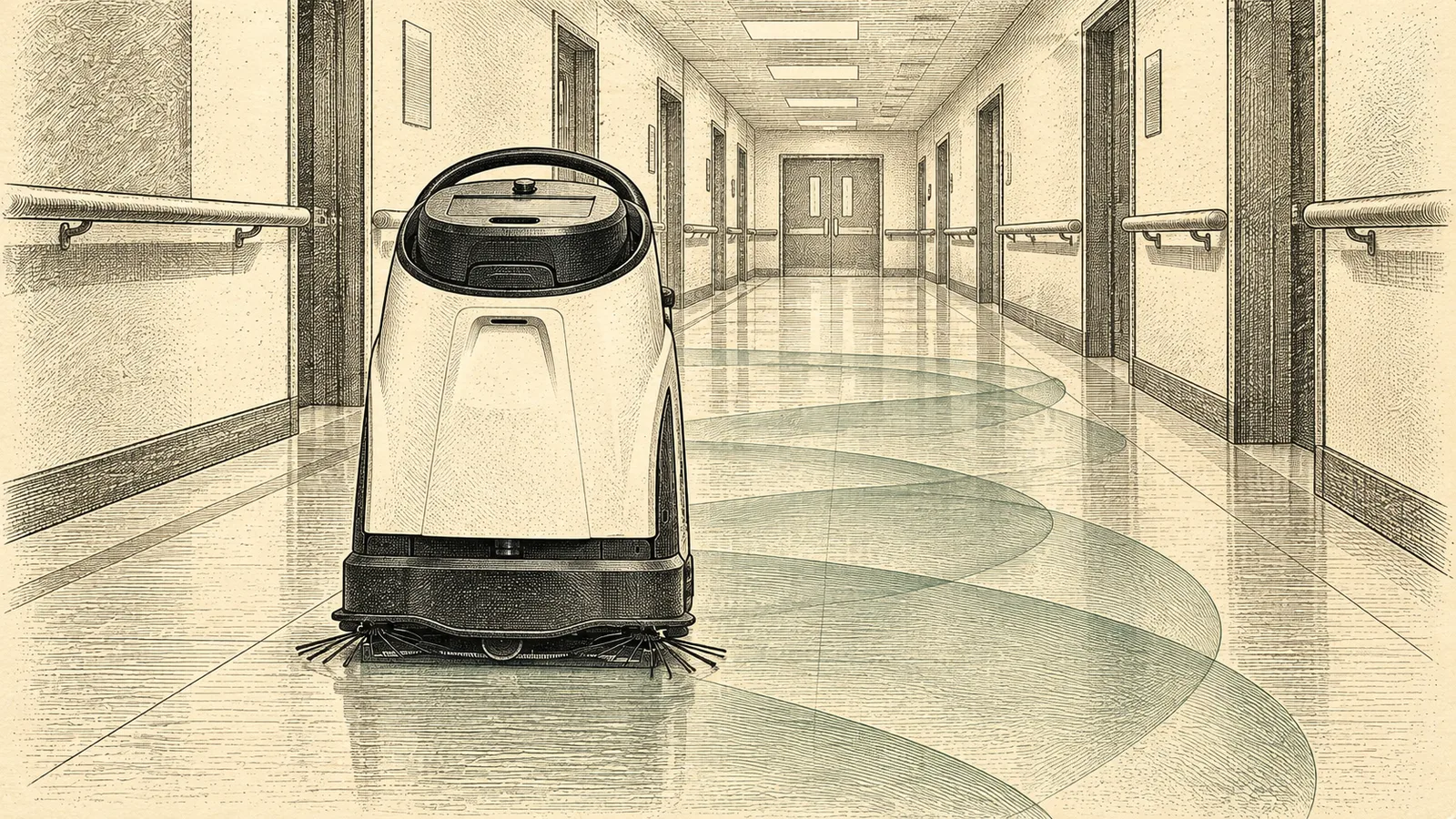
A hospital corridor is an appealing robot route: long, repeatable, and visible. But “cleaning the hospital” is a much larger job. The useful question is which floor tasks the robot can own while the environmental services team keeps control of the full cleaning program.
Assign the robot a defined floor zone and verify it within the facility’s existing cleaning schedule and infection prevention procedures.
01 / Analysis
Start with the facility’s cleaning plan
CDC guidance calls for cleaning schedules that identify the responsible person, frequency, method, and detailed procedures for each area. A robot route should fit inside that plan. It should never be treated as a replacement for the plan itself.
The distinction matters because floors differ from high-touch surfaces. CDC notes that routine patient-area floors are generally lower risk for pathogen transmission than high-touch surfaces, while some areas require different treatment. A machine assigned to a corridor cannot be assumed to handle patient rooms, spills, isolation procedures, or surface disinfection.
02 / Analysis
Define a narrow, auditable assignment
Choose a route with predictable access and specify when it runs. Document the floor material, cleaning solution, signs, people responsible for setup, and what happens when a corridor becomes unavailable. Keep the same inspection standard used for manual cleaning.
Run the test alongside environmental services and infection prevention staff. A route report can show where the machine traveled; a human check confirms whether the area meets the facility’s standard. Treat these as two different records.
What to record
- Approved area and excluded spaces
- Scheduled frequency and verified completion
- Spill and isolation exceptions
- Who handles signage, supplies, and failed runs
03 / Analysis
Look for time that can be reassigned
The operational gain may be that staff can focus on high-touch surfaces or detailed work while a corridor is scrubbed. Test that directly. If the team still has to shadow the robot, the hoped-for benefit has not arrived.
A successful pilot leaves no ambiguity about ownership. Staff know which zones remain manual, when to override a run, and how to log a missed area before the next shift.
04 / Analysis
A fair field test
Use a corridor or other approved zone where environmental services already has a clear schedule and inspection routine. Compare several ordinary shifts with and without the robot. Record the work done by staff before and after the route, especially spot cleaning and high-touch surface work that remains outside the machine’s assignment.
Have the facility decide in advance who checks completion and how a missed run is recovered. The pilot is successful only if the approved standard is met and staff can use the recovered time without creating a new supervision burden.
05 / Analysis
Limit of this note
This note is about workflow design. It does not claim that a floor robot disinfects a space or satisfies any facility’s infection control requirements. Those decisions belong to the facility’s clinical and environmental services teams.
Sources and method
This paper synthesizes the sources below and proposes a site-level evaluation method. It does not present original field measurements or a controlled trial.