
The short answer
Autonomous forklift ROI for tire distribution warehouses comes mainly from taking repetitive pallet moves between racking, staging lanes and dock doors off the labor hours of the laborers and freight, stock, and material movers, hand type of work, on fixed routes that run around staff. The savings range on this page is a planning estimate, not a promise, and it moves with the share of each shift that is route-based pallet work, the lease cost quoted after a free site assessment, and the floor layout. A site assessment is the only way to replace the range with a precise figure.
Key takeaways
- The return comes from repeat pallet routes, not from the vehicle alone.
- Read the savings range as a planning estimate, not a promise.
- Route regularity and floor conditions move the number more than anything else.
- Pedestrian separation is the central safety design task on a forklift route.
- A free site assessment turns the range into a quoted figure for your floor.
Run the numbers for your site
Pick your city or state for a real regional number - we use the real BLS wage there. (On the live site this auto-detects from your location.)
What do you want to automate?
The robot takes the repetitive cart and pallet moves off the heaviest motion.
What return does autonomous forklift ROI for tire distribution warehouses deliver?
Autonomous forklift ROI for tire distribution warehouses comes from one kind of work: pallet moves that repeat on the same routes all shift. Moves between racking, staging lanes and dock doors are predictable enough for a vehicle to run fixed paths around staff. Each move the vehicle takes over is labor time that no longer comes from the laborers and freight, stock, and material movers, hand type of work on the site, and the return is the value of that time set against the lease cost.
The return is not one fixed number. It depends on how much of the movement is repeatable, how many hours of it happen each shift, and what the lease costs once it is quoted. A distributor with long, steady lanes will see more return than one whose moves change every day. The government wage data on this page gives the local wage for this job, which sets the labor side of the math, so the figure you see is tied to the job the vehicle actually does.
What does the work look like in a tire distribution warehouse?
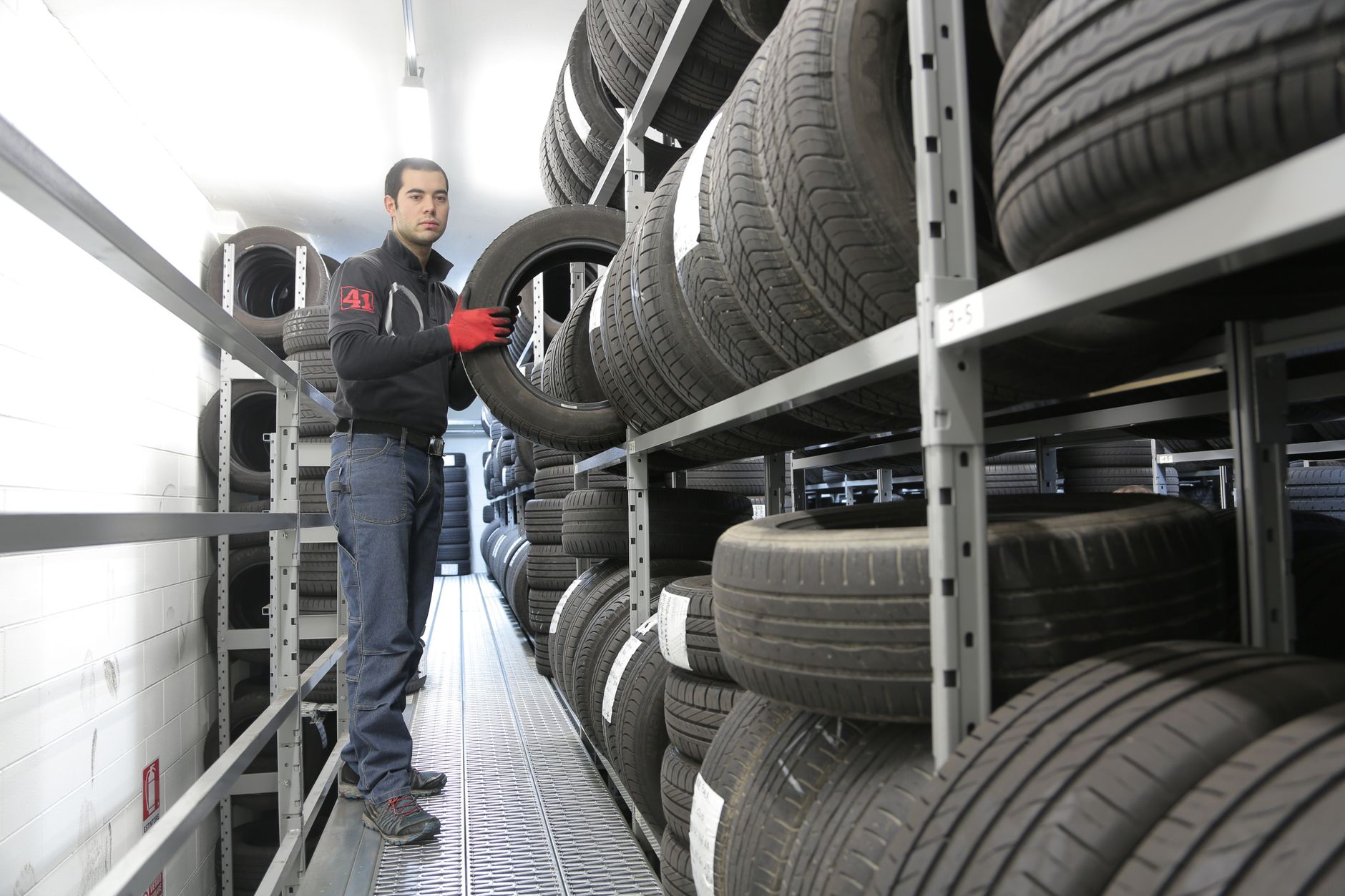
Tire distributors receive finished goods in bulk, store them in racking and ship them to dealers, fleets and retail outlets. Most of the physical work is moving loaded pallets: receiving to put-away, storage to picking areas, and staging to outbound doors. Volume tends to be steady across a shift rather than spiky, which suits automation better than a seasonal operation with sharp peaks. Tires are heavy and stack in bulk, so the tasks that matter most are the ones done over and over with a loaded pallet.
The size of the category is a useful starting point. According to naicslist, citing County Business Patterns 2023, there were about 2,695 establishments in the tire and tube merchant wholesalers category (NAICS 42313). That category is broader than tire warehouses alone, so it does not count those sites directly. Nationally, ONET reports 2,988,900 workers in the broader hand laborers and material movers group in May 2024, which includes the occupation this page is about, with a projection of 3,033,100 by 2034. We did not find a published count of people doing this job at one tire distribution site, so this page does not state one.
Median hourly wage, Laborers and Freight, Stock, and Material Movers, Hand
$4,380
Monthly cost of one full-time worker, at the median wage plus payroll costs (an estimate, not a quote).
How does the savings math work for an autonomous forklift lease?
The math has three parts. The first is the labor hours the vehicle takes over: pallet moves on routes it can run, counted in hours per shift and per week. The second is the share of those hours it realistically covers, since some moves still need a person for exceptions, damaged loads or dock timing. The third is the lease cost, quoted after assessment as a fixed robot lease payment, weighed against the hours recovered and any staff time still needed for supervision.
The calculator on this page is pre-filled for this industry and shows a savings range rather than one figure. Use the range as a planning estimate, not a promise. Before relying on either end, ask what share of routes the range assumes is automated, how many exception hours it assumes, and which shift pattern it uses. Those assumptions are where a range like this can differ from your floor.
What changes the return up or down?
Route regularity is the biggest lever. Lanes that stay put and run the same way each shift give the vehicle more work it can take. Frequent changes to racking, or dock assignments that move daily, lower the share of moves that fit fixed paths, and each re-map takes time away from running the unit.
Floor conditions come next. Clear aisles, a level floor, marked walkways and dependable positioning coverage all let the vehicle keep moving. Foot traffic through planned routes is the main constraint, because it sets how much separation staff need and how often the unit has to slow or stop. Shift length matters too. A long shift with steady pallet flow spreads the lease cost over more hours, while a short single shift leaves the same cost against fewer moves.
What are the risks to the return, and how do you avoid them?
The most common risk is over-scoping. A site that automates every route on day one meets exceptions it has not planned for, and the return falls while staff learn the system. Start with the routes that repeat most, run them for several weeks, and widen the scope only when the measured hours hold. A clean baseline is cheaper than a large first phase that stalls.
The second risk is staff acceptance. Operators who see the vehicle as a threat stop trusting it, and exceptions pile onto the people who were supposed to be freed up. Train the crew who work beside the units, set clear rules for when a person takes over, and name a contact on each shift. Service is the third risk. A unit down for days wipes out its share of the return, so the quote should show how repairs are dispatched and whether a spare unit is covered. As an integrator, we pick the unit for the floor, lease it, deploy and integrate it, train staff and service it nationwide, which keeps those pieces under one plan.
- Repeat pallet moves on fixed routes
Autonomous Forklift
Runs the same path each time without fatigue
Staff
Adapts quickly when the route changes
- Long shifts with steady flow
Autonomous Forklift
Keeps a steady pace under staff supervision
Staff
Stays flexible across tasks and can rest or rotate
- Unusual or damaged loads
Autonomous Forklift
Stops and signals for help
Staff
Judges the load and decides what to do
- Dock timing and carrier changes
Autonomous Forklift
Follows scheduled routes, which must be updated when they change
Staff
Adjusts on the spot
- Cost pattern over time
Autonomous Forklift
Fixed lease payment plus service
Staff
Costs that move with hiring, training and turnover
- Work outside mapped routes
Autonomous Forklift
Not suited without remapping
Staff
Covers it without setup
How do safety numbers shape the decision?
Safety is part of the return, because incidents cost hours and trust. The U.S. Bureau of Labor Statistics reports that total recordable cases in warehousing and storage were 4.8 per 100 full-time workers in 2024, with days-away, job restriction or transfer cases at 4.1 and days-away cases alone at 1.5. Fatalities in the industry rose to 32 in 2024 from 28 in 2023, although BLS notes a series break beginning with 2023 data because of the NAICS 2022 revision, so compare those years with care.
Forklift risk concentrates in a few patterns. An OSHA directive based on BLS data identifies pedestrians struck by lift trucks as the leading fatal event in lift truck related work fatalities. An older NIOSH alert from 2001 breaks forklift fatalities down as overturns at 22%, workers on foot struck at 20%, crushing at 16% and falls from forklifts at 9%. That breakdown is dated, but it points to the same design task: keeping people and moving trucks apart on the route.
How common is autonomous forklift adoption in warehouses?
Adoption is real but uneven. A vendor-reported survey, covered by a trade publication, found more than 70% of respondents had adopted or planned to adopt autonomous mobile robots or automated guided vehicles. That figure covers AMRs and AGVs in general rather than forklifts, and it comes from a company in the market, so read it as direction rather than a measured rate.
Full automation is still rare. A trade article citing a report puts full automation at about 3 to 5% of warehouses, and notes that nearly 10% of new leases signed by one large industrial landlord incorporate automation. The practical read is that many sites add automation in stages on a few routes, which is the pattern this page assumes. We found no survey specific to autonomous forklift adoption, so the adoption picture here is indirect.
What is a realistic timeline from assessment to payback?
Expect the timeline to run in stages. Assessment and route mapping come first, then the lease is quoted, then deployment and integration, staff training and go-live support follow. A single-route start can move quickly once the floor is mapped, but the calendar depends on dock schedules, any floor work and how many routes are in scope. Payback cannot be stated before the inputs are measured, so any date given before assessment is a guess.
A phased start usually runs in three steps: one or two routes first, several weeks of measured results against the baseline hours, then a decision on wider scope. Payback comes when the hours taken over, net of supervision and exception time, cover the lease over its term. The assessment is where those hours are measured, which is why it comes before any number is committed.
How do you get a precise figure from a free site assessment?
A free site assessment replaces the range with a figure. We map the routes, log pallet moves by type over sample shifts, measure the share that fits fixed paths, and identify the staff time still needed for exceptions. Those measurements give the labor hours the vehicle takes over, which feed the calculator and the quote, so the savings range becomes a number tied to your floor.
Bring your dock schedule, a rough count of shifts and lanes, recent safety records for the area, and any plans to change racking. The quote covers the whole setup, not only the vehicle: the unit suited to the floor, the fixed robot lease payment, deployment, staff training and nationwide service. Payment is quoted after the assessment, so you see the number before you commit to anything.
Frequently asked questions
Want an autonomous forklift at your tire distribution warehouse?
Tell us about your site. We will recommend the robot, quote the lease, and keep it serviced.
Sources
- US Bureau of Labor Statistics, Occupational Employment and Wage Statistics (OEWS May 2024)
- O*NET Online local trends, hand laborers and material movers
- U.S. Bureau of Labor Statistics, Occupational Outlook Handbook, hand laborers and material movers
- naicslist, NAICS 42313 tire and tube merchant wholesalers (County Business Patterns 2023 figure)
- U.S. Bureau of Labor Statistics, industry injury and illness data, warehousing and storage (NAICS 493)
- OSHA Compliance Directive CPL 04 on powered industrial trucks
- NIOSH 2001 alert on forklift fatalities (archived)
- SDCExec coverage of a vendor-reported warehouse automation survey
- GlobeSt trade article on warehouse automation citing a report