
The short answer
The autonomous mobile robot ROI for airport cargo terminals comes mainly from labor hours, because the robot runs the fixed routes that move cargo between staging and loading areas and frees people for work that needs judgment. The return is a range set by how many hours of laborers and freight, stock, and material movers, hand work the robot really takes over, the lease cost quoted after a free site assessment, and how steady the route volume is. Payback timing follows those same inputs, so the calculator on this page is pre-filled for this setting and the final figure comes from your own floor data.
Key takeaways
- The return comes mostly from labor hours on fixed cargo routes, not from headcount cuts.
- The savings range is priced on the hours of laborers and material movers work the robot takes over.
- Lease cost is quoted after a free site assessment, built on your floor and your shift data.
- Turnover and unfilled shifts raise the value, while poor route fit and idle units lower it.
- Measure your own floor for a few weeks before committing to a full fleet.
Run the numbers for your site
Pick your city or state for a real regional number - we use the real BLS wage there. (On the live site this auto-detects from your location.)
What do you want to automate?
The robot takes the repetitive cart and pallet moves off the heaviest motion.
What return can an airport cargo terminal expect from an autonomous mobile robot?
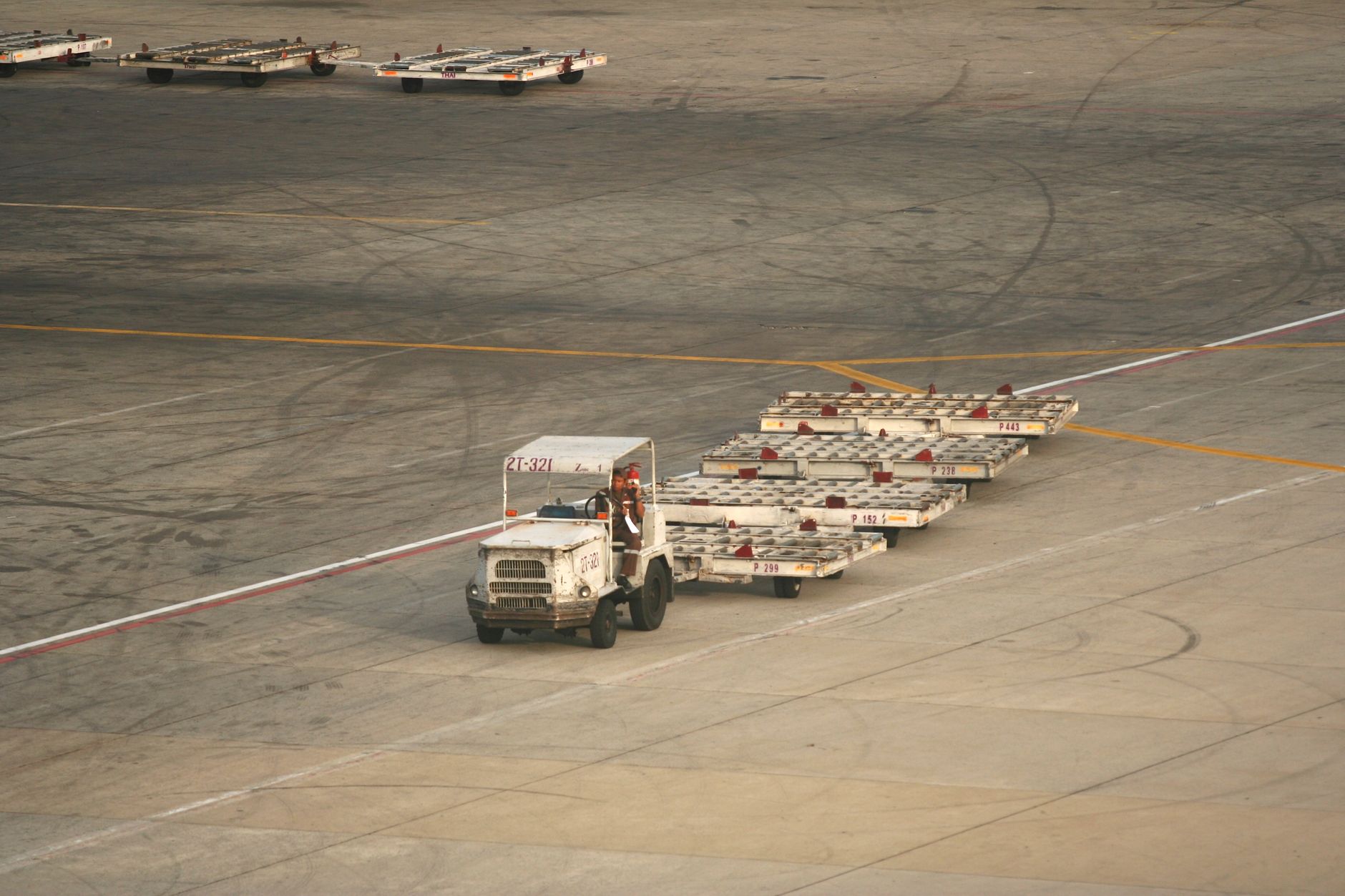
Cargo on a terminal floor moves in short, repeated trips. Freight is staged near the building, then carried to loading positions where containers and pallets are built up for the next departure. An autonomous mobile robot ROI for airport cargo terminals depends on how much of that movement follows a fixed route a robot can run without a driver. Where much of it does, the return shows up as labor hours returned to the people who handle exceptions, documents and damaged loads.
A realistic return is a range, not a promise. It is built from three parts: the hours of work the robot takes over, the cost of leasing the robot through financing, and the operating effects that come with it, such as steadier throughput and fewer manual trips. Each part depends on the floor. The robot needs clear lanes, a predictable flow of freight and staff who know how to call the unit at each handoff point.
This page explains where the return comes from, how the math works, what moves the number, the risks, a timeline from assessment to payback, and how to get a precise figure from a free site assessment. The calculator is pre-filled for this setting, so the range beside this text reflects a typical cargo floor, not your building.
How big is the airport cargo workforce, and why does turnover matter?
The U.S. airport system is large. According to AAAE, reporting the Federal Aviation Administration's National Plan of Integrated Airport Systems for fiscal years 2025 to 2029, the plan lists 3,292 public-use airports, of which 3,287 already exist. Cargo volume is concentrated at a much smaller set of those sites, which is why an airport cargo terminal is a specific operation with its own staffing pattern rather than a generic airfield.
Staffing is where the pressure shows. A survey of 142 air cargo professionals, run from February 5 to March 3, 2025 and reported by Aviation Business News, found that 59% had seriously considered leaving the industry. Respondents cited unpredictable schedules, outdated technology and limited career progression. Air Cargo Week, citing the IATA Ground Operations Survey of 2023, reports handling turnover of up to 50% a year, and says 60% of operators reported not having enough qualified staff. Those are industry-wide figures and were not measured at one terminal, so use them as context to check against your own records.
Turnover matters for ROI because every open shift has to be covered by overtime, temporary staff or a slower floor. A robot on a fixed route does not quit, but it cannot replace the judgment a lead handler brings to a damaged pallet. That split shapes the whole return.
Median hourly wage, Laborers and Freight, Stock, and Material Movers, Hand
$4,380
Monthly cost of one full-time worker, at the median wage plus payroll costs (an estimate, not a quote).
Where does the labor return come from on a cargo floor?
The labor side of the return is the hours of moving work the robot takes over. For this setting, that work is priced on the hours of laborers and freight, stock, and material movers, hand work, the kind of job that stages, carries and positions freight. The government wage data for that occupation appears in the panel beside this text, so you can apply your local figure to your own hours without guessing.
The occupation is large. According to the Bureau of Labor Statistics Occupational Outlook Handbook, the hand laborers and material movers group had about 7.0 million jobs, and Laborers and Freight, Stock, and Material Movers, Hand is listed at 2,988,900 jobs. That scale means many employers compete for the same workers, which shows up as recruiting pressure on airport and contractor payrolls.
Count the hours two ways. First, time a sample of shifts and log every trip between staging and loading. Second, mark which of those trips follow a fixed path, since those are the trips a robot can run. The table below shows the task types that usually fall into each group. For the illustrative crew on this page we assume six people on a typical shift. That is a planning assumption, not a published count, and your roster replaces it during the assessment.
How does the ROI math work for a cargo terminal robot?
The formula is simple. Take the hours per week the robot can realistically handle, multiply them by the local wage for laborers and freight work, add the operating effects you can measure, then subtract the lease cost, integration and training, and any service costs not already included. Compare the result with the status quo, which includes overtime, temporary coverage and the gap left by unfilled shifts.
The most important input is the share of work the robot realistically takes. Not every trip on a cargo floor is a route trip. Some are one-off moves, and some need a person to open a door, reposition a container or check a manifest. A sound model starts with the share of trips that run on a fixed path, then discounts for exceptions, charging time and the handoffs people still make. Most sites find the realistic share lower than the first estimate and higher than the pessimistic one.
Lease cost enters as a fixed amount for the lease term, quoted after the site assessment. Financing spreads that cost over the term, so compare the lease payment with the labor hours released each month, not with the full equipment cost. The calculator on this page shows a savings range built from these inputs. Read it as a range that moves when any input moves, not as one number to report upward.
What changes the return up or down?
Four factors move the number most: route fit, volume steadiness, the staffing gap and the number of handoffs. Route fit asks whether the cargo flow can be drawn as repeatable lanes. Volume steadiness asks whether peaks are predictable enough to schedule robot runs. The staffing gap is the difference between the crew you have and the crew you need on a normal shift. Handoffs count the points where a person must take over, because each one is time the robot does not save.
Turnover can raise the value of the return, because unfilled shifts are costly to cover. Stable crews reduce that effect, so the return is larger where turnover is high and smaller where a steady team already covers every shift. Injury exposure works the same way, since a robot that takes repetitive pushing and towing off the daily routine changes the risk picture, as discussed below.
The checklist below covers what to verify before trusting any figure, including the ones in this calculator.
Where does a person still win over a robot?
A robot is good at repeating a known route at the same speed without fatigue. People are better at everything that requires judgment about the load, the paperwork or the situation on the floor. Planning as if the robot does everything leads to a weak plan and a disappointing return, so the split of work has to be drawn honestly before the numbers are run.
Injury risk is why many operators look hard at this work. According to the Bureau of Labor Statistics, transportation and material moving occupations recorded 468,830 days-away-from-work cases in combined 2023 to 2024 reporting, about 26% of the national total and the largest share of any occupation group. Contact incidents were the leading cause of days-away cases, at 27%. For overexertion cases in this group, half led to days away, with a median of 21 days, based on 2021 to 2022 data.
A robot does not remove those exposures, because people still load, unload and walk the floor. What it can do is take repetitive pushing and towing out of the daily routine, which is where many overexertion strains begin. Any injury figure in a business case should come from your own incident log rather than national averages.
- Route repetition
Autonomous Mobile Robot
Runs the same lane at the same speed, shift after shift
Staff
Repeats the route but slows as fatigue builds over a long shift
- Peak surge
Autonomous Mobile Robot
Adds runs on a known lane when the lane is clear
Staff
Can shift to other tasks and absorb an unexpected surge
- Damaged or odd loads
Autonomous Mobile Robot
Needs a person to inspect and decide
Staff
Spots damage, adjusts the load and decides what to do
- Paperwork and checks
Autonomous Mobile Robot
Does not check manifests or documents
Staff
Checks, signs and records each load
- Overnight coverage
Autonomous Mobile Robot
Runs its route without a crew on site when the setup allows it
Staff
Needs scheduling, breaks and supervision
- Judgment near aircraft and trucks
Autonomous Mobile Robot
Follows its configured safety zones and stops
Staff
Reads the situation and adapts to it
What are the risks to the return, and how do you avoid them?
The biggest risk is a weak fit between the route and the floor. Lanes that cross active traffic, change every week or pass through tight doorways consume the hours the robot was meant to save. The fix is a site assessment that maps the floor, sets fixed routes and agrees which handoffs stay with people.
The second risk is idle equipment. A robot that waits because no one has loaded it, or because the handoff point sits too far from the dock, earns nothing. Plan the staging and loading points before the unit arrives, and train the staff who will call it and clear its lane.
The third risk is expecting the robot to solve a labor problem it cannot touch. It takes over specific hours of work. If shifts are short for other reasons, those gaps remain. A pilot with one unit, measured against the hours released, is the safer way to extend the fleet only after the data holds. Keep a plan for downtime too, since a stopped unit hands its work back to the crew.
What does a typical robot shift look like on a cargo floor?
A shift runs on the cargo schedule rather than on the robot's schedule. Before the first departure window, the lead checks fleet status, confirms the lanes are clear and assigns the staging and loading points for the day. During the busy stretch, the robot keeps its fixed routes while people take over documents, damaged loads and anything that needs a decision.
Between peaks, the unit returns to a charging point during a quiet period, and the team reviews stoppages and handoff logs. Those logs are the source of the hours figures used in the next review, which is why a well-kept log matters as much as the robot itself.
Where does adoption stand, and how does this compare with other sites?
Airport cargo is still an early category, and most adoption data comes from warehouses and factories. A 2025 automation study of 217 respondents, reported by Robotics 247, found that 41% used shuttle systems or mobile robotic storage and retrieval systems, and 59% planned to upgrade or implement within two years. Those are warehouse figures, not airport figures, so treat them as direction only.
A separate survey reported by SDCExec found that over 70% have adopted or plan to adopt AMRs or AGVs, and 21% use self-driving forklifts. That figure blends current use with planned use, so it shows momentum rather than a settled rate. Both are useful analogues for the cargo floor, where the same route logic applies.
On airports, autonomous baggage and cargo tugs have moved from trials into staged rollouts at several large hubs. One large Asian hub has tested autonomous baggage tugs since February 2022, and a U.S. airport has demonstrated an autonomous tractor carrying unit load devices. These are useful proof points, but each depends on a tightly controlled airside setup, so the lesson is route discipline rather than copying a fleet size.
How long does it take to reach payback, and how do you get a precise figure?
A typical path runs in stages. The free site assessment maps the floor, measures crew hours on sample shifts, and proposes fixed routes and handoff points. That leads to a lease quote built on your numbers. Once financing is approved, integration and staff training follow, then a go-live period in which routes and staffing are tuned.
Payback timing depends on how fast the hours release and how quickly the team trusts the routes. Expect the early weeks to show the least release, because staff are still learning the handoffs. Payback arrives when the hours released cover the lease cost over the term, and that depends on the steady share of work the robot takes, not on the first week.
To get a precise figure, book the free site assessment and share your shift schedules, incident and turnover records, and cargo volume estimates for typical and peak days. Service Robot Co. is a US commercial robot integrator. We pick the robot that fits the site, lease it through financing, deploy and integrate it, train the staff and service it nationwide. The lease quote comes after the assessment, so the range on this page becomes your number only once your floor has been measured.
Frequently asked questions
Want a warehouse robot at your airport cargo terminal?
Tell us about your site. We will recommend the robot, quote the lease, and keep it serviced.
Sources
- US Bureau of Labor Statistics, Occupational Employment and Wage Statistics (OEWS May 2024)
- BLS Occupational Outlook Handbook, Hand Laborers and Material Movers
- AAAE report on FAA NPIAS 2025 to 2029
- Aviation Business News, air cargo talent crisis survey
- Air Cargo Week, labour and skills shortage
- Robotics 247, Peerless Research Group automation study
- SDCExec, warehouse automation adoption survey
- BLS Injuries, Illnesses and Fatalities, latest numbers
- BLS TED, nonfatal injuries with days of job transfer or restriction, 1992 to 2022