
The short answer
Autonomous mobile robot ROI for hotel laundries comes mainly from taking repeated linen cart runs off staff on set routes between floors, the laundry, storage and the dock. The savings range is set by the share of those runs a robot can realistically absorb, measured against the local wage for that work and the lease cost quoted after a site assessment. Plan around the range a free site assessment produces for your building, because it is an estimate and not a guarantee.
Key takeaways
- The return comes from linen runs a robot works on a set schedule, not from one headline figure.
- The savings range depends on the share of runs the robot can realistically absorb.
- Route count, distance, elevator access and staff turnover move the number the most.
- Injury exposure drops only where the robot replaces manual pushes and the remaining lifts are tracked.
- A free site assessment produces the savings range and the lease quote for your building.
Run the numbers for your site
Pick your city or state for a real regional number - we use the real BLS wage there. (On the live site this auto-detects from your location.)
What do you want to automate?
The robot takes the repetitive cart and pallet moves off the heaviest motion.
Autonomous mobile robot ROI for hotel laundries: what return to expect
Most of the return from an autonomous mobile robot in a hotel laundry shows up as labor hours moved off repeated linen runs, not as one headline figure. The number depends on how many soiled and clean linen trips the building makes each day, how far each trip runs, and how much of that work a robot can carry on a fixed schedule without a person walking beside the cart. Treat the savings range on this page as a frame, then test it against your own run counts.
The setting is large. IBISWorld counts 46,091 hotels and motels as businesses in 2025, growing about 2.4% a year from 2019 to 2024, so the linen cart problem repeats across a very wide base of properties. Other counts of the same market run higher, so confirm which base your own region uses before you size a rollout. Labor pressure is part of the picture as well. The American Hotel and Lodging Association's 2025 State of the Industry, built with Oxford Economics and STR/CoStar data, projects about 2.17 million direct hotel employees in 2025, adding about 14,000 jobs.
Where does the return come from in a hotel laundry?
The return comes from three kinds of movement. Soiled linen travels from floors and the dock to the laundry. Clean linen travels back to storage and floor closets. Heavy carts are pushed through service corridors and up and down elevators. Each movement consumes labor, and each also carries physical exposure. The Cal/OSHA DOSH housekeeping fact sheet lists linen-cart loading, pushing and pulling among common injury-causing tasks, so the same work that takes hours also takes a toll on the body. A robot reduces that exposure only where its routes replace the manual pushes.
Linen work repeats on set routes: the same floors, the same corridors, the same dock and the same storage rooms every shift. That repetition suits autonomous mobile robots, which follow mapped routes on set times. The return is strongest where routes are long, frequent and predictable. It is weakest where the building is small, the runs are irregular, or the elevators are shared heavily with guests at peak hours.
The robot takes the laborers and freight, stock, and material movers, hand type of work off the staff plate, and that is the work the return is counted on. Room cleaning, sorting and quality checks stay with the people who do them today.
Median hourly wage, Laborers and Freight, Stock, and Material Movers, Hand
$4,380
Monthly cost of one full-time worker, at the median wage plus payroll costs (an estimate, not a quote).
How does the savings math work?
The calculation starts with the hours of freight, stock and material moving work the robot takes over. Those hours are valued at the local wage for that job, using the government wage data on this page. From that value, subtract the lease cost quoted after a site assessment, any staff time added to load, supervise or clear the robot, and any extra dock or storage handling the change creates. What remains, shown as a range, is the savings range. Each input has to be measured for the building, not borrowed from another property.
The share of work the robot realistically takes is the variable that matters most, and it is rarely 100 percent. A workable plan assigns the robot the scheduled runs while staff still handle sorting, exceptions and loads that need hands. Room work competes for the same staff. Smartness, a consultancy benchmark, cites checkout cleans of about 20 to 35 minutes and stayovers of about 15 to 25 minutes. Those are room cleans, not linen runs, so they show what housekeeping time is at stake, not how many hours a robot will absorb.
Linen volume sets the run count. A consultancy planning figure from Caldwell and Gregory uses about 15 pounds of linen per room per day, with wet laundry about 30% heavier. As a worked example, a 200-room property at that planning rate handles about 3,000 pounds of linen a day before the wet-laundry allowance. Divide the total by what one cart carries, and you have a first estimate of trips per day to test against your own logs.
Treat that planning figure as a starting point only. Occupancy, linen par levels and the number of laundry cycles each change the real weight moved, so the assessment replaces it with counts from your building.

What changes the savings range up or down?
Route count and distance push the number up. A long haul from a basement laundry to upper floors means more staff time per trip, so each run the robot replaces counts for more. Short, scattered routes do the opposite, because the time saved on each run is small and setup time takes a larger share.
Elevator access matters as much as distance. A robot that waits on a shared elevator loses cycle time, and the schedule has to absorb that wait. A freight elevator that is free at set hours gives the schedule room to work, while a single lift that guests use at peak check-in hours can cut the number of runs the robot finishes per shift.
Local labor and staffing change the math too. AHLA projects New Hampshire about 21.9% below its 2019 employment and Montana about 16.29% above it, so the labor supply behind the local wage varies widely by state. Turnover is high across the sector. A 2025 hospitality labor report, as summarized by Hotel Business, puts annual turnover at 70% to 80% for hotels and restaurants, although it does not break that figure out by job level, so treat it as a sector signal rather than a figure for laundry staff.
Occupancy swings change the run count from week to week. A property with steady high occupancy gives the robot steady work, while seasonal dips thin the schedule and narrow the savings range. A savings range built only on a peak month will overstate the year.
What are the risks to the return, and how do you avoid them?
The biggest risk is assuming the robot takes all of the cart work. If it covers only the scheduled runs, the rest of the linen still needs staff, so model the return on the runs you can schedule, not on total cart hours. Start with one route before any wider rollout, and keep the unassigned runs visible in the logs.
A blocked route is the second risk. A propped door, a cart parked in a corridor or a crowded elevator lobby can stop the robot, and the hours it was meant to absorb go back to staff. Agree route rules with housekeeping and laundry leads before go-live, and keep the clear lanes marked in the areas the robot uses.
Injury exposure does not fall on its own. The Bureau of Labor Statistics industry profile for accommodation reports 2.3 total recordable cases and 1.2 days-away cases per 100 full-time workers. That page does not state its year, so use the figures as a baseline to track against, not as a target the robot will hit. Track the lifts that remain after go-live, because the robot only removes the pushes it actually runs.
A third risk is a plan that assumes the robot never stops. Service days, software updates and repairs take units out of the route for periods, so the schedule needs a named fallback for those hours.
What is a realistic timeline from assessment to payback?
The sequence runs in phases: site assessment and mapping, a route and integration plan, a lease quote, installation with go-live support, staff training, and then a measured review period. Each phase depends on the building, so ask for a dated schedule in the assessment quote rather than relying on a generic one. We lease the robot through financing, deploy and integrate it, train the staff and service it nationwide, so one partner covers the whole sequence.
Payback arrives when the hours the robot absorbs cover the lease cost and any added staff time over the period you measure. The assessment cannot confirm it alone, because run counts are only proven once the robot works the real routes. Plan a review after one full cycle of operation, using the run logs you started during the assessment, and adjust the route list from there.
Keep the early review honest. In the first weeks, staff tend to keep carts moving alongside the robot while they learn the routes, which lowers the measured share of work taken. Count those manual runs as they happen, so the review reflects the real split rather than the plan.
How do I get a precise figure from a free site assessment?
A free site assessment maps the routes, counts and times linen runs, checks elevator access and the dock layout, and estimates the share of work a robot can take. The output is a savings range for your building and a lease quote, which we give after the assessment rather than before it. The range is an estimate, and the quote is a fixed lease payment on terms you review before signing.
To make the assessment faster, gather a run log covering at least a typical week, room counts by floor, a building plan showing the laundry, storage and dock, your shift schedule, and the local wage assumption you want to test. The more of those you bring, the closer the savings range sits to what your building will actually do.
Ask the assessment to show its inputs next to the range. A good estimate lists the runs assumed, the share of those runs the robot takes, the staff time it keeps, and the lease terms it depends on, so you can change one input and see the effect on the range.
How many people does this work, and what does the robot take off their plate?
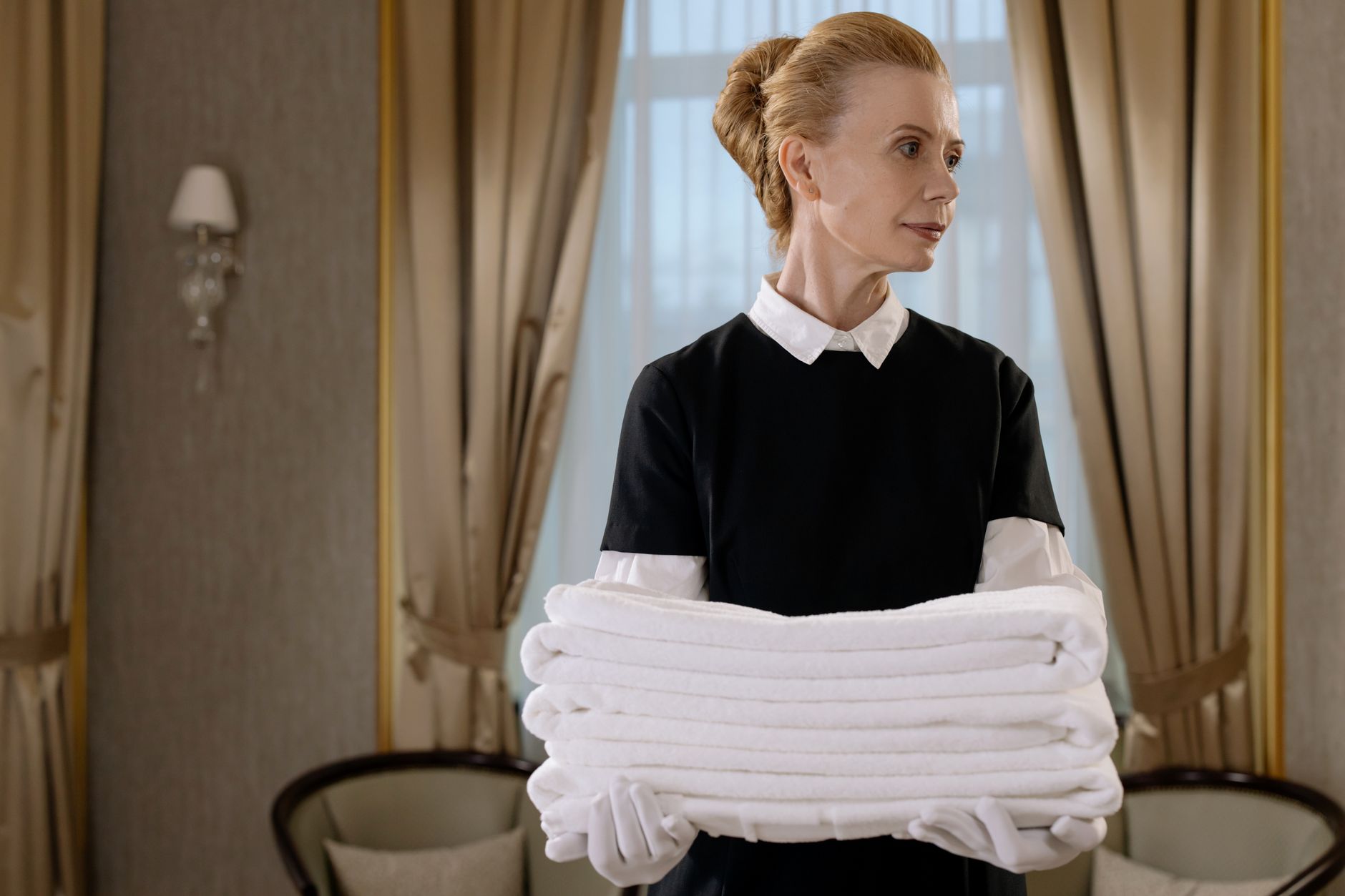
A 24/7 linen operation needs more than one shift of coverage. According to a single Department of Labor seasonal job posting, which we use here only as an illustration, a coverage formula divides 168 operating hours a week by 35 hours per worker. That gives about 4.8 full-time workers, which rounds to about five people on linen handling at one site, with a floater for peaks. This is working arithmetic on those two inputs, not a published headcount for hotels.
The people doing this work are mostly laborers and freight, stock, and material movers, hand type of workers. The robot takes that kind of work off their plate: the freight, stock and material moving hours on linen runs. Housekeeping staff and laundry leads keep room cleaning, sorting, quality checks and exceptions. The robot does not change who cleans rooms, and the plan should not suggest it does.
Turnover makes that split more useful. With annual turnover reported at 70% to 80% across the sector, every new hire has to learn the rules of the route, so the route list needs to be written down and a trained lead needs to be on each shift.
What should a first pilot cover?
Start with the route that carries the most runs, often soiled linen from the floor stack to the laundry, rather than the whole building. A pilot shows the real share of work the robot takes before you commit to more units or more routes. Keep it measured: count runs, time each stoppage and log every manual cart that still moves during the robot's hours.
Plan coverage for the days a unit is down for service. We dispatch service nationwide, but a single unit that stops leaves its routes to staff until it returns, so the assessment should name which runs fall back to carts and who covers them. Write that fallback down with the same care as the schedule.
Set the pilot's success measure before it starts. A useful measure is the share of scheduled runs completed on time without manual help, reviewed weekly, together with the count of injuries and near misses on the linen route. That gives the decision a basis drawn from your own operation.
Frequently asked questions
Want a warehouse robot at your hotel laundry?
Tell us about your site. We will recommend the robot, quote the lease, and keep it serviced.
Sources
- US Bureau of Labor Statistics, Occupational Employment and Wage Statistics (OEWS May 2024)
- IBISWorld, Hotels and Motels in the US, number of businesses
- American Hotel and Lodging Association, 2025 State of the Industry (Oxford Economics and STR/CoStar data)
- Hotel Business, report on hospitality workforce turnover
- Bureau of Labor Statistics, industry profile for accommodation
- Cal/OSHA DOSH fact sheet, housekeeping musculoskeletal injuries
- Smartness, average cleaning time per room (consultancy benchmark)
- Caldwell and Gregory, linen planning figures (consultancy)
- Department of Labor, seasonal job posting used for coverage arithmetic