

The short answer
Delivery robot ROI for hotels comes from the labor hours taken off repeated room service and supply runs, adjusted for the share of those trips a robot can realistically handle and compared with the lease cost. The savings range on this page moves with floor layout, elevator access, run volume and how much staff time each run takes today. A free site assessment narrows that range into a lease quote you can check against your own run logs.
Key takeaways
- The return comes from repeated corridor and elevator trips, not from replacing a whole staff.
- Savings are a range that depends on the share of runs a robot can realistically take.
- The labor side is measured in the hours of waiter and waitress type work the robot takes over.
- Elevator access, run volume and downtime coverage decide most of the gap between a strong and a weak return.
- A free site assessment turns the range into a lease quote based on your property's own run logs.
Run the numbers for your site
Pick your city or state for a real regional number - we use the real BLS wage there. (On the live site this auto-detects from your location.)
What do you want to automate?
The robot walks the repetitive trays; staff stay with guests and tables.
What is delivery robot ROI for hotels?
Delivery robot ROI for hotels is the return a property gets when a leased robot takes over repeated trips that staff make today, such as carrying room service orders, linens, amenities and supplies between a kitchen or storeroom and guest floors. The return is measured in labor hours moved off the floor, set against a fixed robot lease payment and any avoidable costs the robot removes. It is a return on work that repeats on a schedule, which is why the math starts with trips per shift rather than with the machine.
According to the American Hotel & Lodging Association (AHLA) 2026 State of the Industry, as reported by Hotels magazine, hotel operations employment is about 2.2 million in 2026, with growth of more than 30,000 jobs in 2026. IBISWorld estimates 46,091 hotel and motel businesses in the United States in 2025. Many of those properties run room service or supply runs across several floors, so the same routes are walked again and again through the day.
Where does the return come from in a hotel?
Room service and supply runs repeat along fixed hallways and elevators. A tray goes from the kitchen to a floor and back. Linens and amenities move from a storeroom to the same floors in the same order. A delivery robot suits that kind of route because it maps corridors, avoids obstacles and, in some buildings, calls elevators. Vendor descriptions say this is autonomous, but we treat elevator access as a claim to verify on each site.
The one independently reported elevator link in our research is an integration between an elevator company and a delivery robot at a hotel in Auckland, New Zealand, in April 2025, reported by the Mann Report. It shows the elevator call can be made by software rather than by a staff member pressing a button, which removes one hidden step from a multi-floor run. Not every building has that link, so the return depends on whether your elevators can be reached this way.
The return therefore comes from three places: staff time on the trips a robot takes over, fewer stalled runs during busy periods, and staff time freed for guest-facing work. Each one needs a figure from your own operation before it goes into the calculator.
Median hourly wage, Waiters and Waitresses
$3,798
Monthly cost of one full-time worker, at the median wage plus payroll costs (an estimate, not a quote).
How does the ROI math work for a hotel delivery robot?
The calculation has four inputs. The first is the hours of waiter and waitress type work the robot takes over each week, counted from trips that run on fixed routes. The second is the share of those trips the robot realistically handles, which is less than all of them because some runs need a person for judgment, large loads or guest handling. The third is the local wage for this job, taken from the government wage data on this page. The fourth is the lease cost, quoted after a site assessment.
The labor offset is the hours multiplied by the share and by the wage. The return is that offset compared with the fixed robot lease payment and any avoided costs, such as overtime on busy nights or agency coverage for open shifts. The result is a savings range, not a single figure. Because the inputs are ranges, the output is a range too, and we show the low and high ends side by side so the decision maker sees the spread.
A useful test is to count runs for one week on one floor, time a sample of them, and multiply out. If the count is off by a factor of two, the return moves by roughly the same factor, so the count matters more than any formula.
What share of room service work can a robot realistically take?

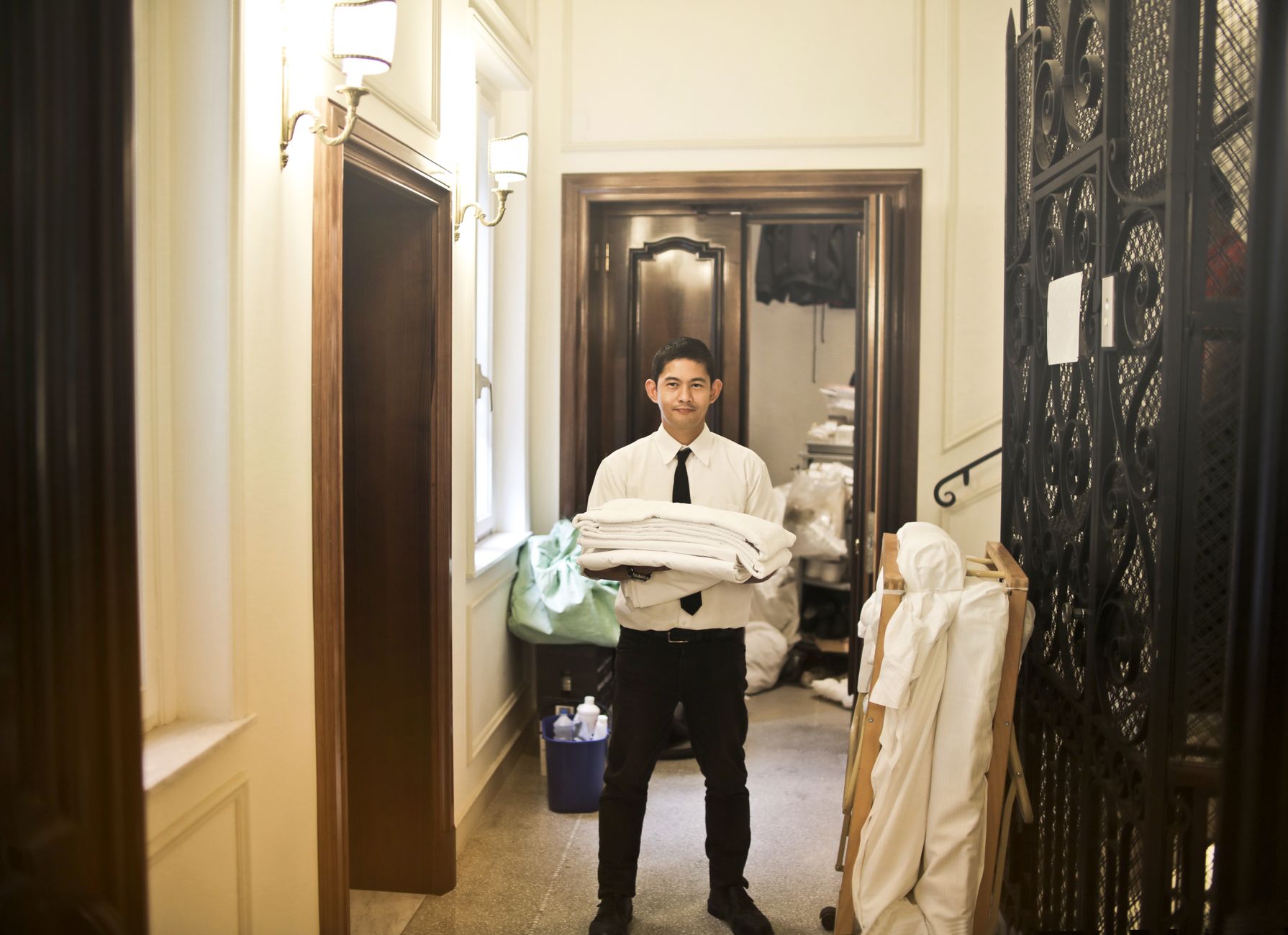
The share is the most important input and the one most often overstated. A robot is good at the long, repeated, predictable part of a run: the walk, the elevator wait and the corridor. It is weaker at the parts that need a person, such as building the order, handling a guest request at the door, carrying an oversized load, or moving through a service corridor that is blocked.
Vendor-reported figures put robot delivery at about 12 minutes against 38 to 45 minutes for staff. Those numbers have not been confirmed by an independent study, and they do not say whether the staff time covered the walk alone or the whole order cycle. Treat them as questions to put to a vendor, not as inputs to your model.
A realistic planning share is set on site, route by route. A short run between a kitchen and one nearby floor may be handed off in full, while a multi-floor run through a busy lobby may stay with staff. Keep the planning share conservative until the first weeks of run logs show what the robot actually completes.
How does the staff hours side compare with hotel labor?
The labor side is priced on the hours of waiter and waitress type work, because that is the work a robot takes off the floor for room service and supply runs. The government wage data on this page gives the local wage for that job. According to the BLS Occupational Outlook Handbook, there were 2,329,700 waiter and waitress jobs in 2024, with a projected 1 percent decline from 2024 to 2034, a loss of 16,300 jobs.
Turnover makes those hours harder to fill. Ankura's September 2025 travel and leisure update says more than 71 percent of hotels report unfilled positions, and annual turnover exceeds 70 percent in frontline roles. When shifts go unfilled, the hours a robot covers can be labor the hotel is already short of, not a cut to a full crew.
Headcount is a useful sanity check. Dividing AHLA's 2026 figure of about 2.2 million hotel operations jobs by the 46,091 hotel and motel businesses IBISWorld estimates for 2025 gives about 48 people per property across all departments. That is a derived average from two sources in different years, and it covers every role, not only room service staff. It is the typical headcount shown for this page, and the site assessment replaces it with the count for your property.
| Task | Today | With a robot |
|---|---|---|
| Room service tray runs from kitchen to guest floors | Staff time per run, from the hotel's run logs | Robot completes the route, staff load and unload |
| Linen and amenity runs from the storeroom | Staff hours per shift, from the schedule | Robot carries scheduled loads on fixed routes |
| Elevator waiting during multi-floor runs | Waiting time at each elevator bank, measured on site | Software call where the building has the link |
| Supply restocking on guest floors | Trips per floor per shift, counted during the assessment | Robot covers routine restocking, staff handle exceptions |
| Guest requests and order exceptions | Staff time, kept with the team | Stays with staff |
Hour figures come from each property's own schedule and run logs, measured during the site assessment. This page does not publish a verified national hours figure for hotel room service, so no per-shift hour total is shown.
What changes the number up or down?
Several factors move the range. Elevator access and multi-floor routes raise the offset because they add the most walking and waiting per run. Run volume matters because a robot earns its lease cost only when there are enough trips to keep it working through the shift. Layout matters too: a clear, wide, level corridor lets the robot finish its route, while blocked service corridors and frequent door openings cut its share.
Staffing reality matters as well. If open shifts are common, the hours the robot covers are worth more. If a hotel already runs lean on nights, the robot may be the only way to keep room service running at all, which turns the return from a cost saving into a continuity gain. Operating hours matter for the same reason: a unit that runs overnight covers hours that would otherwise go unstaffed.
What are the risks to the return and how do you avoid them?
The main risk is a robot that stalls. A blocked elevator, a closed corridor or a failed unit hands the trip back to a person, so the offset drops to zero for that run while the lease payment continues. Plan for downtime in the model rather than assuming full uptime. We provide on-site dispatch, remote triage and spare unit coverage, so one failed unit does not stop service, and the return should be checked against that coverage.
Injury risk is a second issue. According to BLS injury and illness charts, the accommodation and food services sector recorded a total recordable rate of 2.6 per 100 full-time workers in 2024, with about 234,800 cases. Trays, carts and supply runs are part of that handling load, and a robot takes some of it. A hotel-specific 2024 rate was not verified for this page, so check the BLS industry tables before citing a hotel figure internally.
Staff acceptance is the third risk. Front-of-house staff who see the robot as a threat will work around it, and runs will not be handed off. Brief the team before go live, name who owns robot exceptions, and track handoffs during the first weeks. Training belongs in the deployment, not after it.
How long until a hotel reaches payback?
A realistic timeline has five phases: free site assessment, mapping of routes and elevators, one leased unit on the route with the most trips, go live support with run logging, and a review of the hours actually taken over against the planning share. Payback arrives when the cumulative offset covers the lease payments and any setup items named in the lease quote. The site assessment sets the dates for each phase, so this page does not promise a calendar.
Starting small gives the cleanest answer. One unit on the busiest route produces the most reliable data for the least exposure. A second unit or floor follows the first review. Phased deployment keeps the hotel running throughout, since existing staff keep covering the routes the robot does not yet serve.
How do you get a precise figure from a free site assessment?
A free site assessment is the step that turns the savings range into a lease quote. We are a US commercial robot integrator: we pick the right robot for the site, lease it through financing, deploy and integrate it, train the staff and service it nationwide. During the assessment we walk the property, map corridors, service elevators and loading points, and count runs per shift from the kitchen and storeroom. We also time a sample of runs and note where staff stop or where a route is blocked.
Staff hours come from the hotel's own schedule and run logs, not from a national average. The output is a route map, a planning share by route, a range of hours offset, and a fixed robot lease payment quoted for the scope we agree. You receive the range with its inputs, so you can check each one. If a figure is missing, the report says so rather than filling the gap. Lease options and financing terms are set in that quote, after the assessment, not before.
Frequently asked questions
Want a delivery robot at your hotel?
Tell us about your site. We will recommend the robot, quote the lease, and keep it serviced.
Sources
- US Bureau of Labor Statistics, Occupational Employment and Wage Statistics (OEWS May 2024)
- BLS Occupational Outlook Handbook, Waiters and Waitresses
- Hotels magazine, AHLA 2026 State of the Industry
- Ankura travel and leisure update, September 2025
- IBISWorld, Hotels and Motels number of businesses
- BLS injury and illness charts, nonfatal injuries by industry
- Mann Report, elevator integration with a delivery robot at a New Zealand hotel, April 2025