
Key takeaways
- Flight kitchens already automate carts with overhead rail and guided vehicles, so mobile robots target the repeat floor runs.
- One Dubai flight kitchen reports handling over 20,000 meal carts a day, which shows how much cart movement one site can carry.
- Published daily cart counts for the same kitchen differ by source and year, so treat them as scale rather than benchmarks.
- U.S. food preparation employment is projected to shrink about 3% from 2024 to 2034, while roughly 148,000 openings a year still need filling.
- Robots are leased through financing, and the payment comes in a quote after a free site assessment.
Can autonomous mobile robots for airline catering kitchens help?
Yes, in a narrow and practical way. Autonomous mobile robots for airline catering kitchens do best on the repeat moves that pull cooks and packers away from food: carts and bins carried from prep to cold storage, from cold storage to the dock, and back again. The robot does not cook, plate or load the aircraft. It handles the transport loop so people can stay at their stations.
We should be direct about what we found. We did not find a published case of an airline caterer running autonomous mobile robots to move tray carts inside a flight kitchen. The documented automation in this setting is mostly overhead monorail, conveyor and guided vehicle systems built on installed infrastructure. An autonomous mobile robot needs no overhead rail, so it may suit a kitchen that is too busy or too tightly built for an installed system.
Fit depends on your routes, floor condition and cart volume, so we start with a site walk rather than a product recommendation.
Why does cart movement take so much attention in a flight kitchen?
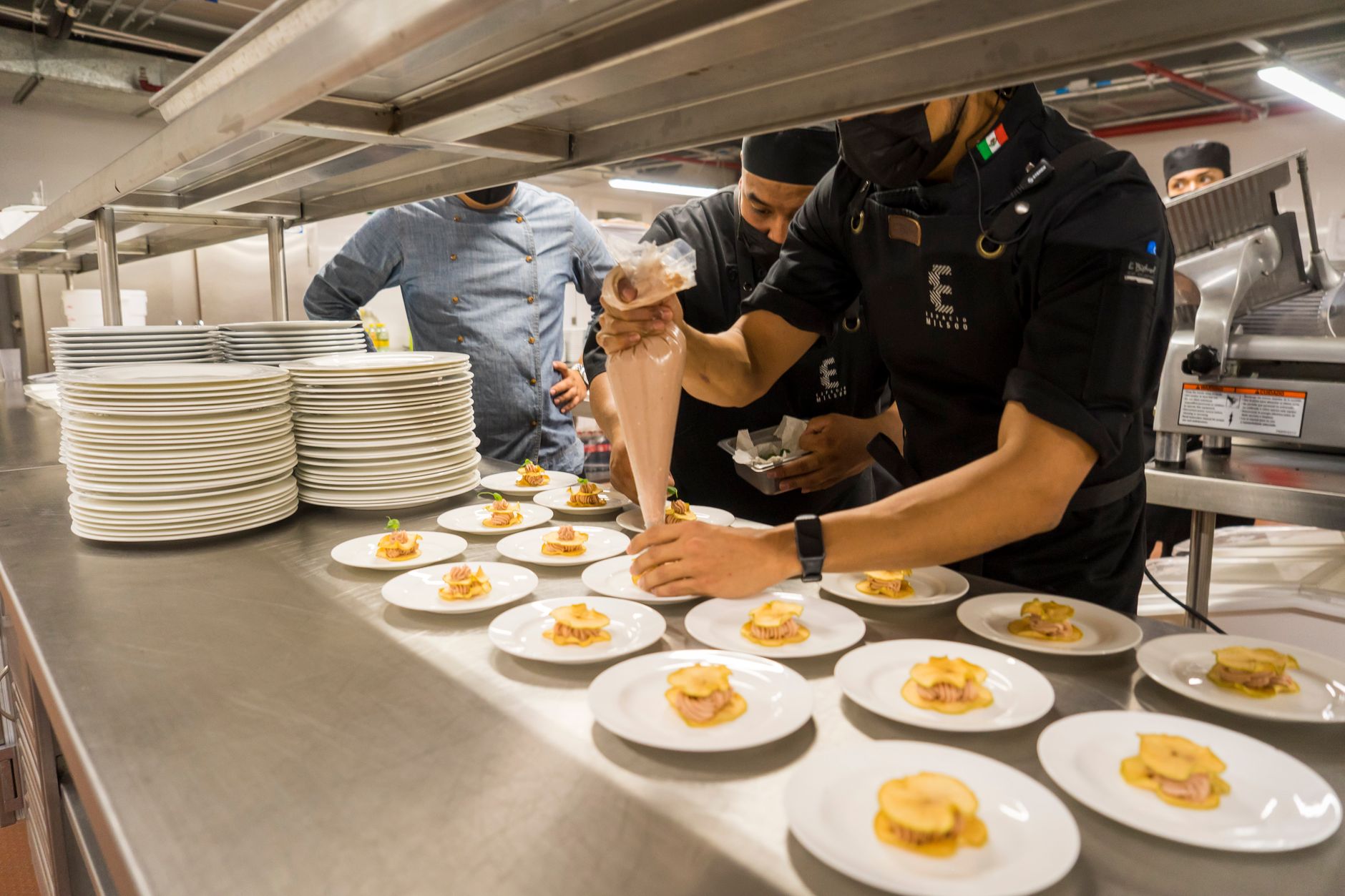
A flight kitchen runs on timing. Meals are prepared, chilled, packed onto carts, staged and sent to the dock to meet departures that do not move. A cart that sits too long or reaches the dock late becomes a problem for the aircraft, and the person moving it is pulled off the line to fix it.
The scale can be large. The operator of one Dubai flight kitchen reports handling over 20,000 meal carts and 3,000 bar carts, according to its March 2023 fact sheet, and that document lists 2.55 km of overhead monorail lines. A Gulf News report gave a lower figure of over 7,500 meal carts a day, with no year confirmed, so published counts differ and should be read as scale only.
Rail-based systems built for this scale are large. According to the supplier's own case study, the same facility runs two electric monorail systems with 188 vehicles over about 2.5 km and 160 vehicles over about 2 km. A trade press report, also based on supplier information, says the system stages up to 40 carts per plane just in time.
Staffing adds pressure to all of this. Food service roles are hard to keep filled, and the figures later in this page show how persistent that is across the sector.
What are the main benefits for the kitchen?
The first benefit is fewer people on repeat transport. Cooks and packers stay on the stations that need skill, and the transport loop runs at a steady pace whoever is on shift.
The second is steadier flow between prep, cold storage and the loading dock. Fixed routes make each run predictable, which helps the dock plan its staging and reduces the time a loaded cart waits.
The third is a lighter physical load on the people who remain. Pushing heavy carts across a busy floor all shift is hard work, and taking those repeat pushes off the line helps keep experienced staff where their judgment matters.
How does the robot work day to day?
Before go live, the site is mapped and the routes are set. Staff load a cart at a station, the robot drives it along its path to cold storage or the dock, and it returns when called or when the next load is ready. Dispatch can be tied to a call from the station, so the unit runs when a load is actually waiting.
The robot slows or stops when a person enters its path, and it waits for the way to clear. Routes can change as the kitchen changes, but those changes should go through the integrator so the map stays accurate and the team knows what the unit will do.
Which areas of the kitchen does it cover?
Coverage follows the transport loop, not the cooking. The areas below are where we would expect the robot to work. The site assessment confirms which ones fit your floor, your doors and your traffic.
How does it work alongside the existing team?
A robot plus a smaller team, not a robot in place of the whole crew. The team keeps food production, food safety checks, labeling and the dock handoff. The robot takes the repeat moves in between, so the change shows up mostly in the job itself: fewer carts to push and more time on the line.
Expect people to stay on the floor for loading, exceptions and handoffs. We train the staff who run the unit and the people who will work beside it, and we stay for go live support while the routine settles in.
What do the labor figures say about this work?
The U.S. Bureau of Labor Statistics counts 902,700 food preparation worker jobs in May 2024 and projects that employment will shrink about 3% from 2024 to 2034. The same projection still points to roughly 148,000 openings a year. Total jobs may shrink, but filling openings remains a steady task for the kitchen manager.
Turnover in food service is high. Restaurant industry data cited by a restaurant labor blog puts 2025 hourly turnover at about 110% in limited-service restaurants and 92% in full-service restaurants. Those are restaurant figures, not flight kitchen figures, so read them as a sign of the labor market rather than a benchmark for your site.
Hiring pressure has shifted as well. National Restaurant Association figures, as cited in the same blog, show the share of operators reporting insufficient staffing fell from 78% in 2021 to 22% in 2025. A quick-service operator survey reported that 70% of operators cited unfilled positions heading into a holiday season, though that release does not confirm the year, so treat it as a directional signal only.
What drives the savings, and what can be promised?
The savings come from hours taken off repeat transport and from fewer shift gaps on that loop. We did not find a verified hour range for flight kitchens, so we will not give you one. The honest way to size it is to count your real cart runs per shift, multiply by the walk time, and compare that with the hours your team spends on the loop today.
The quote after a free site assessment models this from your own numbers: cart runs, route length, number of stations and the hours the loop takes now. Robots are leased through financing, and the payment comes in that quote. Service is handled nationwide, with on-site dispatch and remote triage.
Judge the case on a route you can measure, a quote built from that route, and a team that knows what the unit will and will not do.
What can an autonomous mobile robot not do?
It cannot cook, season, plate, check food temperatures or make the judgment calls a flight kitchen depends on. It does not lift a loaded cart onto an aircraft, and it does not work outside its mapped routes. Stairs and doorways that change often add work, and standing liquid or rough floors can stop a unit, so floor condition belongs in the assessment.
It also does not remove the need for people. A unit that stops for an exception waits for a person, so the team has to respond quickly. A short loop or a floor that changes every week may leave little time to save, and we will say so in the assessment.
How do we get started?
Start with a free site assessment. We map the route, look at the floor, count cart runs and talk through food safety and the dock handoff. From there we recommend a unit or a small fleet, and you receive a lease quote built on your site.
Robot leasing runs through financing, so the cost is spread over the lease rather than paid at the start, and the payment comes in the quote. Robot deployment and integration, staff training and go live support follow the quote. A sensible first step is one leased unit, so the team learns the route before any expansion is discussed.
Frequently asked questions
Want a warehouse robot at your airline catering kitchen?
Tell us about your site. We will recommend the robot, quote the lease, and keep it serviced.
Sources
- U.S. Bureau of Labor Statistics, Occupational Outlook Handbook: food preparation workers
- Trade press report on flight kitchen cart automation
- Operator fact sheet, Dubai flight kitchen, March 2023
- Supplier case study, Dubai flight kitchen
- Gulf News, flight kitchen technology report
- Restaurant labor turnover statistics, restaurant labor blog
- Quick-service operator staffing survey release