
Key takeaways
- End-of-line case packing and palletizing is the dairy plant work that is hardest to keep staffed around the clock.
- A cobot beside the packing crew covers the repetitive stacking while your people run the line and handle exceptions.
- Vendor-reported case studies point to fewer short shifts and faster changeovers, but results depend on your own line.
- Savings are measured in hours recovered, so take a baseline on your line before go-live.
- Start with a free site assessment, then get a lease quote through financing.
Can cobots benefit dairy processing plants at the end of the line?
Yes, most clearly at the end of the line, where case packing and palletizing are steady, repetitive and hard to staff around the clock. Cobots for dairy processing plants are collaborative robot arms that pick up cases, stack them and load pallets alongside the people already on the line. That kind of bounded work is where a cobot is most useful.
The benefit is coverage. A packing line that runs through the night needs people on every shift, and gaps show up first in that work. A cobot can carry the lifting and stacking through the hours a crew cannot fill, so the line keeps moving while your staff spend their time on checks, exceptions and the parts of the job that need a person.
This page walks through the problem at a dairy plant today, the main benefits, how the robot works day to day, which areas it covers, how it shares the floor with staff, what drives the hours recovered, what it cannot do, and how a plant gets started.
What does end-of-line packing look like at a dairy plant today?
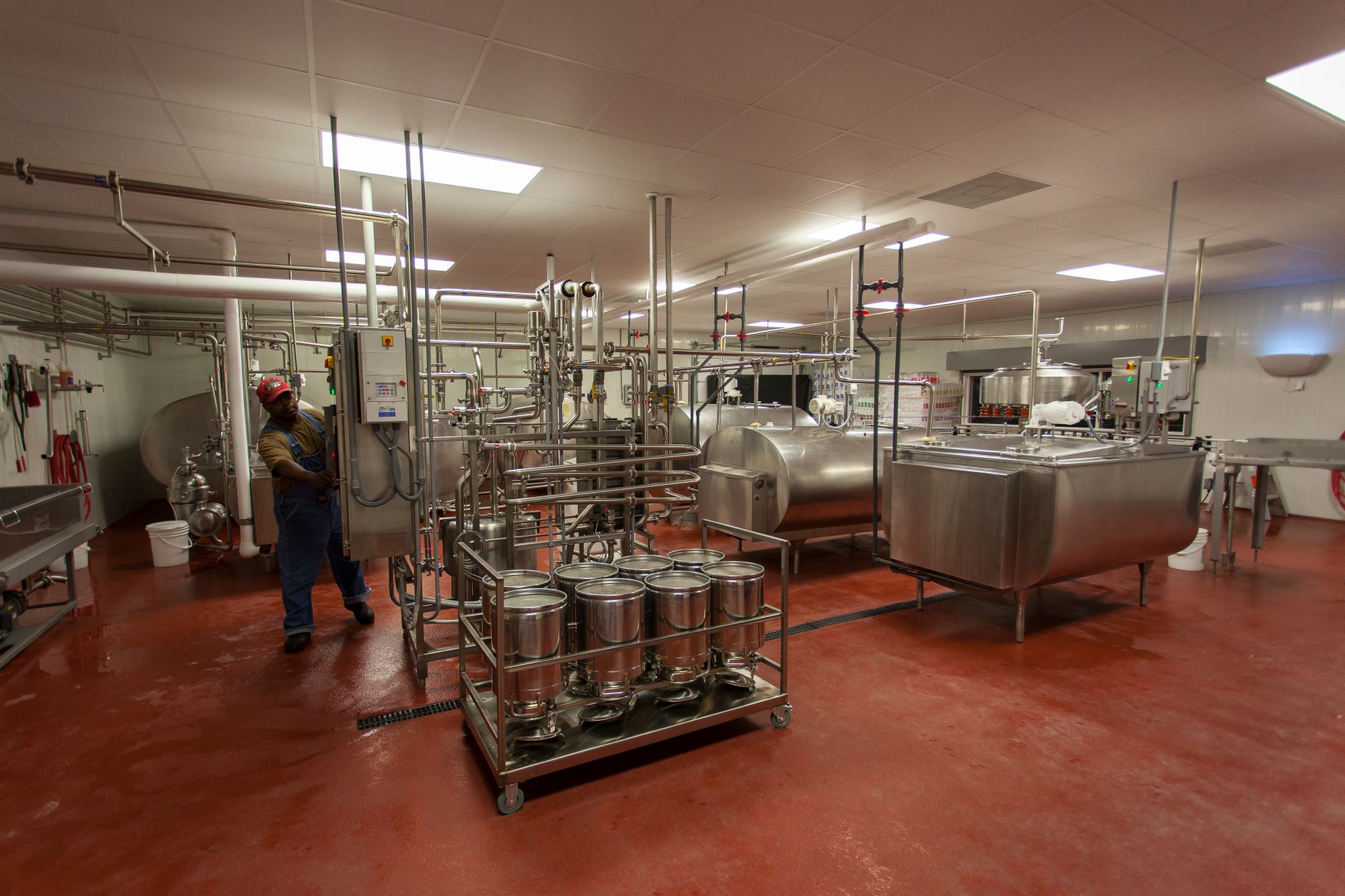
Cases come off the packaging equipment at the end of the line and move to a packing crew, who fill, close and stack them before the pallet goes to the cooler or the dock. It is physically repetitive work, and the same motion repeats through the whole shift. That repetition is the reason the work is hard to sustain on nights and weekends.
Staffing is the pressure point. Dairy product manufacturing employs about 156,000 people, according to Data USA, and Wisconsin, California and New York carry the largest shares at 28.6k, 15.5k and 12.2k. Across all industries, the hand packers and packagers occupation was larger still, with 645,210 people employed in May 2023, according to the U.S. Bureau of Labor Statistics. The pool is large, but a single plant competes for people locally, and one open night shift can hold up the whole end of the line.
Turnover adds to the strain. A Canadian survey on food processing skills put annual turnover at about 19 percent, according to Food Business News. The survey year was not confirmed and the figure comes from Canada, so read it as a direction rather than a US benchmark. A UK survey found 55 percent of food sector respondents planned to leave their business within the timeframe that survey measured, according to Food Manufacture.
What are the main benefits of cobots on dairy packing lines?
The first benefit is coverage. A cobot does not need a break, and it can hold the end-of-line position on a shift the crew cannot fill. In a vendor-reported case study at a nut processing plant, the site was short 15 to 20 people per shift, and after a cobot took over palletizing at up to 10 cases per minute, end-of-line labor dropped by one person.
The second is changeover. In a packaging trade article on a Scandinavian food producer, three cobots handled labeling, carton erecting and palletizing, and changeover time fell from six hours to 20 minutes. That figure is vendor-reported, but it shows where a cobot can earn back time on a line that switches formats often.
The third is the crew. In a vendor-reported case study at a food manufacturer whose goal was to reduce injury risk without cutting jobs, the system ran at 10 cycles per minute and workers were reassigned to other roles. On a dairy line, that matters because the people who know the product and the sanitation routine stay on the floor.
How does a cobot work on a case packing line day to day?
A cobot sits at the end of the line, usually at the palletizing or case packing station, and takes cases as the line delivers them. It picks, places and stacks in a fixed pattern set during deployment. The crew keeps the work that needs hands and judgment, such as checking product, clearing a jam or handling the odd case that does not fit the pattern.
Speed is a number to plan around, not assume. The palletizing cobot in the nut plant case study handled up to 10 cases per minute, and another vendor case study reported 10 cycles per minute on a separate task. Build your plan from the rate measured on your own line, since case size, pattern and infeed spacing all change it.
Setup at deployment covers more than the pattern. The team sets the infeed spacing so cases arrive where the arm expects them, sets the pallet position and confirms how the cell hands a full pallet to the crew. Those three points decide whether the cell runs smoothly or stops every few minutes, so they get the most time during commissioning.
Which areas of the plant does the cobot cover?
Most of the value sits in a handful of zones at the end of the line, not across the whole building. The footprint is set by the line the cobot serves, so the site assessment maps the packing station, the infeed, the pallet area and the exit before any hardware is chosen.
The zones below are where the cobot works and where a packing crew already stands. Each one is set up with the staff who run it in mind.
Sanitation access also shapes the layout. Crews need to reach the cell, the infeed and the pallet area for cleaning, so we check clearances during the site assessment rather than after the equipment arrives.
How do cobots work alongside existing packing crews?
A cobot is a companion to the crew, not a replacement for the whole team. The staffing picture we aim for is a robot plus a smaller crew: fewer people doing repetitive stacking, and the same people trained to run the cell, handle exceptions and keep the area clean.
The principle is an old one on food lines. A vendor case study at a food manufacturer described the goal as cutting injury risk without cutting jobs, and the workers were moved to other roles. On a dairy line, the crew's knowledge of product, cases and sanitation remains the part a cobot cannot replace.
Plan for training and ownership before go-live. Each shift needs a named operator who knows the stop, restart and basic check routine, and a lead who owns the cell. Our team trains staff during deployment so the crew is comfortable with the equipment before the first full run.
What drives the savings in hours and labor?
The savings come from three places: hours of stacking the crew no longer carries, shifts that stop running short, and changeover time that no longer idles the line. Hours are the honest unit here, and each plant should measure its own baseline before go-live, then compare after.
The published figures are vendor-reported, so treat them as direction. One nut processing case study reported end-of-line labor dropped by one person, and a Scandinavian food producer reported changeover falling from six hours to 20 minutes. Neither is a dairy benchmark.
A vendor also estimated return on investment in about six months for a palletizing cobot packing 400 cartons daily, according to a vendor case study. Timing depends on volume, the number of shifts and how many are short today. We have not verified an hours range for dairy lines, so we do not offer one here, and the payment comes in the quote after a free site assessment.
A baseline does not need special software. A shift lead can record the same few items for two or three weeks before go-live, then repeat the count after. Record these items:
- Hours per shift the crew spends stacking and palletizing cases
- Shifts per week that run short at the end of the line
- Changeover minutes for each format change
- Cases per minute at the packing station on a normal run
What can a cobot not do?
A cobot is not a whole-plant system. It handles the repetitive, bounded motion at the end of the line. It does not run sanitation, make product decisions, fix a damaged pallet or handle every case format without setup.
Physical limits matter. Payload, reach and speed set what fits on a given station, so a heavy or oddly shaped case may need a separate setup or a person. Throughput tops out where the cell is designed to, and a rate such as up to 10 cases per minute is a ceiling from one case study, not a promise for your line.
Dairy-specific needs need checking before deployment. Confirm wash-down requirements, the temperatures the cell will see, and how often it has to come apart for cleaning. We check these during the site assessment rather than assume them.
When the cell stops, the crew needs a clear routine. Off-pattern cases, a jam or a sensor fault should each have a written response, so a packer knows whether to clear the case, call the lead or leave the cell for the service team. We write those steps with your crew during commissioning.
How do plants get started with a leased cobot?
Getting started with cobots for dairy processing plants begins with a free site assessment. We map the line, the packing station and the pallet area, then pick the robot that fits the work. That visit shows what fits, how many shifts the cobot can cover and what the deployment involves, before you make any commitment.
Robots are only leased, through financing. The payment comes in the quote after the site assessment, so the figure for your site is clear before you decide. Service runs nationwide, and the terms are set out in writing in the quote.
After signing, we deploy and integrate the cobot, train your staff and provide go-live support. Phase the rollout, starting with one station, so the line keeps running while the crew learns the cell. A first station gives the crew a few weeks to learn the stop, restart and check routine, and it gives you real throughput data for the full line. Once the first station holds steady, the second is a smaller step. Once it is running, service runs nationwide, from remote checks to on-site visits.
Frequently asked questions
Want a cobot at your dairy processing plant?
Tell us about your site. We will recommend the robot, quote the lease, and keep it serviced.
Sources
- U.S. Bureau of Labor Statistics, packers and packagers, hand
- Data USA, dairy product manufacturing
- Vendor case study, nut processing plant
- Vendor case study, palletizing in six months
- Vendor case study, repetitive motion reduction
- Packaging trade article, food producer cobots
- Food Business News, plant turnover report
- Food Manufacture, UK food sector retention survey