
Key takeaways
- Cobots take the repetitive stacking, banding and packing at the end of busy press lines.
- Operators stay on quality checks, job changes and exception handling, with the cobot working beside them.
- Projected declines in press operator jobs make end-of-line hiring a steady concern for printing plants.
- A free site assessment comes first, and the lease is quoted after it, through financing.
How can cobots help printing plants?
Cobots for printing plants take over the most repetitive work at the far end of a press line: stacking finished jobs, banding the stacks, and packing them into cartons or onto skids. A collaborative arm works beside an operator, picks up what comes off the delivery end, and builds the same pattern shift after shift without losing its place. The person keeps the parts of the job that need judgment, such as checking the sheet and deciding when a stack is wrong.
For a plant manager the appeal is practical. End-of-line work is often where a busy press room gets stuck. When finished work backs up at the delivery end, the press slows or stops while people catch up. A cobot that keeps pace with the delivery end removes one common reason for that backlog and gives staff time for the checks that matter.
This page covers where the cobot fits, what it does day to day, which areas it works in, how it shares the floor with your crew, what drives the savings, what it cannot do, and how a plant gets started.
What does end-of-line work look like at a printing plant today?
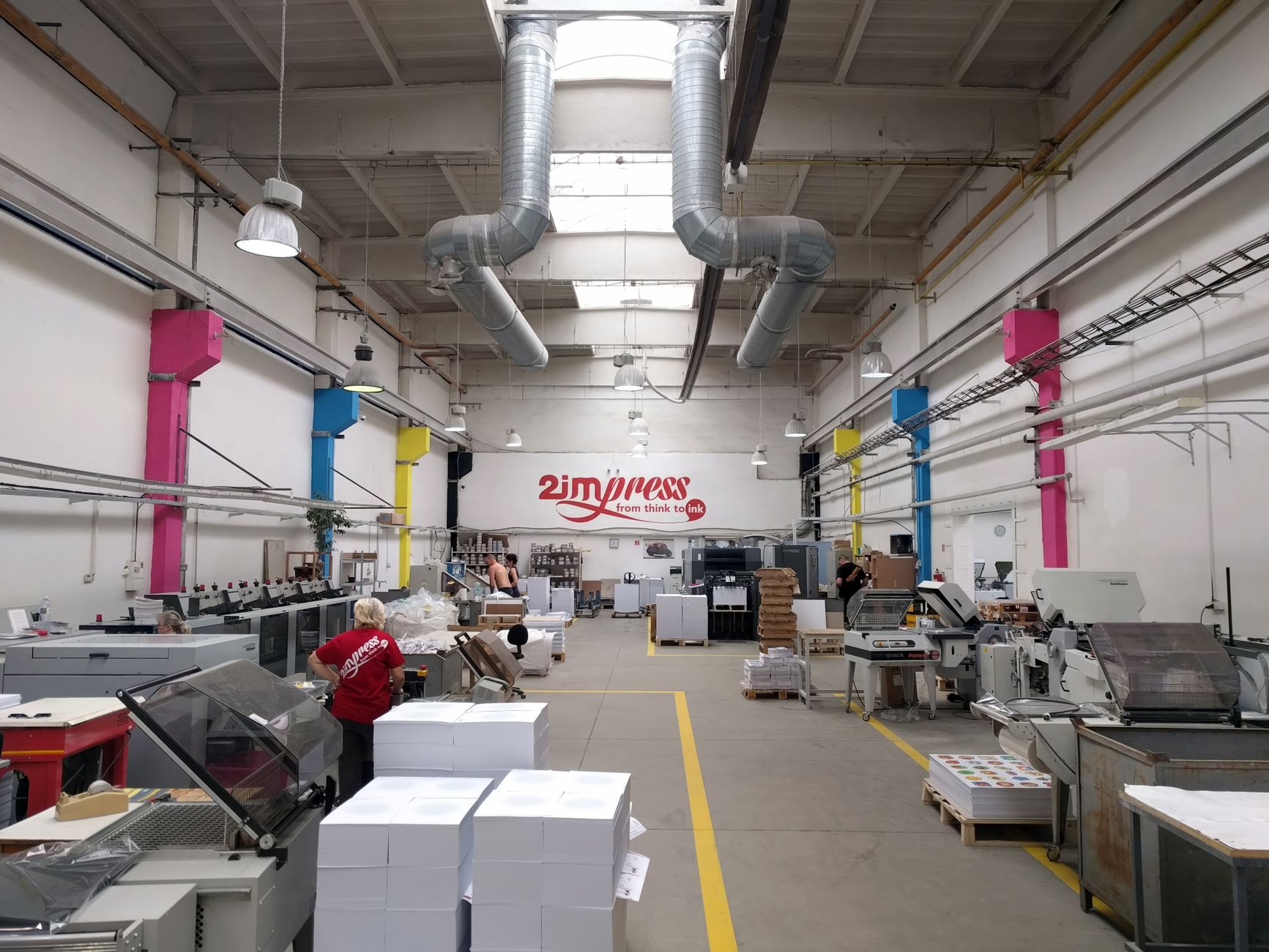
At many plants the press runs and the finishing crew follows. Finished jobs come off the delivery end in stacks, and people count, square, band, label and carry them to a pallet or a shipping carton. The work is physical, it repeats all shift, and it often lands at the busiest part of the day when the press runs hardest. That combination makes it a strong candidate for automation and a poor use of people who should be checking print quality.
The labor picture is tight. According to the U.S. Bureau of Labor Statistics, 151,450 people were employed as printing press operators in May 2023. A job outlook page that cites BLS projections puts the outlook at about 8% decline from 2024 to 2034, with roughly 13,700 openings a year. A trade article built on older Census data, with no year given, counts 22,580 establishments and 369,632 employees in the printing industry.
Read those numbers as a hiring problem as much as a headcount problem. A projected decline alongside roughly 13,700 openings a year means you will keep hiring for these roles, and a plant that fills end-of-line jobs by hand carries that hiring load each time. Automating the repetitive end of the line lets the people you hire do work that holds their attention.
What are the main benefits of cobots at the end of the line?
The first benefit is less manual lifting at the place where the body takes the most strain. A cobot maker's end-of-line material presents cobots as a way to ease labor shortages and reduce injuries from manual palletizing. That is a vendor position, so treat it as a reason to pull your own lifting and injury records rather than as a result you can count on.
The second benefit is steadier output. Pallet changes eat time, and in a palletizing case study from a consumer goods plant in India, the cobot maker reported a 5% gain in overall equipment effectiveness from reduced pallet-change time after the plant deployed two cobots to replace hand lifting. That figure is vendor-reported and comes from outside printing, so read it as a direction for your own pallet-change log, not as a forecast for your line.
The third benefit is where your people spend the shift. Staff who are not hand stacking can check print quality, handle job changes and deal with the exceptions that need a person. That is where experienced operators add the most value.
- Less manual lifting and stacking at the end of the line
- A consistent stack pattern from the first run to the last
- Shorter pallet-change time, which feeds overall equipment effectiveness
- Operators freed for quality checks, job changes and exceptions
- Cover on shifts where stacking and packing positions are hard to fill

How does a cobot work at the end of the press day to day?
A typical cell sits at the delivery end of the press. Finished work comes off a conveyor or delivery table, the cobot picks each stack with a gripper matched to the carton or sheet format, and it places the stack on a pallet in a set pattern. Integration sets the handoff so the arm waits for the conveyor rather than fighting it, and the cell is planned around the formats that run most often.
Layout is less of a barrier than many managers expect. One cobot palletizer is described as built for end-of-line work in limited floor space and designed to work with conveyors, which is the kind of layout most finishing areas already have. A trade article on cobots for end-of-line palletizing tasks points to the same pattern across packaging lines, so the approach is not tied to a single setup.
The day runs in cycles. When a pallet fills, an operator swaps it out, bands it or moves it to staging, and the cobot starts the next pallet. Staff set the job pattern at changeover, and the cell keeps the same handoff rule on every shift so operators learn one routine instead of several.
Which areas of a printing plant does the cobot work in?
The cobot is most useful wherever finished work changes hands. Most plants have a short list of those handoff points, and each one maps to a different station at the end of the line. During the site assessment we walk each area, time the handoffs, and decide where the arm earns its place.
The six areas below are where this work usually sits in a printing plant. Each has a clear start and end, which is what makes a task a good fit for a collaborative arm.
How do cobots work alongside existing staff?

A cobot works next to people, not in place of the crew. The usual setup is one cobot plus a smaller team of operators, not zero staff. Operators load stock, watch stack quality, handle banding and labels, and step in when a job falls outside the programmed pattern.
We train staff on the cell during deployment and integration, so the people who run the press also understand what the cobot does and how to clear a stop. Training is built around the shifts they already work, so it does not pull a whole crew off the floor at once.
That arrangement matters for morale and for safety. Operators stay close to the work instead of repeating one lift all shift, and supervisors keep control of the schedule while the cobot follows it. The team gets better at reading the line, which is the part a machine cannot replace.
What drives the savings, and how do you measure them?
Savings come from three places: hours that stop going to repetitive stacking, banding and packing, fewer delays at pallet changes, and less time lost when a backed-up stack slows the press. Of these, the hours your team spends on the end-of-line task each shift are the largest and the easiest to measure, so the site assessment starts there.
We did not find a verified hours figure for printing plants that run a cobot, so we do not quote one. The closest sourced number is the cobot maker's reported 5% overall equipment effectiveness gain from reduced pallet-change time at a plant outside printing. Use it as a direction, then check it against your own pallet-change log.
Track three numbers before any conversation about a lease: hours on the end-of-line task per shift, pallet changes per shift, and minutes the press waits on the finishing area. Those three numbers show whether a cobot fits your floor. The lease is quoted only after the site assessment, so every figure in the quote comes from your own line.
What can a cobot not do in a printing plant?
A cobot is not a press operator, and it is not a whole finishing crew. It will not feed the press, clear a web break, fix a jam at the press, or judge print quality on the sheet. Those jobs stay with people, and the cell should be designed around them rather than around the hope that an arm will absorb them.
The limits are also practical. Heavy or oversized stacks need a different tool or a different setup, and frequent job changes with many formats need planned gripper changes. The cell works best when it is built for the formats that run most often, with the rare ones handled by hand.
Plan for downtime too. If the cobot is stopped for service, the line needs a manual fallback, so staff should know the handoff rule and the plant should keep a plan for covering the station during repairs.
- Feed the press or clear web breaks and jams
- Judge print quality on the sheet
- Lift stacks above its rated payload or beyond its reach
- Handle unplanned job formats without a gripper change or reprogramming
How do you get started with cobots for printing plants?
Start with a free site assessment. We map the end of your line, measure the stacking, banding and packing work, look at the conveyor and floor space, and recommend the right cobot for the site. The lease is quoted after that assessment, and the payment comes in the quote.
Our commercial robot leasing runs through financing, so you can test the approach without tying up capital. We deploy and integrate the cell, train your staff, and service it nationwide with one partner and one number to call. Many plants start with one leased unit on one line as a pilot, then add units where the numbers hold.
Our job is to pick the robot that fits your floor and keep it running after go-live. If the assessment shows that a cobot does not fit your line, we will say so and point you to the handoff changes that would help instead.
Frequently asked questions
Upcoming manufacturing events
- Trade showBrats & RobotsNov 10, 2026Alliant Energy Center Exhibition Hall, Madison, WI
- Trade showMATE Farm & Ranch ShowFeb 11 to 13, 2027MetraPark, Billings, MT
- ExpoPFMA Expo 2027Feb 17 to 18, 2027Washington County Fair Park, West Bend, WI
- ExpoLouisville Facilities Maintenance ExpoApr 15, 2027Mellwood Art Center, Louisville, KY
Want a cobot at your printing plant?
Tell us about your site. We will recommend the robot, quote the lease, and keep it serviced.
Sources
- U.S. Bureau of Labor Statistics, QCEW data for printing and related support
- U.S. Bureau of Labor Statistics, OEWS data for printing press operators
- Job outlook page for printing press operators
- Trade article on the printing industry economic impact
- Cobot maker palletizing guide with vendor-reported case material
- Cobot maker end-of-line material
- Cobot palletizer application catalogue entry
- Trade article on cobots for end-of-line palletizing