
Key takeaways
- Tractor-trailer tires weigh over 100 lb according to a patent filing, so repeated handling strains workers at loading and inspection stations.
- A cobot takes the lifts at one station while staff handle setup, inspection and upkeep.
- An EU-OSHA case study reports 600 to 700 lifts per day at one cobot line, a useful baseline for your own count.
- Hours saved should be measured on your own floor, not promised from other sites.
- Start with one station, a free site assessment and a lease quote.
How can cobots benefit tire manufacturing plants?
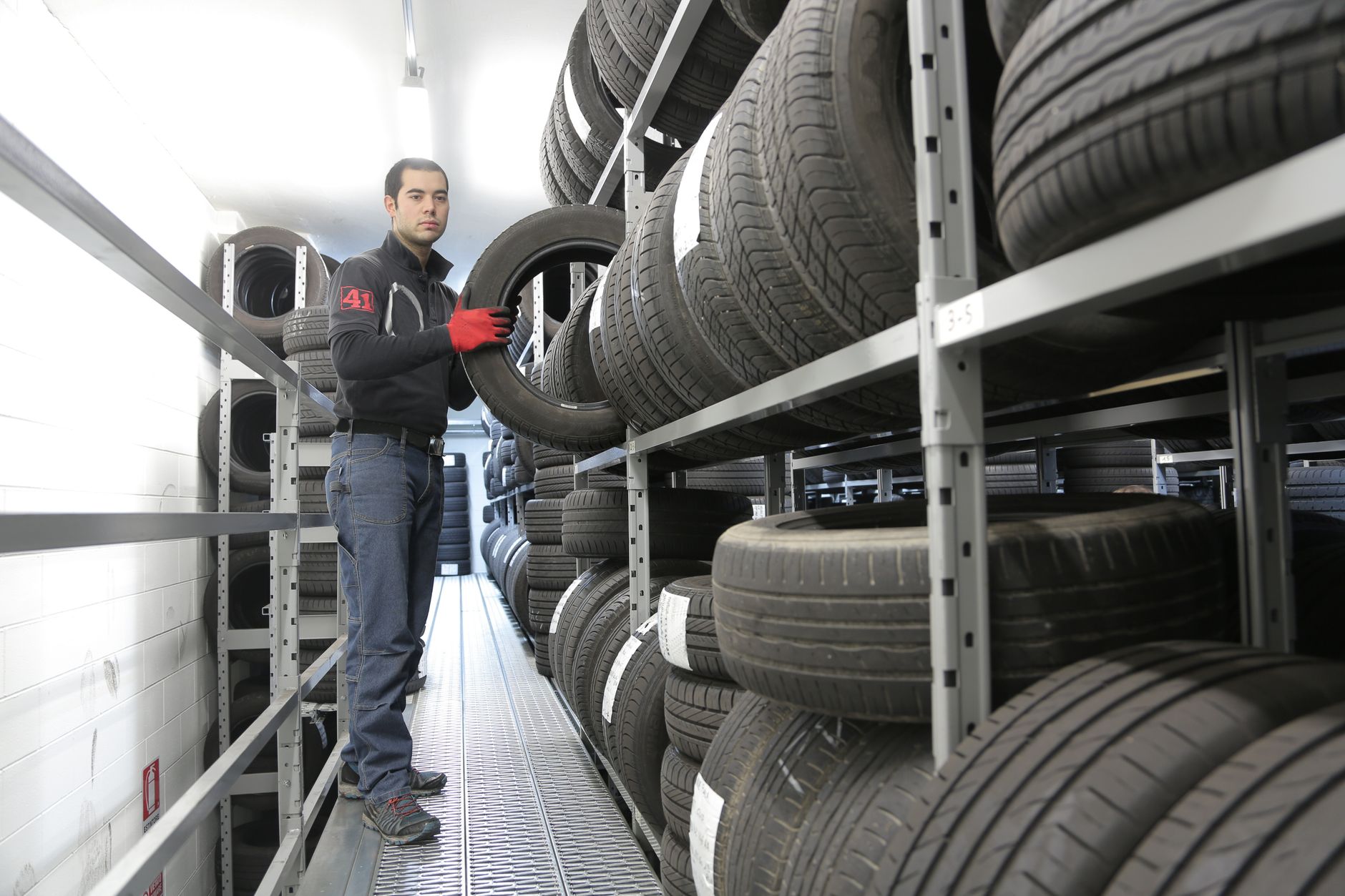
Cobots for tire manufacturing plants earn their place at stations where a person lifts a tire, sets it down and repeats the motion all shift. A tire is heavy and awkward to grip, and that weight is what turns a routine task into a daily strain. A US Patent and Trademark Office patent background describes tire plant employees who lift and position individual green tires, with typical weights of 25 and 50 lb for passenger car tires and over 100 lb for tractor-trailer tires, according to that filing.
The benefit is not that a cobot does work no person can do. It takes the most repetitive lifts off people who are already doing them, at loading, unloading and inspection stations where the tire weight is the strain. A cobot can load a building drum or a curing press, unload finished tires onto a stack and present a tire for inspection, while operators keep the work that needs a trained eye and a decision.
Service Robot Co. is a US commercial robot integrator. We help a plant pick the right robot for its site, lease it through robot lease financing, deploy and integrate it, train the staff and service it nationwide. The next step is a free site assessment, and the lease payment is quoted after that visit.
What does tire handling do to workers today?
A 2003 Navy ergonomic assessment of a tire shop found significant risk in the shoulder, neck and back. It said tires above roughly 87 lb exceed the MIL-STD 1472F recommended manual lifting limit for a male population, and that team lifts above about 174 lb also exceed that limit. The assessment covered a service shop rather than a plant, but tractor-trailer tires in a plant, at over 100 lb according to the patent filing, sit above that same limit.
Guidance on large tires recommends handling them between waist and chest height, with a co-worker, or with a mechanical device or cart. Those are sensible controls, yet a team lift or a cart still puts a person into every lift, and the reach and set-down cycle keeps repeating.
The strain is cumulative. The same reach, lift and set-down, repeated across every cycle, is what builds shoulder and back complaints over months rather than in a single bad lift. A plant may first notice the problem as rotation requests and absence at one station, well before a formal injury report appears.
What are the main benefits of cobots at these stations?
The clearest benefit is less manual lifting at the stations that repeat it most. An EU-OSHA healthy workplaces case study describes a cobot lifting parts of 2.5 to 3.5 kg at an estimated 600 to 700 lifts per day at an automotive supplier. Those parts are far lighter than a green tire, so the figure shows the scale of repetition the robot can take over, not the weight it can handle.
The second benefit is repeatability. A cobot presents the tire to the drum, press or inspection point the same way on each cycle, which gives the operator a consistent place to work from. The third is redeployment. Once the lifts come off a person's shift, that person can move to inspection, setup or quality checks.
A 2025 synthesis in the ATM journal finds cobots improve ergonomics when they take over forceful, repetitive, overhead or extended-reach subtasks, especially in assembly and material handling. Tire loading often shows several of those traits at once, which is why loading and inspection are the first places to review when a plant considers cobots for tire manufacturing plants.
How does the robot work day to day?
A cobot at a tire station is an arm mounted at a fixed point, with a gripper sized for the tire bead or sidewall. Parts reach it from a staging rack or conveyor, and it places each tire at the drum, press or inspection point. The program sets the position, the speed and the pause points, so the operator can adjust the cycle without rebuilding the cell.
Changeover is where the plant feels the work. Switching between tire sizes can mean a different gripper, a new program or new staging positions, and that takes staff time. The site assessment maps those changes before a unit goes in, so the plan for each size is written down rather than improvised on the floor.
The cobot's rated payload has to cover the heaviest tire it will handle, and the gripper has to hold that tire without marking the bead or tread. Those checks belong to the site assessment and come before any quote is given.
Which areas of a tire plant does a cobot work in?
Tire plants run as a sequence of rooms, and a cobot earns its place where the tire changes hands between operations. The six areas below are the ones where loading, unloading and inspection happen most often, and where tire weight is the strain.
Not every station suits a cobot. A cell has to fit the floor, the staging and the cycle time, and a station handling very heavy tractor-trailer tires may still need a mechanical assist or a team lift. The zones below are a starting map, and the site assessment decides which of them is worth a unit.
How do cobots work alongside existing staff?
A cobot does not replace the crew. It takes the lifts at one station, while the people around it do the setup, monitoring, fault clearing, inspection and maintenance. A plant running a cobot still needs a team on every shift, so the realistic picture is a robot working with a team, not a robot running alone.
The workforce size gives a sense of scale. According to the US Bureau of Labor Statistics, 18,360 people were employed as tire builders in May 2022. IBISWorld, a third-party market research firm, estimates 58,253 people were employed in US tire manufacturing in 2025, and that estimate has not been checked against BLS data.
The industry footprint is also large. The US Tire Manufacturers Association's 2017 relaunch release said its 12 member companies operated 57 tire-related manufacturing facilities in 17 states. That is the most recent association count we found, and it is nine years old, so treat it as a sense of scale rather than a current count.
Where do the savings come from?
The savings come from hours. Each hour a person does not spend lifting green tires is an hour that can go to setup, inspection or quality work, and each lift taken off a station reduces the strain the plant has to manage. The sources we found do not measure hours for a tire plant, so we will not give a range for your site from them.
What we suggest is a simple log before any planning conversation. Count the lifts per shift at each candidate station, time one full cycle by hand, note how many people touch a tire on the way to the next operation, and record the rework and absence tied to that station. The EU-OSHA case shows 600 to 700 lifts per day at one line, a useful number to compare your own count against.
With that log, the site assessment can turn your hours into a labor picture that fits your shifts. An estimate built on your own numbers is worth more than any figure taken from another plant.
What can a cobot not do?
A cobot cannot judge a tire. It can present a tire for inspection, but a person still decides on a bead defect, a sidewall mark or a uniformity result. A cobot also cannot carry the heaviest tractor-trailer tire at every station, so some tires will still need a team lift, a cart or a mechanical device.
A cobot shares space with people, so cell design, guarding and stop points matter as much as the arm itself. The site assessment checks where people and the arm meet, and the layout is set before the unit goes live.
It also cannot replace the plant's own maintenance and quality teams. We service the robot after it goes live, but the plant still needs people who know the process, the tire sizes and the station. A cobot that is set up well still needs someone who watches it run.
How do we get started?
Start with a free site assessment. We map the stations, measure the tire weights and staging, check the floor and power, and identify the station that makes the best first unit. A phased start with one station lets the plant learn changeover before it commits to a second.
Robots are leased through robot lease financing, and the lease payment is quoted after the site assessment. The quote covers the unit, deployment and integration, training for the staff who will run the cell, and nationwide service after go-live. Compare the quote with your own hour log, not with a figure from another plant.
Once the cell is live, we stay with the plant through go-live support and training, so the staff know how to run the cell, clear faults and call for service. The first conversation is the site assessment, and it gives you a clear view of whether a cobot fits your stations.
Frequently asked questions
Want a cobot at your tire manufacturing plant?
Tell us about your site. We will recommend the robot, quote the lease, and keep it serviced.
Sources
- USPTO patent filing, tire plant handling background
- Navy ergonomic assessment of a tire shop, 2003
- Guidance on handling large tires
- EU-OSHA healthy workplaces case study, collaborative robot lifting parts
- ATM journal, 2025 synthesis on cobots and ergonomics
- US Bureau of Labor Statistics, OEWS May 2022 tire builders
- IBISWorld, tire manufacturing employment
- US Tire Manufacturers Association, 2017 relaunch release