
The question, in the buyer's words
Our 60,000-seat stadium has a retractable roof membrane, and riggers spend three days on the catwalks every spring checking seams; could drones fly the roof and flag tears before the first home game?
Key takeaways
- A drone can speed the aerial survey of a stadium roof membrane, but it does not replace hand tear checks yet.
- Routine membrane inspection is usually done twice a year, so the spring round is one of two.
- Falls account for a large share of construction deaths, which is why catwalk hours deserve a close look.
- No verified accuracy figure exists for drones finding membrane tears or seam faults, so run a trial first.
- Flights over an occupied venue need an FAA-compliant plan, a night rule check and a privacy review.
Can drones handle stadium roof membrane tear checks before the first home game?
A drone can take over part of the spring job on a stadium roof membrane, mainly the aerial survey that tells riggers where to look. It cannot yet be shown to replace the close tear checks and seam checks done on the catwalks. Our research found no standards-based or peer-reviewed figure for how accurately drones detect membrane tears or seam faults, and a missed tear could hold up the opening.
So the useful question is not whether a drone can fly the roof. It is whether a drone pass can shorten the time riggers spend on steel while keeping the hand checks at least as thorough as they are now. You answer that with a trial over one season on your own roof, comparing the drone log with what riggers find, rather than with a general claim about drones.
Two things make the stakes high. The membrane is part of the building envelope, so a tear that goes unseen can grow in wind and rain. The riggers' time is also limited each spring, so any method that cuts catwalk hours without lowering detection is worth testing before the season, not after it.
How often does a stadium roof membrane need inspection?
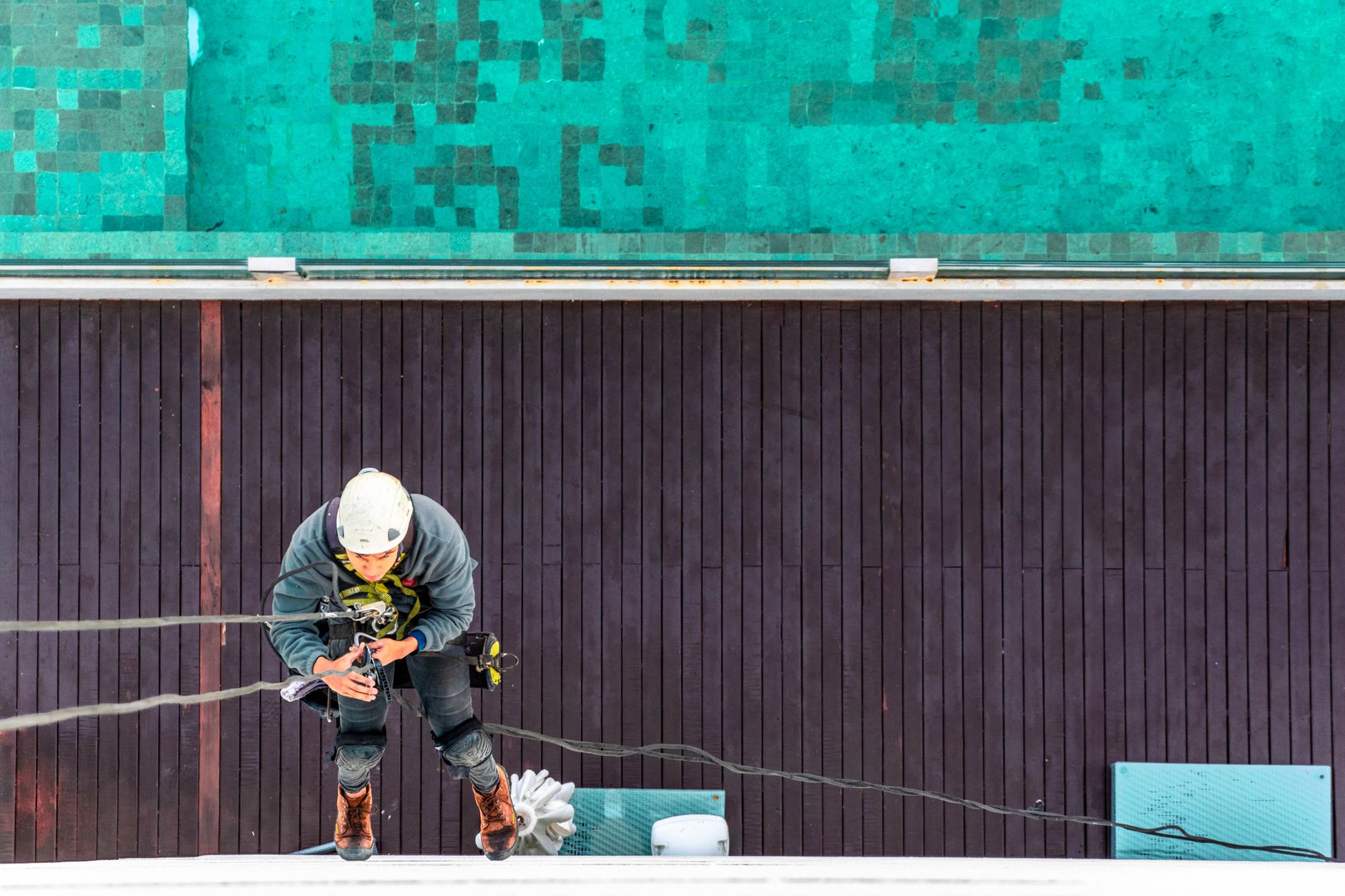
According to a membrane maker's maintenance training manager, quoted in construction trade press, routine membrane inspection is usually done twice a year, and holes and tears that developed since the last inspection are patched. If your spring check is one of those two rounds, a drone can change how that round is run, but it does not change how often the roof must be looked at.
An encyclopedic entry on tensile-fabric structures, which we treat as low-authority, lists routine checks twice a year covering tension levels, hardware corrosion and fabric integrity. The same entry puts specialized cleaning every 3 to 5 years. Use that list as a prompt for your own inspection checklist, and confirm intervals with the membrane supplier and your engineer of record.
The interval matters for planning. If the membrane is inspected twice a year, a tear that appears after one round may not be seen until the next, so the record of patches from each round is what shows the engineer where the fabric is wearing.
How much catwalk time do riggers spend, and why does it matter?
Your riggers spend three days on the catwalks every spring, and that time comes out of other work. The larger concern is fall exposure on that steel. According to an insurer's roofing safety summary citing an OSHA-investigated fatality study, falls were about 37 percent of construction deaths in 2015 to 2019, with 1,902 of 5,172 deaths.
The Occupational Safety and Health Administration, citing Bureau of Labor Statistics data, reported that 1,008 construction workers died on the job in 2020, and 351 of those deaths came from falls from elevation. The same insurer summary gives roofers a death rate of 29.9 per 100,000 full-time workers, against 15.2 for all construction, but that data is older, so treat it as context rather than a current rate. Each hour a rigger spends on a catwalk is an hour of exposure that a drone pass could reduce.
Scheduling is the other cost. A three-day block on the catwalks forces the crew into one window before the season, and a delay in that window pushes the check toward the opening. A drone pass that shortens the walk can make the window easier to hold, even if riggers still finish the job.
What can a drone see on a membrane, and what can it miss?
A drone camera can cover the top face of the membrane quickly and from a steady height, which helps spot holes, abrasion, loose edges and standing water. Drone roof guides also cite thermal imaging for finding trapped moisture under single-ply roofs and air leakage at seams and penetrations. Those guides are vendor material written for single-ply roofs, and a PTFE-coated fabric may not behave the same way, so treat the claim as something to test on your roof.
What a drone is likely to miss is anything that needs touch or a close look: fixings, clamps, the underside of the membrane, and the seam edges where the fabric is held. Vendor case studies describe aerial images supporting roof condition surveys, with a surveyor assessing the roof from those images. Those accounts are vendor-reported, and they show the images were used for assessment, not that every defect was caught.
The honest answer is that coverage differs by part of the roof. The top face and the general condition of the fabric are the easiest to survey from the air. Fixings, clamps and seam edges need hands and close sight, and our research gives no figure for how often drones match a rigger's findings there.
- Top face of the membrane
Drone
Covers the open roof from a steady height in one pass, weather allowing
Staff
Surveys from the catwalks and access points, with partial sight lines
- Fixings, clamps and seam edges
Drone
Limited to what a camera can resolve from the air
Staff
Close look and touch check on each fixing and seam edge
- Repeat comparison year to year
Drone
Same flight path and image set each season, easy to compare
Staff
Depends on each rigger's notes and photos
- Fall exposure on steel
Drone
Keeps people off the catwalks for the aerial part
Staff
Riggers stay exposed to fall risk while walking the steel
- Weather and access
Drone
Wind, rain and flight restrictions can cancel a pass
Staff
Works in more conditions, with its own safety limits
- Proof of detection
Drone
No verified accuracy figure found for membrane tears or seams
Staff
Established practice, though our research also found no detection rate for riggers
Is flying a drone over an occupied stadium roof allowed?
The Federal Aviation Administration allows routine operations over people and routine operations at night under conditions, under a final rule that took effect April 21, 2021, according to a university drone program. Before that, the earlier rules required waivers for both. Over-people eligibility is tiered by the aircraft's injury-risk profile, so the aircraft you pick determines which operations you can run.
Night flight needs more care than daytime work. A law firm summary describes anti-collision lighting visible for at least three statute miles and night training, but those specifics were not confirmed against FAA text, so check them directly before you plan a night flight. Privacy is a separate track: a law firm note says flights that comply with the drone rules may still raise privacy questions under state or local law, which matters over a venue with neighbors and nearby buildings.
Plan the flight paperwork early. A survey over an occupied venue needs a documented plan for the people below, a check of the airspace near the site and a clear rule for when flights stop. Ask the assessor to write those steps into the plan so the engineer and the venue manager sign off on the same document.
What would a spring drone survey look like on a stadium roof?
Start with a site assessment that maps the roof, the access points, the airspace around the venue and the days the stands are empty. Flights run when the seating bowl is clear, because a survey over occupied stands carries a different risk from one over an empty roof. The output is an image set and a defect log that your engineer reviews against last year's record, with each flagged spot tied to a location on the roof.
The seam and tear work does not disappear. Riggers use the drone log to decide which catwalk sections to walk and which seams to check by hand, so the walk becomes targeted instead of full coverage by default. The aim is shorter catwalk sessions with equal or better coverage, and that claim is only proven when the drone log is compared with the hand-check findings over a full season.
Set a trial that can fail. Run the drone pass and the normal rigger walk on the same roof in the same season, then compare the two defect lists. If the drone misses items the riggers find, the drone pass is a supplement, not a substitute, and the crew stays on the full schedule.
| Task | Today | With a robot |
|---|---|---|
| Walk the catwalks and check seams | Three days each spring, by your own figure | Hand checks only on sections the drone log flags |
| Survey the top face of the membrane | Done on foot from the catwalks and access points | One aerial pass, with length set by the site assessment |
| Record and compare defects | Notes and photos kept by each rigger | Image set tied to roof locations, reviewed by the engineer |
| Patch found tears | Patched by riggers on the same visit | Patched by riggers once the flagged list is confirmed |
The three-day figure is your own estimate. We did not verify drone flight times, because they depend on roof size, weather and the aircraft selected, so the withRobot column is set by the site assessment and trial.
Where does a drone fit next to a rigger crew?
Think of the drone as the first pass and the riggers as the second. The aircraft covers the open membrane and flags what looks wrong, and the crew walks only what needs a hand check. That split puts the crew where touch, tension and fixing checks matter, and keeps them off steel for the parts of the roof a camera can cover from the air.
Plan for the days the drone is grounded. Wind, rain or a flight restriction can cancel a pass, and then the riggers do the full walk as before. Keep the existing rigger schedule as the fallback until a season of comparison data shows how much of the work the drone pass can carry.
The staff side matters too. Riggers who know the membrane will read a drone log faster than someone who has only seen the roof from the ground, so include the crew lead in the flight plan and in the review of flagged items from the first season.
How would we set this up with you?
We are an integrator for US businesses, so we choose the aircraft across manufacturers based on the roof, the airspace and the flight plan, rather than offering one vendor's catalog. We lease the aircraft through financing, deploy and integrate it with your engineer and crew, train the staff who run it, and service every unit under our service plan, backed by regional service engineers in the states we serve.
The first step is a free site assessment. The lease quote follows it, with a fixed lease payment that reflects your roof, scope and schedule, and no large upfront capital is needed. Ask in the quote whether a spare or loaner unit is included, so the schedule holds if one aircraft is down on inspection day, and ask how the insurance and liability terms apply to flight logs.
What we do not promise is detection accuracy. We can set up, fly and service the aircraft, but whether the drone log replaces any part of the rigger walk is a question your engineer answers from a trial, not from a sales claim.
Frequently asked questions
Upcoming event venues & stadiums events
- Trade showBrats & RobotsNov 10, 2026Alliant Energy Center Exhibition Hall, Madison, WI
- MeetupMPI Virginia Morning Brew Meet-Up, November 2026Nov 10, 2026Hampton, VA
- SummitVA1 Governor's Tourism Summit 2026Nov 18 to 20, 2026Kalahari Resorts & Conventions, Spotsylvania, VA
- ConferenceVirginia Association of Fairs ConventionJan 14 to 17, 2027Williamsburg Lodge, Autograph Collection, Williamsburg, VA
Want a drone at your stadium roof membranes?
Tell us about your site. We will recommend the robot, quote the lease, and keep it serviced.
Sources
- World Construction Network, Hightex maintenance training manager statement
- Encyclopedic entry on tensile-fabric stadium membrane structures (low-authority)
- Markel roofing fall prevention summary citing OSHA-investigated fatality data
- OSHA news release citing BLS construction fatality data for 2020
- Princeton drone program, FAA rule for operations over people and at night
- FAA, operations over people
- Thompson Hine, FAA allows drone operations over people and at night
- Frost Brown Todd, drones overhead and privacy