
The question, in the buyer's words
Our coffee roastery hauls 150-pound green coffee bags by hand from receiving to the roast room, and two of our loaders already have bad backs; could autonomous mobile robots carry those bags to the roasters without blocking the roast room door?
Key takeaways
- A mobile robot can handle the horizontal carry of green coffee bags, not the final lift into the roaster.
- Confirm that the rated payload covers a 150 lb bag plus its cart, with margin, before anything else.
- Stage bags in a marked bay beside the roast room door so the robot never blocks it.
- Two loaders with back problems call for an ergonomic review of the whole task, not only a robot.
- A free site assessment measures your routes and bag volume before any lease quote.
Can mobile robots haul green coffee bags for a roastery without blocking the roast room door?
A roastery receives green coffee in heavy bags, and someone has to move each one from the receiving area to the roast room before the roaster can run. Hauling a 150 lb bag by hand is hard on the body, and when two loaders already have bad backs, every receiving day slips the roast schedule. Mobile robots, which are autonomous vehicles that drive a set route without a driver, are one way to take that carry off people.
The question has two parts. The first is whether a robot can physically carry a bag of that weight. The second is whether it can do so without parking in the roast room doorway, where it would block staff, the door, and cart traffic. Both parts depend on the layout of receiving, the staging point, and the room, plus whether the robot's rated payload is verified for that load.
The short version is that a robot is a reasonable candidate for the horizontal move, from receiving to a staging spot, when the route is clear and the staging spot sits beside the door rather than in it. It does not finish the job, because the last lift into the roaster hopper stays manual or aided, and it is rarely justified at very low bag volume. The sections below explain the reasoning and what to measure.
How many roasteries would face this receiving problem?
No official federal count of coffee roasters came up in this research, and the counts that exist differ by definition. Poidata lists 6,091 coffee roasters in the US as of June 2026, with California and Florida leading, according to that data report.
A separate web census of specialty roasters lists 4,091, led by California with 287, in a listing dated late August 2026. Because that census covers specialty roasters only, it counts a narrower group than the first figure. For an official number, the Census Bureau's County Business Patterns and Economic Census track establishments by industry, but this page did not pull those figures.
The national total matters less to you than three local facts: how far receiving sits from the roast room, how many bags you move on a receiving day, and whether you have floor space for a staging bay beside the door. Those three decide whether this question applies to your site, and a site assessment measures all three.
How heavy is a 150 lb green bag for a loader's back?
A 150 lb bag is heavy by any manual handling standard. The load constant in the Revised NIOSH Lifting Equation is 51 lb, the maximum for two-handed lifting under ideal conditions, according to the Canadian Centre for Occupational Health and Safety's summary of the method. A 150 lb bag is roughly three times that constant, so the recommended weight limit for a real lifting task at that load falls well below 51 lb, and the lifting index runs far above 1.0.
No coffee-specific ergonomic study turned up in this search, and no source here addresses a 150 lb bag directly. Bag weights also vary by origin. One coffee supplier's ordering guide lists a 70 kg Colombian bag at about 154 lb, so a 150 lb bag sits close to the heavier origin bags. Weigh your own bags on your own scale before you size anything.
Injury data points the same way. According to the National Safety Council, which compiles BLS data, overexertion involving days away from work totaled 492,140 cases for 2023 to 2024. Overexertion was the leading cause of days-away-plus-restriction cases, at 32%, and the median days lost for days-away cases was 8. These figures cover all industries, not roasteries, but they show how common and costly carrying injuries are.
If two loaders already report back problems, the first step is an occupational health review of the whole receiving task. A robot removes some of the carry, but it does not replace that review.
- Carry from receiving to staging
Autonomous Mobile Robot
Repeats the same route and takes the load off the back
Staff
Adjusts on the spot to a blocked aisle or a dropped bag
- Bag at 150 lb
Autonomous Mobile Robot
Works only within rated payload plus margin, checked with the cart in use
Staff
Can judge a damaged or mis-stacked bag, but each lift at this weight is well past the 51 lb load constant
- Doorways and traffic
Autonomous Mobile Robot
Needs a measured clear lane and a stop point beside the door
Staff
Steps aside, holds the door, and fits through tight gaps
- Pace over a long receiving day
Autonomous Mobile Robot
Steady pace with no fatigue, limited by route length and charging
Staff
Quicker on one short move, but fatigue and back pain slow long days
- Last lift into the hopper
Autonomous Mobile Robot
Does not do this step, which still needs a lift assist or tilter
Staff
Does this step, ideally with an aid
- Low volume days
Autonomous Mobile Robot
Hard to justify for a few bags a week
Staff
Covers a few bags with a hand truck or pallet jack
- Obstacles in the route
Autonomous Mobile Robot
Usually stops and waits until the path clears
Staff
Clears the obstacle and keeps moving
Can a mobile robot carry a 150 lb bag through a roastery floor?
Payload is the first gate. The rated payload must cover the bag, any pallet or cart under it, and a safety margin. Ask for the rating in writing, and confirm it applies to your floor type and drive system, not only to a best case test. A 150 lb bag on a cart can push a unit close to its limit, so the margin matters more than the headline figure.
The route is the second gate. Measure every doorway the robot must pass, including the receiving door, any corridor pinch point, and the roast room door. Note thresholds, floor drains, ramps and seams in the concrete. Many roasteries run on older floors, and a route that looks smooth on a plan may catch at a drain grate or a seam.
The staging point is where most of the blocking risk sits. The robot should stop in a marked bay beside the roast room door, not in the doorway, so staff can open and pass without moving it. Staff unload there, and the robot returns to receiving. A painted lane and stop zone keep the door clear and keep the robot out of the roasting work area.
If receiving and the roast room sit on different floors, the robot needs an elevator or another way between levels, and that adds its own integration and control check. Settle that question in the site assessment, before any quote is written.
How would a receiving day change with a robot?
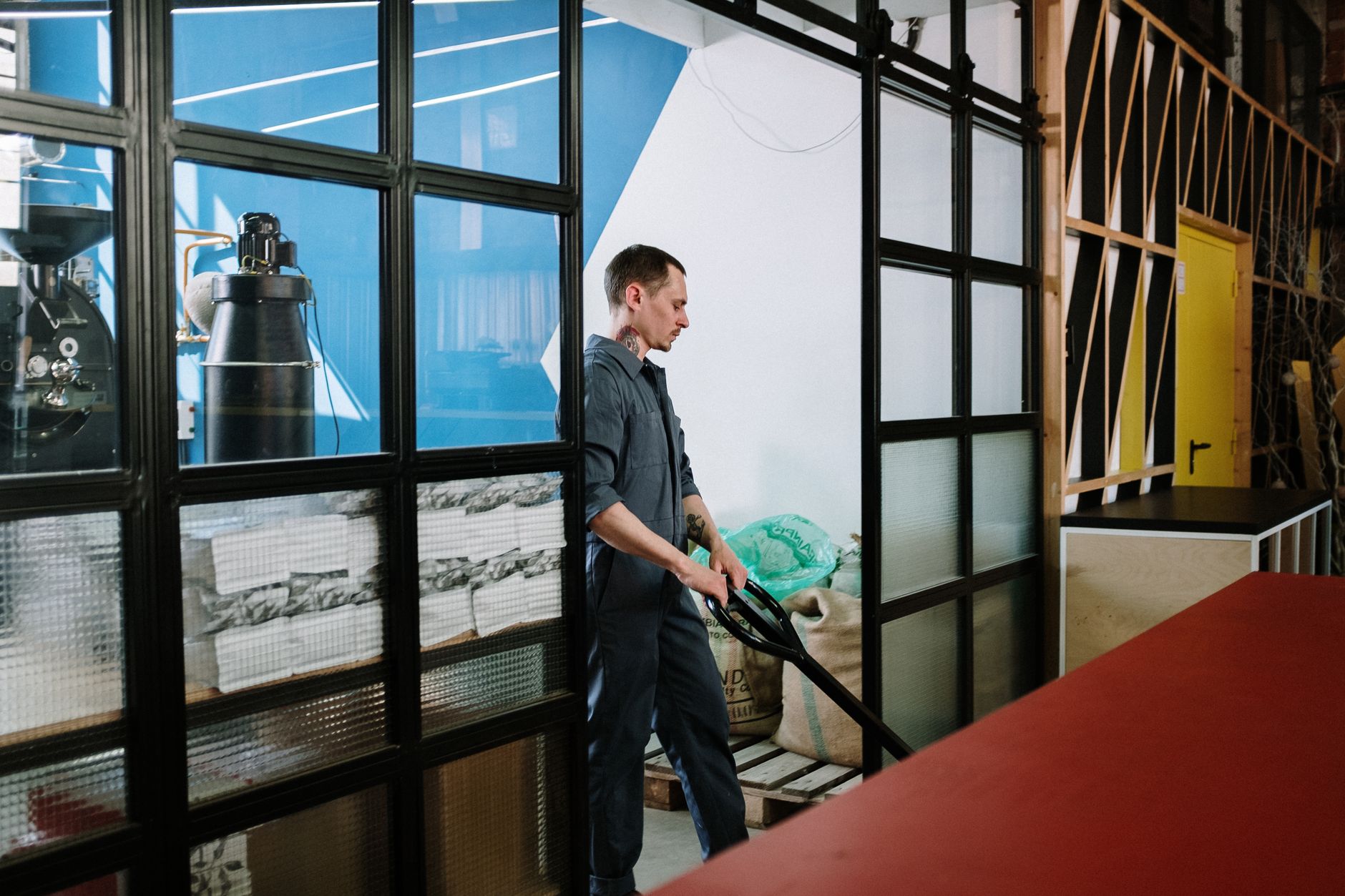
Today, a receiving day usually runs as a series of carries. A loader breaks down a pallet, lifts each bag, walks it to the roast room, and sets it beside the roaster. At 150 lb per bag, every carry is a load a loader has to brace for, and when two loaders carry back problems, the roast queue waits on them.
With a robot in the loop, the sequence changes. A person still manages the truck, counts bags, checks condition, and stacks them onto a cart or pallet the robot can take. The robot drives the carry to the staging bay. Roast staff unload there, and a tilter or lift assist moves the bag into the hopper.
The remaining labor is lighter and more supervisory, and the robot's pace is steady. The BLS reports that hand laborers and material movers held about 6.9 million jobs in 2025, with employment projected to grow 4% from 2025 to 2035, about as fast as average. That suggests the work stays in demand, though this research did not find turnover figures for the role, so any retention plan needs your own hiring data.
The schedule gain is what owners feel first. A receiving day that no longer waits on sore loaders keeps the roast queue moving, but the size of the gain depends on bag volume and route length. The site assessment measures both before anyone promises a change.
When is a robot the wrong fit for a roastery?
A robot is the wrong choice in several common cases. If you move only a few bags a week, a hand truck, pallet jack, or tilt aid may solve the problem with far less change to the building. If the route has narrow doors, steep ramps, or broken floors, the robot may not clear the path, and the work stays manual. If bags arrive loose rather than palletized, there is nothing stable for the robot to carry.
The bigger limit is the final lift. A robot does not put a 150 lb bag into a roaster hopper, so the lift assist decision stays on your list whether or not you add a robot. Treat the robot as one control in the ergonomic fix, not the whole fix.
Adoption data suggests approval is often the bottleneck. A January 2025 survey by Peerless Research Group, reported by Material Handling 24/7, of 217 respondents found that 48% of companies already use robots, 32% plan to adopt within three years, and only 32% have approved funding for new robotics. These figures cover businesses broadly, not roasteries, but they point to budget approval as a common hurdle.
- Fewer bags per week than a hand truck or pallet jack can cover without strain
- Doorways, ramps or thresholds the robot cannot measure through
- Bags that arrive loose and cannot be stacked on a cart or pallet
- No plan for the final lift into the roaster hopper
- Floors with frequent drains, seams or level changes on the route
What should you check before leasing a robot?
Before choosing any model, gather the facts that decide the answer: bag weight on your own scale, bags per receiving day, route length, doorway widths, floor condition, and the minutes each carry takes today. The research behind this page did not find roastery hours per shift or floor area, so those figures must come from your own timing and measurements.
Then ask for the robot specification in writing: rated payload with the cart you plan to use, speed, stopping distance, charging time, and what the robot does when something blocks its path. For a busy roast room, a robot that stops and waits is safer than one that tries to squeeze past people.
We are an integrator across robot makers, so the choice follows your site rather than one brand. The process starts with a free site assessment that measures routes, doorways, and the staging bay. The lease payment is quoted after that assessment, and the lease runs through financing. We deploy and integrate the robot, train staff, and service it under our service plan with regional service engineers.
How does getting a leased robot work with us?
It starts with a free site assessment. We map the route, measure doorways and the staging bay, check floor condition, and confirm the load with your team. That mapping decides whether a robot fits and which unit suits the job, and it is also the point where we will tell you if the site does not fit.
After the assessment you receive a quote. The robot is leased through financing, and the lease payment is set in that quote rather than estimated in advance. Deployment follows, with route mapping, integration into your receiving process, and go-live support while staff learn the workflow. Training covers the people who load the cart, the people who unload at the roaster, and the person who checks the robot each shift.
Service continues after go-live under our service plan, with regional service engineers and remote triage for faults. We do not promise a schedule gain before the assessment has measured your bag volume and route time, and the quote states what the plan includes.
Frequently asked questions
Want a warehouse robot at your coffee roasting rooms?
Tell us about your site. We will recommend the robot, quote the lease, and keep it serviced.
Sources
- Poidata coffee roasters report
- Keenable US specialty coffee roaster atlas
- CCOHS summary of the NIOSH Revised Lifting Equation
- National Safety Council overexertion data
- National Safety Council top work injury causes
- BLS Occupational Outlook Handbook, hand laborers and material movers
- Material Handling 24/7 on Peerless Research Group robotics survey
- Coffee supplier ordering guide on bag sizes