Key takeaways
- A conveyor wins where the same high volume follows the same path all year. An AMR fleet wins where routes, loads or layouts change.
- Daifuku, a materials handling maker, says conveyors are bolted in place and AMRs can start with a single robot, and that a hybrid often fits best.
- Interroll lists a parcel conveyor platform at up to 2.5 m/s and 10,000 pieces per hour, a throughput one robot cannot match on a single path.
- Fixed systems handle peak well only if they were sized for it, and sizing for peak can leave assets idle much of the year, according to Cleverence.
- Model at least three scenarios over 3 to 7 years, and find the flows that carry about 80 percent of your volume before you decide.
Is an AMR or a conveyor better for a mid-size warehouse?
Neither wins everywhere. A conveyor wins where the same high volume moves along the same path all year, and an AMR fleet wins where routes, loads or layouts change. Many mid-size warehouses end up with both. Service Robot Co. compares the two approaches against your flows, then leases, deploys and services the robots that fit.
The comparison is between approaches, not products. A conveyor is a fixed line that moves items past stations at speed. An AMR is a vehicle that picks its own path, carries one load at a time and can be sent anywhere the floor allows.
Both have honest strengths and honest limits, and many published comparisons come from companies that sell one side. This article draws on sources from both camps and says who is speaking.
What does each approach do best?
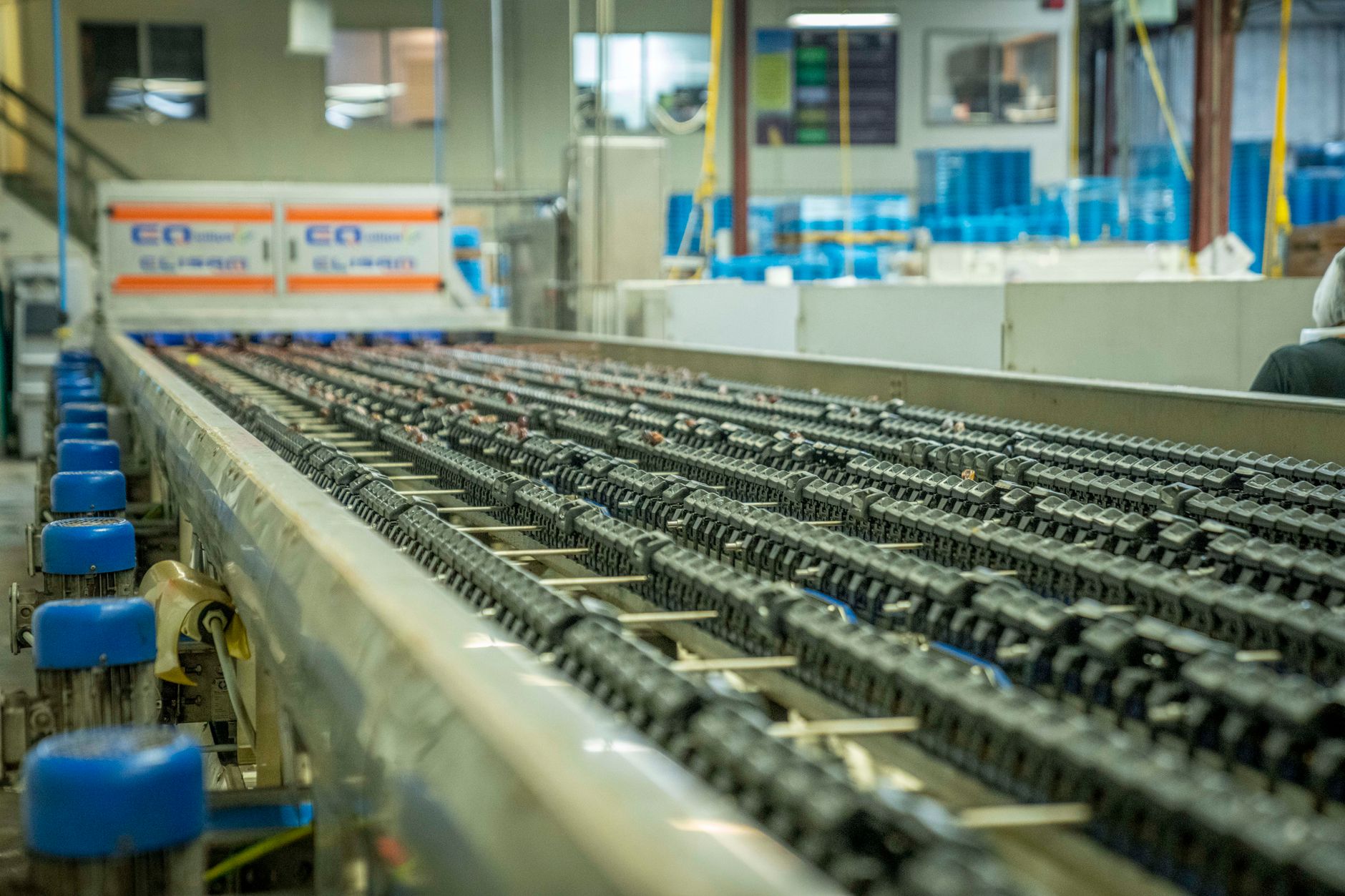
Giovanni Stone, senior vice president at Daifuku, writes that conveyors can provide more throughput and route packages more reliably to other operations than any other technology, and calls them reliable, fast and well established. Interroll lists its High Performance Conveyor Platform at a maximum speed of 2.5 m/s and throughput of up to 10,000 pieces per hour, aimed at courier, express and parcel operations.
AMRs win on adaptability. Stone says they need no tracks or large amounts of fixed equipment, and that a system can start with a single robot at a lower entry cost, which suits smaller businesses. Mobile Industrial Robots lists top speeds of 1.5 to 2.0 m/s across its range, from a 250 kg model to a 1,350 kg model.
These are different units of capacity. One conveyor line moves items continuously, while each robot moves one load per trip. The right comparison is how many robots a given flow would need, and how that fleet behaves at your busiest hour.
How do layout and growth change the answer?
Conveyors are fixed by design. Stone writes that they must be bolted in place, so the layout is set, and Cleverence adds that fixed systems may need clear spans, set ceiling heights, mezzanines or specific slab qualities. If your contracts or SKUs change often, that rigidity costs you. Cleverence uses contract mixes that change every 6 to 12 months and SKU re-slotting every quarter as examples where it bites.
AMRs are friendlier to older buildings with mixed layouts, according to Cleverence, but they are not free of geometry. For a pallet AMR such as the MiR1200 Pallet Jack, Mobile Industrial Robots lists an operational corridor of 2.10 m at full speed and 1.55 m at reduced speed, and 3.80 m for two robots to pass at full speed. Narrow aisles and shared lanes still shape what a fleet can do.
Timing matters too. Interact Analysis said in July 2025 that many companies were delaying warehouse automation investment and that new distribution center construction was sluggish. For a mid-size operator in an existing building, that favors approaches that fit the building you have.
What happens at peak volume?
Peak is where the two approaches diverge most. Cleverence says fixed systems can handle peak well, but only if they were sized for it, and that oversizing for peak can leave assets underused for much of the year. AMR fleets can add or remove robots to match seasonal peaks, though it says peak orchestration and traffic control become more complex as the fleet grows.
There is also a ceiling on convergence. Stone notes that there is a limit to how much volume can be taken to or from a specific point. A drop-off station that ten robots reach at once is a bottleneck, and no extra robot fixes it.
For a mid-size site the practical test is the ratio of your peak hour to your average hour. A flat profile with a steady stream favors a fixed line. A spiky profile with seasonal surges favors a fleet you can grow and shrink.
What does it take to run each one day to day?
Upkeep looks different. Cleverence says a fixed system carries preventive maintenance, spare parts and sometimes specialized technicians, while an AMR fleet carries software costs, battery lifecycle costs and maintenance that tracks robot count and hours of use. Stone says AMR batteries need replacing around the five-year mark, and Mobile Industrial Robots lists a design life of 5 years or 20,000 hours of active operation for its pallet AMR, with lithium-ion batteries rated for 3,000 full charging cycles before capacity falls below 80 percent.
People share the floor with robots, so speed and noise matter. The same pallet AMR lists a top speed of 1.5 m/s (5.4 km/h) at maximum payload and a maximum noise level of 77.3 dB. A conveyor keeps its hazards in one place, at the line. A fleet moves its hazards around, so traffic rules, lane markings and a speed plan belong in the project from the start.
Safety work follows the robot. ANSI/A3 R15.08-2 puts the risk assessment for industrial mobile robot systems on the integrator, in line with ANSI/ISO 12100 or ANSI B11.0, and requires residual risks from expected use and misuse to be listed for the user. Ask whoever installs your robots for that document and read it before the first shift.
Ask the same maintenance question of both sides. Who comes when it stops, how fast, and what is stocked locally? A conveyor line and a robot fleet both fail eventually, and the better answer is the one with a named person and a time attached.
Where do AMRs and conveyors work together?
Hybrids deserve a look. Stone says a hybrid approach that combines the strengths of both may suit many sites. Cleverence describes a fixed high-speed core with AMR lanes for surges, and says that for very high-rate induction, merging and sortation a conveyor backbone may still be the most predictable choice.
The hardware already overlaps. Locus lists conveyor feeding and sortation among the uses of its Vector robot, and ANSI/A3 R15.08 defines Type B mobile robots as AMRs with attachments such as roller tables, conveyors and linear lifts. If a robot carries a conveyor or feeds one, the safety assessment covers the combination, which the standard assigns to the integrator.
One example of a split, which is our suggestion and not a rule: run the stable, high-volume stretch from dock to pack on a conveyor, and use robots for replenishment, staging and the irregular trips that change from season to season.
How should a mid-size warehouse decide?
Start with your flows. Cleverence suggests identifying the work patterns that cover about 80 percent of volume, noting that the more stable and high-volume those patterns are, the stronger the case for fixed automation in those lanes. Brownfield sites with irregular aisles tilt toward AMRs. It also advises modeling at least three scenarios, conservative, baseline and aggressive, over a 3 to 7 year horizon.
Fixed systems carry more upside in sustained high-volume scenarios, and AMRs often carry less downside risk in negative ones, in Cleverence's framing. That is a useful way to read your own uncertainty. If you are unsure about volume, a pilot of robots on one flow costs less commitment than a line.
The steps below put that into order. Keep your first AMR project small and tied to one route, so you learn how your building behaves before you decide the rest.
How does Service Robot Co. approach the choice?
We lease and service robots, so we are not neutral about what we do. We are neutral about which approach fits you. For a stable, high-volume line, a conveyor may be the right answer and we will say so. For changing routes or an older building, we compare AMRs across manufacturers and recommend the one that fits.
We lease the robots on a 3-year lease with a $1 buyout at the end, deploy them, integrate them with your systems, train your crew and service them. The site assessment comes first, and it covers your flows, your aisles and your peaks.
Want help picking the right robot? Talk to us
Book a free site assessment with Service Robot Co. Bring your flows, your peak hour and your layout, and we will tell you where robots help and where a fixed line is the better call.
Every robot we lease comes with 24/7 support with 10-minute specialist triage, regional service engineers in every serviced state, three check visits a year and a 12-month warranty.
Frequently asked questions
Want a robot working for you?
Tell us the job and the site. We will recommend the robot, quote the lease, and keep it serviced.
Sources
- Automated Warehouse: Is there still a place for the humble conveyor? (Daifuku)
- Cleverence: AMRs vs fixed automation for 3PLs
- Interroll: High Performance Conveyor Platform
- Mobile Industrial Robots: MiR1200 Pallet Jack specifications (PDF, June 2025)
- Mobile Industrial Robots: product overview (PDF, May 2025)
- Locus Robotics: Vector datasheet (PDF, 2026)
- The Robot Report: ANSI/A3 R15.08-2 AMR safety standard (October 2023)
- Supply Chain Digest: Interact Analysis AMR forecast (July 2025)