
Key takeaways
- Treat oxygen runs as a controlled medical-gas workflow, not generic courier traffic.
- Separate full, partial, and empty cylinders by policy, rack, and scan event before the robot moves.
- Elevator logic, corridor dwell, and urgent override rules matter as much as the robot itself.
- Closed-loop issue and return tracking is what keeps cylinder automation audit-ready.
What does a safe oxygen-cylinder AMR loop look like?
Yes, AMRs can handle oxygen cylinder runs inside hospitals, but only when the hospital designs the job as a tightly bounded medical-gas loop. The workable pattern is simple. Full cylinders leave a secured storage point in a dedicated rack or cart, travel on a defined route to respiratory care or a clinical floor, and empty cylinders return through a separate, equally controlled path. The robot is the mover, not the decision-maker.
The opening design rule is segregation. According to the Joint Commission FAQ updated on April 21, 2026, cylinders a hospital defines as empty must be kept separate from cylinders intended for patient care use, and empties must be marked so staff do not grab the wrong tank in a rush. That matters because a cylinder run often happens under time pressure, especially around respiratory therapy, transport, emergency care, and backup supply events.
The second rule is accountable handoff. A safe AMR loop has a named origin, a named destination, a route that does not become hallway clutter, and a return event for empties. When hospitals skip any of those pieces, they do not have repetitive transport automation. They have wandering inventory.
- One secured source location for full cylinders
- A separate return path and rack for empties
- A defined floor-by-floor delivery roster
- A human confirmation at release and receipt
- A STAT override that bypasses batching
Start with three cylinder states, not one pile
Hospitals often speak about full and empty cylinders, but the operating model usually needs three states. There is full and ready for patient care, partial and still usable under hospital policy, and empty or depleted for return. The Joint Commission notes that full and partially full cylinders may be stored together if the organization permits it, while partials without an integral gauge, or with a gauge reading the hospital treats as depleted, should be stored with empties.
That is not a paperwork nuance. It decides what the robot is allowed to pick. If a cart or rack mixes unopened backup cylinders with partly used floor stock, the AMR cannot preserve clinical intent. The simplest control is rack-level separation with matching digital states, so the software knows whether it is dispatching a full-ready unit, collecting an empty-return unit, or refusing a pickup because a scan shows the wrong condition.
- Full-ready: unopened or policy-defined full cylinders for immediate patient care use
- Partial-in-use: cylinders still acceptable for use under local policy and gauge reading
- Empty-return: depleted cylinders, tagged or rack-labeled to prevent confusion
Where should pickup and drop racks sit?
CMS requires hospitals to meet the 2012 edition of NFPA 99, and the public CMS K0923 survey language gives useful thresholds for oxygen-cylinder storage. Up to 300 cubic feet of cylinders available for immediate use in one smoke compartment may be outside an enclosure. More than 300 but less than 3,000 cubic feet must be in an enclosure or enclosed interior space with securable doors. At 3,000 cubic feet or more, the storage room must meet the stricter design and ventilation rules tied to the code.
That drives floor layout. Your robot should pick from a real medical-gas storage point, not from an improvised nook near a nurse station. OSHA also says assigned storage spaces should be in well-protected, ventilated, dry locations and away from elevators, stairs, or gangways. In practice, the best layout places the secured cylinder room close enough to the service elevator for short travel, but not inside the elevator lobby and not in the line of egress.
CMS survey language also requires a precautionary sign readable from 5 feet on each storage-room door or gate with the wording CAUTION: OXIDIZING GAS(ES) STORED WITHIN NO SMOKING. If the area holds oxidizing gas near combustibles, the same K0923 language points back to 20 feet of separation, or 5 feet if sprinklered, or a cabinet with a half-hour fire rating. Those facts should shape the architecture before the first route is mapped.
- Use separate secured racks or cages for full-ready and empty-return cylinders
- Keep pickup points out of the elevator lobby and out of corridor choke points
- Post the required oxidizing-gas signage on each storage enclosure
- Design drop zones so a human can scan, verify, and remove a cylinder without blocking traffic
How should the run work from storage to respiratory care and the floors?
The cleanest workflow begins in central storage or the medical-gas room. A technician or supply clerk scans a full cylinder out of inventory, places it into a dedicated transport fixture, and releases it to the AMR. The robot travels either to respiratory care for cross-docking or directly to a designated floor handoff point, depending on how the hospital staffs its oxygen distribution. Empty cylinders move the other direction on a separate mission type.
Respiratory care usually works best as the control tower for exceptions. Routine replenishment can move on a milk-run cadence, but respiratory therapists should own the rules for floor minimums, emergency reserve, and equipment compatibility. That means the AMR can carry the cylinder, yet the release logic still depends on clinical stock targets rather than generic courier timestamps.
On the floor, the handoff point should be specific. Not a hallway corner. Not a random alcove. A defined rack, room, or recessed bay where the receiving unit confirms the serial or asset ID, acknowledges quantity, and either swaps an empty immediately or flags the return for the next cycle. That keeps the loop closed and keeps cylinder dwell visible.
- Issue full cylinder from secured storage
- Scan cylinder ID, state, source, and destination
- Move on a dedicated AMR mission to respiratory care or floor handoff
- Confirm receipt before the mission closes
- Scan empty cylinder back into return status and dispatch pickup
What changes when the trip crosses an elevator?

A delivery robot for elevators and a multi floor delivery robot workflow are really access-control projects with a medical-gas wrapper. The robot needs service-elevator access, door timing that does not leave a cylinder parked in public circulation space, and fallback behavior when the car is busy or blocked. If the robot can summon the elevator but cannot secure the handoff zone on arrival, the workflow is unfinished.
The code-backed constraint is that storage belongs away from elevators and that egress corridors cannot become storage areas. The Joint Commission says items cannot be stored in egress access corridors, and even in-use wheeled items must move within 30 minutes. That means the AMR should not queue outside the elevator as a standing rack. It should arrive just-in-time, enter, ride, exit, and clear the corridor quickly or retreat to a lawful waiting point.
Operationally, hospitals usually want elevator windows, service-car preference, and destination-specific arrival notices to the receiving team. If the elevator is unavailable beyond a short threshold, the mission should escalate, not idle forever. For oxygen work, delay is a clinical risk and a hallway-management problem at the same time.
- Reserve service elevators for cylinder missions when possible
- Avoid any standing wait in public lobbies or egress corridors
- Set a timeout that reassigns delayed missions to a human runner or alternate queue
- Send arrival alerts before the robot exits onto the destination floor
How do urgent overrides work without breaking control?
An urgent override is not a faster version of the routine queue. It is a separate dispatch class. When a floor, ICU, ED, or respiratory therapist requests a STAT cylinder, the AMR system should bypass batching, reserve the next lawful route, and notify both the source and receiving team that the mission is a priority exchange.
The handoff still needs two confirmations. One person verifies the full cylinder released to the robot. Another confirms receipt at destination. The Joint Commission's storage guidance explains why the labeling discipline matters here. Empty cylinders must be marked so staff do not face confusion or delay when a full cylinder is needed rapidly. In an override path, that principle becomes software and staffing logic, not just rack signage.
A smart override also preserves the return event. The temptation is to rush a full cylinder upstairs and worry about the empty later. That habit is how hospitals lose location visibility. Better practice is to let the override close only after the destination either scans the empty onto the return queue or records why no return was available on that trip.
- Dedicated STAT queue with no batching
- Immediate source verification of cylinder state
- Destination acknowledgment within a defined timeout
- Automatic return mission for the empty, or an exception record if none is ready
How much accountability should each handoff carry?
Quite a lot. A peer-reviewed report from AIIMS Rishikesh described exactly why oxygen logistics need a two-way record. Its medical gas store had to issue refilled cylinders to wards and receive empty cylinders back, and the hospital was managing about 2,500 cylinders. The article notes that one-way asset tracking was not enough, so returns still had to be tracked through a stock register and spreadsheet. That is the operational gap AMRs should close, not hide.
The right event model is issue, in transit, received, in use, empty, and returned. If the hospital uses integral pressure gauges, the threshold for empty should be encoded in policy and software at the same time. That keeps rack labels, respiratory practice, and the fleet dashboard aligned.
There is real evidence that disciplined oxygen tracking changes outcomes. A 2025 PubMed-indexed dashboard study across 12 hospitals in Lesotho tracked daily usage and cylinder stocks over 359 facility days, reported average oxygen use of 186,802 liters per day, and prevented all 14 potential stockouts identified by the dashboard. The lesson for a U.S. hospital is straightforward. Visibility into issue, return, and reserve is not administrative overhead. It is supply assurance.
- Scan at release, receipt, and return
- Record cylinder ID, fill state, source unit, destination unit, and timestamp
- Bind the empty-threshold policy to gauge readings and workflow rules
- Show floor reserves and overdue returns on a live dashboard
What fire and staff-safety rules shape the final SOP?
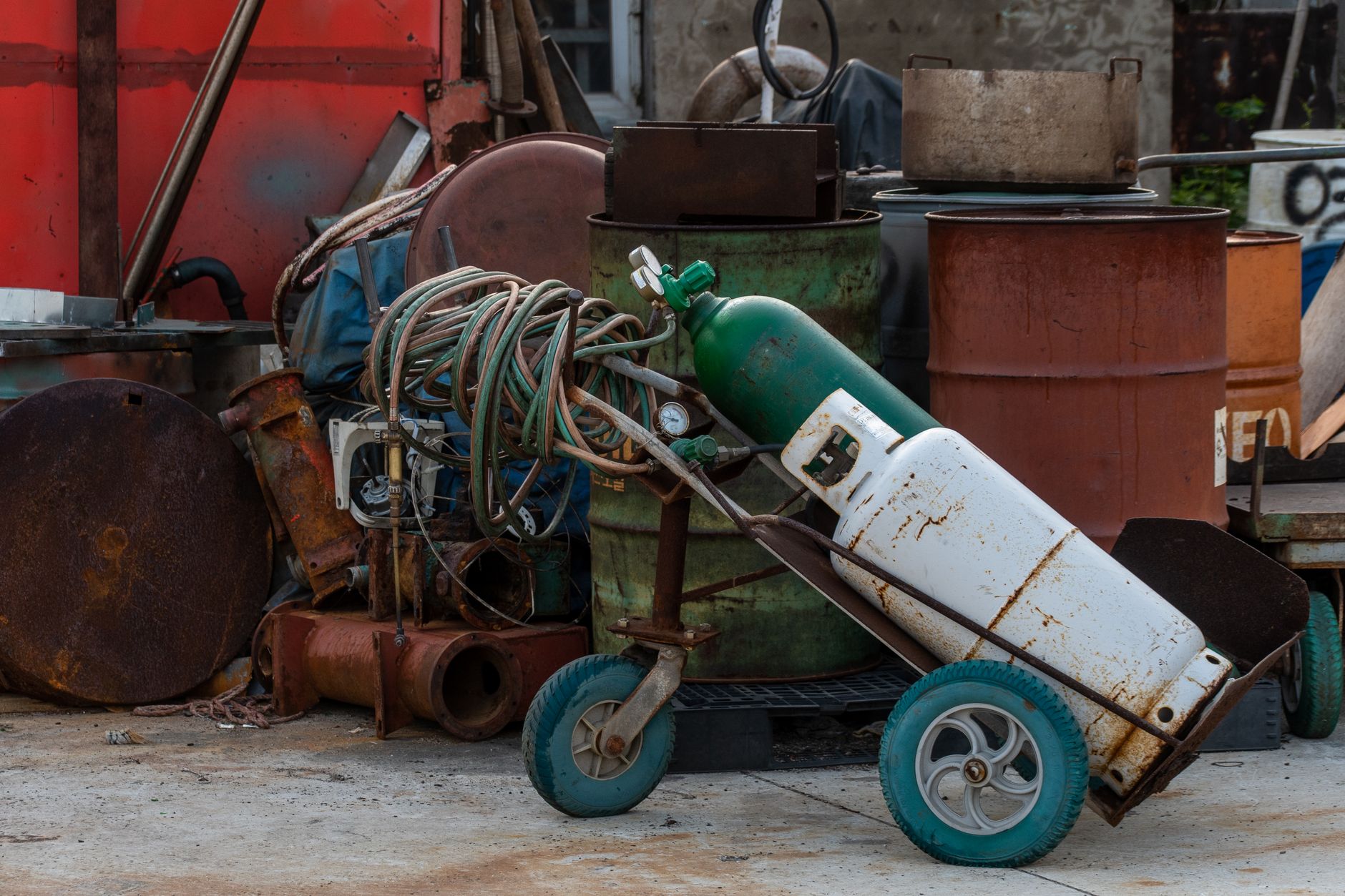
Oxygen is not just another parcel. OSHA requires indoor cylinder storage to stay at least 20 feet from highly combustible material, and oxygen cylinders in storage must be separated from fuel-gas cylinders or combustible materials by 20 feet or by a noncombustible barrier at least 5 feet high with a 30-minute fire rating. NIH guidance adds practical handling detail: cylinders should be secured upright, full cylinders should be separated from empty cylinders, and cylinders being transported should be closed, capped, and secured to the cart.
CMS survey language also states that large cylinders exceeding size E, and containers above 45 kilograms or 100 pounds, must travel on a proper hand truck or cart, while freestanding cylinders must be chained or supported in a proper stand or cart. That matters for AMR payload design. The robot is not replacing the need for a lawful transport fixture. It is carrying one.
OSHA's technical manual notes that normal air is about 20.9 percent oxygen and that atmospheres above 23.5 percent oxygen are oxygen-rich and present a fire and explosion hazard because ordinary combustibles burn more rapidly. That is why greasy gloves, damaged valves, ad hoc staging, and loosely restrained cylinders are not small mistakes. They are design failures.
- Keep cylinders upright and restrained during storage and transport
- Use purpose-built fixtures that protect the cylinder and control tipping
- Separate oxygen from combustibles and ignition sources by code distance or barrier
- Write leak, alarm, and failed-delivery steps into the same SOP as the transport flow
Where Service Robot Co. fits in this kind of hospital project
For hospitals exploring a hospital delivery robot lease pilot, an autonomous mobile robot lease rollout, or a longer AMR lease plan for repetitive transport automation, the hard part is rarely choosing a machine in isolation. The hard part is making elevator access, floor handoffs, fire review, exception handling, and return accountability work together under one operating model.
Service Robot Co. is built for that job as an OEM-neutral, full-service commercial robot integrator for U.S. businesses. We pick the right platform across manufacturers, then handle robot deployment and integration, staff training, service, and support through a nationwide U.S. engineer network. If a site prefers monthly payment programs, purchase or lease, or a hospital delivery robot lease structure before broader rollout, we can shape the program around the workflow instead of forcing the workflow around one vendor's box.
That matters in hospitals because oxygen logistics do not forgive split ownership. A delivery robot for elevators, a multi floor delivery robot route, and a clinical chain of custody all need one accountable operator. One partner. One number. That is what keeps the fleet useful after go-live, not just impressive on demo day.