Key takeaways
- A counter kitting cell fits best where bins are mixed, kits are small and the same counter queue keeps refilling.
- Measure bin variety, cycle time and staff handoffs over at least two typical weeks before any vendor talk.
- Academic models show cobot kit preparation can match manual cycle time while holding it steadier.
- Public evidence for electrical branch counters is thin, so treat any payback claim as a hypothesis to test.
- Have your SKU list, counter dimensions, network drops and floor rules ready before the site assessment.
Does a cobot fit a branch counter at all?
Yes, but only under fairly specific conditions. A cobot kitting cell belongs at a branch counter when staff lose real minutes each day pulling mixed components from bins to build job kits, and when those kits are small, varied and tied to the same counter queue. It is not a warehouse fleet. It is a bench height arm, a bin wall, a staging shelf and a counter worker who still signs off every order.
The academic work supports that narrow reading. A Chalmers study models a cobot mounted on an AGV that sorts parts an operator has already picked into batches of kits. The authors report cycle time comparable to manual preparation, with a more stable cycle time.
Market context helps, but only as background. According to the International Federation of Robotics, about 603,000 industrial robots were installed in 2025, up 11%, and collaborative robots made up about 66,000 of them, or about 11% of installations. None of that measures counter kitting in branches.
What do the kitting studies actually show?
The most relevant finding comes from a follow-up Chalmers study. It finds cobot supported kit preparation is most beneficial with diverse kits and smaller component quantities per SKU, compared with manual preparation. Picture a contractor ticket that lists many small items, each in a quantity of only a few. That is the pattern the study favors.
A University of Padua record reports an 18.6% reduction in makespan in a collaborative kitting scenario. Makespan is the total time from the first pick to the last completed kit, which makes it a fair proxy for throughput. The public record does not describe a branch setup, so treat the figure as a starting point rather than a forecast.
Neither study is a field trial at a counter. Read them as evidence that the approach can work with diverse, small quantity kitting, and nothing more.
How much bin variety is too much?
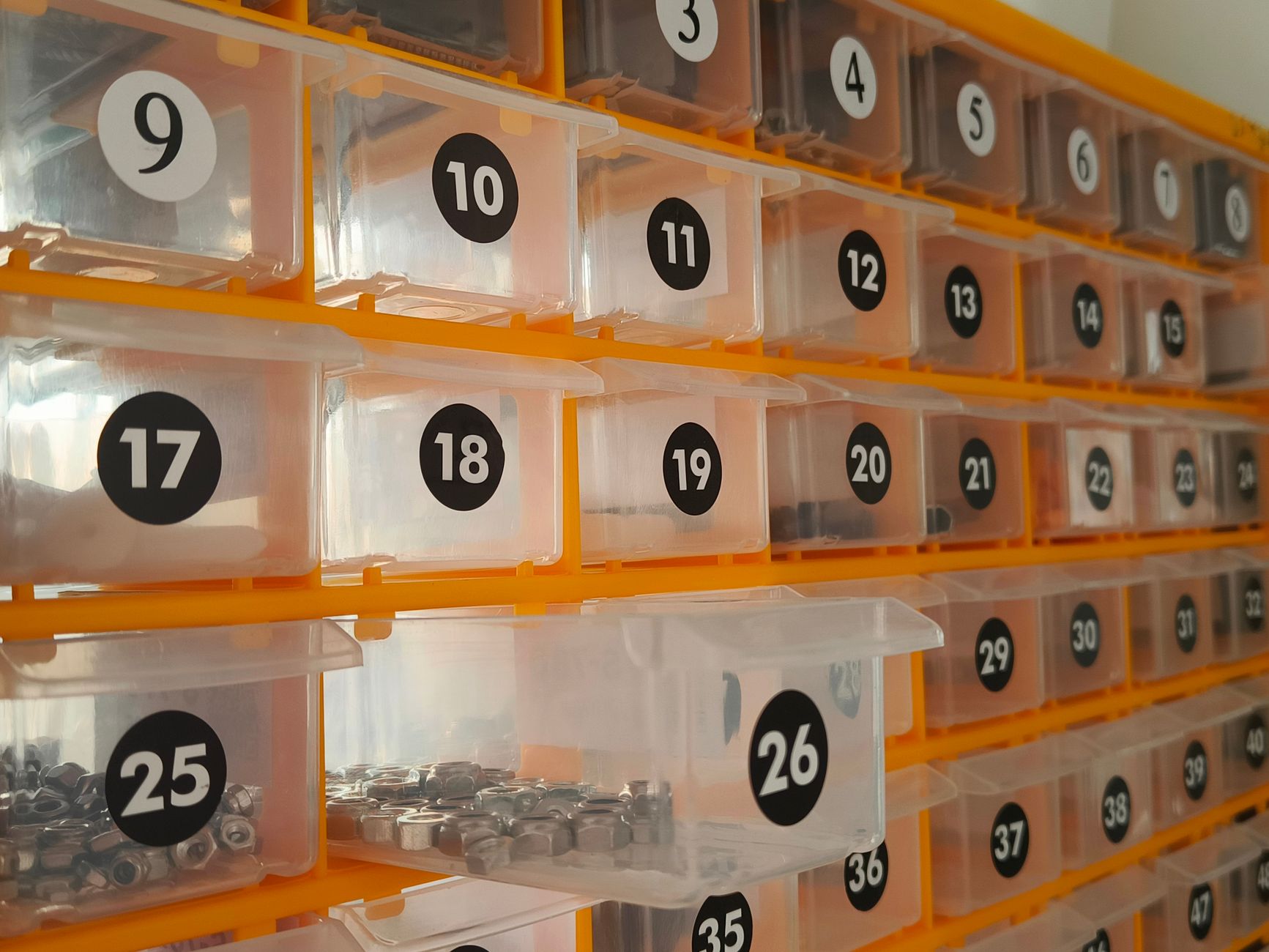
Start with variety, because it decides whether an arm is worth the effort at all. A counter fed by a handful of fast moving bins is a different problem from one with a deep, churning mix. The Chalmers results point toward mixed kits and small quantities, so your job is to count how often that happens rather than assume it.
Capture these four numbers over at least two typical weeks, pulling from order history where you can and from a staff tally where you cannot.
- Distinct SKUs pulled at the counter each day, split by bin zone
- Average number of lines on a kit ticket
- Units per line, and the share of lines that call for one or two units
- Share of kits that draw from more than one bin zone or shelf
Where do cycle time and handoffs show up?
Time each kit from ticket release to the kit reaching the counter. Then split that clock into picking, walking, waiting for a free worker and handing off. Chalmers reports that cobot assisted preparation held a stable cycle time, and at a counter stability can matter more than average speed. A queue that spikes at opening punishes an unpredictable process, even one that is fast on average.
Handoffs are where branch counters quietly lose time. Count every point where a kit changes hands, such as picker to checker, checker to counter clerk, and clerk to contractor at the pickup window. A cell removes the walk, but it does not remove a handoff. A cell that dumps finished kits onto one shared shelf can create its own queue.
What should the site have ready before an assessment?

Bring data and drawings rather than opinions. An assessment moves faster when the site can show the counter and its surroundings as they really are.
Gather these items before the visit.
- An up to date SKU list with bin locations and a note of any bins that move between zones
- Dimensions of the counter, bin wall and staging shelf, with photos taken at counter height
- Power and network drops near the counter, and any locked or restricted rooms nearby
- A staffing grid showing who touches a kit and the hours when the counter is most stretched
- Written floor rules for customers, forklifts and carts that pass the counter
How does the cell connect to staff and order systems?
Much of the integration work is software, not steel. Cobots often connect to a Warehouse Management System through middleware or APIs, receiving pick lists and confirming completed tasks. A branch running its counter from a different system needs to know whether the cell can read that feed, and who maps the data. Settle that question first, because it sets the schedule more than the arm does.
Service Robot Co. is OEM neutral. We pick the robot that fits the job across manufacturers, then deploy, integrate, train and service it under RoboCare, our service plan, backed by regional service engineers in every state we service. Our offer is a lease, through financing, over three years, with one fixed payment quoted after a site assessment.
Going live is where cells win or lose counter trust. Write the handoff rules and the stop rules down, rehearse them with the people who will use the cell, and keep a named contact for the first weeks of running.
Where does the published evidence stop?
Be plain about the gap. No public source reviewed for this piece covers electrical distributor branch counters or will call kitting, and none gives an independently audited payback for mixed SKU branch kitting. Universal Robots' logistics page, checked in November 2026, says its cobots handle mixed SKU kitting and that cells can be implemented in weeks, not months. That is vendor marketing, and the page gives no payback figures.
An archived copy of Locus Robotics' industrial page lists electrical, plumbing and HVAC supplies among its markets. That page describes mobile robots for picking rather than cobots, so it signals where distributors already run automation, not how a counter cell performs.
The practical move is to pilot one counter zone, time it against the baseline you built in the earlier sections, and set a go or no go test before the first unit arrives. Treat any payback claim, including the ones collected here, as a hypothesis until your own weeks of data say otherwise.
Frequently asked questions
Want a robot working for you?
Tell us the job and the site. We will recommend the robot, quote the lease, and keep it serviced.
Sources
- Chalmers study: cobot kit preparation with AGV
- Chalmers follow-up: diverse kits and small quantities
- University of Padua record: collaborative kitting
- University of Padua record: collaborative kitting
- International Federation of Robotics, President's report 2026
- Universal Robots logistics: robotic packing and kitting
- Racklify: cobot integration and WMS connections
- Locus Robotics industrial page (archived)