Key takeaways
- Published slope ratings in the documents we read run from 20 percent inside the work area for one commercial robot to 45 percent for one Toro variant, and some makers publish no percentage at all.
- Read the unit and the location of the number: Husqvarna rates the boundary lower than the inside of the work area, and one review wrote a slope figure in degrees where the maker used percent.
- Wet grass is a traction and timing decision. Greenzie's own documentation says light rain is fine and muddy fields risk ruts, so a wet-day rule belongs in the site plan.
- Thin, low obstacles are the hard case. Greenzie's documentation says small items that do not stand up out of the grass can be run over, so sprinkler heads need fixing, marking or a keep-out zone.
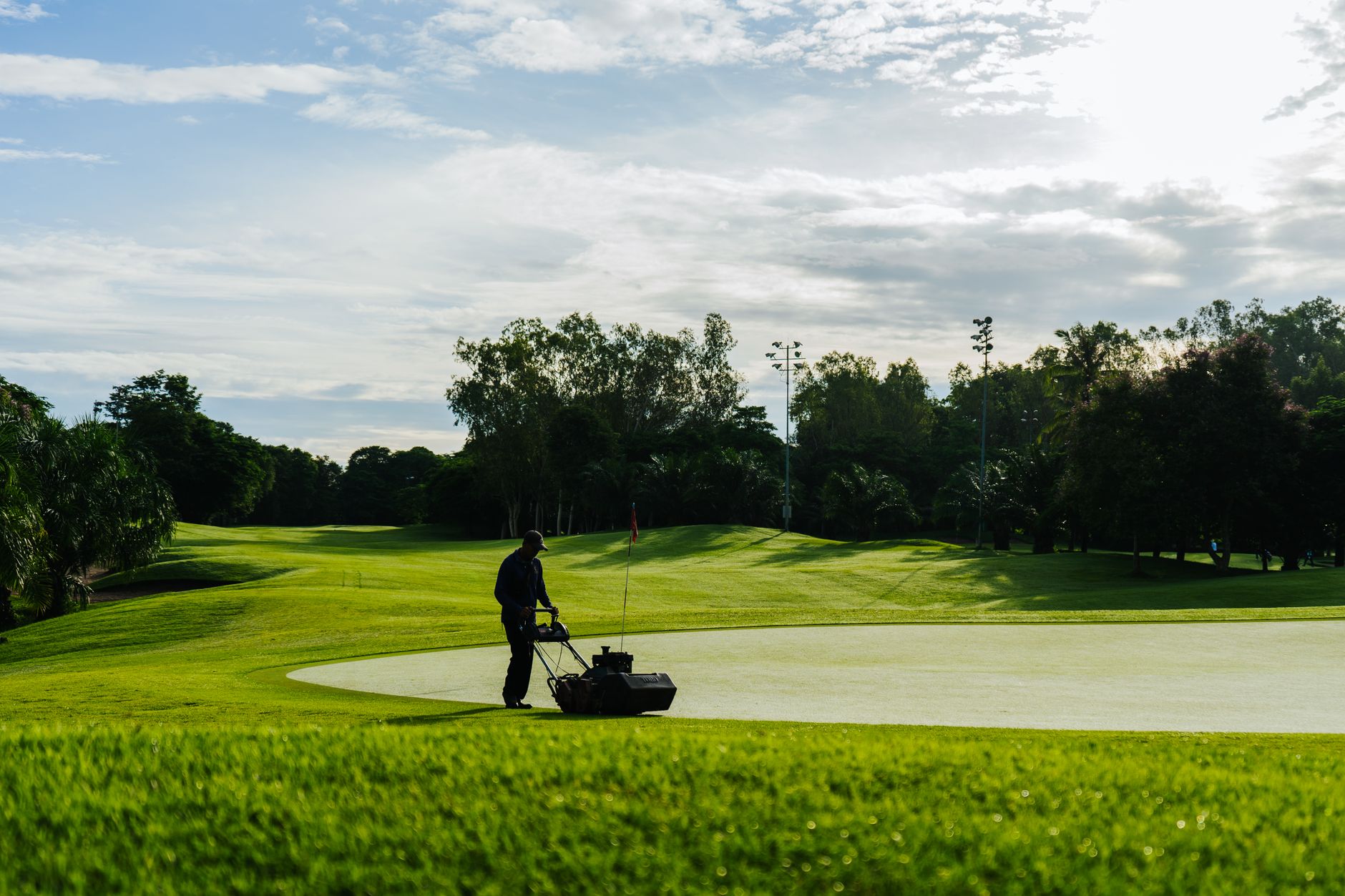
- On a golf course the robots still leave bunker surrounds and rough edges to a trim mower, and the work is supervised: plan for a person nearby, not an empty course.
- Service Robot Co. walks the slopes, maps the keep-out zones and picks the machine for the site, then leases it on a 3-year lease with a $1 buyout.
How do autonomous mowers handle slopes and wet grass on commercial properties?
Autonomous mowers handle slopes up to a published rating and avoid ground that is too steep or too wet. Service Robot Co. measures each property's steepest grades, picks a machine rated above them, and maps keep-out zones for the rest. Ratings differ widely between makers, so your site's numbers matter more than a brochure.
This guide covers what the manufacturers publish about slopes, rain and obstacles, what independent reviewers and working contractors report, and the golf course specifics: sprinkler heads, bunkers and the edges around them. Everything is attributed to the page it came from, and the sources list at the end links each one.
How steep a slope can a commercial robotic mower handle?
It depends on the machine, and the makers state it differently. Husqvarna's CEORA 546 EPOS page lists a maximum slope of 20 percent inside the installation and 15 percent at the boundary. Toro's Turf Pro brochure, revised in March 2025, lists 30 percent (17 degrees) for the Turf Pro 500, 35 percent (19.5 degrees) for the Turf Pro 300 and 45 percent (24 degrees) for the 500S variant.
ECHO's TM-2000 page gives 30 percent. Kress's KR174 page, which describes a 1.2-acre model, gives 40 percent. Greenzie publishes no percentage. Its documentation, as of April 2023, says a boundary placed on a slope may make the mower struggle and turn down the hill in autonomous mode, and it advises keeping hills inside the perimeter. MowScout's guide to the Scythe M.52 states no slope limit either, so that is a question to put to the maker.
Read the unit before you read the number. A 2023 review of ECHO's mowers wrote its slope figure in degrees, while ECHO's own page uses percent. A grade of 30 percent is roughly 17 degrees, which Toro's brochure confirms by printing both. A rating of 30 degrees would describe a far steeper hill.
Husqvarna's two numbers show the second trap. The rating at the boundary is lower than the rating inside the work area, so a bank that runs along an edge is judged against 15 percent, not 20. Measure the steepest part of every slope you want mowed, not the average.
What do you do with banks a rating does not cover?
The documents point to three options. One is a machine with a higher rating: Toro lists a 500S variant at 45 percent beside the 30 percent standard model. A second is to keep the grade inside the perimeter and mow around it, which is what Greenzie advises, or to mow flat areas as a separate job. The third is to leave steep banks to people. MowScout's guide says the CEORA is rated to only about 20 percent, roughly 11 degrees, so steep banks need a different machine.
Most commercial properties end up with a mix. The retention-pond bank, the berm along the road and the strip beside a retaining wall stay on a hand mower or a different machine, and the open turf in between goes to the robot. A map that says so on day one prevents the awkward moment when a mower tries a slope it was never meant to see.
What happens to a robotic mower on wet grass and in rain?
Rain raises two separate questions. Can the machine run in it, and should the turf be cut in it? On the first, Husqvarna's CEORA 546 page lists a weatherproof design built to operate 24/7 through the growing season, including in rainy conditions, with an IPX5 rating. Kress's KR174 page lists a rain sensor and IPX5 protection. Toro's Turf Pro brochure gives a working temperature range of 23 to 140 degrees Fahrenheit.
On the second, Greenzie's documentation, as of April 2023, is the most specific we found. It says light rain is fine, heavy rain may cause false obstacle detections, and muddy fields risk ruts. It adds that tight turns in wet grass can leave missed strips, which an extra perimeter pass cleans up. A German test of the CEORA 544 EPOS on smartgeber.de recommends pausing in very wet soil to avoid tracks, which the app allows, and building rain buffers into the weekly plan.
Clumping is the other wet-grass complaint. FireFly's AMP-L100 flyer lists optional active roller brushes that it says eliminate grass clumping and keep the rear roller clean so the height of cut stays put. Husqvarna says the free-hanging blades on the CEORA cutting disc maintain cutting results in rainy conditions. Neither claim replaces a wet-day rule written for your turf.
That is why Service Robot Co. writes the wet-day rule into the site plan before the first pass: which zones pause after rain, for how long, and who decides. Wet slopes get the strictest rule, because slipping is likeliest where the grade is highest.

How do robotic mowers detect obstacles, and what do they miss?
The sensing differs by maker. Toro's Turf Pro brochure lists sonar sensors, five on the Turf Pro 500, plus a resistive bumper for collision detection, and Toro's GeoLink page says the fairway mower stops when it detects an obstacle and resumes once the obstacle is out of the way, sending a text if it needs a person. FireFly's flyer lists LiDAR-enabled object detection. MowScout describes the Scythe M.52 as using eight HDR cameras and 12 ultrasonic sensors, with a choice of slowing, steering around a tree or pole, stopping for a person or pet, or halting to call for help. A 2023 Mowing Magic review of ECHO's TM-2000 found its sonar and bumper detection a bit slow and in need of contact with the object.
The gaps are in what sits low or thin. Greenzie's documentation says small obstacles in the grass may not be detected, that the mower will run over anything that does not stand up out of the grass, and that thin items such as guide wires are a particular problem. It suggests marking them with cones or removing them on the perimeter mow. Moving between shade and full sun can also cause false detections, and the mower may pause while its camera adjusts.
Trees matter for a different reason. MowScout's CEORA guide says heavy tree canopy, deep tree lines, tall building shadow and dense overhead structures can degrade the satellite fix and stall the mower. The NALP article cited in the sources, written by Jill Odom, says spaces with dense tree canopies tend to be inefficient because the mowers make too many adjustments. Canopy is a mapping problem as much as a sensor problem.
How do robotic mowers deal with sprinkler heads on a golf course?

The documents are thin on sprinkler heads, and that is itself useful. None of the maker pages we read says how its machine treats a pop-up head, so the answer comes from the site walk, not the brochure.
What the documents do say points to a method. Greenzie's documentation says small obstacles that do not stand up out of the grass may not be detected and will be run over. FireFly's flyer describes exclusion zones for permanent features it names as bunkers, lakes, native areas or other hazards, and says the mower will not mow or travel through them autonomously. Toro's brochure says working perimeters and no-go zones are set in the app.
In practice the sequence is simple. Walk each hole after an irrigation cycle, flag any head, valve box or quick coupler that sits proud of the turf, and then fix its height, mark it as a keep-out zone or leave that patch to a hand mower. Run the first pass supervised and watch how the machine treats the heads that sit flush.
Keep the mowing window and the watering window apart on the schedule. A fairway watered at dawn is wet when the robot runs, which brings the wet-grass rules above into play.
What do robotic mowers do around bunkers and edges?
Golf Course Management reported in November 2024 on a Southern California club that runs three FireFly AMP fairway mowers and 22 Kress units in the rough. The club's director of agronomy said the robots do not mow the rough perimeter or the areas around bunkers. A 48-inch rotary trim mower handles those, taking about 12 hours over two days for 4 acres. While a fairway mower runs, an employee hand-rakes the greenside bunkers and spot-checks the fairway bunkers. He reported mowing hours falling from about 2,200 a year to about 300 hours of trim mowing.
The makers have been adding tools for the edges. Golfdom reported in February 2025 that FireFly's update added Fairway Mode, which saves mowing and operating boundaries so the mower turns in the rough or within the fairway, and enhanced keep-out zones that route the mower around fairway obstacles while keeping straight mowing lines. FireFly's flyer says its exclusion zones keep the mower out of bunkers and lakes entirely.
Slopes on a golf course raise one more question. Neither FireFly's flyer nor Toro's GeoLink page, the fairway products we read, lists a slope rating. On rolling fairways that is a point to settle in writing with the maker before any mapping starts.

Do autonomous mowers still need someone on site?
MowScout's Scythe M.52 guide calls it "supervised autonomy, not a set-and-forget robot." Once a zone is mapped it runs its pattern on its own, but it stops and requests a human assist on obstacles it cannot confidently clear. Timber Toste of Mow Bot Ltd told the NALP's The Edge in May 2026 that a technician is on site monitoring when a mower is in autonomous mode and can shut it down. His goal is a two-person crew running two robots across 20 to 25 acres a day.
Toro's page says one supervisor can operate multiple mowers while on the property and gets a text when a machine needs a hand. FireFly's fleet at the Black Desert Championship, four AMPs across 60 acres of fairways, finished in about four hours each night, according to Golfdom. MowScout adds that CEORA-class mowers cut open turf only: edging, trimming, bunker surrounds and fine detail still need people.
Planning for a person nearby is why training belongs in the rollout, not after it. The checklist below turns the documents above into a walk you can do before any autonomous pass.
Want help picking the right robot? Talk to us
Service Robot Co. is OEM-neutral. We walk the property, measure the slopes, mark the drainage and the hazards, and pick the right machine for the site across manufacturers. We lease it on a 3-year lease with a $1 buyout at the end, deploy it, train your crew and service it, with 24/7 support with 10-minute specialist triage, regional service engineers in every serviced state, three check visits a year and a 12-month warranty.
Book a free site assessment and bring the awkward corners: the banks, the sprinkler-heavy lawns, the shaded stretches. Our golf course pages at servicerobotco.com/industries/golf-courses and servicerobotco.com/industries/golf-courses/fairway-mowing go deeper on fairway and rough programs.
Frequently asked questions
Want a robot working for you?
Tell us the job and the site. We will recommend the robot, quote the lease, and keep it serviced.
Sources
- Husqvarna, CEORA 546 EPOS product page
- Husqvarna, CEORA product page (US)
- Toro, Turf Pro 500/300 and Range Pro 100 brochure and specifications (rev. 03/25)
- Toro, GeoLink autonomous fairway mower page
- ECHO Robotics, TM-2000 turf mower product page
- Mowing Magic, review of ECHO commercial turf mowers (November 2023)
- Kress, KR174 robotic lawn mower product page
- Greenzie University, Limitations and gotchas (as of April 2023)
- MowScout, Scythe M.52 guide (updated July 2, 2026)
- MowScout, Husqvarna CEORA commercial guide (updated July 2, 2026)
- smartgeber.de, Husqvarna CEORA 544 EPOS test (March 2026)
- National Association of Landscape Professionals, What Contractors Need to Know Before Going All-In on Robotics (May 15, 2026)
- FireFly Automatix, AMP-L100 autonomous fairway mower flyer (2026)
- Golfdom, FireFly Automatix unveils autonomy software update for AMP mowers (February 12, 2025)
- Golfdom, Black Desert Championship to use autonomous fairway mowers (September 24, 2024)
- Golf Course Management, Autonomous mowers on display at 2025 GCSAA Conference and Trade Show
- Toro, autonomous mowing overview