Key takeaways
- Winter moves edges, paths and drains, so last season's map needs a walk before the first pass.
- Walk the boundary yourself and confirm the recorded shape encloses only playable turf.
- Each cart-path crossing should be either excluded or trained through, and checked on the map.
- Test hold windows across a full day, using remote logs, before anyone signs.
- Watch the first run in person, then sign one dated record that lists every failure.
What should a course confirm before the first pass?
Before a robot mower makes its first pass of the season, the superintendent should confirm four things: the boundary matches the course as built, each cart-path crossing behaves as intended, hold windows stop and resume on time, and a supervised test run comes back clean. Then the results should be signed off in writing.
Winter changes the ground. Edges settle, cart paths get patched, drains shift and limbs come down, so a map drawn last autumn may describe a course that no longer exists. We could not find a published acceptance-test procedure or superintendent sign-off form for robotic golf mowers. The checks here are a practical structure drawn from how mapping systems are described to work, meant to be agreed with the vendor in writing.
How do you confirm the boundary matches the course?
A patent describes teaching a mower its work boundary by pushing or driving it around the perimeter while it records the path. The same patent checks whether the mapped shape encloses a bounded area and flags narrow bottleneck spots that are too tight to pass. That patent is written for residential yards, so treat it as a model, not a golf standard.
Another patent says a boundary can be recorded with GPS, wheel encoders, vision, lidar or radar. The method matters, because each one reads differently under tree canopy and beside buildings, so ask which method the fleet used and what accuracy the vendor expects.
- Walk the full perimeter and compare each corner against the course as it stands today.
- Check every narrow throat, such as a gap between a bunker and a collar, and confirm the mower can pass it or is kept out of it.
- Confirm the mapped shape holds only playable turf, with no open ground leading to roads, water or the clubhouse lot.
- Record the positioning method and the date in the acceptance file so later drift can be traced.
Are cart-path crossings excluded or trained through?
Another patent treats hazards as separate exclusion zones. According to that patent, the mower generally will not enter one unless a transit path is trained through it. That model could apply to cart paths, which are the crossings where a stray pass is most likely to meet a golf cart.
For each crossing, confirm one of two outcomes: the crossing is excluded so the mower stops short, or a transit path is trained and lines up with the paved crossing rather than sitting a short distance to one side. Walk each one with the map on screen. We found no golf-specific cart-path survey method or accuracy figure in our research, so ask the vendor to put the expected positional accuracy at crossings in writing.
How should hold windows be tested?
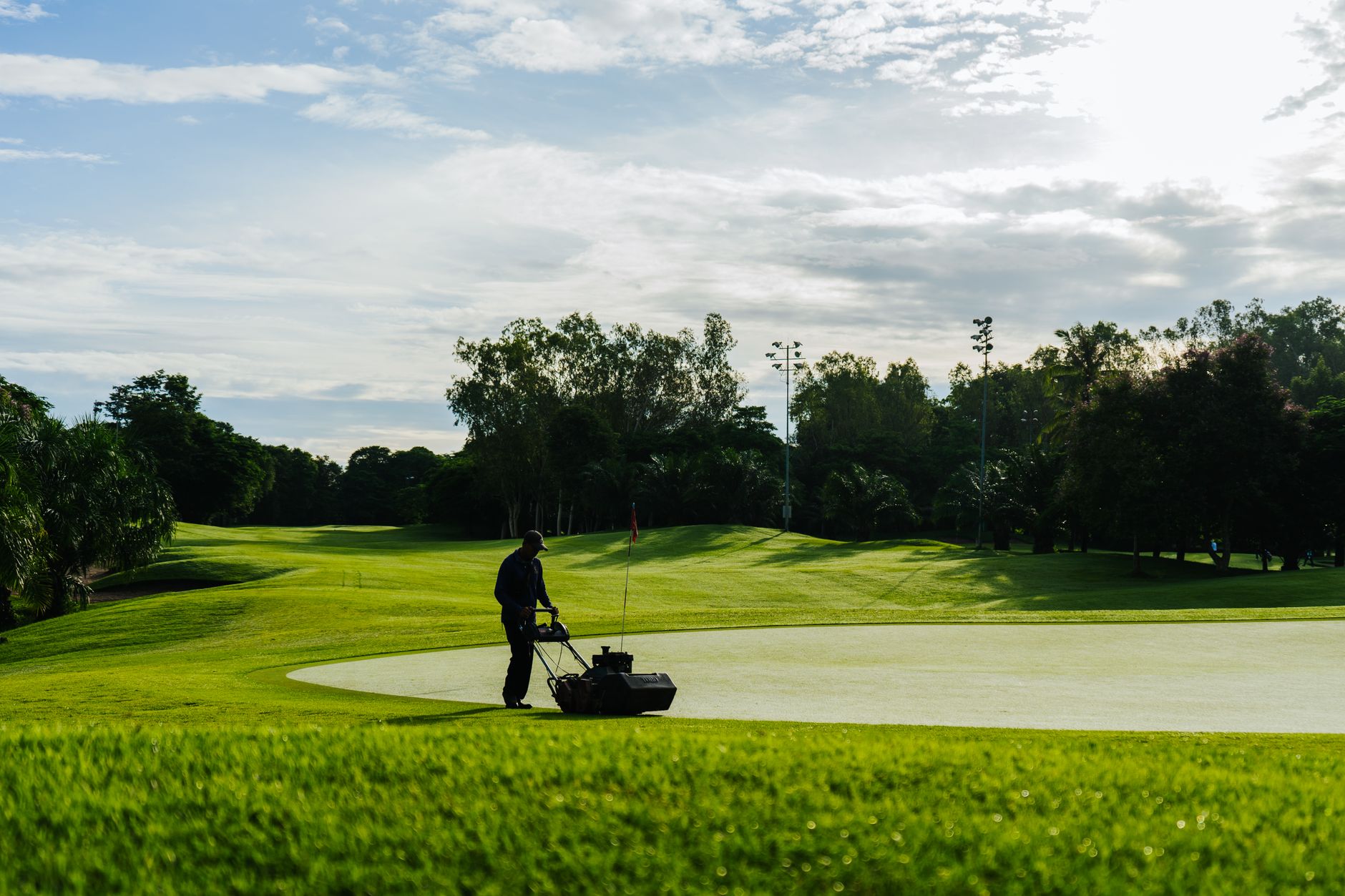
Hold windows only prove themselves across a full day, not at a single spot check. Set each window the way the course will run it, then watch the mower through the whole cycle, including the moment it is due to resume.
Golfdom reports on a vendor-described system that lets superintendents monitor and control a mower from a phone, tablet or computer anywhere on the course. Use that remote view during the test so the person checking holds does not have to stand beside the unit. Log every hold that failed to stop the mower or failed to release it on time, and keep the test open until those logs are clean.
What should the supervised test run cover?
The first pass should be watched, not trusted. A 1999 University of Florida fairway prototype was taught its route by the superintendent, who first drove the unit around the perimeter, according to an archived Michigan State University trade article. Modern systems are different machines, but the principle carries: someone who knows the course should ride along for the first run.
Golf Course Industry reports that superintendents feel uneasy leaving an automated mower unattended on the most closely watched turf. Plan the run with a person in sight of the unit for its early passes, then extend to unattended runs only after the logs are clean. A Golfdom listing also summarizes a 2020 to 2023 study of Husqvarna robotic mowers at five Nordic golf courses, where superintendents gave overall mowing quality very high ratings. We read only that summary, so treat it as directional rather than settled.
Cover at least one full loop of the mapped area, every cart-path crossing, every hold window, and a return to the charging point.
What goes into the superintendent's sign-off record?
The sign-off should be one dated record that the superintendent signs. Each line should point to a test that was actually run, and any failure should stay on the page with its fix, not disappear into a verbal okay. A USGA Green Section Record article asks how robot mowers affect turf management and the golfer experience. We did not read its full text, and it does not supply a sign-off template.
Service Robot Co. is OEM-neutral, so the acceptance criteria can follow the course rather than one manufacturer's catalog. We lease robots through financing on a 3-year lease, with one fixed lease payment quoted after a site assessment, and our RoboCare service plan backs each unit with regional service engineers. We deploy, integrate and train as part of that work, so the acceptance file is written with the people who will run the fleet.
- The name of the person who ran each test, and the date it ran.
- The date of the last map update, plus any storm damage or tree work since then.
- The vendor support contact and the escalation route for a failed unit.

Frequently asked questions
Want a robot working for you?
Tell us the job and the site. We will recommend the robot, quote the lease, and keep it serviced.
Sources
- USPTO patent 12197227 (autonomous mower boundary teaching)
- USPTO patent 12048267 (exclusion zones and trained transit paths)
- USPTO patent 12568878 (boundary recording methods)
- Golf Course Industry, The GreensMower of the Future
- Michigan State University archive, 1999 trade article on a University of Florida fairway prototype
- Golfdom, Industry Experts on Embracing the Future of Robotics and GPS
- Golfdom, autonomous mower tag listing (Nordic golf course study summary)
- USGA Green Section Record, How Do Robot Mowers Affect Turf Management and the Golfer Experience