Key takeaways
- Hand crews still win on tight display islands and wet spots near fitting areas.
- Floor robots win on long, flat tile runs that repeat on the same route.
- Vendor top speeds are theoretical ceilings that assume no turns, refills or charging.
- Published carpet test data for floor robots is thin, so test carpet zones yourself.
- Run both methods in the same three zones for one real traffic week, then compare minutes per square foot.
Which method cleans a mixed uniform floor faster?
Neither method wins everywhere. On hard tile at entry lanes and wide center aisles, a floor robot holds a steady, repeatable pass that a hand crew struggles to match across a full shift. On carpeted fitting areas and around display islands, a person with a mop or a small vacuum still moves faster, because a person can step around a bench leg, wait for a customer to clear and come back to the corner.
A uniform store mixes all three conditions under one roof, so a fair comparison has to cover tile, carpet and islands together. Testing one surface alone tells you about that surface and nothing about the store.
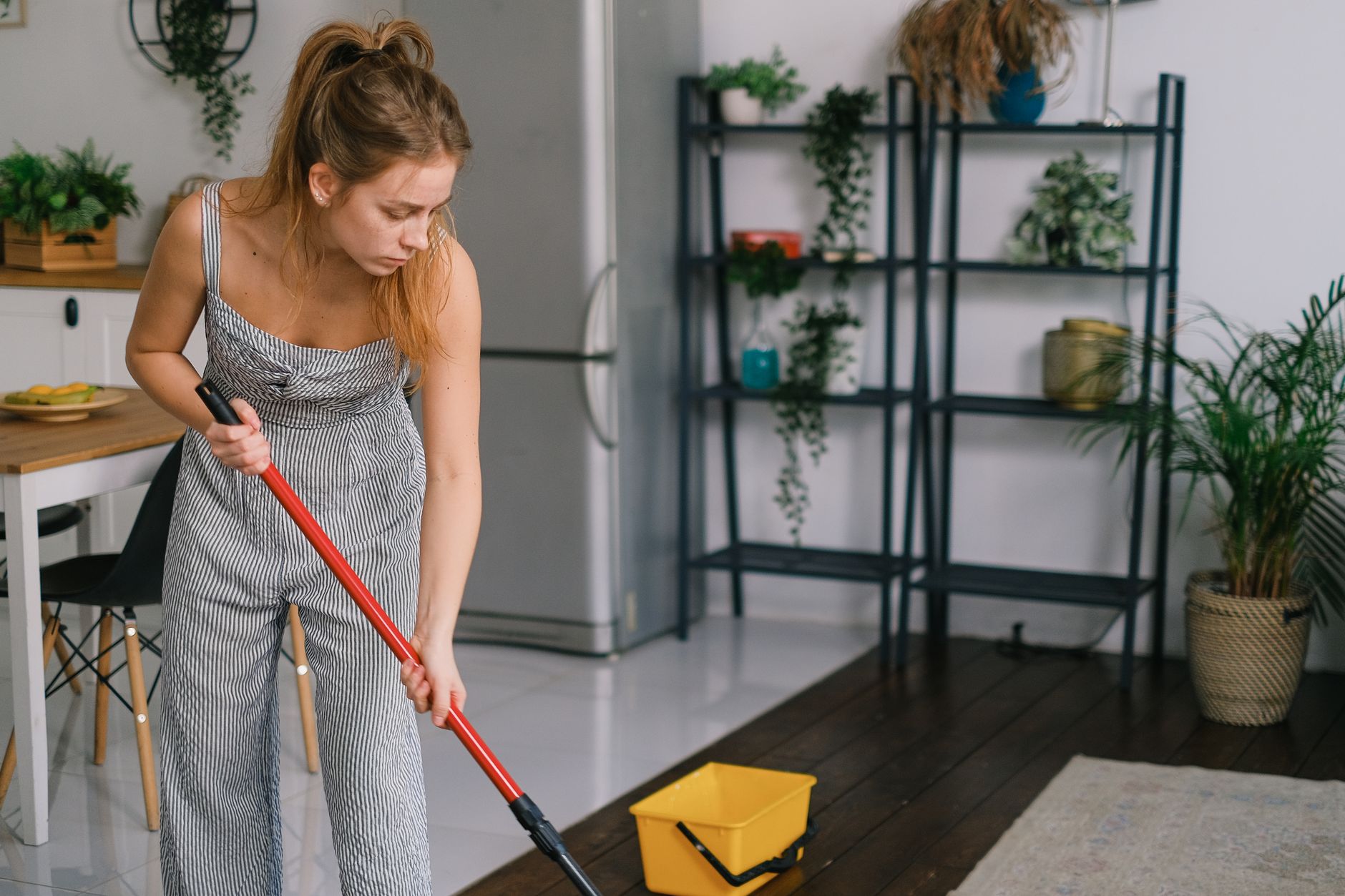
Where does a hand crew still win?
A person can lift a rack, reach under a fitting bench and decide that a wet patch by the register needs a second pass before anyone walks across it. Those calls are hard to script, and they matter most in a store where customers try things on while standing on the floor.
Crews also handle the messy jobs. A robot can drive over a dropped pin cushion or a stray hanger, but it cannot pick them up or move a fixture out of its path.
Where does a floor robot pull ahead?
Robots earn their place on long, flat runs that repeat the same route. Before opening or after close, a robot can cover entry tile and open aisles without pulling staff off the sales floor or asking customers to step aside.
Coverage is the strongest case. According to Nilfisk's listing, its disk-brush system reports 98% to 99.5% floor coverage, which is a coverage metric rather than a throughput figure. Consistency matters on tile, because a missed strip is easy to see.
A single machine can also be built for both surface types. Pudu's MT1 vacuum configuration is marketed for carpet and hard floors, with a 55 cm path and HEPA filtration, according to its vendor listing. Kärcher's KIRA CV 50 is a 13.5-inch autonomous vacuum for carpet and hard floors, listed with IEC 63327 safety certification for use around the public, according to Kärcher's product page.
What do published robot speeds actually mean?
Vendor sheets publish large numbers. As of November 2026, Kärcher lists about 49,406 sq ft/hour as the maximum theoretical area performance for its roller-brush KIRA B 200 model. Nilfisk lists about 28,000 sq ft/hr for its SC60, with a 28-inch cleaning path and a 5 to 6 hour run time. Both are vendor-reported ceilings.
Read them with care. A vendor guide to commercial floor cleaning robots explains that maximum figures are often path width times top speed, assuming no turns, refills or charging. A store full of islands and corners will never see that ceiling, and the gap between ceiling and daily result is where the real comparison lives.
Hand numbers need the same caution. A study by ManageMen, Inc. for Unger reported 4,878 sq ft/hour for the Excella system against 2,564 sq ft/hour with a 24 oz string mop head, a manufacturer-promoted comparison. I found no independent study that settles hand mopping pace on mixed uniform floors. CleanLink defines productivity as both efficiency, meaning the time to finish, and effectiveness, meaning the thoroughness of the result. That is the right lens for this test.
How do the two methods compare by surface?
Tile entries favor robots. Hard, flat and repeatable, they suit a machine that runs the same lane every night. Expect the robot to win on time and consistency here, provided the path width fits the lane.
Carpet fitting areas are the weak spot in the evidence. I found no independent carpet test results for floor robots. A Supermarket News checklist for robotic floor scrubbers flags carpet pile limits, cleaning path width and safety certifications as points to verify. Until your own week shows otherwise, a crew with a small vacuum should keep the fitting areas and the edges around each chair.
Display islands split the work. The robot covers open lanes between islands, while the crew handles the footprint under each stand and the corners a sensor may read as clutter. Build the robot route around the open lanes and give the crew the rest.
How do you test both over one week of real traffic?
Choose three zones that match the surfaces above: an entry tile lane, a carpeted fitting area and an aisle with display islands. Map each zone and count its square feet, so every result is measured per area. Then run the test as follows.
Keep the traffic real. A test in an empty store measures the robot's ceiling, not the store's floor. Weekday mornings, lunch-hour lulls and a Saturday fitting rush each change the result, so the week should include all of them.
At the end of the week, assign each zone to whichever method cleaned it faster and more consistently. Many stores will end with a split, robots on tile and crews on carpet and islands, and that split is a valid answer.
- Log crew minutes per zone every day, including walk time, cart moves and the time spent resetting displays.
- Run the robot through the same zones each night, and record start and stop times, pauses and any staff intervention.
- Score every pass with a walk-through check for streaks, missed corners and residue at display bases.
- Count customer interruptions and any slip reports for each zone across the week.
- Compare minutes per square foot and quality scores, not total minutes, because zone sizes differ.
Where does a managed robot lease fit?
Service Robot Co. is an OEM-neutral integrator based at servicerobotco.com. We choose the machine for the surface, whether a scrubber, a vacuum or a combined unit, across manufacturers rather than from one brand's catalog. We lease robots through financing on a 3-year lease, with one fixed lease quoted after a site assessment.
After the lease starts, we deploy, configure and train your staff, then service every unit under RoboCare, our service program, backed by regional service engineers in every state we service. A split result from your week of logs is a common and workable starting point: one leased unit on the tile lanes, with the crew keeping carpet and islands.
Frequently asked questions
Want a robot working for you?
Tell us the job and the site. We will recommend the robot, quote the lease, and keep it serviced.
Sources
- Kärcher commercial floor scrubber and vacuum listings
- Nilfisk Liberty SC50 fact sheet
- NASSCO autonomous floor scrubber listing
- Knox Labs commercial floor cleaning robots guide
- CMM article on Unger Excella study
- CleanLink Minute on cleaning productivity
- HowToRobot autonomous commercial vacuum listing
- Supermarket News robotic floor scrubber checklist