Key takeaways
- A cobot usually wins when the task is repetitive, the takt is steady, and seasonal turnover keeps forcing retraining.
- Temp labor stays useful for variable work, irregular SKUs, and rush periods that change faster than a cell can be reconfigured.
- The real comparison is not robot versus human effort. It is stable automated output versus a revolving staffing pattern.
- Packaging and warehousing jobs are relatively low paid and physically demanding, which is exactly where absenteeism, quits, and injury exposure start to erode peak-season productivity.
What is the better choice when peak season hits?
For packaging, labeling, and simple pick-and-place work, a cobot beats a temp hire when the job is repetitive, the line rate is predictable, and every new worker needs coaching before they become useful. In those conditions, the bottleneck is rarely raw labor availability alone. It is the speed at which a site can turn new people into steady output without quality drift.
That is why the comparison should be framed against the real alternative most operators use in peak season: temporary labor. If your plan depends on repeatedly filling the same end-of-line role with new people, absorbing no-show risk, and retraining after every turnover cycle, a cobot starts to look less like a technology project and more like operating discipline.
Temp labor still has a place. Highly variable packing logic, late product changes, or promotional work that changes every few days can favor people. But when the work content is narrow and repeatable, the hidden drag of staffing churn often costs more throughput than managers expect.
- Best fit for a cobot: repetitive carton loading, label application support, simple orientation tasks, and fixed-sequence pick-and-place work
- Best fit for temp labor: fast-changing kits, frequent SKU exceptions, odd-shaped items, and short bursts of work with unstable work instructions
Why does seasonal labor break down so fast in end-of-line work?
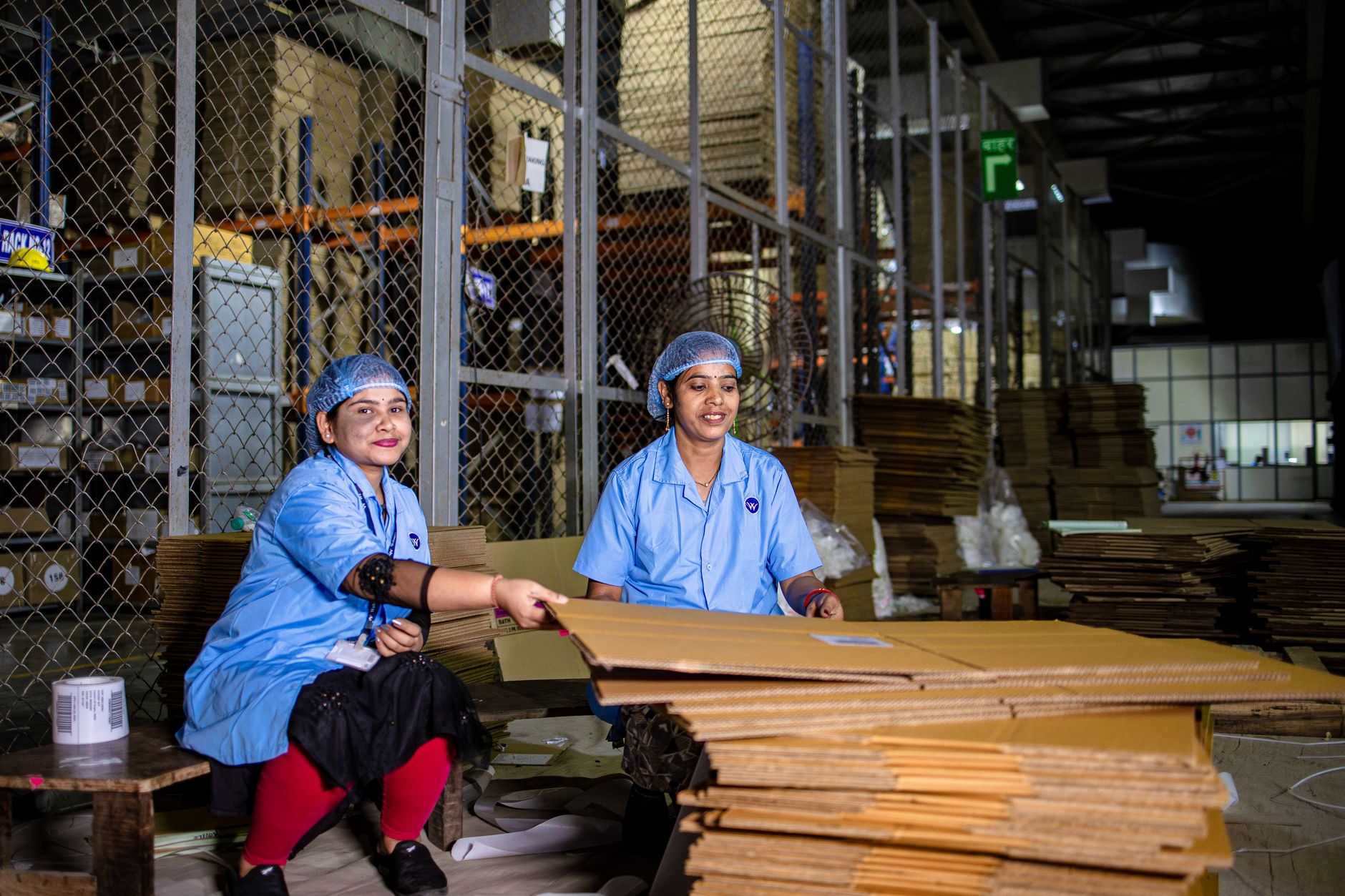
Peak packaging jobs are easy to open and hard to stabilize. According to the U.S. Bureau of Labor Statistics, packers and packagers, hand had a mean hourly wage of $18.05 in May 2025, while packaging and filling machine operators and tenders averaged $21.44. Those are important jobs, but they are not highly paid enough to erase the friction of commuting, shift switching, or workers leaving for a slightly better offer nearby.
The training burden matters too. The Bureau of Labor Statistics classifies packers and packagers, hand as short-term on-the-job training roles, while packaging and filling machine operators and tenders typically require moderate-term on-the-job training. That sounds manageable on paper. On a live floor in November, it means supervisors and line leads are constantly pulled into coaching, error correction, and rebalancing.
The American Staffing Association reports that temporary and contract staffing employment fell 7.5 percent from the fourth quarter of 2025 to the first quarter of 2026. Its research page also says staffing firms place about 11 million employees per year. The staffing channel is large, but it is inherently fluid. That fluidity is exactly what hurts end-of-line output when every shift depends on muscle memory and repetition.
What do the labor numbers say about churn and coverage risk?
Recent labor data still shows churn in the operating environment that warehouses and plants depend on. In the U.S. Bureau of Labor Statistics JOLTS data for June 2026, manufacturing had 481,000 job openings and a quits rate of 1.5 percent. Transportation, warehousing, and utilities posted a 2.4 percent quits rate in the same month.
Those rates are not abstract. They describe the backdrop behind your seasonal staffing plan. A temp-heavy packaging line does not just need enough applicants. It needs enough reliable applicants who stay long enough to hit standard work, avoid labeling mistakes, and stop needing constant oversight.
This is where cobots gain ground. A robot cell does not remove all labor. Someone still stages product, clears exceptions, refills labels, and oversees changeovers. But it can remove the most repetitive slice of the job from the churn cycle, which lowers the number of new hands you must absorb at the worst time of year.
Where does a cobot clearly outperform a temp hire?
A cobot tends to win when the motion is simple and repeatable. Think pick from tote to carton, present product for label placement, place finished units into a tray, or load a machine at a fixed cadence. If the line rate is known and the exception rate is low, the robot can hold pace without the daily variability that comes with an all-temp crew.
The quality effect is usually more important than the headline labor effect. Seasonal lines lose time through small misses: crooked labels, inconsistent carton fill, line starvation during breaks, and supervisors breaking away to retrain somebody who has been on site for six hours. A cobot does not fix bad process design, but it does make a stable process stay stable.
There is also a safety angle. According to the U.S. Bureau of Labor Statistics, warehousing and storage had a nonfatal injury and illness incidence rate of 4.8 cases per 100 full-time workers in 2024, and general warehousing and storage was 4.9. Repetitive reaches, lifts, and awkward end-of-line motions are not the only cause, but they are part of the picture. When a cobot takes over the dull, repeated movement, the remaining human work can shift toward oversight and exception handling.
When is a temp hire still the smarter move?

Not every peak-season task deserves automation. If product presentation changes constantly, if packaging rules are decided by customer-specific inserts, or if you are dealing with irregular items that demand human judgment every few seconds, temp labor remains more forgiving. People can improvise in a way a tightly scoped robot cell cannot.
Temp staffing also makes sense when the peak is genuinely brief and the work content is not stable enough to justify engineering attention. A four-week burst of highly mixed gift assembly is different from twelve weeks of repetitive carton loading on a mature line. Treating those jobs as identical leads to bad automation decisions.
The right question is not whether humans are more flexible than robots. Of course they are. The right question is how much of your seasonal volume runs through a narrow band of motions that never should have been relearned by new workers in the first place.
How should operators compare the two options on the floor?
Start with the failure points, not the brochure. Measure no-shows, time to first independent shift, changeover frequency, scrap or relabel rates, and the number of minutes per shift lost to coaching. If those figures spike every peak season, you are not dealing with a simple hiring problem. You are dealing with process instability.
Then isolate one cell with plain work content. Packaging and labeling are good candidates because they often have clear infeed, clear placement logic, and visible defects. If the job can be explained to a new temp in a few minutes, there is a good chance it can be broken into a robot-ready sequence plus a smaller set of human exception tasks.
Finally, compare staffing demand at the margin. A cobot does not need to replace an entire line to win. If it removes one or two hard-to-fill positions from every shift, reduces retraining load on line leads, and keeps output from sagging during the first two weeks of peak, it may outperform a larger temp plan that looks cheaper only before churn shows up.
- Track ramp time in days, not just heads hired
- Separate steady-state tasks from exception handling
- Measure supervisor time spent retraining seasonal workers
- Check where labeling errors and micro-stoppages cluster
- Model the minimum crew needed if one repetitive station is automated
What role does an integrator play in making that decision?
This is where Service Robot Co. fits. The hard part is rarely picking a robot in the abstract. It is matching the application, end effector, guarding, line interface, training plan, and support model to a real U.S. facility with real seasonal pressure. Service Robot Co. approaches that as an OEM-neutral commercial robot integrator, so the recommendation starts with the job and the operating constraints, not with a predetermined brand.
That matters because peak-season automation only works if one partner can carry the full path from cell selection to financing, deployment, integration, training, and field service. A packaging operator does not want three vendors debating root cause on a Monday in December. The practical value is one vendor for the lifecycle, backed by a nationwide U.S. engineer network that can support the unit after go-live.
The decision is really about stability
A temp hire is not the wrong answer. It is simply the wrong benchmark in the wrong kind of task. In repetitive packaging work, the real cost is not the hourly rate. It is the repeated loss of rhythm that comes from staffing the same narrow motion with new people over and over.
A cobot beats a temp hire when the work is learnable, frequent, and dull enough that people cycle through it faster than the operation can absorb them. In that situation, automation is less about replacing labor and more about protecting throughput during the exact weeks when missed cartons, slow ramps, and label errors hurt most.
If your peak-season plan looks stable on a spreadsheet but messy on the floor, that is the sign to compare alternatives differently. Not human versus machine. Stable process versus rotating labor.
Frequently asked questions
Sources
- BLS OEWS 2025 national wage table
- BLS education and training by occupation
- BLS JOLTS June 2026 openings table
- BLS JOLTS June 2026 quits table
- BLS employment situation June 2026
- BLS 2024 injury and illness rates by industry
- American Staffing Association employment survey
- American Staffing Association labor leverage analysis