
The short answer
For most dental laboratories, the autonomous mobile robot vs supply runner choice turns on whether the run repeats on a fixed loop between the same stations. A robot makes sense when it carries bins and trays along that route all day while technicians stay at their benches, and it does not make sense when the run changes daily or needs hands-on handling at every stop. Plan on a robot plus fewer runner hours rather than zero staff, and confirm the fit with a free site assessment before any lease is quoted.
Key takeaways
- A robot fits a fixed case-cart loop, not an irregular list of errands.
- Robots carry bins and trays; people still handle cases, exceptions and checks.
- Typical labs are small, so the usual starting scope is one route on one floor.
- Plan for a robot plus fewer runner hours, never a robot with zero staff.
- Time two weeks of your own runs before deciding, because published run-time data for dental labs is thin.
Is an autonomous mobile robot vs supply runner the right call for a dental lab?
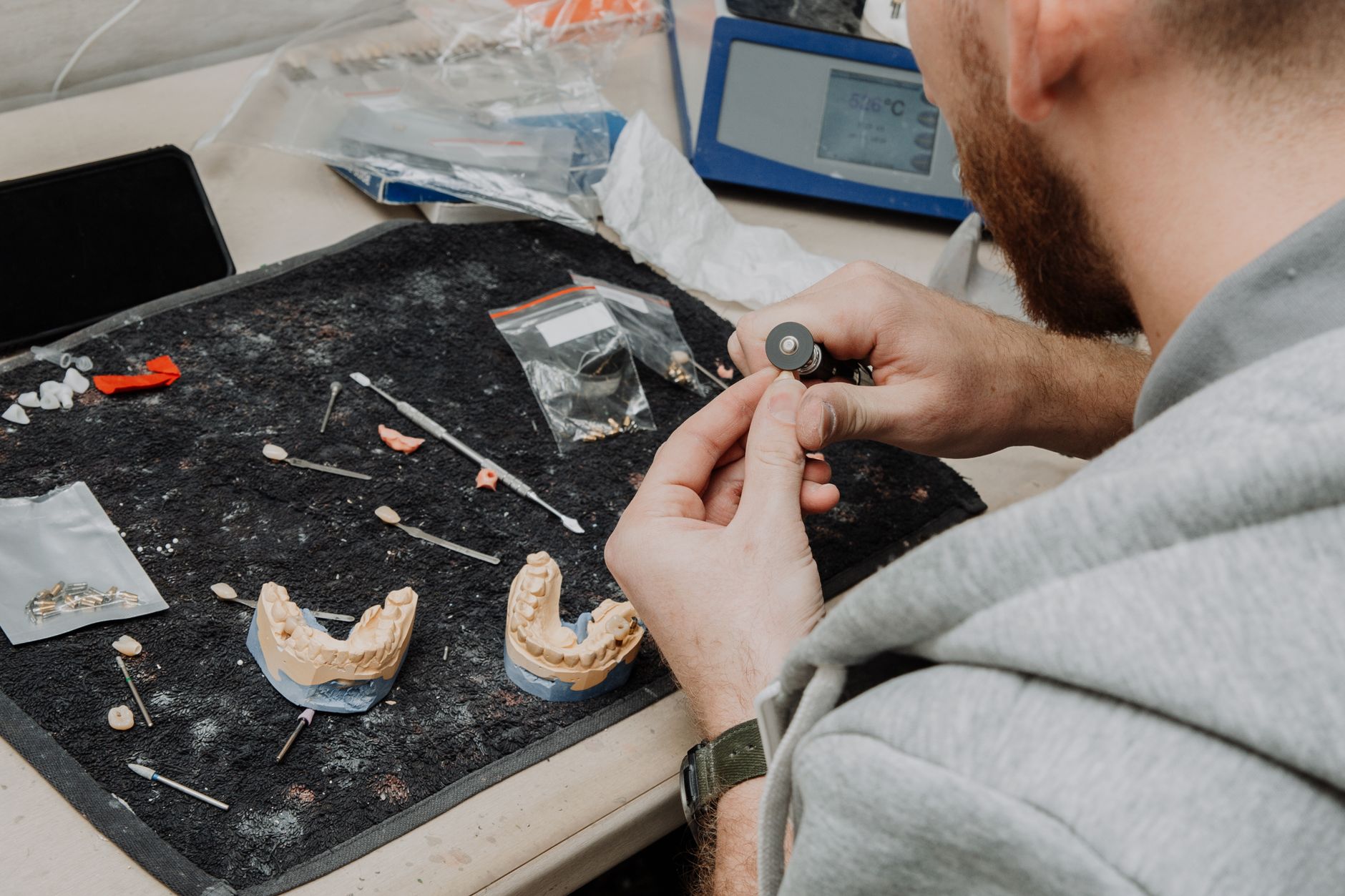
Dental laboratories make crowns, bridges, dentures, aligners and other appliances for dentists, and most of the work moves between a small set of stations: case intake, model work, finishing, quality check and packing. Someone carries trays, bins and cases between those stations many times a shift. That repeated carrying is the part an autonomous mobile robot can take over.
The useful question is not whether a robot can move around a lab. It is whether the moves repeat on a predictable route. If the same loop runs every day, a robot can follow it with little change. If each case goes somewhere else, the robot waits for instructions and the runner is still needed.
Lab size shapes the decision. According to a Vantage Insights summary of 2023 Census County Business Patterns data, the US had about 4,782 dental laboratory establishments (NAICS 339116) with 42,188 employees. VerticalIQ estimates a typical lab has about 9 workers at one location. That points to one route on one floor as the usual starting scope.
When does an autonomous mobile robot make sense at a dental lab?
It makes sense when three conditions line up. The route between stations is stable, the loads are bins, trays or sealed cases rather than loose work, and the walking is taking real time from technicians who should be at their benches. Labs with a steady intake schedule and a clear packing area often meet all three.
It does not make sense when one person already covers the moves comfortably, when the floor layout is still changing, or when most cases need hands-on checks during the move. In those cases a better bench layout or a second person usually does more than a robot would.
A sensible first step is a pilot on one route. Start with one leased unit and one loop, measure the result over several weeks, and only then decide whether to add units. The lease is quoted after a free site assessment, so the first conversation is about your route, not a payment figure.
- Repeat route
Autonomous Mobile Robot
Follows a fixed loop all day with no fatigue between stops.
Supply Runner
Adapts quickly when the route or stop order changes.
- Exceptions
Autonomous Mobile Robot
Stops or waits when it meets an obstacle or an unplanned request.
Supply Runner
Handles a dropped tray, a missing case or a wrong bin on the spot.
- Case handling
Autonomous Mobile Robot
Carries bins, trays and sealed containers only.
Supply Runner
Checks, signs for and handles cases and sensitive items.
- Second shift or early start
Autonomous Mobile Robot
Can run planned loops with no added headcount.
Supply Runner
Needed to load, unload and respond when the robot stops.
- Bench walking
Autonomous Mobile Robot
Takes the walking off technicians on planned loops.
Supply Runner
Can restock benches and check work while walking.
- Setup
Autonomous Mobile Robot
Needs a mapped route and a trained person to watch it.
Supply Runner
Needs process training but no mapping.
What does the supply runner actually do in a dental lab shift?
The runner's day is mostly short loads on a repeating schedule. Finished work moves to quality check, empty bins return to intake, materials come from storage to the benches, and packed cases go to the shipping table. Each trip is brief, but there are many of them, and the runner also answers calls from technicians who need a case moved right away.
Because the runner is a person, the job includes judgment. They spot a case missing paperwork, a tray about to tip, or a bench running low on a material. They also keep chain of custody for patient-related cases, meaning they know where each case is and who last handled it. None of that shows up on a route map, and all of it matters at a dental lab.
Published time studies for supply runs at dental labs were not found for this page, and no verified hours-per-shift figure appears in the sources reviewed. According to J.J. Keller's summary of BLS 2024 data, private employers recorded about 2.5 million nonfatal injuries and illnesses, down 3.1 percent from 2023, with a total recordable rate of 2.6 per 100 workers. Dental labs are not broken out in that summary, so treat it as context. Time two weeks of your own runs, and separate scheduled loops from unplanned requests.
Which parts of the supply run can a robot take, and which can it not?
A robot can take the scheduled loops: intake to bench area, bench to finishing, finishing to quality check, and packed work to the shipping table. It can also return empty bins along the same path. These moves are repeatable, have clear start and stop points, and do not need a person to decide what comes next.
Several parts stay with people. That includes handing off a case that needs a signature or check, urgent unplanned runs, loading fragile or wet items, and any stop where the robot must wait on a door, elevator or dock that is not connected to it. A robot also cannot judge whether a tray is stacked safely unless loads are built to a standard.
The split is usually clean: the robot takes the planned loop, and the person takes the exception. Setting that split on purpose is the design goal, and it is the first thing a site assessment checks.
How much labor is involved, and what does turnover look like?
US data for dental labs alone is thin. The Bureau of Labor Statistics groups dental laboratory technicians with ophthalmic laboratory technicians and medical appliance technicians in its Occupational Outlook Handbook. That combined group had about 66,800 jobs in 2024, and BLS projects an employment change of minus 1 percent from 2024 to 2034, about 700 jobs. Entry typically needs a high school diploma and on-the-job training.
Turnover evidence comes mostly from outside the US. A 2024 conference paper from Bulgaria, based on an anonymous survey, found unsatisfactory pay was the main turnover factor cited by 82.76 percent of lab managers and 69.84 percent of dental technicians. A 2009 Korean survey of 180 dental technicians in three regions found a mean turnover intention of 2.85, which the authors described as high, with poorer working conditions linked to a higher intention to leave. Neither is a US count, and the Korean study is old, but both show that keeping technicians is a recurring concern.
Overtime, night work and sick-day coverage were not measured in the sources reviewed. A lab that knows its own overtime hours and absence rate can judge how much a robot changes the schedule far better than any national average can.
How does a dental lab team work with a robot?
The team works with the robot, not in place of people. The robot takes the scheduled loops, staff still load and unload at each station, and someone still owns the exceptions. A lab that runs this way keeps at least one trained person on site at all times, so no shift runs with zero staff.
Training is short but specific. Staff learn how to stage loads, how to call the robot from a station, what to do when it stops, and how to clear its path. Practice runs during slow hours help more than a classroom session, and a trained lead on each shift keeps the handoffs clean.
Service is part of the arrangement. Our team trains the staff, deploys and integrates the robot, and services it nationwide with on-site dispatch and remote triage. A backup robot program keeps the route running when a unit is down, and go-live support helps the first weeks run clean.
What can a robot not do at a dental lab?
Plenty. A robot does not do bench work, check a case against the dentist's order, or decide what to do with a damaged item. It cannot be counted on to use every door or elevator unless the route is set up for it. It cannot carry more than its rated load, so loads must be built to that rating, and liquids and chemicals should stay off the robot unless its design allows them.
Its limits show up in the work around it. A robot that stops in a corridor blocks the route until someone clears it. A misrouted case can travel a wrong loop until a person notices. Sensors do not replace walkway discipline, so the lab still needs clear floors and no loose items on the route.
The honest test is simple. If most of the runner role is exceptions and judgment, the robot will help less than hoped. If most of it is repeatable loops, a robot can take a large share of the walking.
How do you get started with an autonomous mobile robot at a dental lab?
Start with one route. Pick the loop that repeats most often and has clear start and stop points, usually intake to bench to quality check to packing. Time it, count the stops, and note every door and lift on the way. That map is what a site assessment needs, and it is the basis for any lease quote.
Next, plan the rollout so the lab keeps running. A phased deployment lets staff learn on one loop while the rest of the lab works as usual, and a robot pilot program gives a clear go or no-go before more units are added. Automation demand is growing in general: according to A3 as reported by Automation.com, companies ordered 17,635 robots in North America in the first half of 2025, up 4.3 percent year over year, and according to A3 as reported by Medical Design and Development, full-year 2025 North American orders reached their highest level since 2022. Those are industrial figures, not dental lab data.
Financing runs through lease financing programs, and the fixed robot lease payment is set in a quote after the site assessment. Ask whether service, on-site dispatch, a backup unit and training are included, because those terms decide how much staff time the robot actually frees up.
How is the cost of a dental lab robot lease decided?
Cost is set per site. The number of routes, the number of stops, the floor layout and the service terms all change the quote, so there is no single figure that fits every lab. Compare quotes on the same route definition and the same service terms, or the numbers will not mean much.
Compare the cost against the runner hours it replaces, not against the robot alone. Hours lost to overtime, coverage gaps and bench walking are what move the outcome. Ask what is included, such as maintenance, repair, replacement units and training, so that no hidden fees appear after go-live.
In most labs the job does not disappear. It shifts toward loading, exception handling and checks, so budget staff time for those tasks too.
Frequently asked questions
Want a warehouse robot at your dental laboratory?
Tell us about your site. We will recommend the robot, quote the lease, and keep it serviced.
Sources
- Vantage Insights, NAICS 339116 dental laboratories (summary of 2023 Census County Business Patterns)
- VerticalIQ industry estimate for dental laboratories
- BLS Occupational Outlook Handbook, dental and ophthalmic laboratory technicians and medical appliance technicians
- 2024 conference paper, Varna University of Management journal (Bulgaria), dental lab turnover survey
- KoreaScience, 2009 survey of dental technicians in Korea
- J.J. Keller, summary of BLS 2024 nonfatal workplace injuries and illnesses
- Automation.com, A3 report on first half 2025 North American robot orders
- Medical Design and Development, A3 coverage of full-year 2025 North American robot orders