
The short answer
For most Cincinnati sites, the cleaning robot vs janitor in Cincinnati choice turns on floor type, not the job title. A cleaning robot makes sense where large, flat, mostly open floors are scrubbed on a fixed schedule, often overnight, while a janitor is still needed for restrooms, trash, stairs and touch points. The realistic setup is a robot plus fewer staff, and a site assessment should confirm the fit before any lease quote.
Key takeaways
- A robot fits large, flat, mostly open floors, while a janitor still handles restrooms, trash and touch points.
- The government wage data panel on this page gives the local pay for this job, so the labor case should be built on measured hours.
- Published turnover estimates for janitorial work run high, so fewer overnight shifts to fill is a real operating benefit.
- The coverage benchmarks cited here are manual machine figures from 2009, so verify them on your own floor.
- Start with one leased unit on one zone, then add units after the site data shows the hours saved.
Cleaning robot vs janitor in Cincinnati: which makes sense?
The short answer depends on what the janitor does with most of the shift. If most paid hours go to scrubbing and sweeping large, flat, mostly open floors, a cleaning robot can run that route on a fixed schedule, often overnight. If most hours go to restrooms, trash, stairs, doors and frequently touched surfaces, a robot does not replace that work, and a janitor stays on for it.
Cincinnati buildings vary widely, from older multi-level offices and medical buildings to warehouses, grocery stores, schools and event venues. A robot can be a good fit in one and a poor one in another, so the question is the floor, not the city. Three checks decide most cases: how much flat floor gets cleaned each night, how often the layout changes, and how hard the overnight shift is to fill.
For most sites the outcome is a robot plus fewer staff, not a robot instead of staff. The rest of this page shows how to measure those three checks in your own building before you decide.
What does a janitor actually do during a shift?
A janitor shift is rarely one job. It usually mixes floor care, restroom service, trash and recycling removal, restocking, spot cleaning after spills, and reporting damage or safety issues. Floor work is often the longest single block because it covers the most square footage, but it is broken up by the other tasks, so it is easy to underestimate from the outside.
The fastest way to get the real picture is a walk-through with the crew, timing each task over several shifts. Note which tasks happen at fixed times, such as before opening, and which happen only when needed, such as after an event or a spill. The fixed tasks are the ones a robot schedule can take, and the as-needed tasks stay with people.
Median hourly wage, Janitors and Building Cleaners
$3,952
Monthly cost of one full-time worker in Cincinnati, OH, at the median wage plus payroll costs (an estimate, not a quote).
- Night coverage
Cleaning Robot
Runs on a fixed schedule with no one on the floor
Janitor
Adjusts to what the building needs at that hour
- Floor edges and corners
Cleaning Robot
Limited, so manual passes are needed
Janitor
Reaches corners, edges and tight spaces
- Restrooms and touch points
Cleaning Robot
Cannot do this work
Janitor
Handles it with procedures and checks
- Layout changes
Cleaning Robot
Needs map updates and clear routes
Janitor
Adapts on the spot
- Issue reporting
Cleaning Robot
Logs runs and coverage and flags a stop
Janitor
Reports problems in the moment, but the log depends on the person
- Staffing
Cleaning Robot
Fewer shifts to fill
Janitor
Needs ongoing hiring, and published turnover estimates are high
Which cleaning tasks can a robot take over, and which can it not?
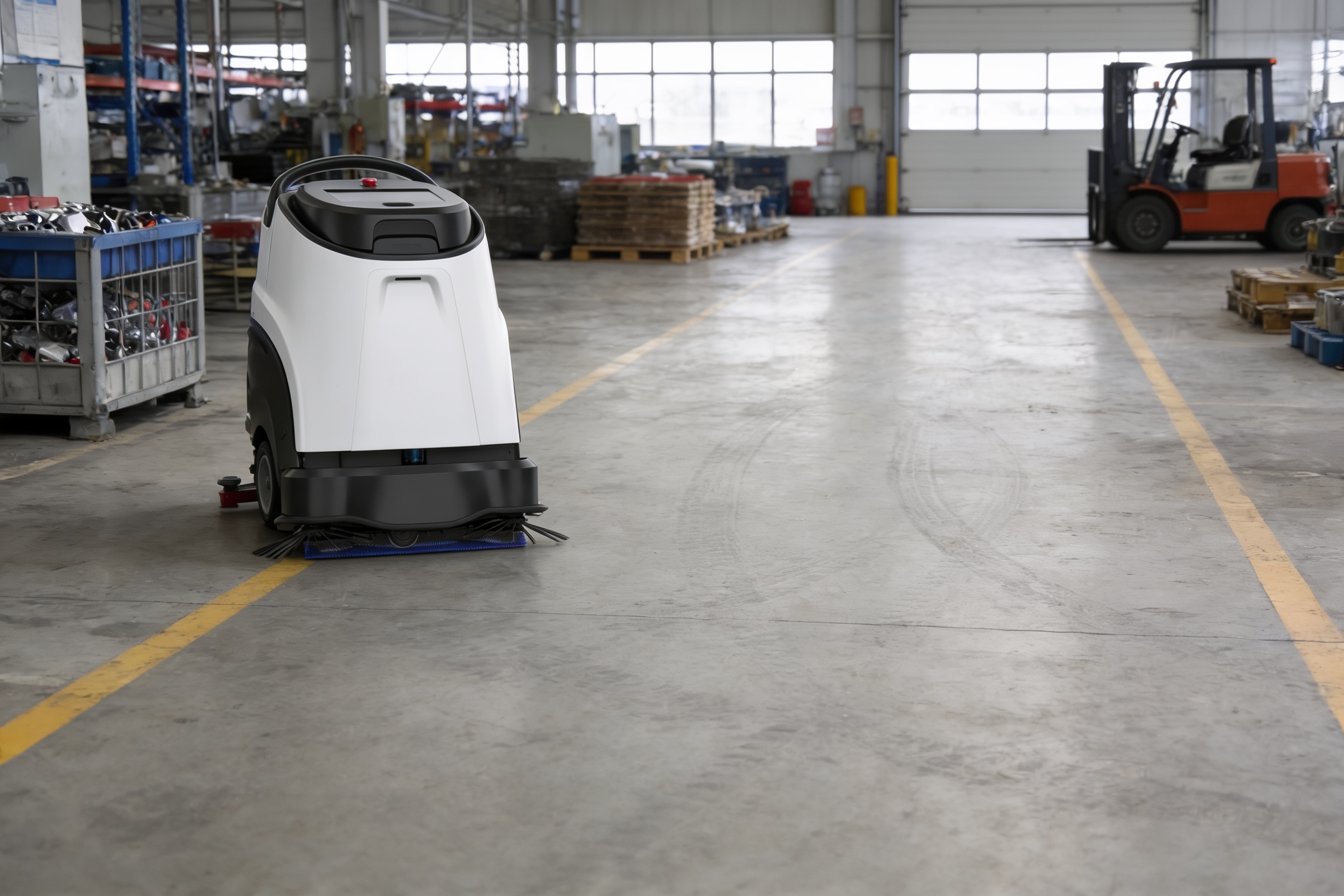
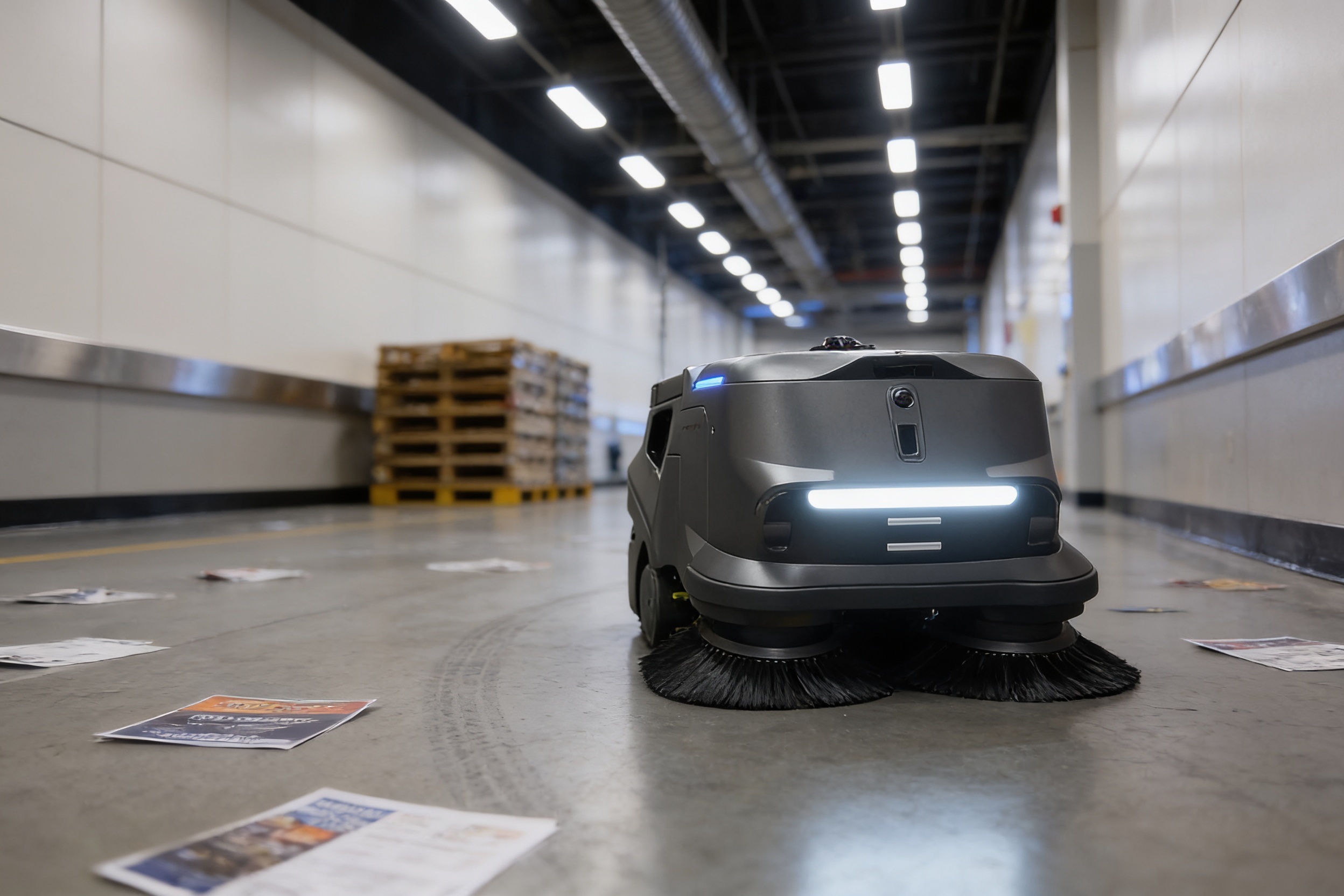
A floor scrubbing or sweeping robot works best on mapped, mostly clear, flat floors. It runs a route on a schedule, returns to its dock and records what it covered, which helps when a building manager needs proof that a zone was done. Large open areas are the natural first zone because they have the most floor for the fewest obstacles.
It cannot clean restrooms, empty trash, wipe door handles and light switches, handle a sticky or irregular spill that needs a person, or work on stairs. It also depends on clear routes, so loose cords, pallets, cartons and temporary signs left in the path can stop a run. A robot is a floor machine, not a general cleaner.
Adoption data points the same way. According to the International Federation of Robotics, global professional service robot shipments rose 24 percent to almost 250,000 units in 2025, and professional cleaning robots rank third by application, with floor cleaning the main use. The IFR cleaning unit count was not found, and its data come from a sample of 238 suppliers and are not projected to the whole industry, so it shows direction rather than a precise count.
What do turnover and injury data say about janitor work?
The U.S. Bureau of Labor Statistics counts about 2.4 million janitor and building cleaner jobs in 2024, according to its Occupational Outlook Handbook. The same source projects 2 percent growth from 2024 to 2034, slower than the average for all occupations, and about 351,300 openings a year, mostly from replacing workers who leave. The Handbook does not publish a turnover rate for the occupation, so that replacement count is the closest official signal.
Industry estimates run higher. Netchex, a vendor blog, says annual turnover commonly runs above 50 percent and that many contract cleaners reach 100 percent or higher. A cleanlink reader survey reported an industry average of 73 percent, though the year was not confirmed. These are not official BLS figures, so read them as a sign of how hard the job is to keep staffed, not as a precise rate.
Injury data adds a second reason to look at the work. BLS reported 21,100 nonfatal injury and illness cases with days away from work for janitors and cleaners, except maids and housekeeping cleaners, in private industry in 2020. The days-away incidence rate for the group was 137.1 per 10,000 full-time workers in 2018 and 157.4 in 2019. A secondary summary citing BLS SOII data puts janitorial services at 2.5 work-related injuries and illnesses per 100 full-time workers in 2024, but that is an all-injury figure for the industry, not the occupation rate.
How much floor can one cleaning robot cover per hour?
The clearest published coverage benchmark is an ISSA 540 table, reproduced by a supplier, and it dates from 2009. For a 17-inch walk-behind automatic scrubber run manually, it works out to about 5,917 square feet per hour, derived from 10.14 minutes per 1,000 square feet. A 24-inch walk-behind scrubber works out to about 8,357 square feet per hour, derived from 7.18 minutes per 1,000 square feet.
These are rates for manual machines, not autonomous robots, and no independent study of autonomous scrubber coverage was found. The source notes that many site factors change the figures. Applied to your floor, the rates give machine time, not labor time. By our arithmetic from those rates, a 50,000 square foot floor takes a 17-inch manual scrubber about 8.5 hours and a 24-inch unit about 6 hours, before setup, travel, breaks, refilling and interruptions.
Use these numbers as the starting point for a site walk, not as a promise. The real rate depends on floor type, route length, obstacles and how often the machine stops.

How does a team work with a cleaning robot?
The workable model is always a robot plus staff, with fewer staff hours spent on flat floors. The robot takes the scheduled scrub or sweep, and the janitor moves to restrooms, trash, touch points and exceptions. Staffing does not drop to zero, because someone still loads the dock, checks the machine, responds to a fault, handles a spill and clears an obstacle.
In practice, cleaning robot vs janitor in Cincinnati is rarely either or. Many sites move floor care into the overnight window, where a robot can run without a person on the floor, and keep a smaller crew for work that needs judgment. The handover matters. The morning lead should check the run report before opening, so problems are caught before staff and customers see the floor.
What can a cleaning robot not do?
A robot cannot judge a sticky spill, choose a chemical for a stain, empty an overflowing bin or read a wet floor sign placed by a person. It cannot use a restroom, deal with a customer, report a broken fixture in a room it cannot enter, or clean stairs and elevators. Expect manual cleanup at the edges of the route, and plan the crew time for it.
Reliability depends on the site. Route blockages, changing layouts, debris and uneven flooring can stop a run. A unit that stops mid-corridor needs a person to clear it, and a site with frequent layout changes needs the map updated, which someone has to schedule and approve.
Is a cleaning robot worth it, and what does it cost to lease?
Worth it depends on the hours the robot takes off the shift, the floor it covers, and how hard the overnight shift is to staff. Start with the local wage for this job shown in the panel beside this text, then attach real hours from your own timing. A robot that takes a large flat floor off the shift and lets a janitor focus on restrooms and touch points has a clear case. A robot on a small, cluttered floor usually does not, and the payback will be weak.
Lease cost depends on the unit, the floor, the service level and the term, so no general figure is given here. A lease quote follows a free site assessment. Before you sign, ask for the coverage assumed, the staff hours still required, the service response time and what happens to the zone while the unit is down, all in writing.
How do you get started with a cleaning robot lease in Cincinnati?
Service Robot Co. works with commercial robots through leases and financing. We pick the right robot for the site, lease it, deploy and integrate it, train your staff, and service it nationwide. The first step is a free site assessment that maps the floor, measures the real route, and separates the tasks a robot can take from those that stay with the janitor crew.
A practical start is one leased unit on one zone, such as a large open floor on the overnight shift. Run it for a set period, measure the machine hours it covers and the staff time that still goes into floor work, then decide whether to add units. Once the site data is in, the lease quote follows, with terms in writing.
Frequently asked questions
Put a robot to work in Cincinnati.
We walk your site, learn the job, and recommend the unit that fits. Then we quote the lease, deploy it, and keep it serviced.
Sources
- US Bureau of Labor Statistics, Occupational Employment and Wage Statistics (OEWS May 2024)
- U.S. Bureau of Labor Statistics, Occupational Outlook Handbook: Janitors and Building Cleaners
- U.S. Bureau of Labor Statistics, Injury and Illness Snapshot: Janitors and Cleaners, Except Maids and Housekeeping Cleaners, 2016 to 2020
- International Federation of Robotics, Global sales of professional service robots surge 24 percent
- ISSA 540 sample cleaning times table, as reproduced by Waxie
- Netchex, Why turnover is high in janitorial and cleaning services
- cleanlink, Staffing challenges many cleaning departments face
- SafetyNow, Janitorial safety stats and facts