
The short answer
A cleaning robot makes sense in an airport hangar when the floor is large, open and mostly smooth concrete that needs the same repeat passes every night. A night janitor is still the better fit for detail work: spills near aircraft and equipment, trash, restrooms, and judgment calls about what is safe to clean. For most hangars the practical answer is a cleaning robot plus fewer people on the night crew, with the robot covering open floor and staff covering everything else.
Key takeaways
- A cleaning robot fits repeat passes on large, open, clear concrete. It does not take detail work around aircraft.
- Janitors and cleaners have injury rates well above the all-occupation rate, so repetitive floor work deserves a close look.
- No verified hangar staffing, overtime or night-shift data was found, so measure your own crew hours on site.
- Plan a robot plus fewer staff, never a robot alone.
- Start with one leased unit on one bay, then scale only if the measured hours support it.
Cleaning robot vs night janitor at airport hangars: which makes sense?
For most airport hangars, a cleaning robot makes sense for the open floor, and a night janitor still makes sense for everything around the aircraft. The robot earns its place where the work is the same pass repeated across a large, open, mostly clear concrete floor. A person earns its place where the work needs hands, judgment, or access to tight spots.
A robot is a poor fit when the floor is crowded with tooling, stands, cables and parked equipment, when spills need a fast human response, or when the layout changes often during maintenance work. It also needs a repeatable route it can follow every night. If a site cannot provide one, a robot is the wrong answer for that bay.
We treat this as a site decision. We assess the floor, decide which open areas a robot can cover, and quote a lease through financing only after that assessment.
What does a night janitor actually do in an airport hangar shift?
A night janitor in a hangar usually works a loop. The loop includes emptying trash and recycling, sweeping or scrubbing floor areas, cleaning restrooms and break rooms, responding to spills, and wiping touchpoints. Floor work is the largest block of walking, and it is also the most repetitive, because the same aisles and open bays get crossed again and again.
The job is physically hard. According to the Bureau of Labor Statistics, janitors and cleaners, except maids and housekeeping cleaners, had 157.4 cases with days away from work per 10,000 full-time equivalent workers in its 2015 to 2019 data, against 86.9 for all occupations. That is about 1.8 times the all-occupation rate, and it is why repetitive floor passes get a close look from anyone managing this work.
A 2017 safety article from a state agency, citing BLS data from 2010, reported that back injuries made up about 46% of musculoskeletal injuries requiring time off, and shoulder injuries about 15%. Those figures are dated. Use them as a pattern for where the load falls, not as a rate for today.
Median hourly wage, Janitors and Building Cleaners
$4,041
Monthly cost of one full-time worker, at the median wage plus payroll costs (an estimate, not a quote).
Which parts of the hangar floor can a robot take, and which can't?
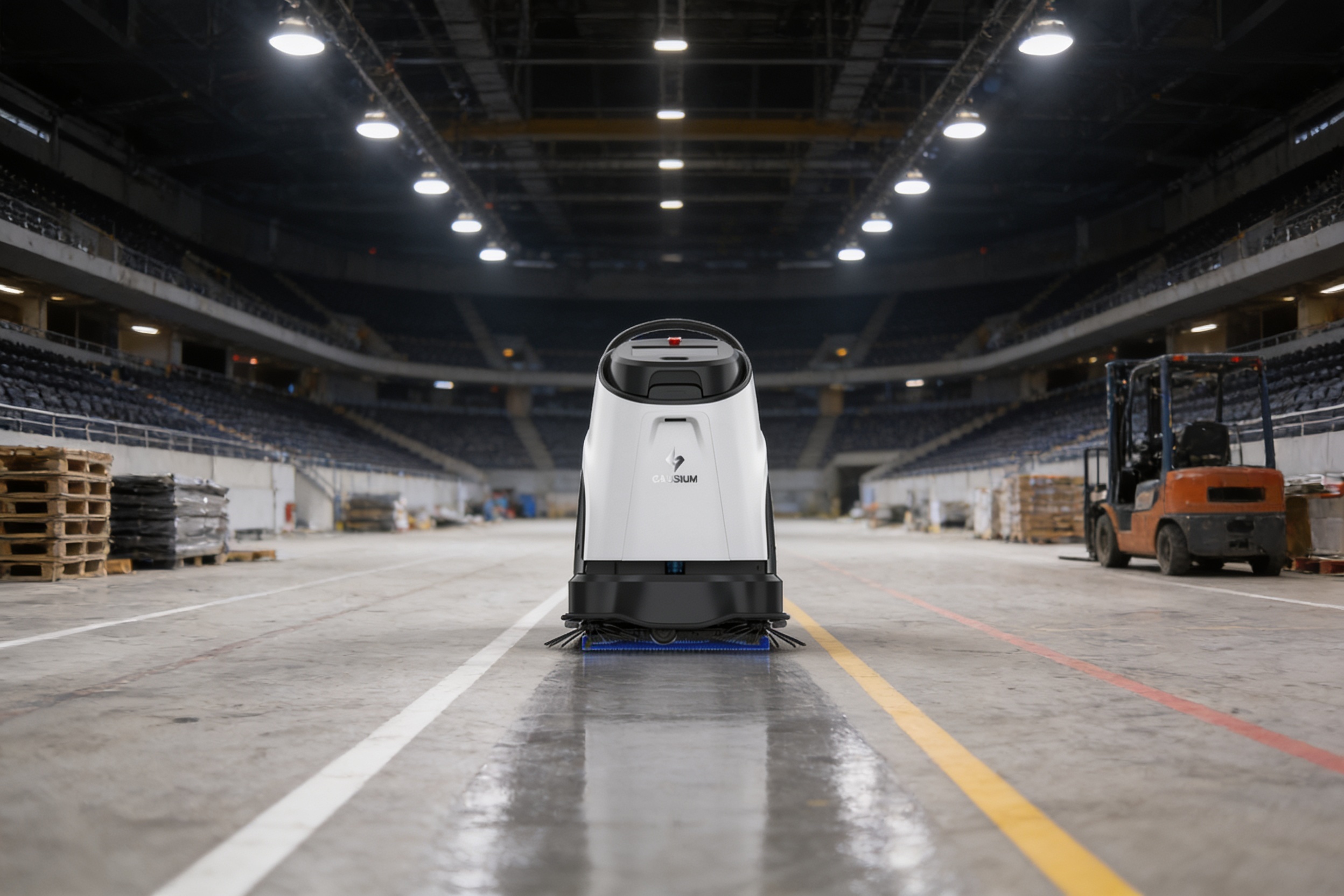
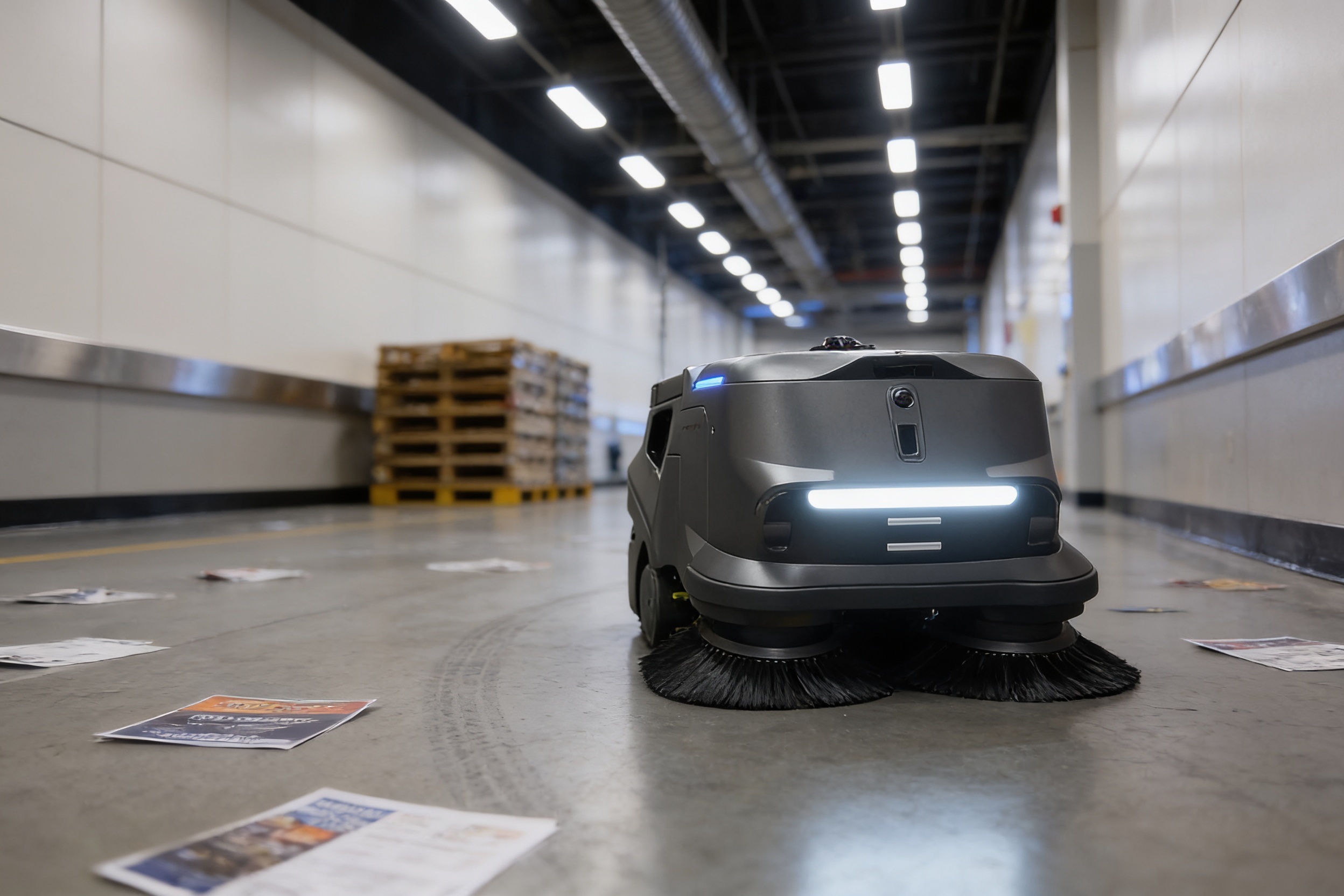
A floor cleaning robot can take the open, repeatable passes: long bays, main travel lanes, and clear concrete between work areas. It follows a mapped route, keeps the same pass pattern through the night, and does not lose track of which lane it finished. The gain is consistency and coverage. It does not add judgment.
A small-airport hangar listed in a municipal document offers 22,400 square feet of available hangar space, measured at 160 by 140 feet. That is a useful scale for a single open bay: large enough that repeat passes add up, small enough that a route can be mapped in one visit.
The robot cannot take the parts that need a person. Spills near aircraft need immediate action and the right materials. Work around stands, cables, carts and parked equipment usually needs a person to move things first. Restrooms, trash, break rooms and surfaces above floor level are outside a floor robot's job. Any area where someone must decide what is safe to wet or sweep stays with staff.
- Open floor passes
Cleaning Robot
Repeats the same mapped route with the same pass pattern each night
Night Janitor
Covers the same route, but pace and thoroughness can drift over a long shift
- Spills near aircraft
Cleaning Robot
Stops and waits; a person must assess and clean
Night Janitor
Assesses the spill, picks the right material and makes the call
- Tight spots and clutter
Cleaning Robot
Struggles with cluttered, tight or stepped areas
Night Janitor
Moves carts, cables and tools, then works around them
- Restrooms and trash
Cleaning Robot
Not part of the robot's job
Night Janitor
Handles the full task
- Judgment and reporting
Cleaning Robot
Follows its program and reports run status
Night Janitor
Adapts to what is in front of them and reports back to the crew
- Consistency late in the shift
Cleaning Robot
Same pass pattern at the end of the night as at the start
Night Janitor
Quality can slip late in a long shift without supervision
How many hours and people does night hangar cleaning take?
The clearest national figures come from the Bureau of Labor Statistics. Its Occupational Outlook Handbook reports about 2.45 million janitors and building cleaners employed in 2024, with projected growth of 2% for 2024 to 2034, which the agency calls slower than average. It projects about 351,300 openings a year, driven largely by turnover and retirements.
Those figures describe the whole occupation, not hangars. This research did not find a hangar-specific staffing count, night-shift share, overtime share, sick-day rate, or occupation-level turnover rate. A secondary website's claim of 150 to 200% annual frontline turnover could not be verified, so it is not used here. Crew size and hours depend on floor area, aircraft traffic and the maintenance schedule, which must be measured on site.
The government wage data on this page gives the local wage for this job. Use it to price the night crew's hours, then compare that cost with the hours a robot would take over, which only a site assessment can measure.
What does a robot's night look like next to the crew?
A robot's shift is set in advance. The route, schedule and stop points are programmed during deployment, and the crew can see run status before and after. The timeline below is an illustrative schedule for one bay. It is not a measured result from any specific hangar.
The robot runs while the crew does the work that needs hands. The handoff matters most. Someone on the night team owns the route, checks the start of the run, and clears obstructions that appear during the night.
How does a robot plus fewer staff compare with a crew alone?
We recommend a robot plus fewer staff, never a robot alone. The robot covers open floor on its route, and the night crew shifts toward checking, spot cleaning, trash, restrooms and response. A hangar with nobody on site overnight is not a site where we would deploy a floor robot.
We pick the robot for the site, lease it through financing, deploy and integrate it, train the staff on routes and stop procedures, and service it nationwide. The lease is quoted after a free site assessment, so the decision rests on your floor and your hours.
What can a cleaning robot not do in a hangar?
A floor robot does not replace judgment. It cannot decide whether a spill is safe to wipe, whether an area is approved for cleaning, or whether a tool cart has moved into its path. It also cannot reach tight gaps around equipment, tall surfaces, or stairs.
Floor condition is a real limit. Specifications for large hangar floors were not found in this research, so surface condition, sealing, joints, drains and slope must be checked on site. Rough or heavily worn concrete, deep joints and standing water can limit a machine's coverage.
The robot also adds work. People walking the same floor need to know its path, and someone must be able to stop it at once. Vendor claims about overnight hours and payback in airport cleaning are self-reported and not audited, and no independent overnight hour comparison for hangars was found. Treat any savings figure as a hypothesis to test during a pilot.
How do injury and safety risks change with a robot?
Fewer repetitive pushes and passes can reduce exposure to the load types behind the injury rates above. This research did not find a verified before and after injury rate for hangar cleaning robots, so treat any reduction as something to track, not a promised result.
The scale of the problem is large. The BLS reported 21,100 nonfatal injury and illness cases with days away from work in 2020 for this occupation in private industry. California's local government sector recorded 4,160 cases with days away from work for janitors and cleaners in 2023 to 2024, a state count with no rate attached.
A robot creates new safety tasks. Pedestrians and tow equipment may share the same floor overnight, so the route, lighting, markings and stop controls need a written safety plan agreed with the facility's safety lead before go live.
How do you get started with a cleaning robot for a hangar?
Start with a free site assessment. We map the floor, measure open area against obstacles, review the night crew's hours and the maintenance schedule, and identify the zones a robot would cover. The lease quote comes from that assessment and is arranged through financing.
Then pilot before scaling. Many sites start with one leased unit on one bay, measure the crew hours that change over several weeks, and then decide whether to add units. We integrate the robot into the cleaning routine, train staff, and provide go live support on site.
Get the service terms in writing: response times, on-site dispatch, remote triage, whether spare units are available, and what happens when a unit is down. For an overnight operation, those terms matter as much as the machine itself.
Frequently asked questions
Want a cleaning robot at your airport hangar?
Tell us about your site. We will recommend the robot, quote the lease, and keep it serviced.
Sources
- US Bureau of Labor Statistics, Occupational Employment and Wage Statistics (OEWS May 2024)
- BLS Occupational Outlook Handbook, Janitors and Building Cleaners
- BLS injury and illness snapshot, janitors and cleaners, 2015 to 2019
- BLS injury and illness snapshot, janitors and cleaners, 2016 to 2020
- California DIR, days away from work by local government, 2023 to 2024
- Washington State safety research article on janitor injury rates, 2017
- Municipal airport document, available hangar space