
The short answer
A cobot makes sense at a sauce plant when a sealing line runs steady volume and cases are packed the same way across shifts, because a robot arm keeps its placement pace without overtime, fatigue, or gaps when someone calls in sick. It does not make sense as a straight swap for the whole operator role, when case formats change several times a shift, or when the job depends on judgment such as spotting a faulty seal. For most plants the practical answer is a cobot cell that takes the repetitive placement while a trained crew keeps the line fed, cleared and checked.
Key takeaways
- A cobot fits steady, repeatable case packing and does not fit a line that changes formats all day.
- Overtime, open shifts and sick days are the strongest reasons to automate placement, so measure them first.
- Plan for a robot plus fewer staff, never a robot with zero staff.
- Test your real containers and cases during a free site assessment before choosing a gripper or cell layout.
- The lease is quoted after that assessment, so compare the full scope in writing.
Cobot vs sealing-line operator at sauce plants: which makes sense?
The short answer is that a cobot makes sense for the repetitive placement step at the end of a sealing line when volume is steady and the case format is stable. A collaborative robot arm picks sealed containers as they leave the sealer and places them into cases in a fixed pattern. It keeps that rhythm on the overnight shift, on a holiday weekend and on a day when two people are out, which is where staffing gaps usually show up.
A person still makes more sense in several situations. A line that switches jar sizes, label versions and case counts many times a shift needs someone who can reset the cell fast and notice when something is off. Any job where the operator spots a bad seal, a dented lid or a leaking pouch and pulls it from the line is a judgment task the arm should not own.
So the real question is less whether a robot can move containers, which it can, and more how much of the operator's shift is repetitive placement compared with feeding, clearing and checking. The sections below work through that split, the labor data behind it and what a sensible first step looks like.
What does a sealing-line operator actually do in a shift?
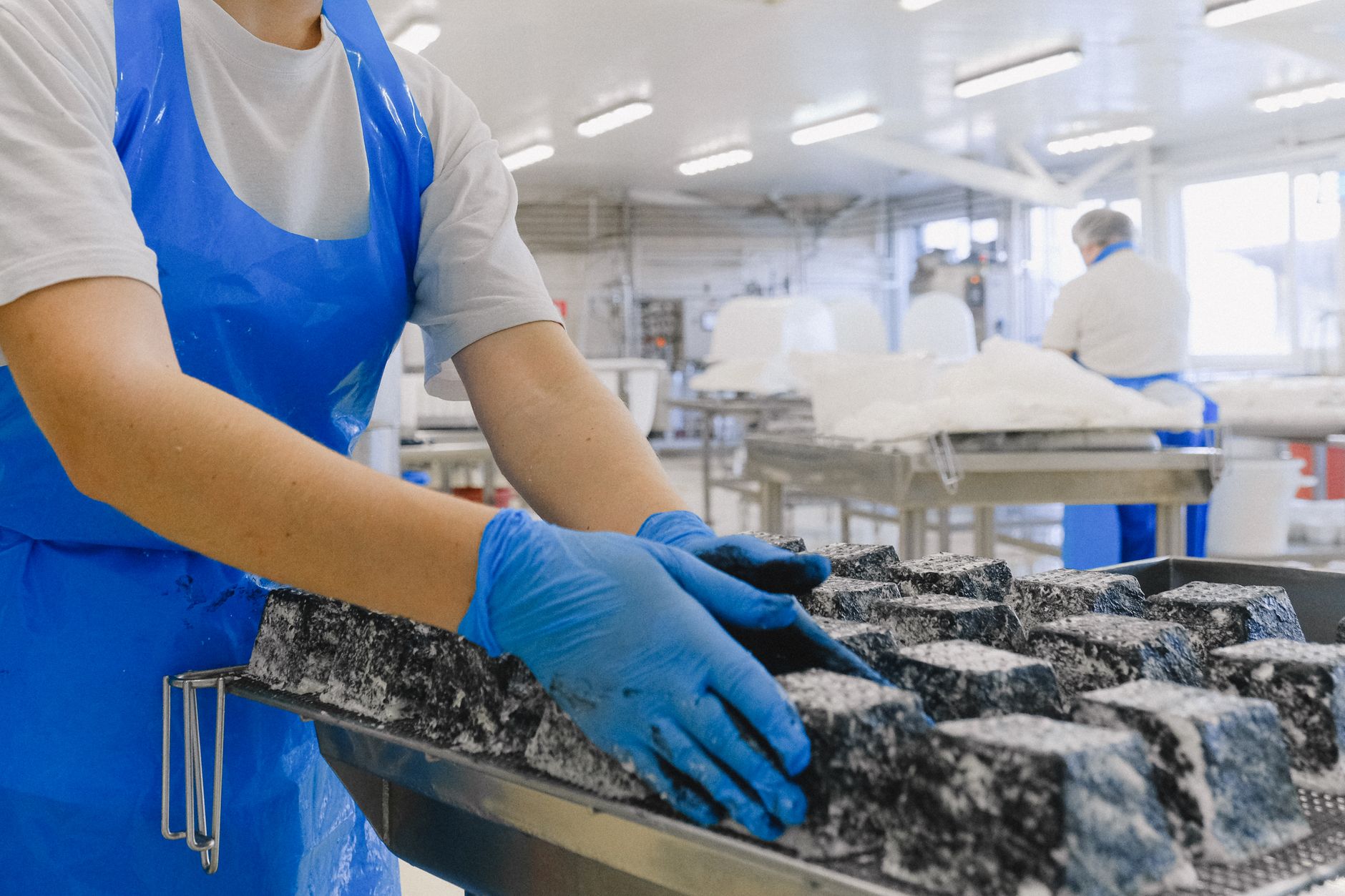
On a sauce line the operator's job is a bundle of tasks, not one motion. The person watches the sealer and filler output, takes containers off the conveyor, checks seal integrity and code dates, places containers into shipping cases, closes and labels those cases and stacks them for the pallet crew. Many plants also use the operator for changeover help, minor adjustments at the start of a run and sanitation support.
The repetitive part is the placement. Picking a container, orienting it and dropping it into a case pattern repeats many times in a shift, and that motion is the part most exposed to repetitive strain. Fatigue shows up late in a shift as slower reaches and sloppier placement. A cobot repeats the same cycle without that drift.
The rest of the operator's time follows no fixed rhythm. Clearing a jam, catching a seal that looks wrong, swapping a case size and calling maintenance when a sensor drops out all need a person close to the line. Before deciding anything, log how the shift really divides, because the placement share is the part a robot can take.
Which parts of case packing can a cobot take, and which can it not?
A cobot arm is well suited to picking containers from a known position and placing them into a known pattern. That covers pick and place of sealed containers into a case, pattern building on one case format and loading empty cases from a staged stack when the cell is designed for it. Vision guidance helps when container orientation varies a little from one piece to the next.
Several parts stay with people or other equipment. Case erecting, taping and final closure are usually separate machines or manual steps unless the cell is scoped to include them. A cobot does not judge seal quality, does not decide whether a container is out of spec and does not recover well from a container that has tipped or split on the infeed. Gripper design and washdown needs must match the sauce and the cleaning regime, and that check belongs in the site assessment.
- Night coverage
Cobot
Runs the placement cycle on overnight shifts, though a trained lead still has to be present
Sealing-Line Operator
Can handle the whole shift and make calls, but needs staffing for each shift
- Format changes
Cobot
Gripper or pattern changes need trained time and a changeover plan
Sealing-Line Operator
Adjusts by hand quickly on mixed formats
- Quality judgment
Cobot
Repeats placement but does not judge seal, lid or code quality
Sealing-Line Operator
Spots a bad seal, a dented lid or a wrong date code
- Late-shift consistency
Cobot
Holds the same placement rhythm from first case to last
Sealing-Line Operator
Pace and placement tend to drift as fatigue builds
- Absence and turnover
Cobot
No sick days, but the cell needs a trained lead and a backup
Sealing-Line Operator
Absence and turnover require replacement and retraining
- Sanitation
Cobot
Needs a washdown-rated design and a cleaning plan
Sealing-Line Operator
Follows the sanitation program already in place
How many people work these lines, and what does turnover look like?
Packaging and filling machine operators are a large occupation. According to BLS May 2023 occupational estimates, as summarized by a third-party site, national employment for this group was about 371,600. Food batchmakers, a related group covering batch processing roles, numbered 169,190 in the May 2023 BLS estimate, up from 166,520 in May 2022, a rise of 1.6 percent.
Turnover for this specific role is hard to pin to one public number. No BLS turnover rate for packaging operators turned up in this research pass. A job-risk website describes high turnover and hiring that is mostly replacement rather than growth for packaging machine operators. The nearest verified signal is the BLS quits rate: according to BLS JOLTS, the overall quits rate was 2.0 percent in December 2025, and that covers all industries, so treat it as background rather than a sauce plant benchmark.
Overtime, night shift coverage and sick days are not in the public figures used here. Those numbers come from your own timekeeping, and they set the true cost of an unfilled shift. The checklist below lists the inputs to gather before comparing options.
Why do overtime and night shifts push plants toward a cobot?
When a packing shift is short a person, the plant can run short and slow the line, or cover the gap with overtime. Both costs land on a plant that already runs tight on labor. Long overtime also adds fatigue, which makes late-shift placement less consistent, and fatigue is hardest on the repeated reaching and lifting that the placement step demands.
Night shifts add a second pressure. Overnight coverage is harder to staff, and a single absence can stop a run. A cobot cell does not clock out, but it still needs a person who can clear faults, reset the cell and watch the output. That is why the plan is always a robot plus fewer staff, never zero staff.
The strongest case for automation is therefore not a single headcount number. It is a steady run where open shifts and overtime keep recurring. When those recur, the placement step is a good candidate, and when they are rare, the operator model may still be the better fit.
How does the team work with a robot on the line?
The cobot cell runs the repetitive placement while one trained person handles what the arm cannot. The operator becomes the cell lead, watching sealer output, feeding empty cases, clearing faults and running quality checks. The work moves from hands on every container to supervision, reset and exception handling.
Training matters more than the robot itself. Staff need to know how to recover from a dropped container, clear a fault safely, change a gripper or case pattern and report sensor issues. Plants that do this well treat the first weeks as a learning period, with the manual method kept available as a backup.
A robot plus fewer staff still means people on every shift, including nights. Plan the coverage first, then decide whether the cell reduces one position or changes the skill mix. A cobot does not remove the need for a trained person on the line.
What can a cobot not do at a sauce plant?
The limits are worth stating plainly. A cobot does not replace a high speed case packer, does not run a whole line alone and does not handle every container shape without a gripper change. Payload, reach and cycle speed come from the arm and the cell design, and a fast line may need more than one arm or a different machine altogether.
Hygiene and changeovers are the second set of limits. Sauce lines run wet, sticky and sometimes hot, so the gripper and cell must meet the cleaning and washdown rules in your plant. Each new container or case format adds a changeover, and a cell that changes formats often may lose the gain that justified it.
A cobot also cannot own quality. Seal checks, date code verification and the call to stop a line stay with trained people. If a plant wants full automation of end-of-line packing, the answer is a different system design, not an assumption that one arm will cover it.
Is automation growing in food and beverage plants?
The International Federation of Robotics reported that U.S. industrial robot installations reached 38,400 units in 2025, up 12 percent year on year. That figure comes from its September 2026 release, which revised an earlier preliminary count of 38,000.
Food and beverage was one of the faster growing customers. Installations there rose 30 percent to 2,900 units in 2025, while automotive, still the largest customer at 13,500 installations, fell 1 percent. According to a robotics trade press summary of IFR World Robotics data, cobots accounted for nearly 12 percent of installations in 2024.
Those are national totals for all industrial robots, not sauce plants. They show the direction of travel and that food and beverage firms are investing, but they do not show whether a cell pays back on one specific line. That depends on case count, shift pattern and the labor that already goes unfilled.
What does the injury and ergonomics picture look like?
Repetitive placement is an ergonomics question as well as a staffing one. According to the National Safety Council summary of BLS data, the overexertion category was renamed in 2023 to overexertion, repetitive motion and bodily conditions, and detailed nonfatal data are published for 2023 and 2024 only. Pull the food manufacturing figures for those years from the BLS injury tables before setting any goal.
A related BLS study gives a sense of scale in food-adjacent work. For poultry processing, using 2016 data, it reported 13.3 days-away-from-work repetitive-motion cases per 10,000 full-time workers, against 2.1 for all private industry. That study is older and covers poultry rather than sauce, so read it as direction, not as a baseline for your plant.
The practical point is that moving repetitive placement to a cell reduces exposure for the people who still work the line, but only if the cell layout avoids new awkward reaches at the case or pallet end. Check the ergonomics of every staffed station as part of the site assessment.
How do you get started with a cobot for end-of-line packing?
Start with the data you already have. Count cases per shift, note format changes per week, log overtime hours and open shifts and list the containers and case sizes in use. Those inputs decide whether one cell fits and set the questions to ask on a site visit.
We are a US commercial robot integrator. We pick the robot for the site, lease it through financing, deploy and integrate it, train the staff and service it nationwide. For a sauce plant, the first step is a free site assessment that covers container handling, washdown needs, floor space and the staffing plan. The lease is quoted after that assessment, so the person signing off sees the full scope before committing.
A sensible first step is one leased unit on one line, run as a phased deployment that keeps production moving, with a backup plan for the early weeks. Measure output, fault rate and staff hours against your baseline before adding a second cell. A pilot like that answers the cobot vs sealing-line operator question with your own numbers rather than anyone's averages.
- Log cases per shift and format changes per week
- Pull overtime hours, open shifts and sick days from timekeeping
- Sample your containers and cases for gripper testing
- Map floor space, case flow and pallet access
- Name a cell lead and a trained backup before go live
Frequently asked questions
Want a cobot at your sauce plant?
Tell us about your site. We will recommend the robot, quote the lease, and keep it serviced.
Sources
- BLS Occupational Employment and Wage Statistics, packaging and filling machine operators
- BLS Occupational Employment and Wage Statistics, food batchmakers
- BLS Job Openings and Labor Turnover Survey release
- International Federation of Robotics, September 2026 US press release
- Robotics trade press summary of IFR World Robotics data
- BLS Economics Daily on poultry processing injuries
- National Safety Council Injury Facts, overexertion and bodily reaction
- Job risk website, packaging machine operator