

The short answer
A delivery robot makes sense at a museum cafe when the job is a repeated trip from the kitchen pass to set tables during a predictable peak. It does not make sense when most of the work is clearing tables, handling spills, answering guest questions, or covering a quiet cafe that one person already staffs, so the delivery robot vs food runner choice depends on how much of the day falls into that peak. In every case the robot works alongside staff, and the cafe still needs people on the floor.
Key takeaways
- A delivery robot fits the repeated carrying leg on a fixed route, not the whole food runner job.
- Weekend lunch peaks decide the math, while quiet weekday hours often leave little to carry.
- We did not find published museum cafe staffing or shift data, so measure your own peak before deciding.
- The model that holds up is a robot plus fewer staff, never zero staff.
Delivery Robot vs Food Runner at Museum Cafes: Where Each One Makes Sense
A delivery robot makes sense at a museum cafe when the job is a repeated trip from the kitchen pass to set tables during a predictable peak. A food runner is still the better choice for the work off that route, including clearing tables, handling spills, answering allergy questions, and covering a quiet cafe that one person already staffs. The delivery robot vs food runner question is therefore less about which option is cheaper per trip and more about how much of the day is spent on carrying.
Museum cafes are not one kind of business. Some are run by the museum, others by a contract caterer, and they range from a counter with a few seats to a full sit-down room beside a gallery. The number of museums gives a sense of how many sites are involved. According to the Institute of Museum and Library Services, the US had an estimated 35,144 active museums in its 2014 data file, more than double the 17,500 working estimate used in the 1990s. IMLS also said the list may contain errors, and not every museum runs a food service, so the museum count is a ceiling on cafes, not a count of them.
The rest of this page works through the decision in order: what the runner does, what the robot can and cannot take, what the labor and injury data says, how weekend peaks change the math, how a robot and staff share a shift, and how to start with a site assessment. Where we did not find published data, we say so rather than fill the gap.
What does a food runner actually do in a museum cafe shift?
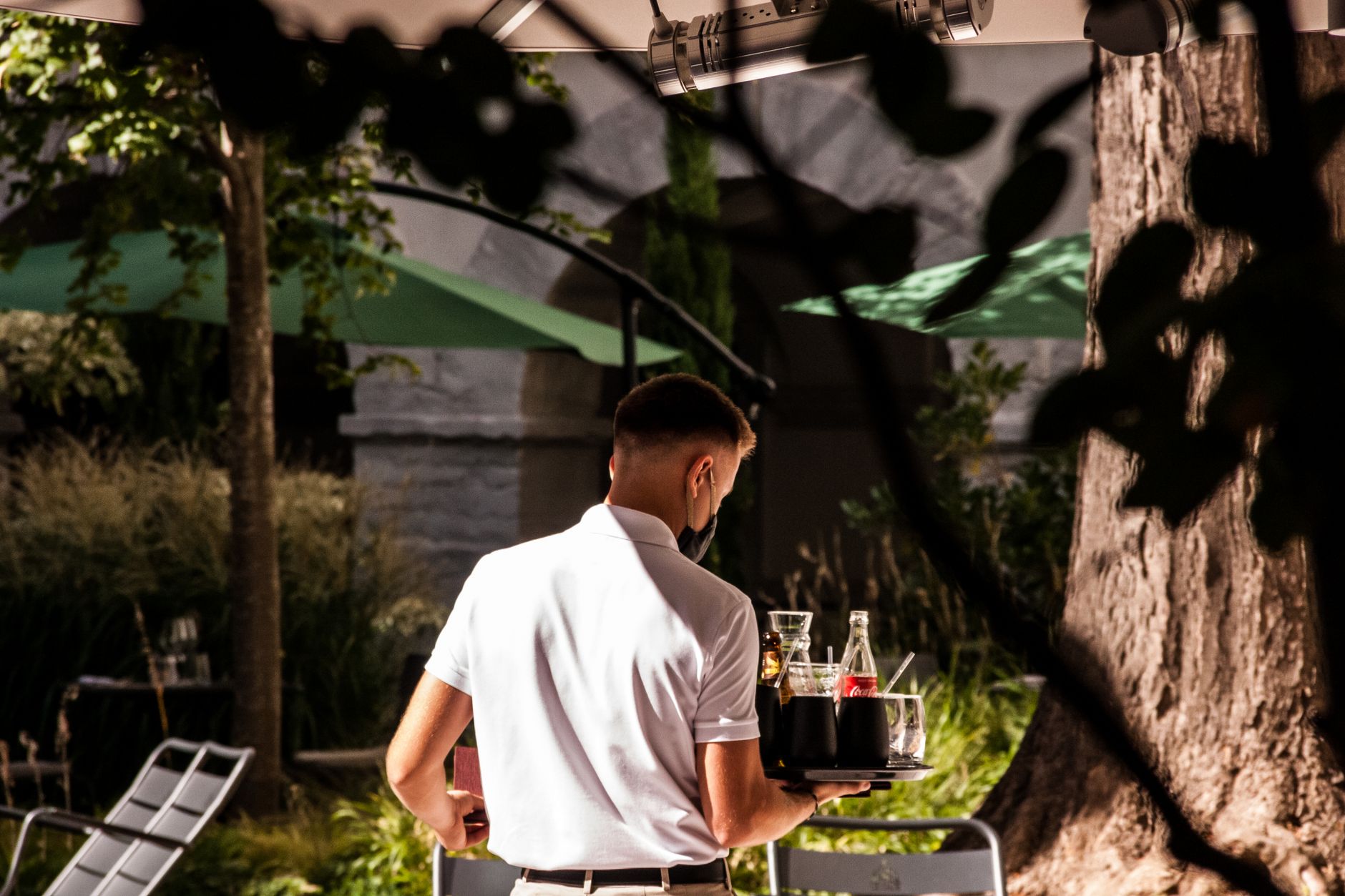
The runner's work is a loop. Pick up plated food at the pass, check the ticket against the order, carry it to a table, bring back empty dishes, and reset the table for the next guest. At a museum cafe that loop has to fit around gallery doors, stairs, strollers, and visitor groups that arrive in waves rather than evenly through the day.
A runner also does work that never shows up on a route. They restock condiments and napkins, call the kitchen when an order is missing, watch a table with a small child, and tell the cashier when the line is backing up. Those tasks depend on judgment and on seeing the room, which is why a runner is a floor role and not only a carrier.
We did not find published staffing levels, shift lengths, or floor distances for food runners or busers at museum cafes. The figures on this page come from the wider restaurant record, and we label them as such. Before you decide, time your own runner's loop through one peak hour, counting trips, tables and minutes spent on tasks other than carrying.
Median hourly wage, Waiters and Waitresses
$3,798
Monthly cost of one full-time worker, at the median wage plus payroll costs (an estimate, not a quote).
Which parts of the run can a delivery robot take, and which can it not?
A delivery robot can take the carrying leg. On a mapped, fixed route between the kitchen pass and a set group of tables, it moves trays without a person walking alongside. The trip repeats more than any other part of the loop, so it is the part that adds up across a busy weekend.
It cannot take the rest. It does not clear plates, wipe a table, take a second order at the table, or fix a wrong dish. It cannot decide that a tray should go to another table because a family just sat down, which is the kind of judgment a runner makes many times in an hour.
A person still loads and unloads the robot, so some of a runner's time moves to the pass rather than disappearing. Route design matters more than speed. A path that crosses a gallery threshold, a stairway, or a crowded lobby needs planning, and the robot only works where the floor is clear and mapped.
What do the hours and labor numbers say about museum cafe work?
Injury data for the food service sector is the best published measure of the physical side of these jobs. According to BLS The Economics Daily, December 2020, full-service restaurants had about 93,800 nonfatal injuries and illnesses in 2019, and about a third of those cases required time away from work. The days-away rate was 88.3 per 10,000 full-time workers in 2019, up from 73.1 in 2018. Cuts and lacerations ran at 23.6 per 10,000, against 7.1 for all private industry.
A BLS fact sheet for 2018 put the count at about 91,800 nonfatal injuries and illnesses in full-service restaurants, with 24,980 cases involving days away from work. It listed contact with objects or equipment as a major event category. The data does not say which tasks caused those cases, so any link to tray carrying is a question to check in your own incident logs rather than a conclusion.
Special food services, a separate category that may cover contract-run cafes, had a higher rate. BLS The Economics Daily reported 107.6 days-away cases per 10,000 full-time workers for special food services in 2017, against 77.9 for food services and drinking places. A museum cafe run by a contract caterer may fall into that group, so confirm which classification your operation sits under.
Turnover is the other side of the labor picture. The BLS JOLTS release for October 2025 showed quits in accommodation and food services falling by 136,000, and the release for November 2025 showed them rising by 208,000. Those are month-to-month changes, not an annual quits rate. We did not confirm an annual rate for this sector, so none is quoted here.
We did not find published data on overtime, night shifts, or sick days for museum cafe staff. Ask the operator for its own schedule and absence records. For the wage side, the government wage data on this page gives the local wage for this job, which you can pair with your own hours to estimate what carrying work costs in labor.
How do quiet weekday hours and busy weekend peaks change the answer?
The answer changes with the calendar. On a quiet weekday, a museum cafe often has a light load, and one runner can cover the whole floor. In that case a robot adds little, because the bottleneck is not the trip. The robot would sit idle, and keeping it in service would bring little return on the work it takes.
Weekend peaks change the math. A busy lunch packs the same route into a short window, and the number of trips, not the number of tables, sets the load. That window is where a robot can take the repeated carrying leg, so the runner stays on the floor clearing, resetting and answering guests.
Museum traffic follows exhibits, school groups, and events, so the busy window may move from month to month. A special exhibit opening can create a peak that a regular weekend never shows. Build the schedule around the observed peak in your own order and tray counts, not around an average day.
Attitudes matter as well. A 2023 study by Ivanov and Webster, based on a global survey from 2018 to 2019, found that people with more positive attitudes toward robots also saw robots as suited to museum settings. That suggests visitors may accept a robot in a museum, but it does not show how guests or staff will react in one particular cafe. Test it with a pilot.
How does a robot and staff team work together on one shift?
The model that holds up is a robot plus fewer staff, never zero staff. The robot takes the carrying leg on one route, and the people on the team do the tasks it cannot. In practice one runner covers the floor, the robot runs the kitchen-to-table route during the peak, and a host or cashier keeps the room.
Staff roles change. Someone has to load trays, restart the robot after a stop, clear a blocked path, and watch the route for obstacles. Train at least one person per shift on those tasks before the robot goes live, and name a backup for each shift so the routine does not depend on one employee.
We pick the right robot for the site, lease it through financing, deploy and integrate it, train the staff and service it nationwide. Part of deployment is working with the museum's facilities team on gallery thresholds, stairs and loading points, so the first week is not spent finding the edges of the map. We train the people who will run the robot, not only the managers who sign the agreement.
What does a weekend shift look like with a robot in place?
A typical weekend shift follows the peak. The robot is idle in the early hours, runs the route through the lunch window, and goes back to idle as the floor empties. The timeline below shows the shape of that day and the staff roles that stay in place through it.
The first and last hours are where setup problems appear. Opening the route, checking the map against that morning's exhibit layout, and closing the route each take staff time. Count those minutes against the savings, because a route set up badly will stop often during the peak and waste the window the robot was leased to cover.
What can a delivery robot not do in a museum cafe?
A robot cannot handle the unexpected on its own. It stops or waits when a person, a stroller, or a dropped tray blocks its path, and someone has to clear that path. During a peak, each stop costs time, so the route needs an escape plan that staff can run without the robot.
It cannot serve a guest. Questions about ingredients, a wrong order, a request to split a bill, or a child who needs help are staff work. It cannot read a table's mood, notice that a guest has left a drink to be cleared, or take a complaint.
It cannot take over the cafe's safety duties. Hot food, glassware, and emergency response stay with people. Carrying work carries risk, as the injury data on this page shows, and a robot adds its own checks, such as a clear route and a stop control, that staff must know well.
It cannot fix a poor fit. A crowded room, a long winding route, or a kitchen pass far from the tables can slow the robot enough that a person is faster. A short, clear route between two fixed points is where it works best, and a site assessment will show whether your cafe is that case.
How do you get started with a delivery robot at a museum cafe?
Start with a site assessment. We map the route, count the peak trays, check stairs and thresholds, and talk with the cafe operator and the museum's facilities team. The lease payment comes in a quote after that assessment, so the numbers reflect your floor and your peak rather than a generic plan.
Pilot one unit on one route for the peak window. Measure the trays carried, the stops, the minutes staff spent clearing paths, and the change in runner time at the start and end of the shift. A pilot gives you measured numbers, which is better than an estimate.
Plan for service before the first busy Saturday. Ask what the lease covers, including repairs, spare unit coverage, and remote triage, and confirm how quickly on-site dispatch can respond. A stopped unit at lunch is a staffing gap, and the plan should cover it.
The first week is a training week. Staff need to know the stop control, how to clear a path, how to restart a route, and what to do when the robot is out of service. Check the stop log at the end of each day and fix recurring stops before adding a route.
Frequently asked questions
Want a delivery robot at your museum cafe?
Tell us about your site. We will recommend the robot, quote the lease, and keep it serviced.
Sources
- US Bureau of Labor Statistics, Occupational Employment and Wage Statistics (OEWS May 2024)
- Institute of Museum and Library Services
- BLS The Economics Daily, December 2020
- BLS fact sheet, full-service restaurants 2018
- BLS The Economics Daily, special food services
- BLS JOLTS release, October 2025
- BLS JOLTS release, November 2025
- Restaurant Technology News
- Journal of Tourism Futures, Ivanov and Webster (2023)